
 Karlovy Vary, Karlovy Vary Region, Czechia
Foul-tasting hot water with laxative ambitions, rapidly declining sightseeing standards and two detours from Karlovy Vary — on the day Czechia set its all-time temperature record.
By the time I finally made it to Karlovy Vary, I had already been to Czechia more times than I could easily count. Prague and Brno were familiar territory, and I had even made it to Ostrava, yet one of the country's most famous spa towns had somehow remained a blank on my map. It was never for lack of interest. Karlovy Vary simply had not fitted conveniently into any of my previous trips, and the train connection from Prague had never been tempting enough to build a day around it.
Then a conference in Prague handed me the opportunity. A Saturday-to-Saturday itinerary from Rijeka via Frankfurt fitted the week almost suspiciously well, and with Rijeka Airport barely twenty minutes from home, the logistics could hardly have been easier. The conference programme started on Monday, leaving Sunday for the trip I had been postponing for years.
This time I removed the transport problem altogether and booked a Hertz rental car at Prague Airport. It would get me to Karlovy Vary on my own schedule and, if the spa town did not fill the entire day, leave me free to see what else western Bohemia had to offer.
I landed in Prague just before six in the evening, collected the car and drove to the Courtyard by Marriott Prague City on Lucemburská, a hotel I already knew. For a single night before a road trip, it was exactly what I needed: familiar, uncomplicated and easy to reach by car without voluntarily driving into the historic centre.
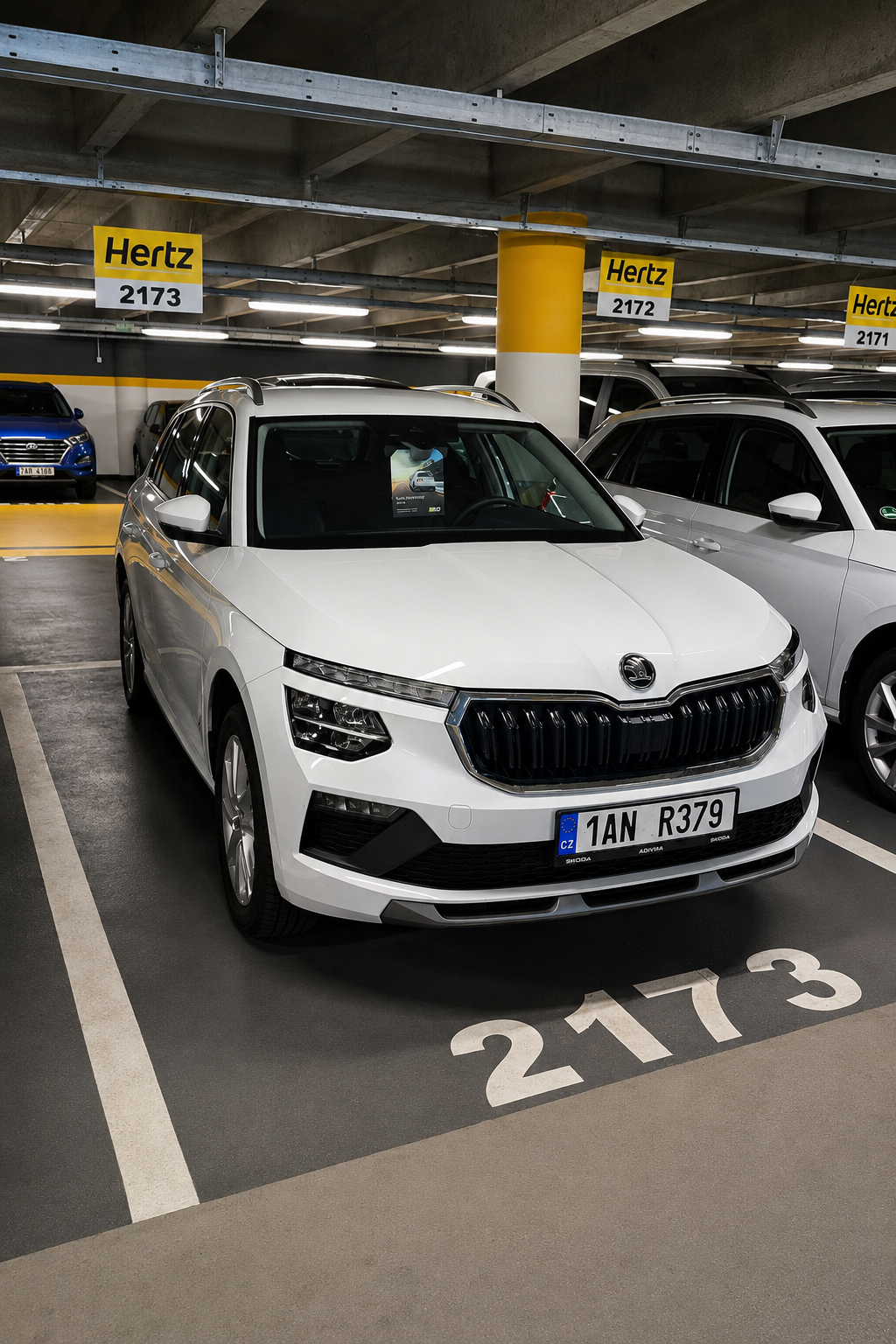
Prague was already baking. Czechia had broken its all-time temperature record that very afternoon, reaching 40.9°C in Doksany. I had seen Prague enough times not to feel obliged to wander around in that heat, so I stayed in the hotel and planned an early start. By the following afternoon, while I was in Karlovy Vary, a new all-time temperature record would be set.
The spa town that never fit the timetable
Karlovy Vary lies roughly 130 kilometres west of Prague, deep in western Bohemia and considerably closer to the German border than to most of the Czech places I usually visited. The town grew around its thermal springs under Charles IV in the fourteenth century and later became one of Europe's great spa resorts, attracting aristocrats, writers, politicians and anyone wealthy enough to spend weeks turning medical treatment into a social event. Its grand nineteenth-century spa culture still defines the place today, and Karlovy Vary is now one of the eleven towns that make up UNESCO's Great Spa Towns of Europe.
I knew what Karlovy Vary represented in broad terms: colonnades, grand hotels, thermal water and the sort of old-European spa glamour I had already encountered in places such as Bad Gastein. The problem was never convincing myself that it was worth visiting; it was finding a practical way to fit it into one of my trips. From Prague, the distance is modest, but the logistics are less attractive than the map suggests. The direct train takes roughly three and a half hours, while buses can do the journey in around two. For many travellers, the bus would be the obvious solution. I, however, cannot stand long-distance buses and use them only when there is genuinely no better option.
That made the rental car the obvious choice. It was quicker than the train and, more importantly, gave me the freedom to treat Karlovy Vary as the first stop rather than the whole day's itinerary. I had no firm plan beyond the spa town itself; I simply wanted the option of continuing through western Bohemia if the day allowed it.
I left Prague early and drove west without any particular drama. Once in Karlovy Vary, even parking turned out to be easier than I had expected. Navigation took me straight to Parking House Libušina, a large garage above the spa district. There were plenty of spaces when I arrived, it was reasonably priced, and from there the historic spa centre is only a few hundred metres away.
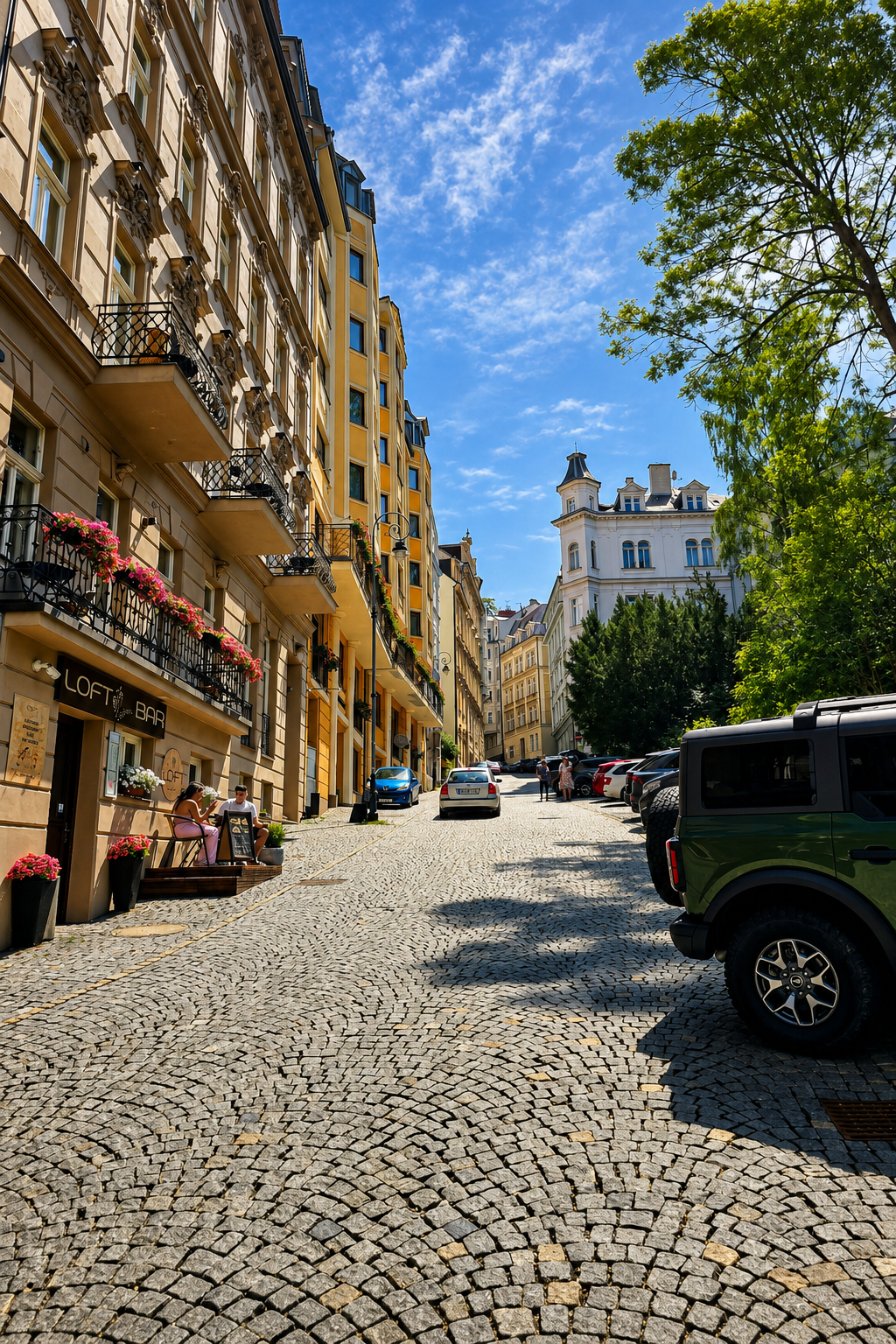
The distance, however, is slightly deceptive. Karlovy Vary is built in the narrow valley of the Teplá River, with the spa district sitting well below the surrounding streets. From Libušina, the way into the centre is not particularly long, but it is steep. Going down was easy enough — although footwear probably matters more than the map suggests — and the elegant roofs, colonnades and hotels gradually appeared below me. The only obvious problem was that everything I was happily walking down would eventually have to be walked back up.
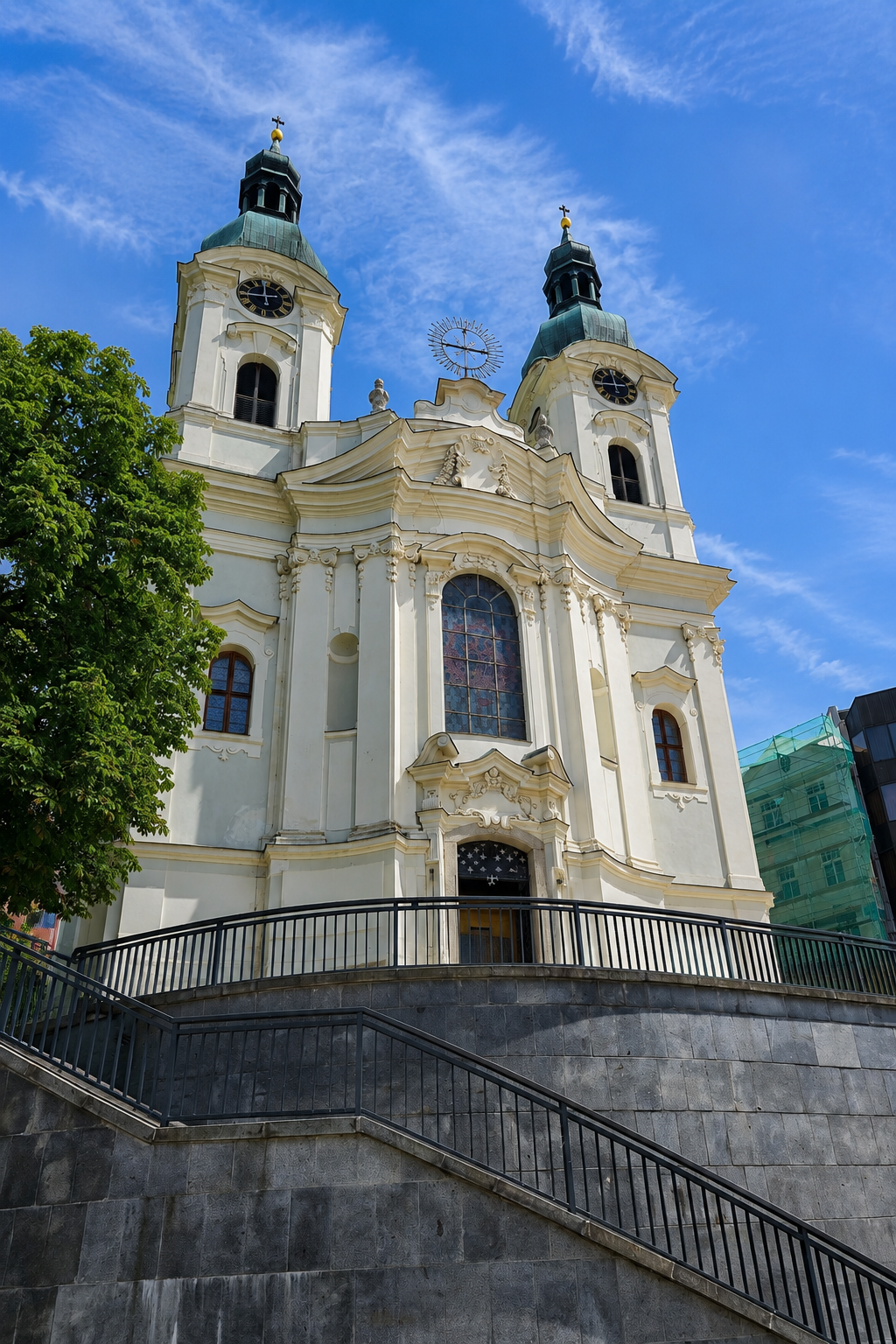
At the bottom, one of the first major landmarks was the Church of Saint Mary Magdalene, its white Baroque façade and twin towers rising directly above the historic spa district. The present church was built in the 1730s to designs by Kilián Ignác Dientzenhofer, one of the major figures of Bohemian Baroque, on a site that had been used for worship since the Middle Ages.
From there, the character of Karlovy Vary changed almost immediately. The church marked the edge of the historic core, but what really defines the town lies just beyond it: the springs, promenades and above all the colonnades built around them.
Walking the colonnades
Before going any farther, one term needs explaining, because I am not sure I properly understood it myself before visiting. A colonnade is, in the simplest architectural sense, a covered walkway supported by columns. In a traditional spa town, however, it has a much more specific purpose.
Karlovy Vary's colonnades were built around groups of mineral springs, allowing spa guests to collect and drink their prescribed water while walking under cover. The walking itself formed part of the cure: gentle exercise between repeated visits to the springs, protected from rain or strong sun. In the great age of European spas, there was also a strong social dimension to all this — the promenade was as much about seeing and being seen as it was about treatment.
The springs themselves are another part of the system that is easy to misunderstand. Karlovy Vary has fifteen recognised medicinal springs, but that does not mean fifteen separate colonnades. Several springs are often grouped beneath the same structure: the Mill Colonnade alone shelters five, while the Market Colonnade has three. The Hot Spring Colonnade, on the other hand, is dominated by a single spectacular source — Vřídlo.
The waters are not fifteen completely different substances either. They come from the same deep thermal system, formed roughly 2.5 kilometres below the surface, and their basic mineral composition is remarkably similar. What changes from spring to spring is mainly the temperature, the amount of dissolved carbon dioxide and, to a lesser extent, some trace components. Those differences matter enough that the traditional drinking cure prescribes not only how much water to drink, but also which spring to use and when.
Once that is clear, the layout of Karlovy Vary starts to make much more sense. The colonnades are not simply a collection of attractive buildings scattered along the river; they organise access to groups of springs and turn moving between them into part of the spa ritual.
The first one I actually encountered was the Market Colonnade, and this was where the whole concept finally became tangible. Architecturally, though, my first reaction was closer to so this is it? than admiration. The white wooden structure felt more like an elaborate pavilion than the grand spa architecture I had imagined — almost as if it could be dismantled and moved somewhere else.
As it turns out, that impression was not entirely unfair. Ferdinand Fellner and Hermann Helmer designed the Market Colonnade in Swiss style in 1882–83, and it was originally intended to be temporary. More than 140 years later, it still looks rather convincingly temporary. The carved timber gives it plenty of decorative charm, but wood inevitably lacks the weight and permanence of stone, and some of the details around the springs showed their age: mineral staining, worn surfaces and finishes that could probably use a little more attention.


The colonnade shelters three springs, including the Charles IV Spring, named after the emperor who, according to local legend, used the thermal water here to treat his aching limbs. That story forms part of the wider founding legend of Karlovy Vary itself.
This Was the Karlovy Vary I Had Imagined
A few minutes later I reached the Mill Colonnade, and this was it. This was the Karlovy Vary I had imagined: monumental, formal and built with the sort of confidence that makes a spa town look important rather than merely picturesque.
Officially, the Mill Colonnade is Neo-Renaissance, although its 124 Corinthian columns, long arcades and strongly classical vocabulary make that label feel almost secondary once you are standing in front of it. Josef Zítek designed it between 1871 and 1881, and even the version that was ultimately built was a compromise — his original project was supposed to be larger and two storeys high. What remains is still 132 metres long, shelters five springs and is by far the largest colonnade in Karlovy Vary.
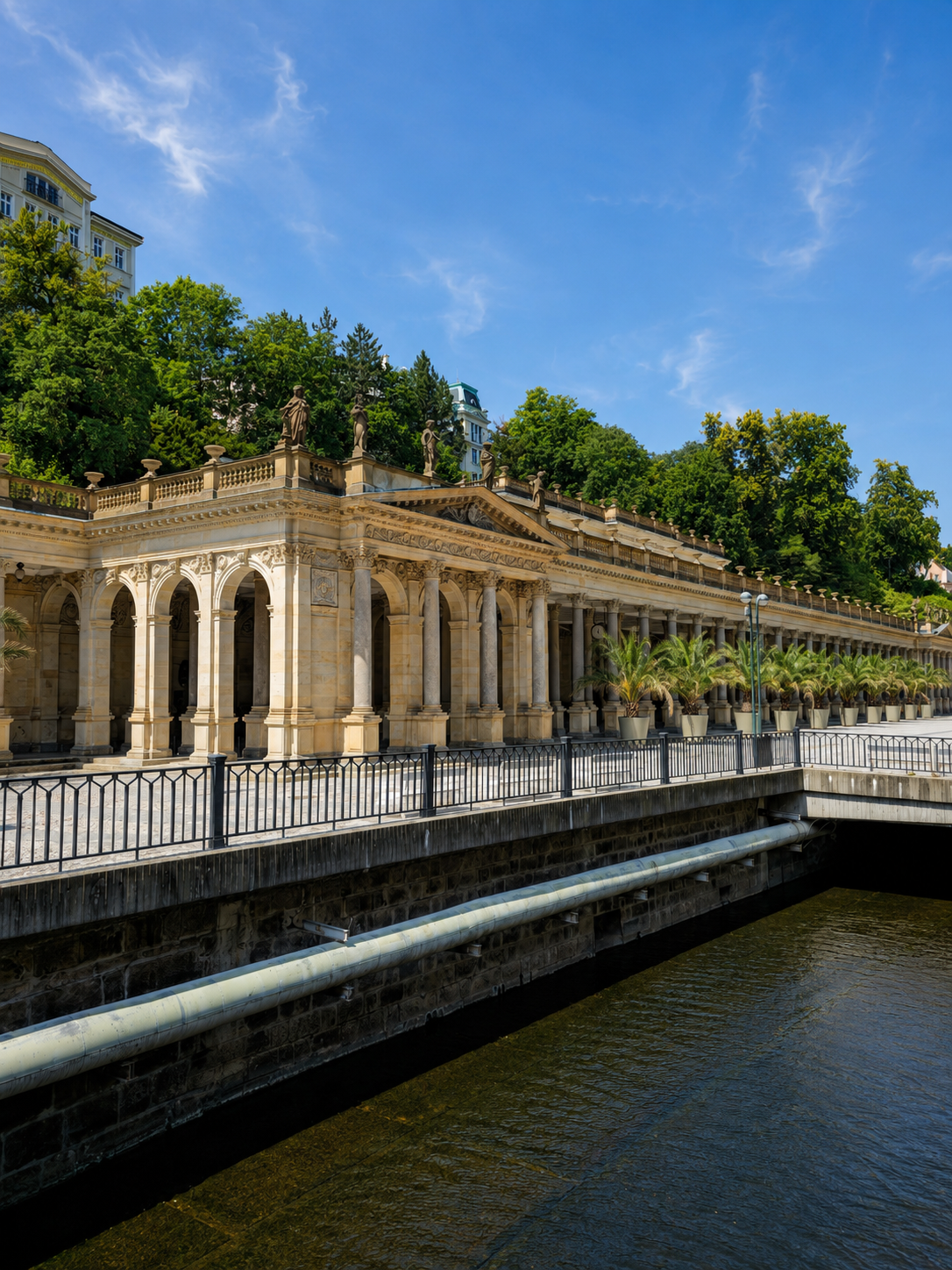
The scale mattered, but the interior was what really sold it to me. The columns repeat towards a distant vanishing point, the ceiling reinforces the rhythm, and everything feels ordered, permanent and almost ceremonial. It is easy to imagine this not simply as infrastructure for drinking mineral water, but as architecture for an age when taking the cure was also a social performance — walking, meeting, observing and being observed.
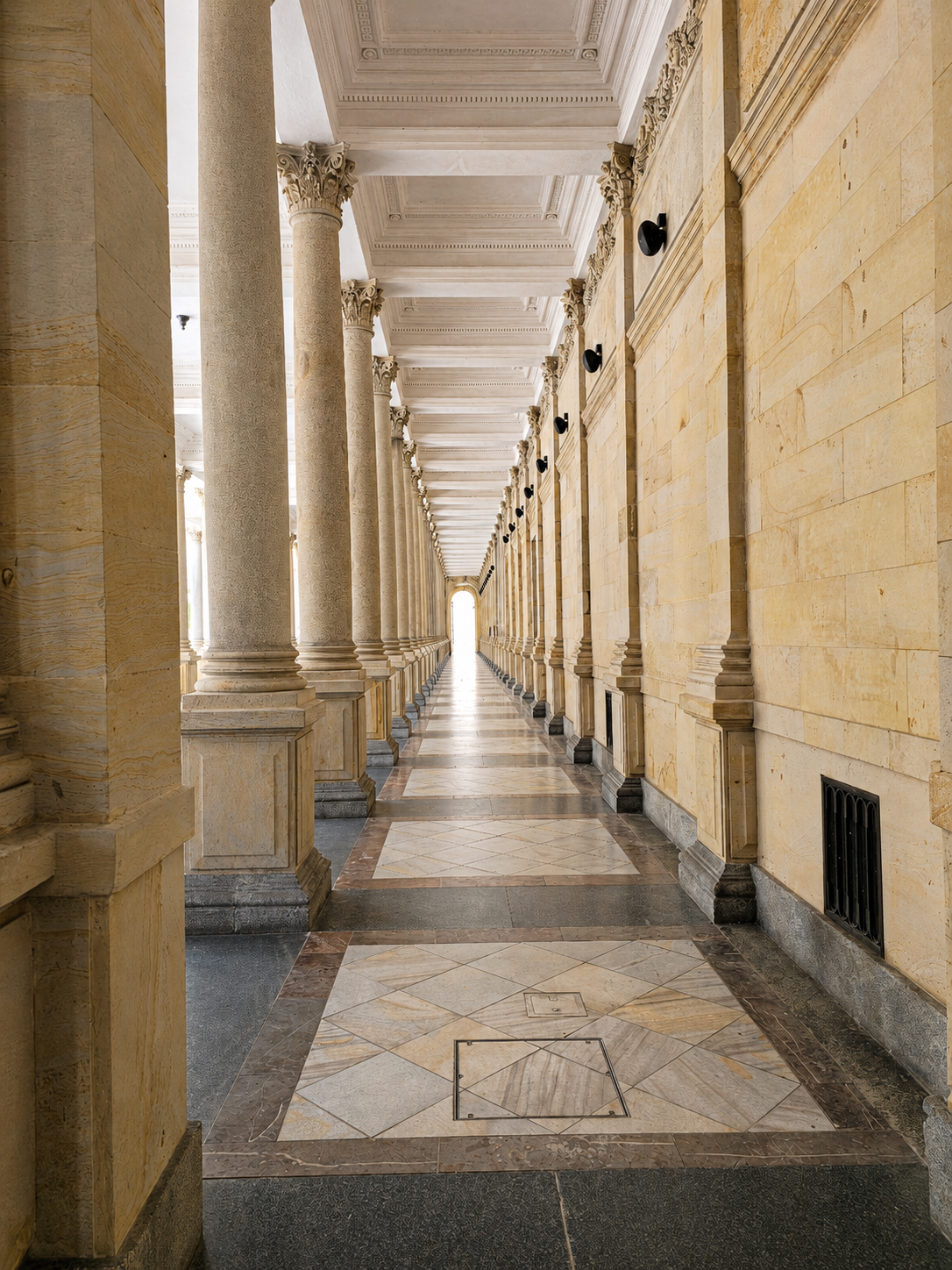
Compared with the slightly improvised feeling of the wooden Market Colonnade, this one felt built to last. It also looked remarkably well preserved, which is not entirely accidental: a major restoration completed in 2021 repaired and renewed much of the stonework, columns, balustrades and interior surfaces.
There is a nice historical irony in all this. Not everyone was impressed when it opened in 1881. Contemporary critics mocked it as a bowling alley and even an asparagus bed, apparently horrified by exactly the quality I liked most: its sheer monumentality.
I continued farther along the Teplá River towards Dvořák Park, where the Park Colonnade offered another sharp change of style. Fellner and Helmer designed this one too, but instead of carved timber or monumental stone, the structure is light and delicate, built largely of ornamental cast iron. What survives today is only one wing of a much larger nineteenth-century pavilion that once combined a restaurant, concert hall and covered promenade.
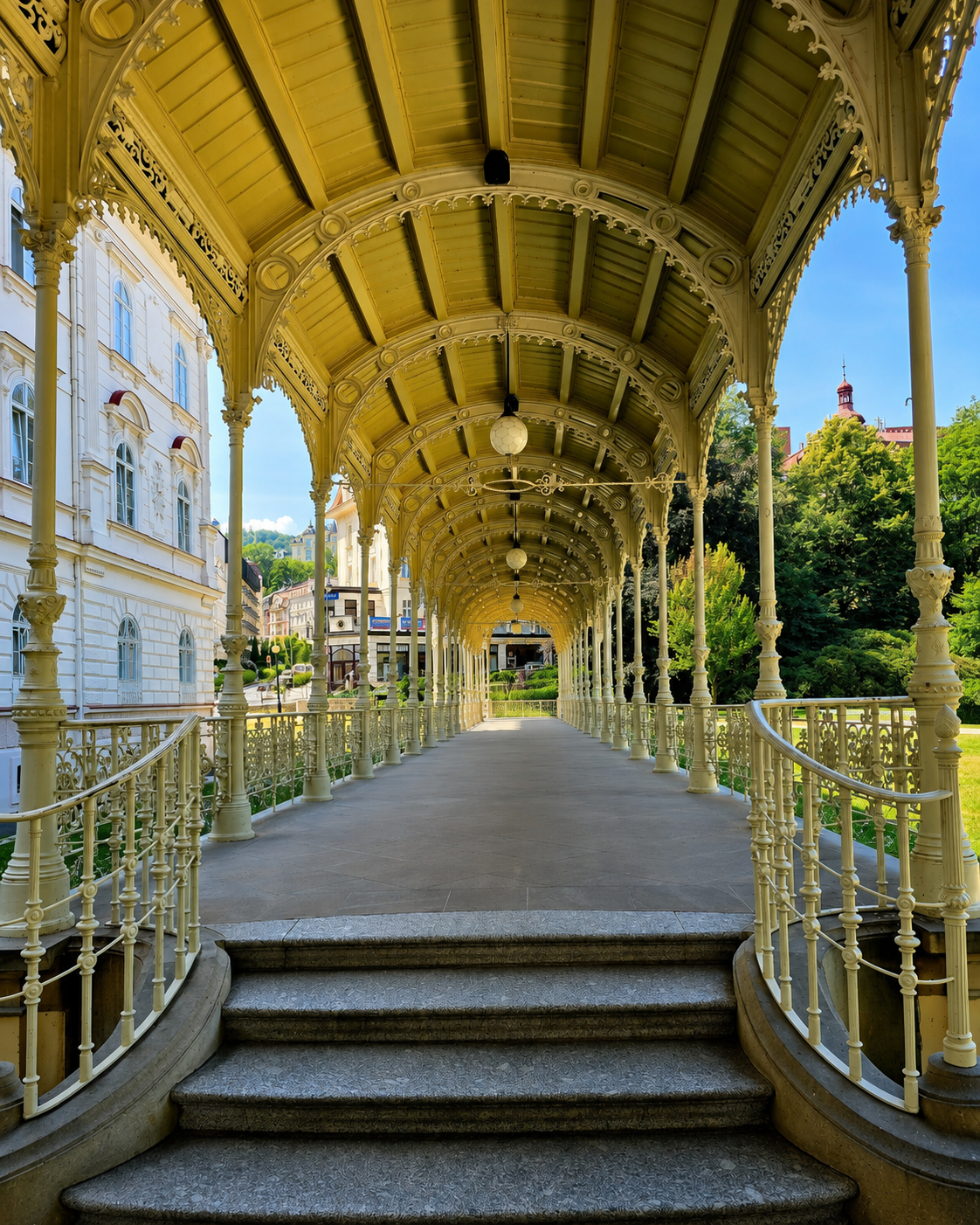
The colonnade now gives access to the Snake Spring, which is actually a much newer addition than its surroundings: it was brought here only in 2001 and remains the most recently opened medicinal spring in Karlovy Vary. At just 28.1°C it is unusually cool, less mineralised than most of the others but particularly rich in carbon dioxide. Its name comes from the grass snakes that once lived in large numbers behind the colonnades — not, disappointingly, from anything more sinister in the water.
There was, however, one detail I did not yet know: the cooler Karlovy Vary springs are traditionally associated with a slightly stronger laxative effect. That information would have been considerably more relevant to me a little later.
By this point I was also beginning to appreciate another quality of spa architecture that had nothing to do with medicine or aesthetics: covered promenades provide shade.
I Almost Missed Karlovy Vary’s Main Spring
I had now gone far enough along the spa district to turn back. Passing the Mill Colonnade again gave me another chance to photograph its interior, and somewhere around this point I started wondering about something fairly basic: where exactly was Vřídlo, the famous main spring I was supposed to be seeing?
The answer was that I had already walked past it.
The Hot Spring Colonnade looks so different from everything around it that I had initially failed to recognise it for what it was. After carved timber, ornamental cast iron and monumental nineteenth-century stone, this large glass-and-concrete building from 1975 looked to me more like an enclosed market hall than a spa colonnade. I simply passed it, assuming the famous geyser must be somewhere else.
Only on my way back did I realise that the building I had dismissed was actually constructed around Vřídlo, the most powerful thermal spring in Karlovy Vary. Its water reaches the surface at roughly 73°C, and the pressure can send a spectacular jet up to around twelve metres into the air. Once inside, there is no confusing it with anything else: the geyser rises through the centre of the hall in clouds of hot mineral spray, turning what from outside had looked strangely utilitarian into one of the most theatrical sights in the city.
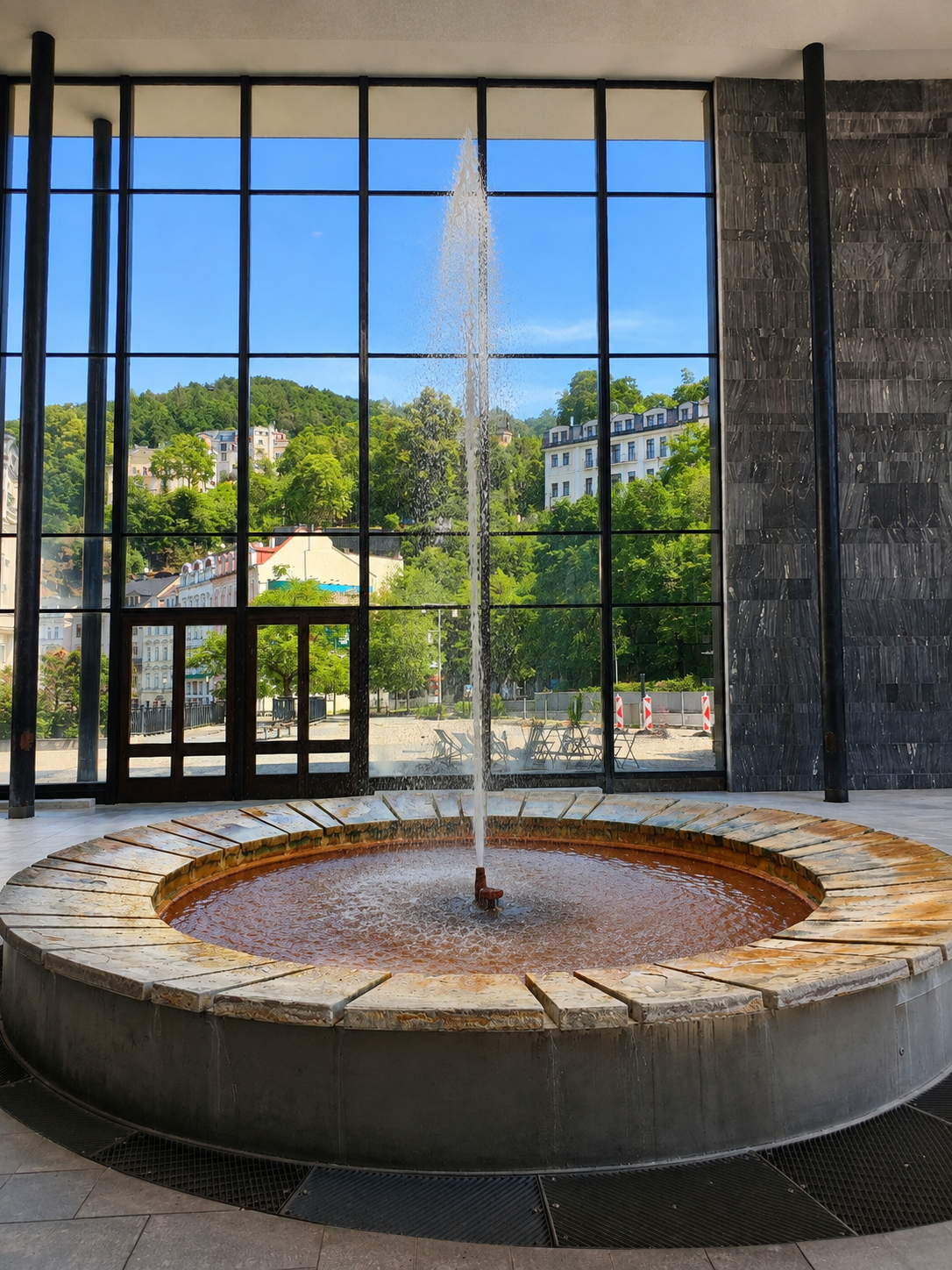
The geyser was also clearly one of those sights that people preferred to photograph rather than analyse too closely. Cameras and phones came out immediately, and I was no different. Visually, Vřídlo is much more convincing than the building that contains it. The colonnade itself never really won me over, but the spring certainly did: this finally looked like a thermal phenomenon important enough to build an entire spa town around.
The architectural contrast was almost absurd. Within a short walk, Karlovy Vary had taken me from a wooden pavilion that still looked temporary after more than a century, through the aristocratic monumentality of the Mill Colonnade and the delicate ironwork of the Park Colonnade, straight into 1970s modernism. Whether that final jump was an improvement is debatable, but it certainly made Vřídlo impossible to confuse with anything else once I knew where to look.
This is exactly the sort of city I would normally explore slowly, stopping for architecture, details and photographs. That morning, however, I was increasingly reducing every decision to shade, distance and whether another few hundred metres were really necessary. Later that afternoon, Doksany would reach 41.9°C, setting a new all-time Czech temperature record less than twenty-four hours after the previous one.
There was an obvious irony in standing beside water emerging from the ground at more than 70°C on the hottest day ever recorded in Czechia. But the temperature of the water was not the strangest part of the Karlovy Vary spa tradition. What surprised me more was what visitors were actually expected to do with it.
Apparently, I Was Supposed to Drink It
Coming from Croatia, I had always associated thermal spa resorts primarily with bathing. You change into a swimsuit, get into the thermal water and spend a few hours moving between pools of various temperatures. So when I started planning Karlovy Vary, I naturally assumed that its famous thermal water would work more or less the same way — perhaps with grander architecture and considerably more history behind it.
Historically, that assumption was not even wrong. In the early centuries of Karlovy Vary, bathing was very much the point, although the treatment was rather more committed than anything I would recognise from a modern spa. Historical accounts describe patients spending many hours immersed in the thermal water, sometimes eating or even sleeping in the bath. The goal was to remain there until the skin softened and eventually cracked, allowing whatever was believed to be wrong with the body to escape through it. Wellness, apparently, was once considerably less relaxing.
Then medicine discovered another possibility: perhaps the water should go inside the patient instead. In the sixteenth century, physician Václav Payer from nearby Loket became an important advocate of the drinking cure. Moderation did not immediately follow. At various points in the spa's history, patients consumed several litres of mineral water a day, sometimes dozens of cups in carefully arranged sequences. It was only later, particularly through the work of eighteenth-century physician David Becher, that the treatment developed into something closer to the system still recognisable today: smaller prescribed quantities, particular springs, walking, diet, bathing and other procedures combined into an individual programme.
That finally explained the peculiar porcelain cups I had been seeing all morning. They were not simply tourist souvenirs but part of the most visible surviving element of a centuries-old medical tradition. Different springs are prescribed in different quantities and at different temperatures, and digestion plays a surprisingly important role in the theory behind them. Cooler springs are traditionally associated with a somewhat stronger laxative effect, while hotter ones are considered more calming to the digestive system. Suddenly the relatively cool Snake Spring I had passed earlier seemed a little less innocent.
Karlovy Vary has also demonstrated considerable imagination in finding other ways to use its mineral water. Modern treatment programmes can include intestinal irrigation with local mineral water. Apparently, if drinking it is not sufficient commitment to the cure, there is another option.
And the water is only the beginning. Some current treatments involve injecting carbon dioxide beneath the skin, while a dry carbon bath places the body inside a sealed bag filled with CO₂. There are Scottish showers using alternating jets of hot and cold water under pressure, and whole-body cryotherapy can take a patient from a town whose main spring emerges at around 73°C into a chamber approaching –160°C. Over several centuries, Karlovy Vary medicine seems to have explored an impressive range of possibilities for getting something into, onto or around the human body.
After all that, simply drinking the water began to seem positively conservative. Vřídlo itself emerges at roughly 73°C, although water intended for the drinking cure is cooled before it reaches the cup. This is fortunate, because swallowing it directly at source temperature would introduce an entirely different branch of medicine.
Unfortunately, I already had relevant experimental data. In Bad Gastein I had tasted the thermal water on which another famous European spa built much of its identity. Warm, salty and intensely mineral, it reminded me of an unpleasant mixture of rust and oral rehydration solution. One sip had been enough.

Karlovy Vary gave Bad Gastein unexpectedly serious competition. I tried the water and found it hot, aggressively mineral and thoroughly unpleasant. On an ordinary day, that might simply have counted as part of the experience. On the hottest day ever recorded in Czechia, voluntarily adding hot mineral water to a body that was already struggling with the temperature felt particularly absurd.
The knowledge that some of the springs also came with mild laxative ambitions did not exactly encourage extensive sampling either. I still had a rental car and no fixed plan for the afternoon, so discovering just how seriously Karlovy Vary intended to influence my bowel movements seemed unnecessary. One taste was enough.
Bad Gastein had finally lost a competition I had never intended to organise: Karlovy Vary now had the worst thermal water I had ever voluntarily drunk.
Goethe, Werther and a Road to Verona
By the time I finished with the springs, colonnades and increasingly inventive ways of introducing mineral water into the human body, I felt I had understood the spa side of Karlovy Vary reasonably well. But spa towns of this calibre were never purely medical institutions. Once aristocrats, artists and wealthy visitors began spending weeks taking the cure, health inevitably became mixed with culture, social life and celebrity.
Karlovy Vary has been attracting famous names for centuries, and one of its most persistent visitors was Johann Wolfgang von Goethe — a man who had already done his best to “brighten” my high-school years by making me suffer through The Sorrows of Young Werther. He apparently enjoyed Karlovy Vary considerably more than I enjoyed Werther: between 1785 and 1823, he came here thirteen times.
One of those visits produced a connection I particularly liked. On 3 September 1786, Goethe slipped out of Karlsbad, as Karlovy Vary was then known, at three in the morning and headed south on the journey that would become his Italian Journey. Less than two weeks later he was in Verona, standing inside the Arena. His reaction was unequivocal: “The amphitheatre is the first important monument of the old times that I have seen—and how well it is preserved!”
A little more than a month after my own day in Karlovy Vary, I would find myself in that same Arena. Goethe had gone there looking for antiquity; I went because I wanted to see what happens when the amphitheatre is filled with thousands of people, an orchestra and Verdi. Different centuries, different priorities, but his observation suddenly felt unexpectedly relevant.

Looking for the Casino Royale Version
Goethe belonged to the old version of Karlovy Vary celebrity culture. Cinema largely supplies the modern one. The Karlovy Vary International Film Festival dates back to 1946 and has transformed the spa town into an annual meeting point for major filmmakers and actors. My timing was particularly good: only five days after my visit, its 60th edition would begin, bringing guests including Dustin Hoffman, Juliette Binoche, Maggie Gyllenhaal, Jesse Eisenberg, Jeffrey Wright and Harvey Keitel.
By the southern end of the spa district, that glamorous identity was becoming visible even without the festival. Designer boutiques, jewellery shops and grand hotels gradually replaced the more medicinal atmosphere of the springs, and for a few streets western Bohemia started to feel as though somebody had transplanted a small piece of Monte Carlo into the Teplá valley.
That comparison was particularly hard for me to avoid because I had already gone looking for James Bond in Monaco. There, the fantasy had worked only in fragments — around the Casino de Monte-Carlo, at the gaming tables and, most convincingly, standing on its balcony at midnight on New Year's Eve. Karlovy Vary was beginning to produce a familiar mixture of genuine luxury and my own slightly overdeveloped cinematic expectations.

At the centre of this version of Karlovy Vary stands Grandhotel Pupp. Its origins reach back to the early eighteenth century, while the Pupp name came with Johann Georg Pupp, appropriately enough a confectioner who arrived in Karlovy Vary and married into a local confectionery family. Over generations, the business grew into the monumental hotel complex that dominates this end of town today.
Pupp became closely associated with the film festival and eventually turned into a film set itself. Last Holiday was shot here, but its most recognisable cinematic role came with Casino Royale, when the hotel stood in for the fictional Hotel Splendide in Montenegro.
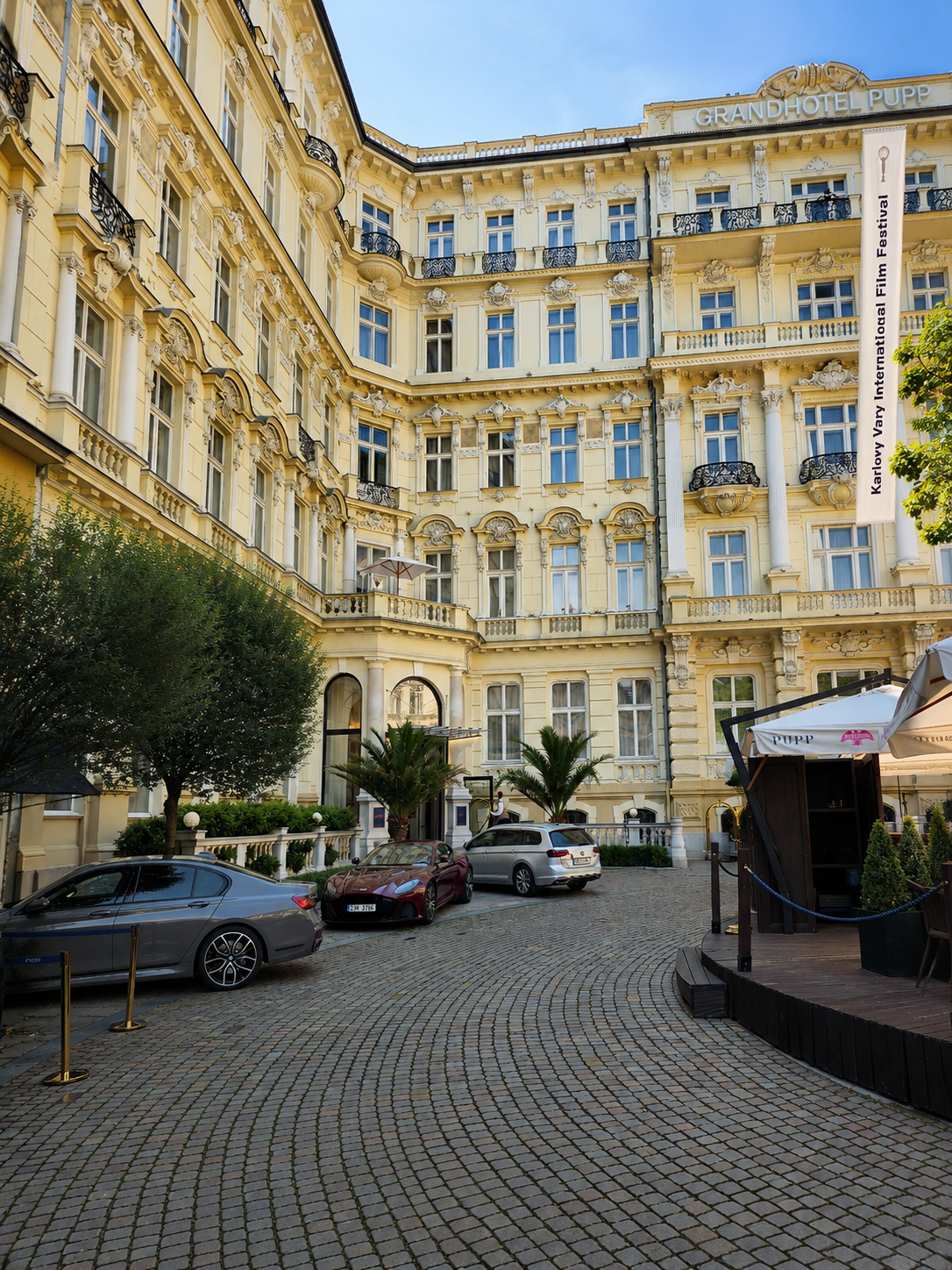
That Bond connection had probably distorted my expectations somewhat. Somewhere in my head, Grandhotel Pupp meant polished marble, expensive cars, evening dress and a reasonable chance that Daniel Craig might emerge from behind a column.
Unfortunately, I was in no condition to contribute to that atmosphere.
Café Pupp: Hydration First, Sugar Later
After hours of walking in extreme heat, I was so thoroughly soaked that being admitted to Café Pupp already seemed generous. Going deeper into the hotel in my condition felt unnecessary. I was neither dressed nor remotely dry enough to be interested in starting a discussion about anybody's interpretation of the dress code.
My first order therefore had nothing to do with gastronomy. I started with half a litre of cold lemonade and another half litre of ice water. Only after both had disappeared did I begin to feel sufficiently human to consider coffee and cake.
Then, for reasons that made considerably less sense in retrospect, I ordered two cakes.
One was the hotel's signature Pupp cake, a dense Central European coffee-house creation that reminded me of the broad Sacher family: rich, heavy and extremely sweet. It was good, but halfway through it began to feel less like dessert and more like an obligation. The second was a meringue cake with strawberries and mascarpone, which sounded considerably lighter and more refreshing than it actually was.
It was even sweeter.
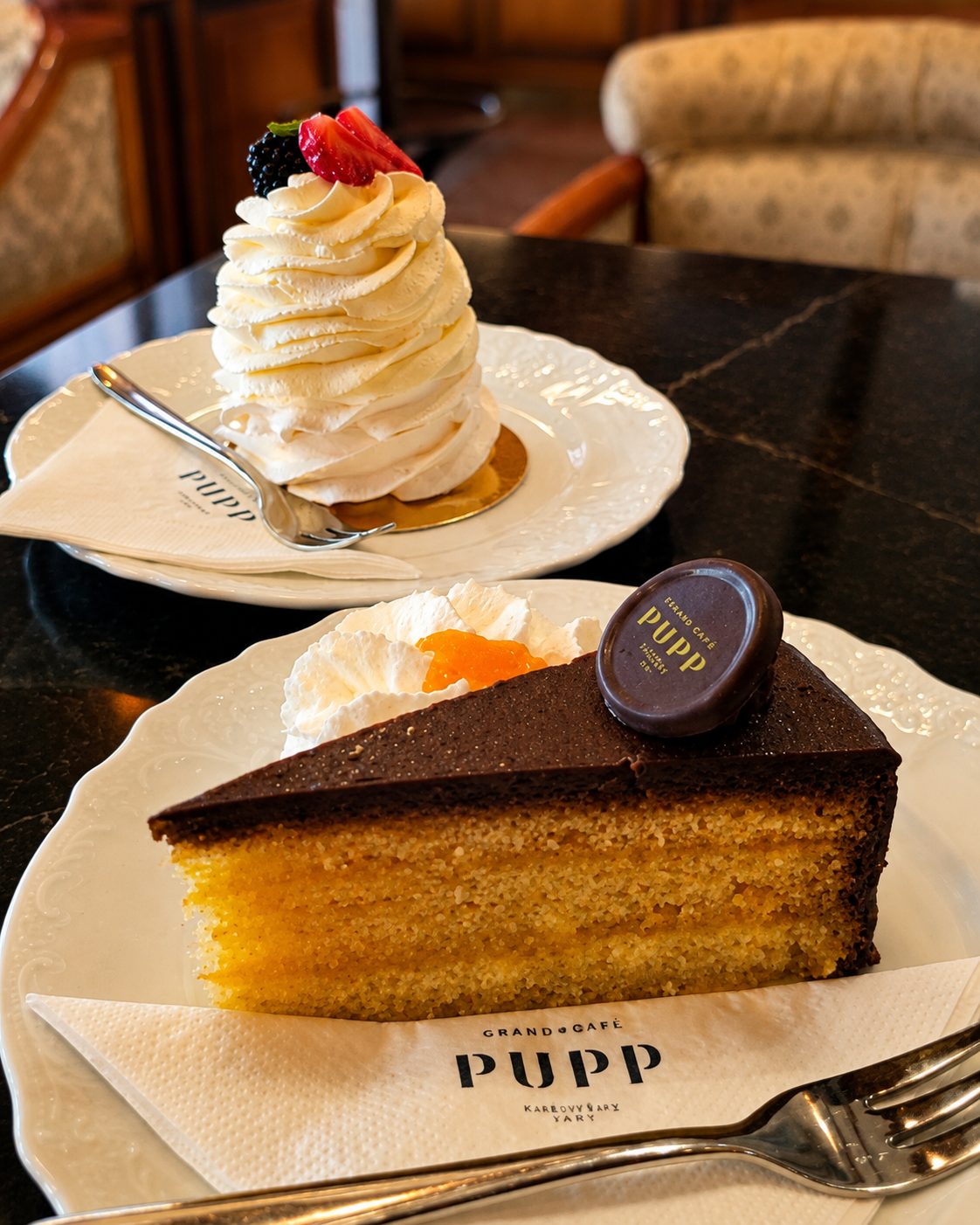
So, on the hottest day ever recorded in Czechia, I had responded to dehydration with hot mineral water followed by two aggressively sweet cakes. Clearly, the sensible choice would have been ice cream.
I corrected that mistake on the square outside.
The hoped-for 007 atmosphere never really materialised. Perhaps Pupp needs evening light, a busy bar and guests dressed for dinner rather than a severely overheated tourist holding an ice cream. During the afternoon it was elegant, historic and undeniably impressive, but I felt considerably more like somebody recovering in a very good café than an extra from Casino Royale.
Eating my ice cream, I finally looked towards the hill and remembered where I had left the car. The steep descent from Libušina that had seemed so harmless in the morning was now waiting to be climbed in the hottest part of the day. I considered the route for approximately as long as necessary to establish that I had absolutely no intention of walking it.
Without the slightest trace of shame, I opened Uber.
About ten minutes later I was back at the garage, in the car and under air conditioning. Karlovy Vary had been beautiful, interesting and considerably stranger than I expected, but I had had enough of it for one day. The rental car, however, had been booked precisely because the spa town did not have to be the end of the itinerary.
It was time to see what else western Bohemia could offer — preferably somewhere requiring substantially less walking.
Sightseeing Standards Begin to Collapse
Western Bohemia still offered several possibilities. Mariánské Lázně appeared immediately on the map, another of the great Czech spa towns, but the photographs did not particularly tempt me. Fairly or unfairly, they gave me the impression of a larger, more conventional spa resort oriented towards mass tourism rather than the kind of place I was curious enough to explore in record-breaking heat. After a morning in Karlovy Vary, I did not feel any great need to test whether that first impression was wrong. Travel decisions made from inside an air-conditioned car while the country is breaking temperature records are not peer-reviewed.
Loket, on the other hand, was only about 15 kilometres away and looked almost absurdly photogenic. The medieval town sits on a rocky promontory wrapped on three sides by the Ohře River, with its castle rising directly above it. Even the name Loket means “elbow”, referring to the shape of the river bend. The castle developed into an important royal stronghold, and the future Charles IV was even confined there as a small child during the conflicts surrounding his parents. Local tradition later connects him with Karlovy Vary as well: he is said to have set out hunting from Loket when his entourage discovered the thermal springs that would eventually give rise to the spa town I had just left.
All of that made Loket interesting, but at that point my priorities had become considerably simpler. What I really wanted was the photograph. Finding the right place to take it, however, proved much more difficult than the finished image suggested. I first tried parking near the railway station and started walking towards town, assuming that somewhere along the way the castle would arrange itself into the postcard composition I had seen online. After a short distance in the heat, I abandoned that idea and returned to the car. By then my sightseeing methodology was becoming brutally efficient: drive, look, estimate walking distance, reject.
After some additional circling around Loket, I eventually found a viewpoint that required considerably less physical commitment.
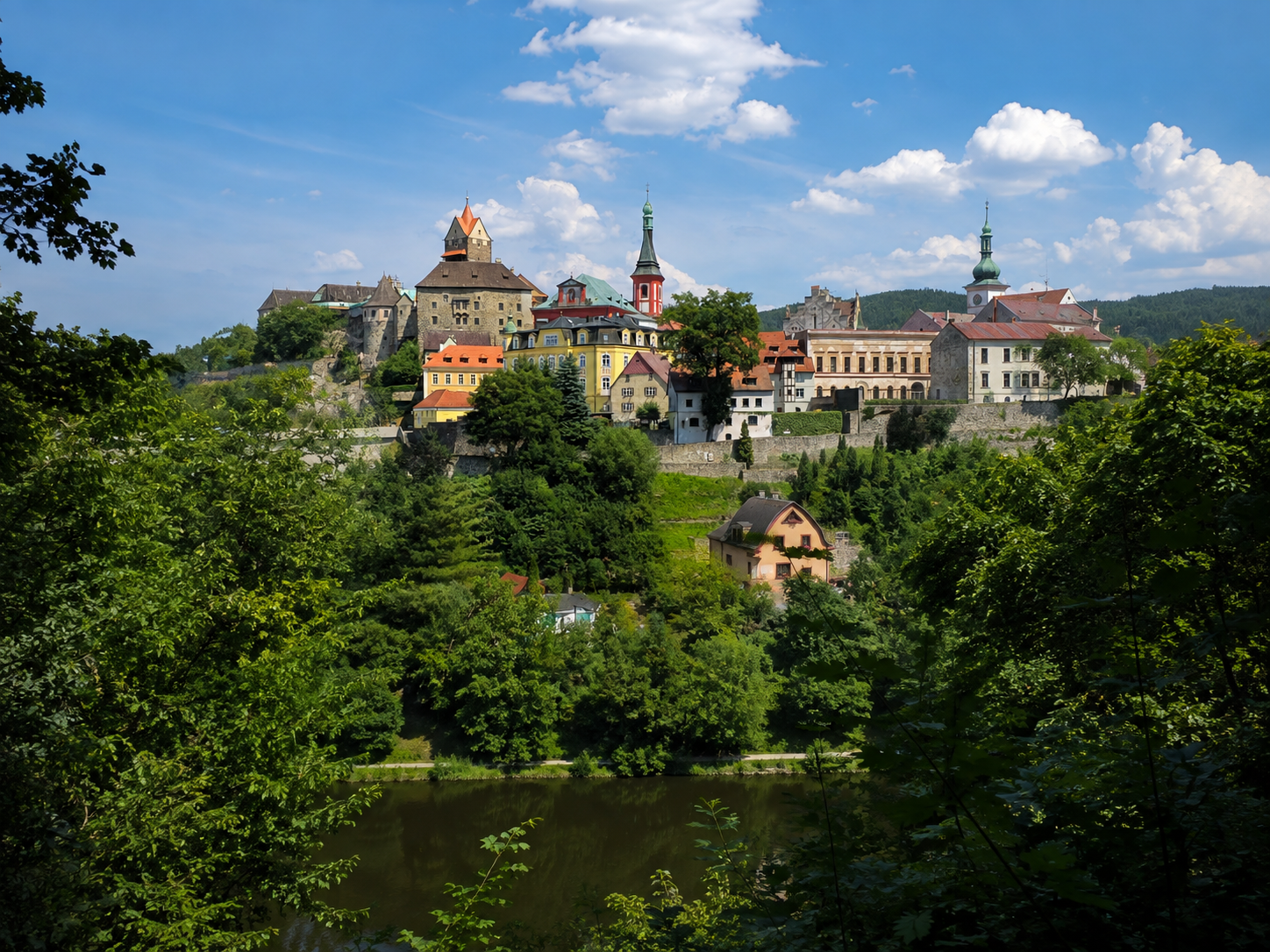
Visually, Loket delivered exactly what I had come for. The castle and compact old town rise above layers of greenery with the Ohře curling around them, producing an almost implausibly picturesque medieval-Bohemian panorama. I had not explored the streets, entered the castle or done anything that a responsible travel writer could honestly describe as visiting Loket properly, but I had obtained the photograph. Under the circumstances, I was perfectly willing to count that as sightseeing.
Bečov: Park, Shoot, Retreat
Bečov nad Teplou was much easier. I drove into the centre and found parking almost directly in front of the castle complex, which by that point felt less like good urban planning and more like a personal favour. My sightseeing standards had now been reduced to a highly efficient procedure: park, get out, take the photographs and return to the air-conditioned car before the weather had time to object.
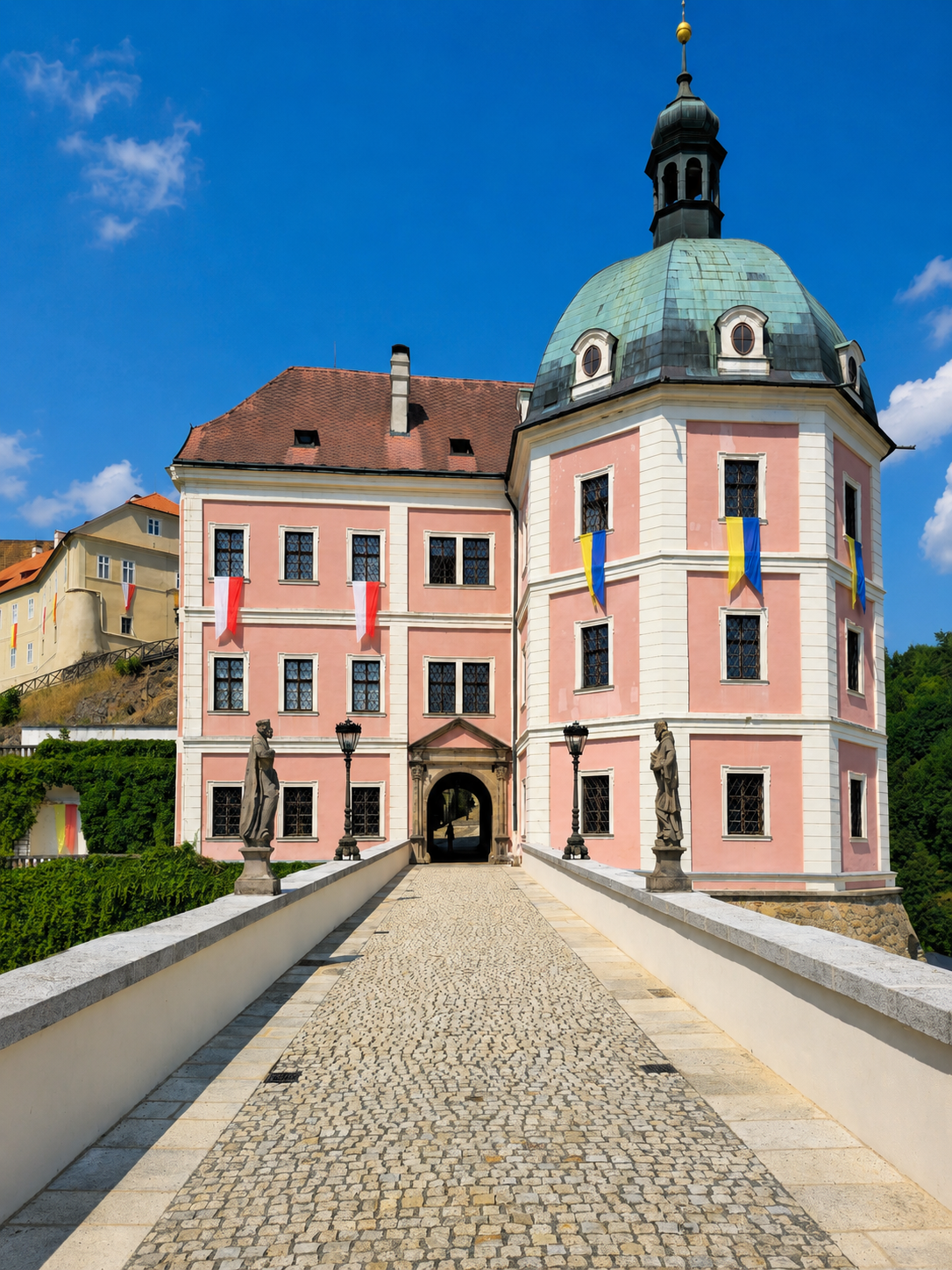
Bečov is essentially one aristocratic complex built in layers down the same slope: a medieval castle at the top, later residential additions around it and an eighteenth-century Baroque chateau below. Its greatest treasure, however, is inside — the Romanesque Reliquary of St Maurus, one of the most valuable medieval objects preserved in Czechia. I did not see it, but its modern history is almost too good not to mention.
The Beaufort-Spontin family, who owned Bečov before the Second World War, hid the reliquary beneath the floor of the castle chapel before leaving Czechoslovakia in 1945. Almost forty years later, Christian Beaufort-Spontin asked American businessman Danny Douglas to negotiate its recovery on the family's behalf. Douglas approached the Czechoslovak authorities offering money for permission to retrieve an unidentified object from an undisclosed location, while refusing to say exactly what he wanted or where it was hidden. Unsurprisingly, that made the authorities curious. Investigators eventually worked out that the trail led to Bečov and found the reliquary in 1985, before Douglas could recover it.
The family never got it back. The Bečov estate had been confiscated after the war, and the reliquary remained in state ownership. After a lengthy restoration, it eventually returned to Bečov as one of the main attractions of the castle complex. So the family's attempt to recover a treasure they had hidden four decades earlier instead helped the Czechoslovak authorities find it first.
On almost any other day, that story alone would have been enough to get me through the door. On this one, however, one of Czechia's great medieval treasures was competing against an air-conditioned car parked only a few metres away. The car won.
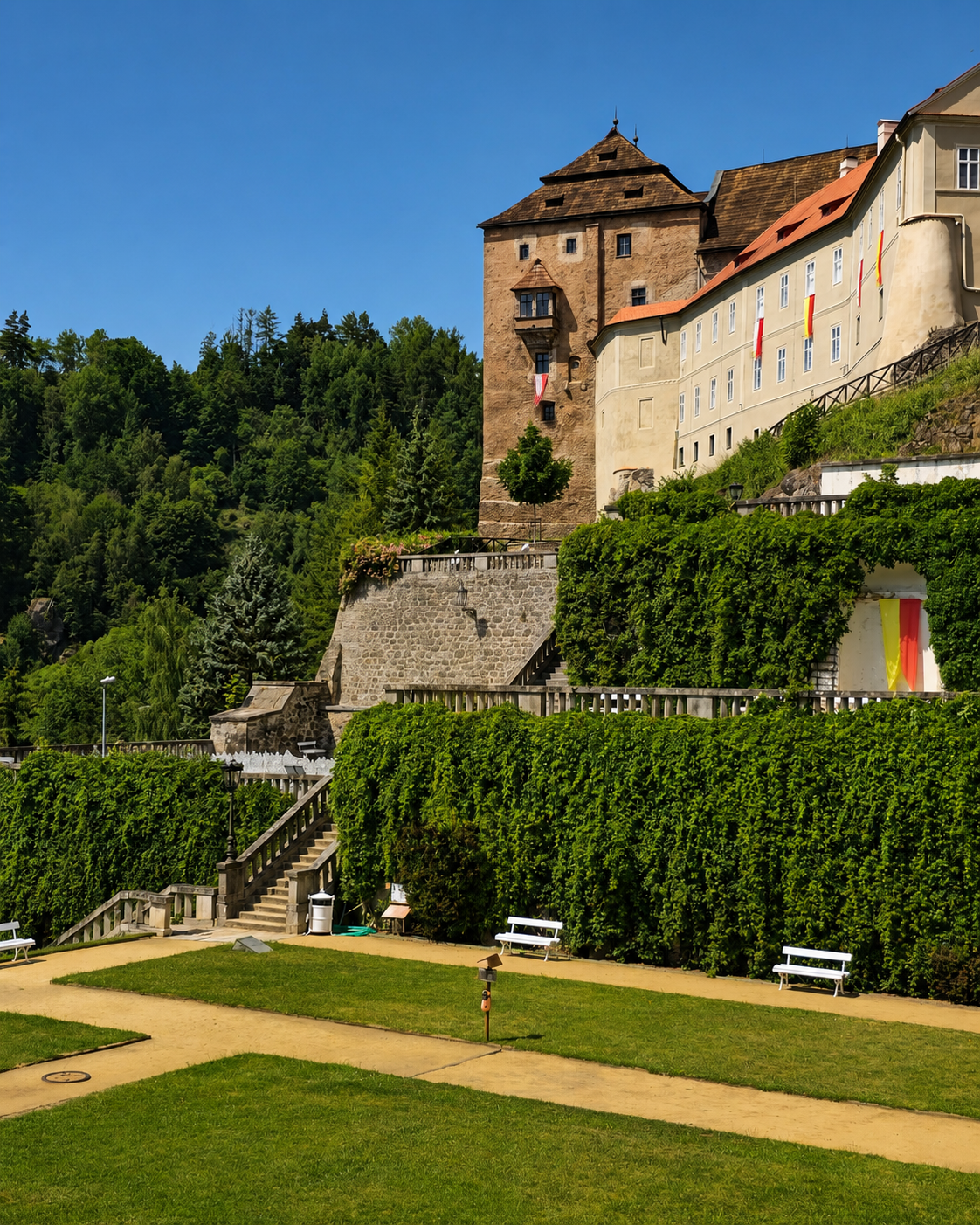
I photographed the gardens, the castle above them and the pink Baroque chateau, then retreated. By now, proximity between a parking space and a monument had become a genuine architectural virtue. Loket had at least required me to hunt for a viewpoint; Bečov represented the logical endpoint of the day's declining sightseeing standards by placing almost everything I wanted to photograph within a very short walk of the car.
There was no point pretending I was going to add another destination. I turned towards Prague.
The Sightseeing Finally Lost
After Bečov, even I was ready to admit that the sightseeing day was over. The drive back towards Prague was straightforward enough, although STAGES sits beside the O2 Arena in Prague 9, on the opposite side of the city from the western approach. After a day spent crossing western Bohemia, I still had to work my way through a substantial part of Prague before I could finally stop.
I had specifically chosen STAGES Hotel Prague because I owed it a booking. Two years earlier I had reserved the hotel for another trip built around opera in Brno and Vienna, only for severe weather to prevent my flight from landing in Rijeka while flooding caused chaos across the region. The whole itinerary collapsed before I even left Croatia, and STAGES allowed me to cancel without charge. Hotels are very good at writing about hospitality; I tend to remember the ones that actually demonstrate it when something goes wrong. I had decided that if another suitable trip brought me back to Prague, I would eventually give them the booking they had lost.
The hotel arrived at exactly the right moment. Once I had photographed the room, it did not take long before I was horizontal on the bed, with no remaining conflict between sightseeing ambitions and the mattress. Karlovy Vary, Loket and Bečov had extracted quite enough enthusiasm for one day.
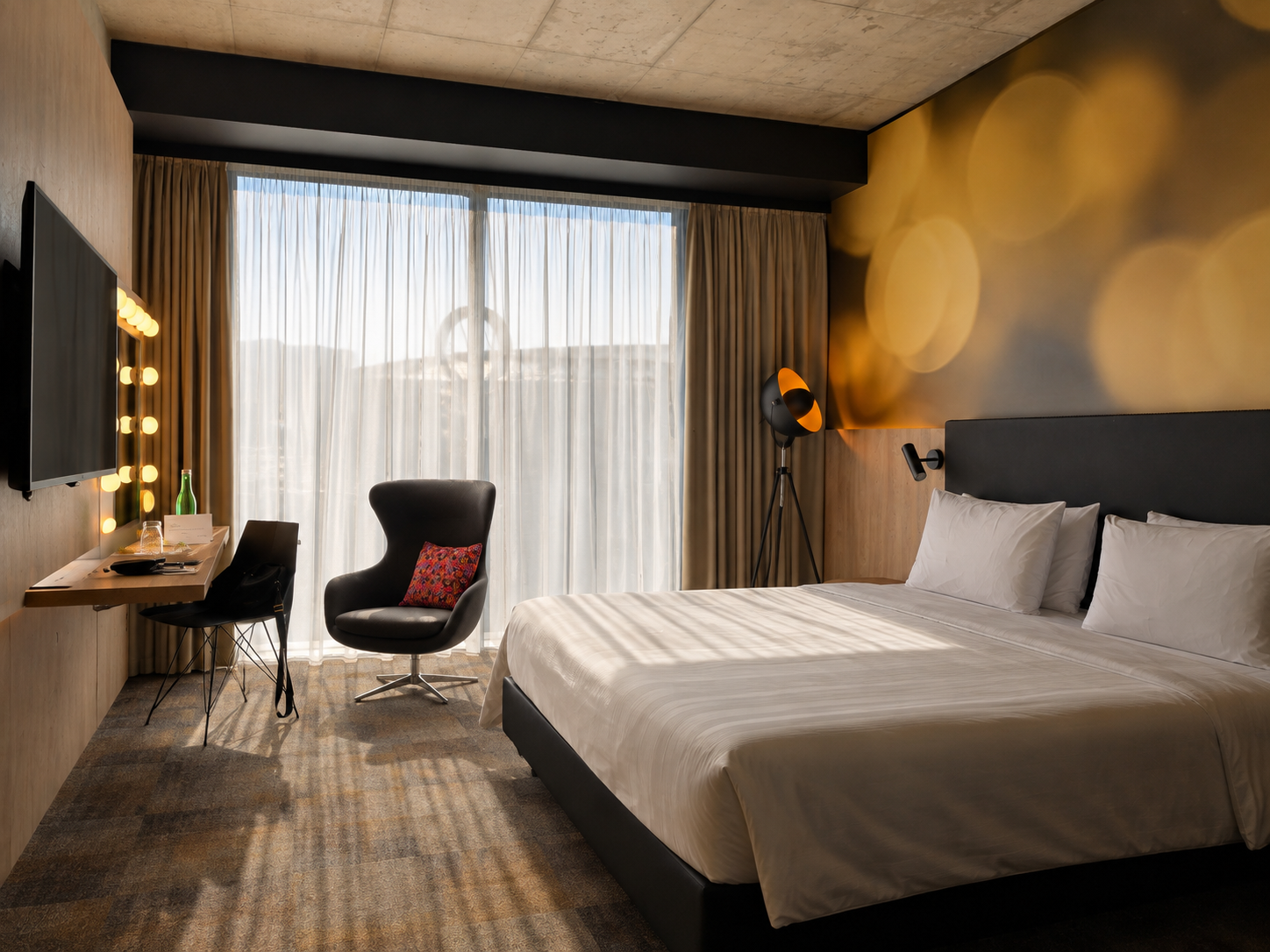
The following morning the conference proper began, and western Bohemia became the overheated prologue to a week of mathematics. As far as I was concerned, the road trip was finished.
Hertz, however, still had one final contribution to make.
One Final Souvenir
Hertz did manage to send me one final souvenir. On 2 July, €41.54 appeared on my card in connection with a speeding offence somewhere along the route. Where exactly, I still have no idea. Perhaps the heat had given me wings; perhaps the automatic Škoda simply made it too easy to stop paying attention to the speedometer. Either way, my rapidly declining sightseeing standards had apparently not extended to the accelerator.
None of this made Karlovy Vary a disappointment. I would come back, stay overnight in a proper spa hotel and arrange the treatments in advance. I might even give the mineral water another chance. On Cyprus, I had already demonstrated that I was willing to negotiate with Aphrodite over eternal youth, so taste is clearly not an absolute obstacle. If Karlovy Vary could credibly promise to remove a few years, I would probably drink the foul stuff without complaint.

Whether I would accept the same mineral water through one of the alternative routes offered by local medicine would depend entirely on how many years we were talking about.
I would, however, check the weather forecast first. The hottest day ever recorded in Czechia is a remarkably stupid time to visit a town famous for hot water.
