 Paphos Municipality, Cyprus, Cyprus
Sixty-one hours across Cyprus, with Aphrodite negotiations, Roman mosaics, a shipwreck, banana groves, impossible blues, suspicious greens and cocktails that appeared to have escaped from a laboratory.
Middle age did not announce itself with a sports car, an inappropriate tattoo or the sudden conviction that I should learn electric guitar.
It arrived more discreetly: grey hairs multiplying in my beard, photographs taken from increasingly selective angles and the suspicion that everybody on Instagram had either become younger or learned to lie better.
At roughly the same time, Cyprus began appearing in my feed with suspicious frequency. One acquaintance posted himself entering a sea that did not look remotely warm. His caption explained that swimming three times around Aphrodite’s Rock could preserve eternal youth and beauty.
Naturally, I found this ridiculous.
I continued finding it ridiculous until a friend mentioned a long Corpus Christi weekend in Cyprus and asked whether I wanted to join.
At that point, realism prevailed—but not completely. I had no intention of swimming three times around a large rock in open water merely to negotiate with a Greek goddess. That sounded less like an anti-ageing treatment and more like an efficient way of terminating the ageing process altogether.
Still, perhaps mythology allowed partial credit. Perhaps simply standing in the foam would be enough. Perhaps Aphrodite was less bureaucratic than advertised.

I joined the trip with no serious belief in divine cosmetic intervention, but enough intellectual dishonesty to leave the question slightly open.
The timetable gave us sixty-one hours between landing in Paphos and our scheduled departure.
That seemed sufficient for one goddess, several thousand years of history and a preliminary discussion about my beard.
A Brief Experiment in Budget Travel
The journey began around midnight, when I drove from Rijeka to Zagreb for a flight leaving at an hour usually reserved for regrettable messages and bakery deliveries.
The flight was slightly delayed, but not enough to deserve a subplot. More importantly, I was not particularly exhausted when we landed. After the night drive, very little sleep and an early flight, I remained irritatingly functional.
The case for premature ageing was already beginning to weaken.
I had also travelled with a single backpack.
This requires context. My usual travel ecosystem involves Marriott hotels, proper luggage, elite benefits and an underlying assumption that published check-in and check-out times are merely opening positions in a negotiation. Arriving in Cyprus with one backpack, no checked baggage and an airport bus ahead of me was therefore not simply economical.
It was a rare field experiment in budget travel.
The bus was cheap, slow and almost entirely stripped of glamour. Since I had no suitcase to drag behind me, even I had to admit that it performed its essential function. It brought us from the airport into Paphos and close enough to the Amphora Hotel & Suites to prevent a taxi from feeling strictly necessary.
The Amphora was a solid four-star hotel beside the sea, costing roughly €100 a night. It had a proper room, gardens, a large pool and a location from which central Paphos could be reached on foot.
It was neither remarkable enough to praise at length nor flawed enough to attack.
What it lacked were the Marriott rituals to which I had become embarrassingly accustomed. There was no elite recognition, no upgrade theatre and certainly no early check-in. Late check-out would prove equally theoretical.
The hotel simply intended to provide the room I had reserved at the time stated in the booking.
I found this reasonable and faintly disorienting.
We left our backpacks at reception and started walking towards the centre.
An Island That Refuses a Simple Map
From Paphos, Cyprus is easy to misread.
The euro, Greek signs, Orthodox churches and taverna menus make the government-controlled south feel like a slightly more formal cousin of Rhodes or Crete. Then traffic passes on the left, British road markings appear beneath the Mediterranean sun and the island’s political history begins interfering with the postcard.
Cyprus became independent from Britain in 1960. In 1974, a coup by elements seeking union with Greece was followed by Turkish military intervention, leaving the island divided. The internationally recognised Republic of Cyprus controls the south, while the north is administered by Turkish Cypriots and has declared itself the Turkish Republic of Northern Cyprus, recognised as a state only by Türkiye. Between the two lies the UN-controlled buffer zone known as the Green Line, which cuts directly through Nicosia.
The Republic of Cyprus joined the European Union in 2004, while EU law remains suspended in the north because the Republic’s government does not exercise effective control there. Britain, meanwhile, never entirely left: it retained the Sovereign Base Areas of Akrotiri and Dhekelia.
We stayed entirely within the territory controlled by the Republic of Cyprus. Even there, the island’s complicated inheritance kept surfacing: euros in the wallet, Greek food on the table, British rules on the road and military territory belonging to another country beyond the motorway.
Cyprus had managed to become an EU member, a divided island, a former colony with two surviving pieces of Britain and a Mediterranean holiday destination without allowing any of those identities to cancel the others.
And we had not even reached lunch.
Moussaka Before Antiquity
Lunch came first at Ta Mpania, on the seafront along Poseidonos Avenue.

The moussaka occupied the visual centre of the table, but it had plenty of company: Greek salad, tomatoes, cucumber, feta, olives and enough additional food to demonstrate that travelling with hand luggage had not inspired similar restraint at lunch.
The top of the moussaka was dark and properly scorched. Beneath it were the familiar layers of aubergine, meat and béchamel, still hot enough to punish anyone who believed appetite should override basic thermodynamics.
It was heavy, unapologetic and exactly right.
Archaeology is always more convincing after lunch.
Before surrendering ourselves to it, however, we took a taxi out of Paphos to see a ship I had never heard of.
The Most Instagrammable Parking Accident in Cyprus
I knew nothing about EDRO III.
I did not know its history, its dimensions or why a full-sized cargo vessel had been left leaning against the Cypriot coast. My immediate assessment was considerably less scholarly:
It was extremely Instagrammable.
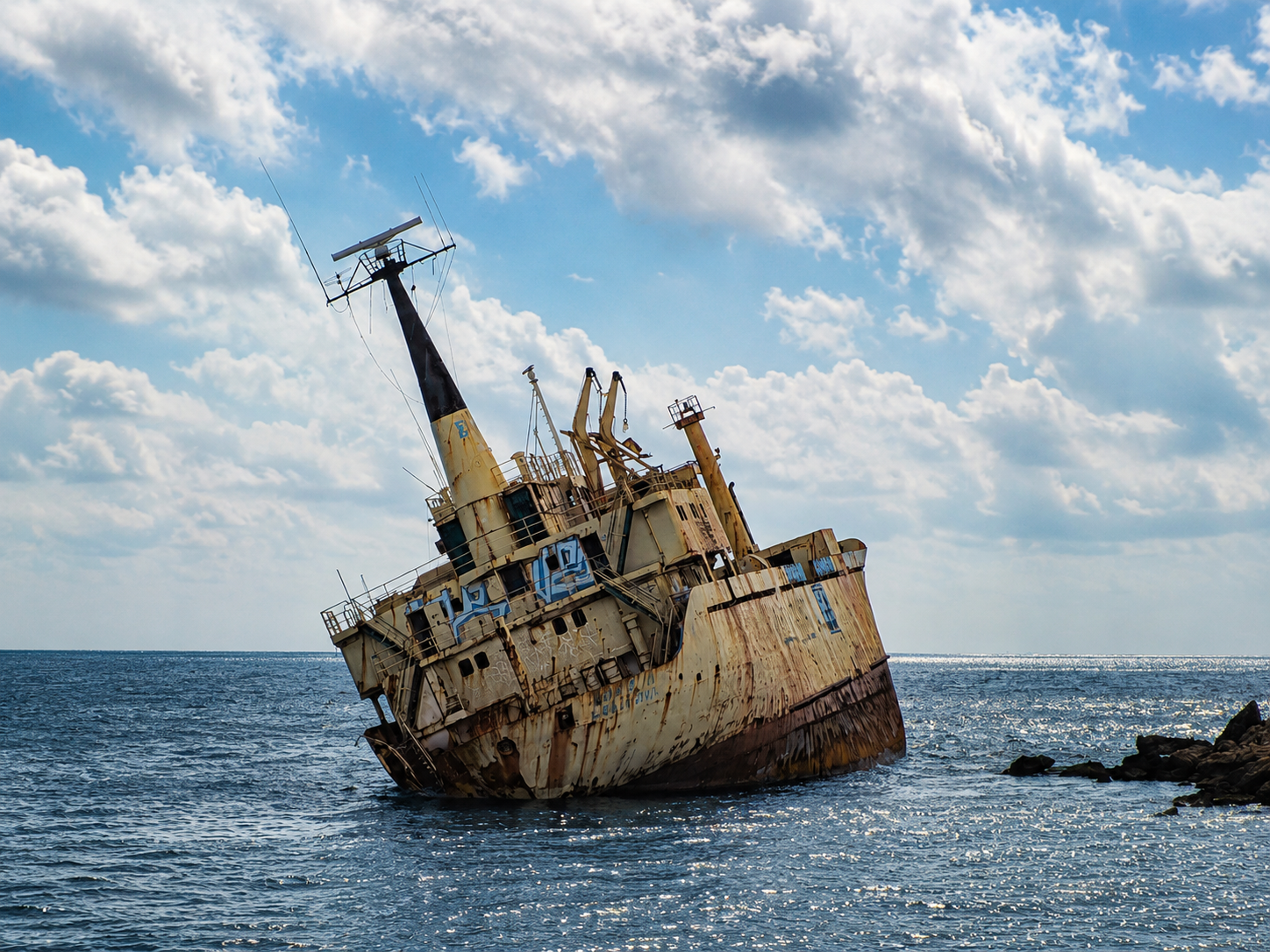
The rusting hull sat absurdly close to shore, large enough to dominate the landscape but conveniently positioned for anyone carrying a phone. Its exposed decks and industrial geometry rose above blue water and pale rock as though somebody had deliberately installed a shipwreck for photographers.
Only later did I learn that EDRO III was an 83-metre cargo vessel built in 1966. It ran aground near Pegeia during severe weather in 2011. The crew escaped safely, but the ship remained wedged against the coast.
At the time, the history was secondary. Cyprus had placed a massive stranded ship beside the rocks and made photographing it almost indecently easy.
I photographed it from every plausible angle, including several whose differences would be detectable only to the person who had taken them.
This was not redundancy.
It was insurance.
Floors That Outlived the Buildings
Back in Paphos, the afternoon moved underground and several thousand years backwards.
The Archaeological Park of Kato Paphos contains remains ranging from the fourth century BC to the Middle Ages. Paphos served as the island’s capital during the Hellenistic and Roman periods, and the site forms part of the UNESCO-listed Paphos complex.
Its best-known treasures are the intricate mosaics preserved in four Roman villas named after the mythological scenes found on their floors: the Houses of Dionysos, Theseus, Aion and Orpheus.
Entire buildings had disappeared while their floors survived.
Myths, hunting scenes, animals and geometric patterns remained precisely arranged beneath protective roofs, created at a time when domestic flooring was apparently expected to survive the civilisation that commissioned it.
There is something mildly humiliating about examining a Roman mosaic after having recently considered laminate.
The park is not a single neat monument but an archaeological landscape: villas, an agora, an odeon, the remains of an early Christian basilica and the broken columns of Saranta Kolones, a Byzantine fortress later destroyed by an earthquake.
Then, beyond the Roman floors and fallen stones, a white lighthouse rose above the ruins with almost comic disregard for chronology.
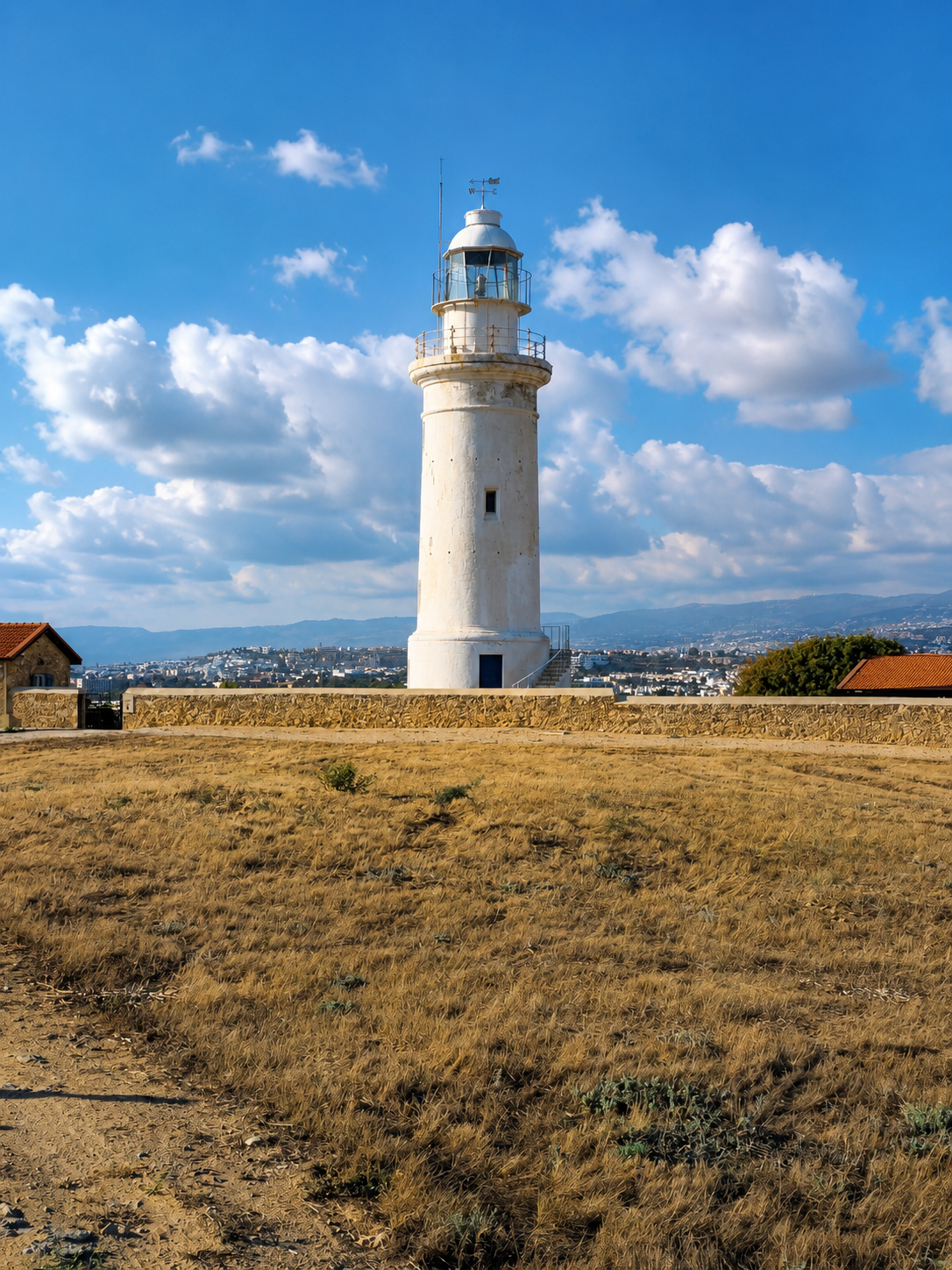
Paphos Lighthouse was built in 1888 during British rule. Surrounded by ancient foundations, it looked like a nineteenth-century official who had arrived centuries late but nevertheless expected to be included.
The same archaeological afternoon also included the Tombs of the Kings, another local attraction with a name that requires clarification.
No kings are known to have been buried there. The monumental underground tombs were carved into solid rock during the Hellenistic and Roman periods for senior officials and aristocrats. Their scale, Doric columns and sunken courtyards earned them the royal title.
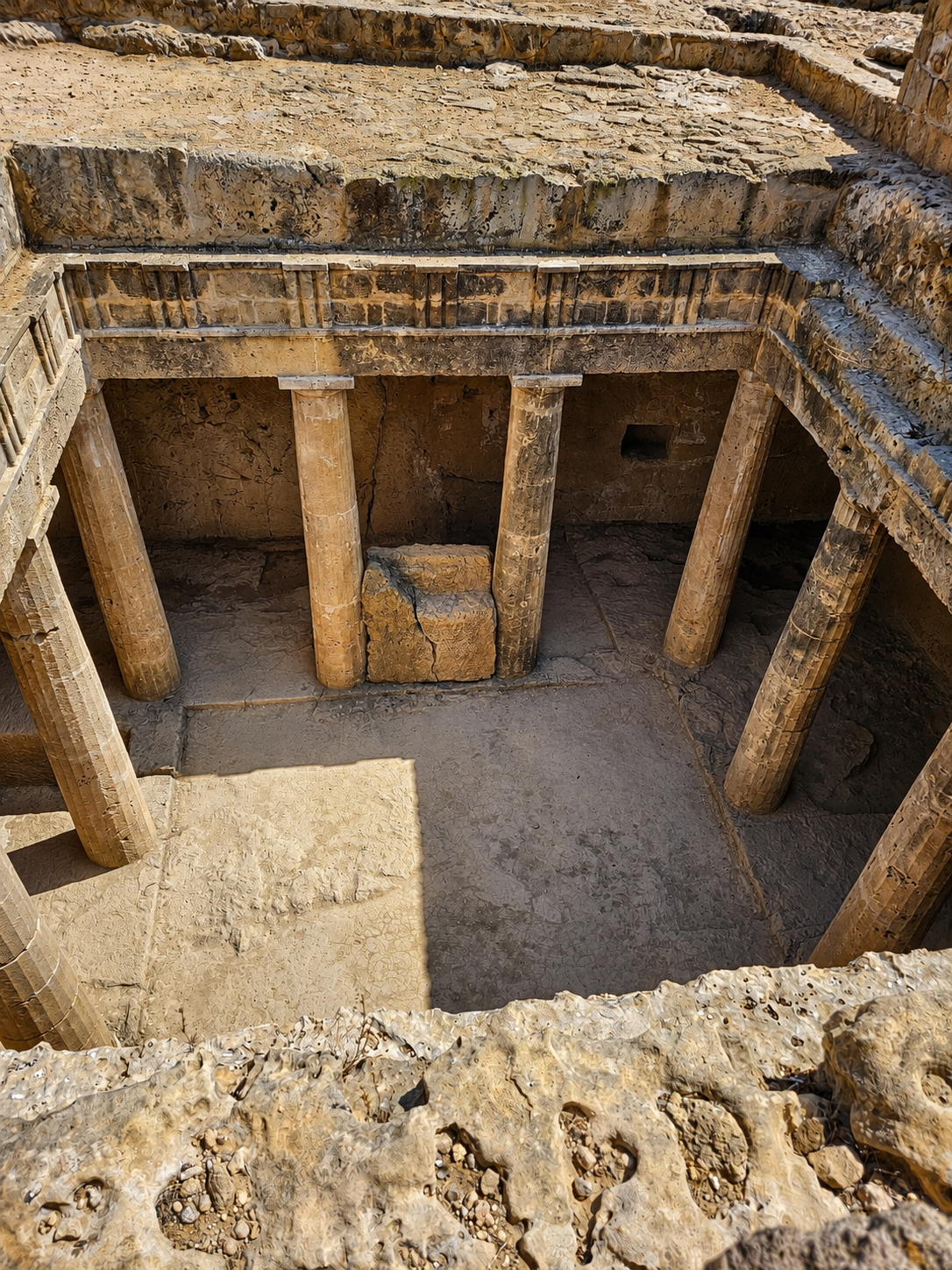
From above, parts of the site looked like openings in a dry, stony landscape.
Once inside, they became architecture.
Burial chambers opened from courtyards below ground level. Columns still organised the space, turning a necropolis into something unexpectedly theatrical. The temperature dropped, the modern city vanished and the dead had clearly received more impressive accommodation than many of the living.
Cocktails, a Castle and No Eaten Pelicans
After the archaeological park, we returned to Paphos Harbour.
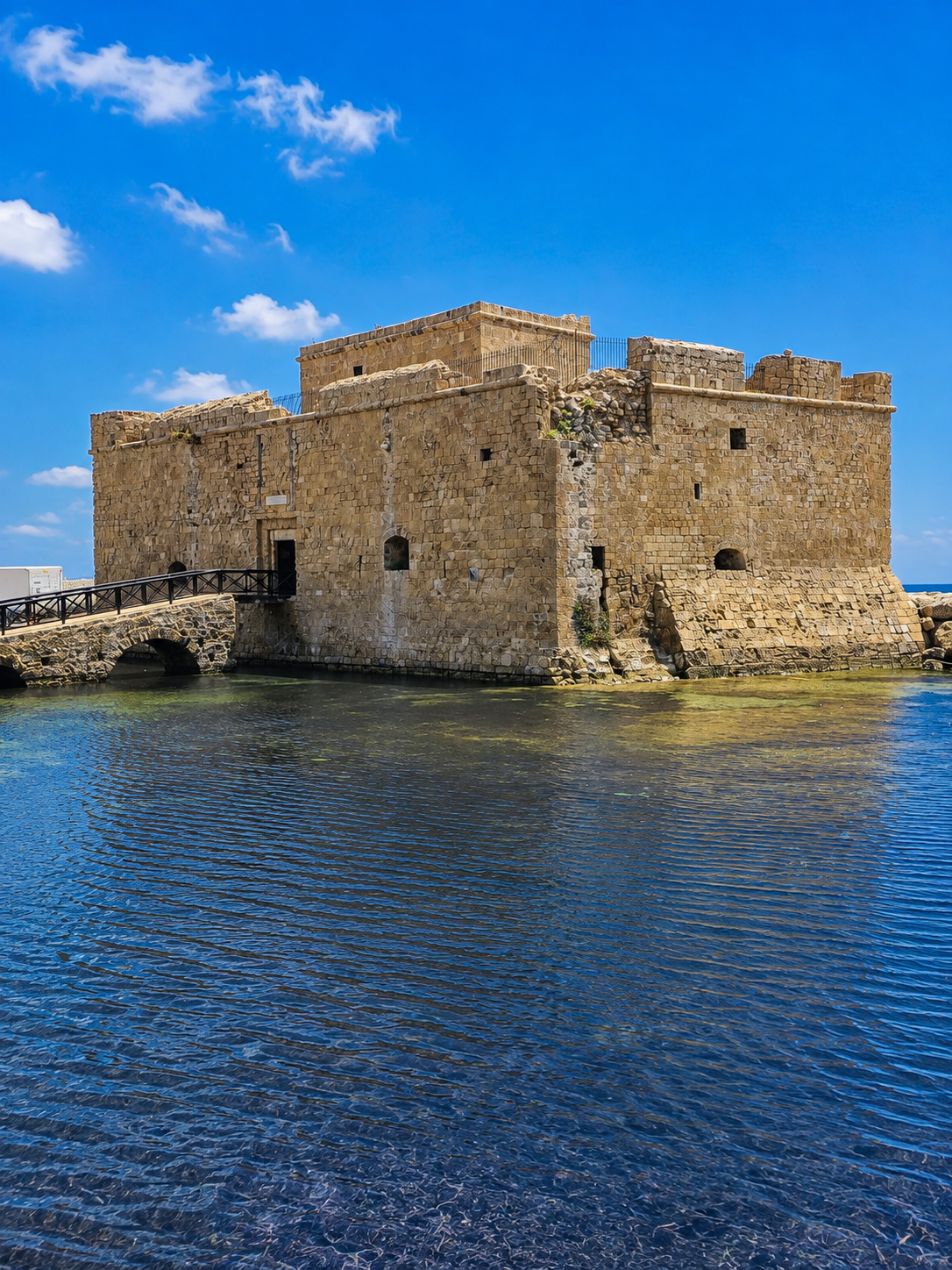
At its western end stood the compact medieval castle that has spent centuries changing jobs. It began as a Byzantine fort protecting the harbour, was rebuilt by the Lusignans, dismantled by the Venetians and restored by the Ottomans. The British later used it as a salt store, a surprisingly undignified late career for a waterfront fortress.
We stopped at the Pelican Restaurant for cocktails.
No pelicans were eaten.
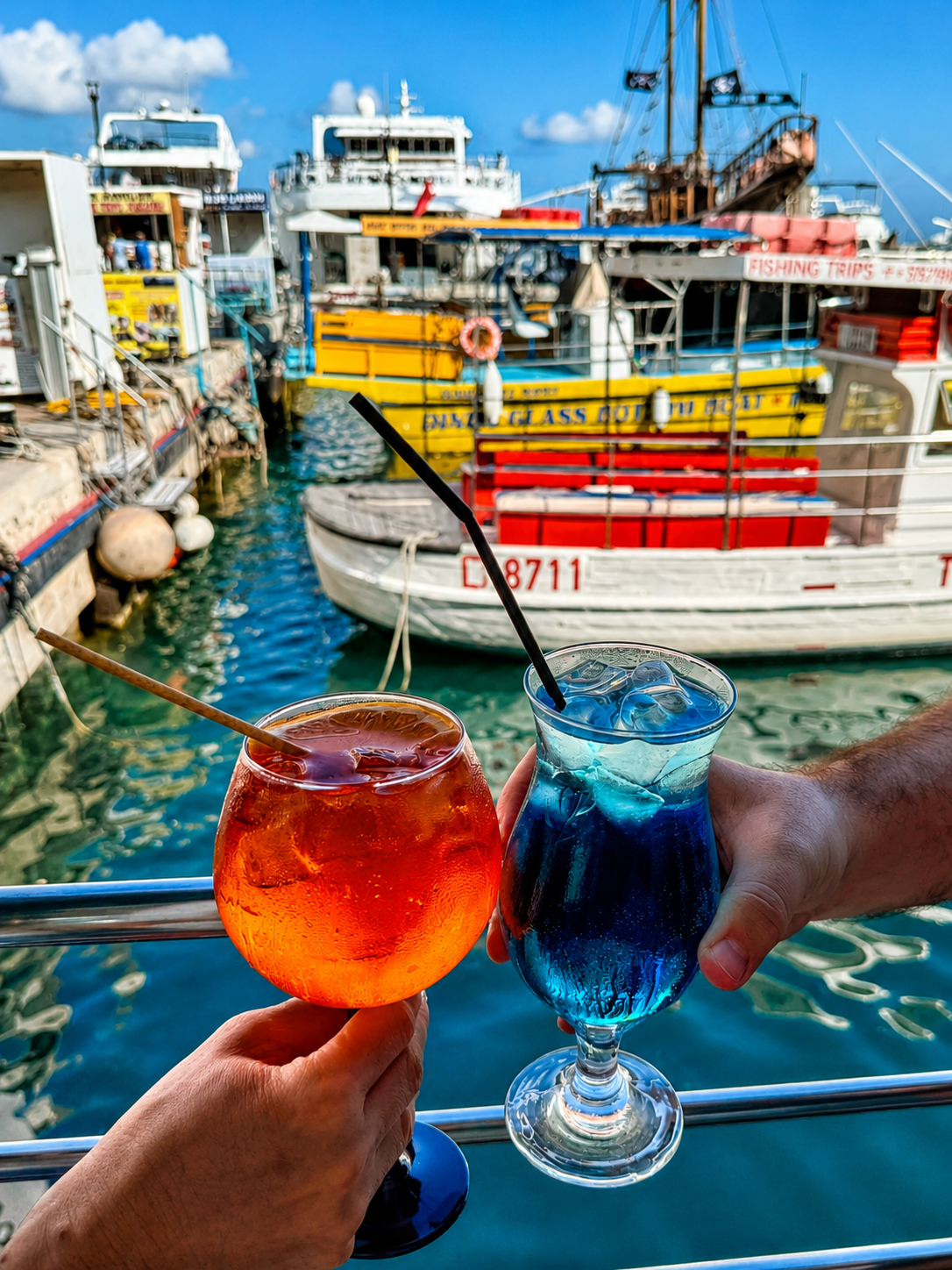
Our drinks came in aggressively incompatible colours: an orange Aperol Spritz and something blue enough to suggest that the Mediterranean had been concentrated and sweetened.
Paphos had provided a shipwreck, a necropolis, Roman mythology, a British lighthouse, an Ottoman castle and cocktails in laboratory colours within a single afternoon.
Back at the Amphora, the light softened across the pool, palms and low hotel buildings.
There was still no upgrade, no lounge and no status recognition.
Everything else worked.
For a non-Marriott, it was unsettlingly competent.
Red Plates and the Wrong Side of the Road
The following morning, we collected a small gold Suzuki.
Cypriot rental cars carry red registration plates, effectively announcing to local drivers that the person approaching them may still be negotiating with the traffic system.
The plates warned everyone else.
I was less worried.
I had already driven on the left during a road trip through Cornwall, the peninsula in southwest England where narrow lanes, stone walls and approaching vehicles had taught me that wing mirrors are partly consumable.
That experience made me the obvious choice for the keys—admittedly by a standard that was not especially demanding.
Cyprus therefore did not introduce me to left-side driving. It merely added stronger sunlight, a gold Suzuki and an itinerary planned as though the island had no meaningful distances.
The British influence remained clearest on the road. Everything else around us felt more like Crete or Rhodes: dry land, pale buildings, Greek menus, olive trees and archaeological sites appearing wherever modern development might otherwise have proceeded efficiently.
The Middle East entered the experience primarily through Google Maps, which briefly relocated us to Beirut while we were driving through Limassol.
I continued following the road rather than investigating the geopolitical implications.
Impossible Blues in Limassol
Limassol was brighter, broader and more polished than Paphos.
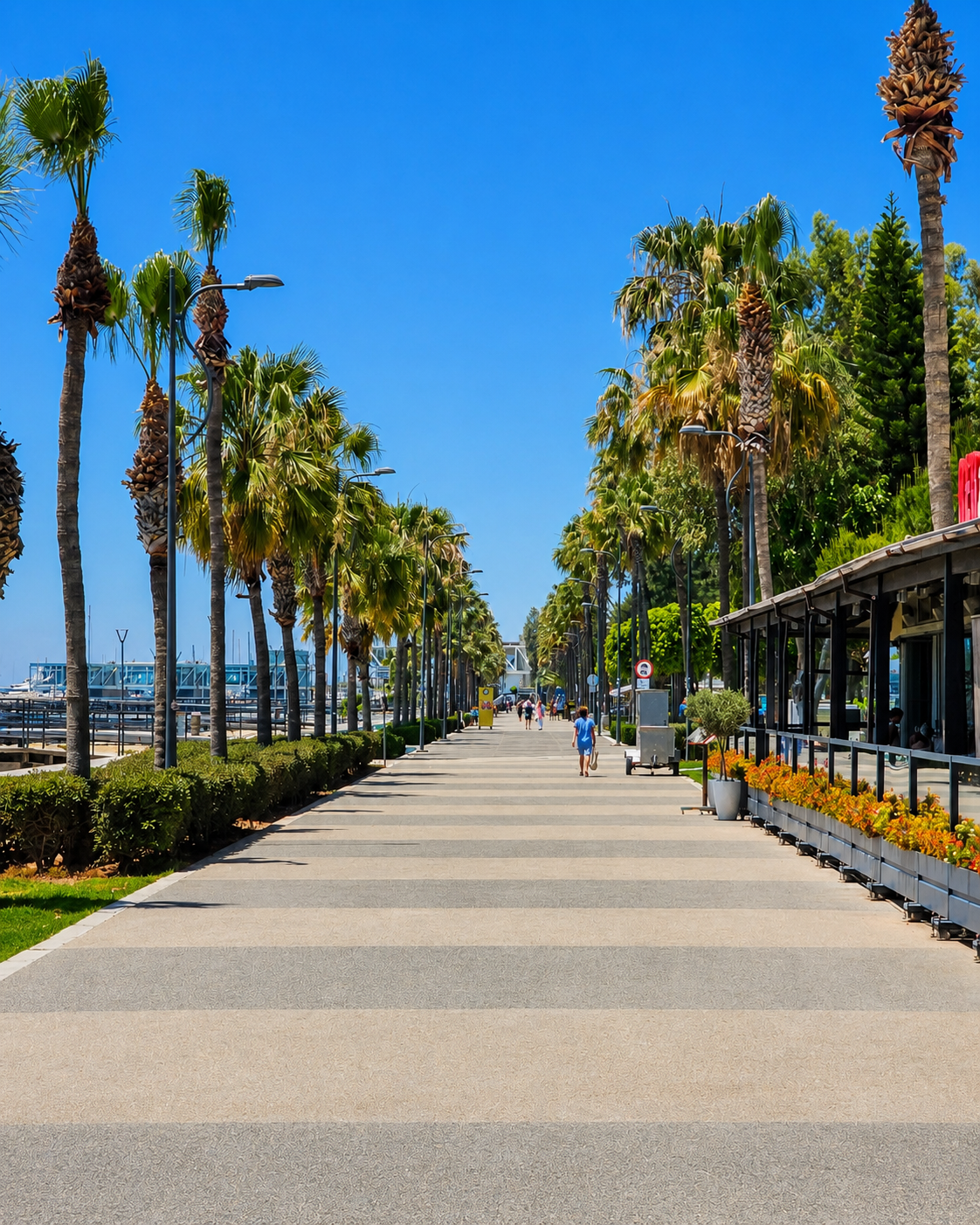
Its Molos promenade stretched beside the sea through palms, lawns, sculpture, timber platforms and carefully controlled water features. The city seemed determined to place another shade of blue into every available gap: sea, sky, channels, painted details and glass.
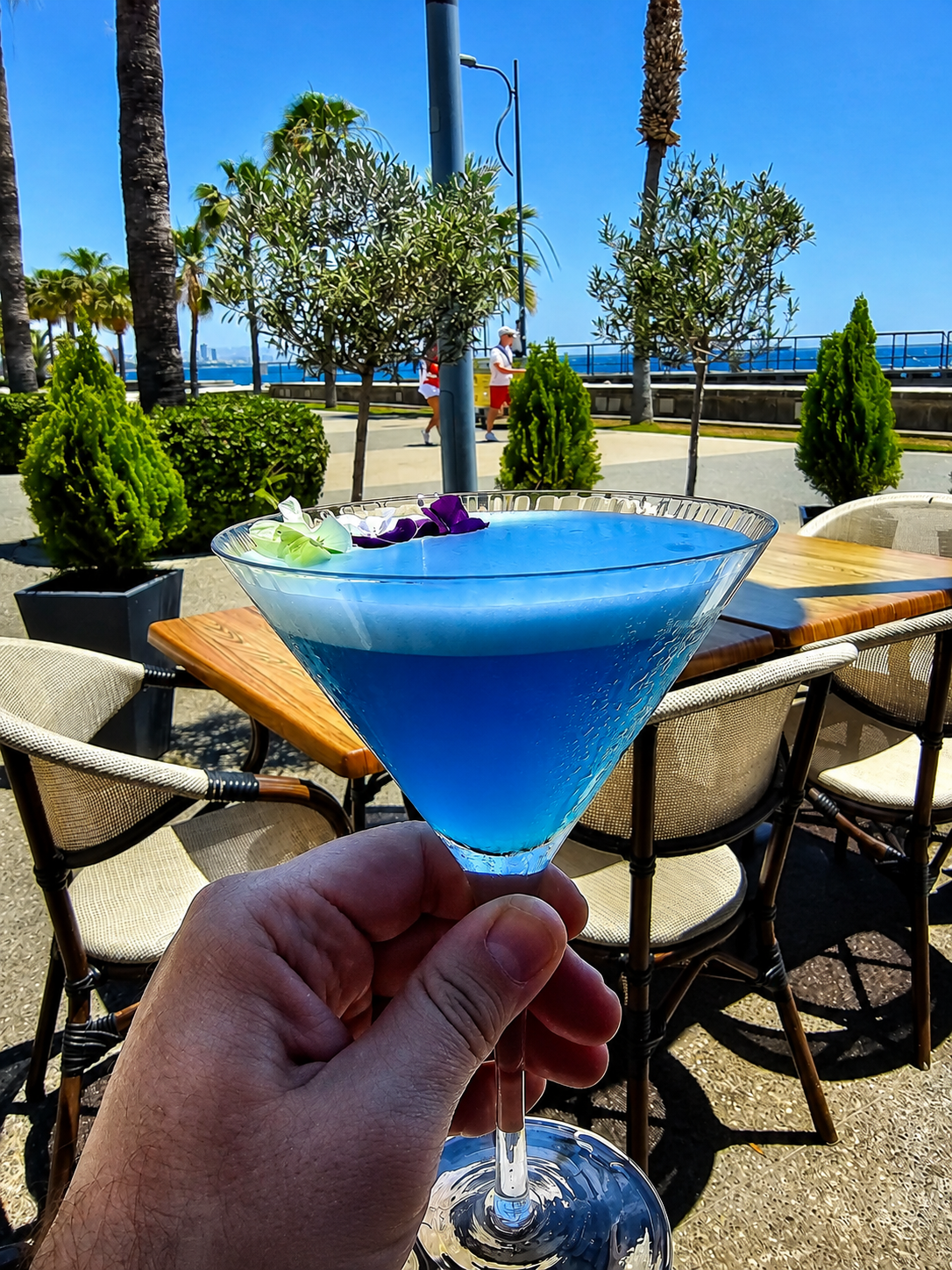
At Red Resto Bar beside the promenade, I ordered a Blue Lagoon.
Its colour suggested that no lagoon had been consulted during production.
The waiter was from Serbia, exceptionally kind and immediately switched to our language. After the digital excursion to Beirut, hearing something familiar in the middle of Limassol’s impossible blue provided a small and very human correction to the map.
The old port and marina brought us back to working boats, ropes and fishing equipment, followed by the large colourful LIMASSOL sign that every waterfront city now appears legally required to install.
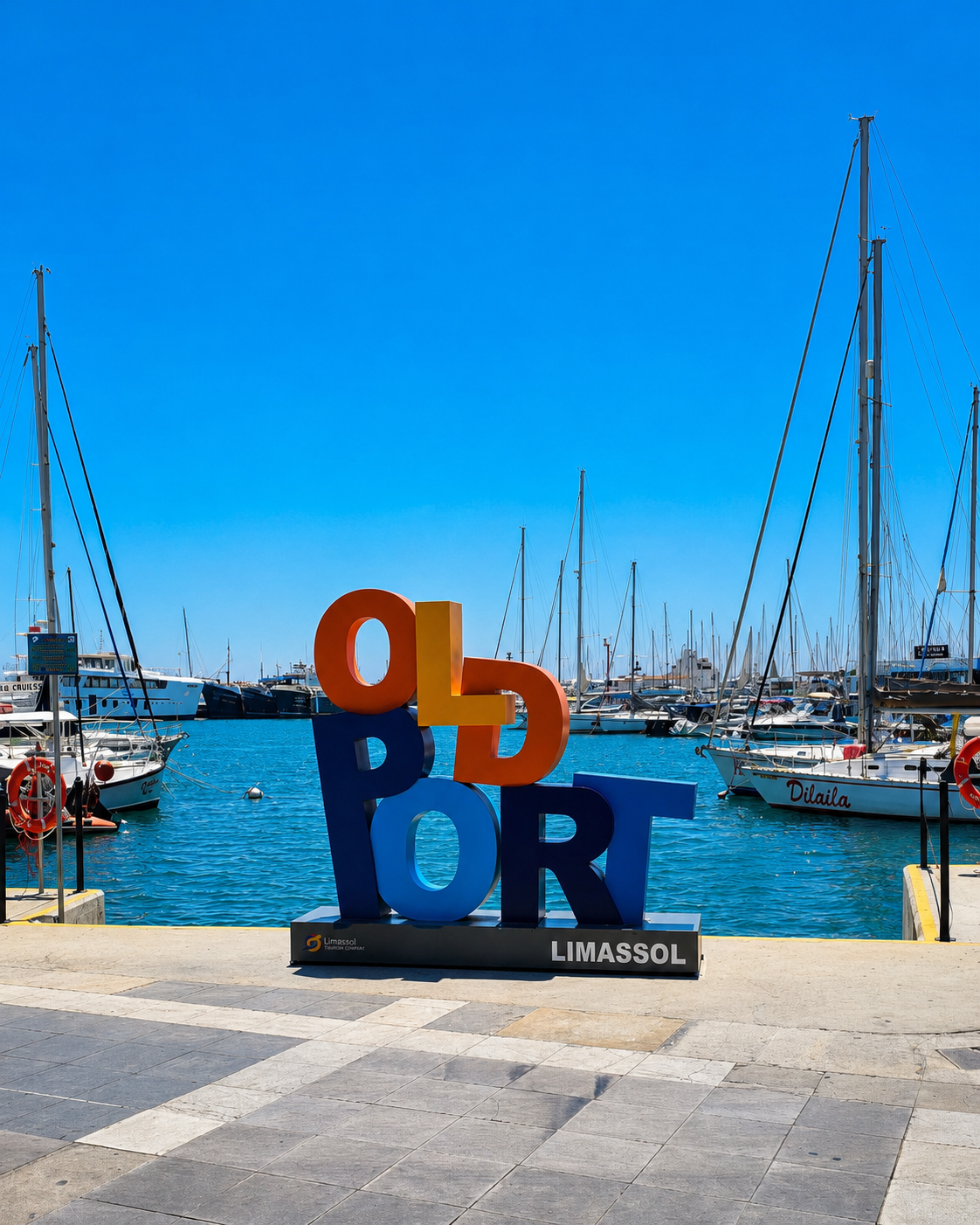
I regarded it with appropriate scepticism and then photographed it.
Nearby, Limassol Castle supplied the required medieval layer. Tradition connects the site with the 1191 marriage of Richard the Lionheart and Berengaria of Navarre, though the present structure owes much to later rebuilding.
The day had begun with chemically improbable blue.
It was about to become considerably older.
Commandaria Before the Crusaders Became Souvenirs
West of Limassol, Kolossi Castle rose above the surrounding greenery as a compact block of pale stone.
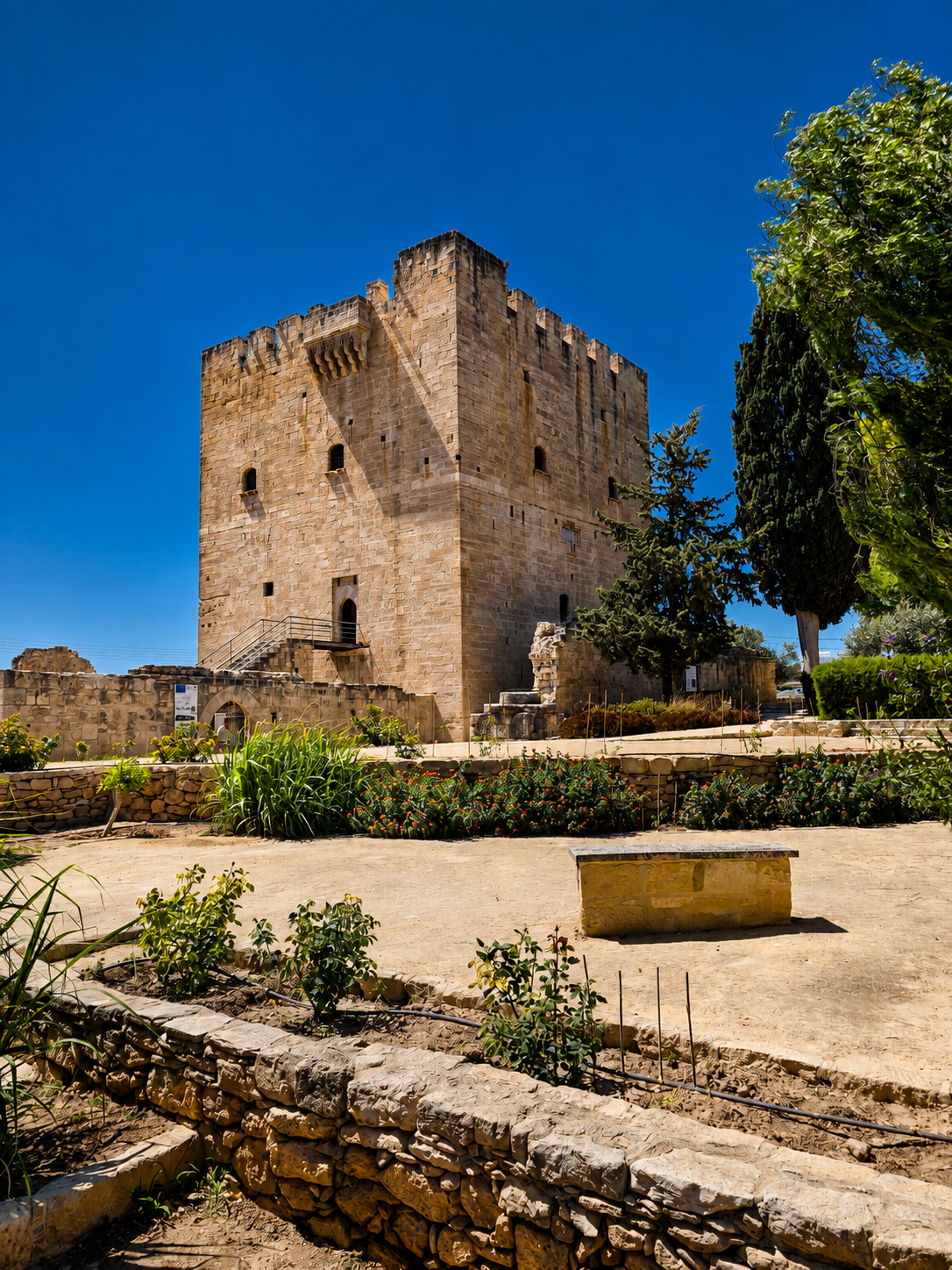
The present fortress dates mainly from the fifteenth century, replacing an earlier structure. It served as the Grand Commandery of the Knights Hospitaller and was also associated with the Knights Templar. The surrounding estates produced sugar and the sweet wine that became known as Commandaria—one of the world’s oldest wines still carrying the same name.
The castle itself was severe and efficient, less romantic ruin than vertical statement.
We did not need long. Its purpose in the day was clear: one tower, one connection to Crusader history and one reminder that Cyprus had spent centuries occupying the route between people who wanted to control the eastern Mediterranean.
Then we continued to Kourion.
An Ancient City with Excellent Priorities
Kourion occupied a hill above the coast with the confidence of a civilisation that understood location.
It was once one of Cyprus’s most important city-kingdoms and was eventually devastated by a major earthquake in the fourth century. Its most famous surviving structure is the Greco-Roman theatre, originally built during the Hellenistic period and expanded under Roman rule.

The restored seating curved around the stage while the Mediterranean occupied the horizon beyond it.
Ancient planners may not have understood emergency exits to modern standards, but they had mastered the closing image.
Elsewhere, mosaics survived beneath protective structures, while columns and foundations stretched across a dry plateau above the sea.
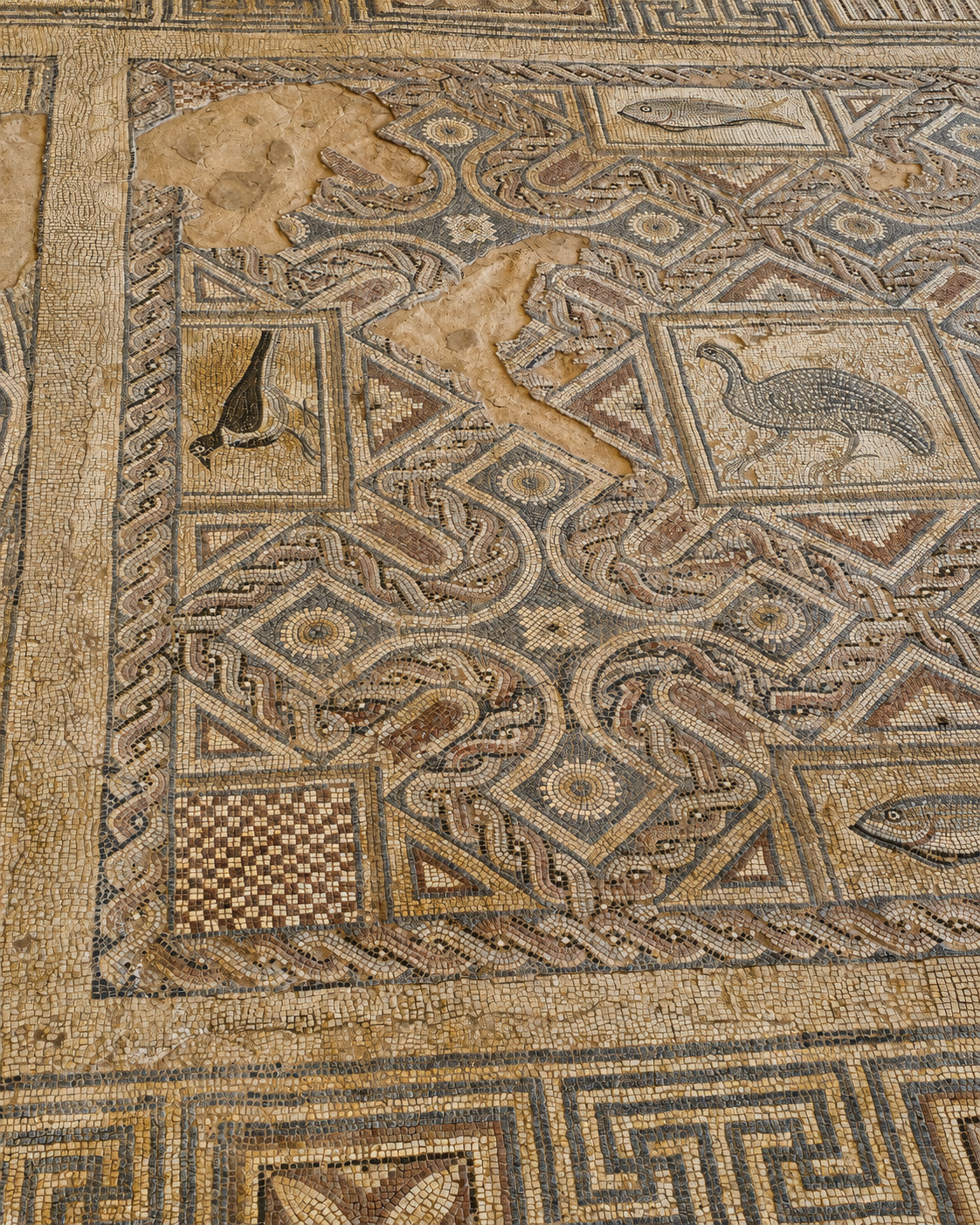
From the edge, the landscape descended in layers: ochre earth, fields, a pale beach and water so blue that Limassol’s cocktail suddenly appeared less exaggerated.
After several hours of ruins, we drove down to Kourion Beach for lunch.

Lamb chops arrived with potatoes, broccoli and green sauce. They were straightforward, substantial and far more useful than another interpretation panel at that stage of the afternoon.
We had one final destination.
Aphrodite was waiting.
Negotiating with a Goddess
Petra tou Romiou is one of those places where geology and mythology have reached a mutually beneficial commercial arrangement.
The huge rocks stand off the southwestern coast near Paphos. According to legend, Aphrodite emerged there from the sea foam. The name Petra tou Romiou—“Rock of the Greek”—belongs to a separate story involving the Byzantine hero Digenis Akritas, who supposedly hurled giant rocks into the sea to repel raiders.
Popular tradition adds that swimming around the formation three times may deliver eternal youth and beauty, luck, fertility or true love.
I was interested primarily in the first two.

My plan remained conservative. I would walk into the water, wet my feet and stand in the foam long enough for Aphrodite to register that I had made an effort.
The goddess rejected half-measures.
One wave reached my knees. The next reached my shorts. A third removed any meaningful distinction between entering the sea and swimming in it.
Within minutes, my shirt and shorts were completely soaked.
I had not circled the rock once, let alone three times. I had merely underestimated the Mediterranean while dressed for photography. Still, standing in the surf beneath those enormous rocks, in the late-afternoon light, felt precisely foolish enough to become one of the best moments of the trip.

The photographs were excellent.
This is what matters.
Returning to Paphos in wet shorts was not an attractive prospect. I removed them and drove back in my boxer briefs, an adaptation not mentioned in any traditional account of the ritual.
Aphrodite had not visibly made me younger.
She had, however, reduced my wardrobe.
Daiquiris and an Unplanned Greek Pop Star
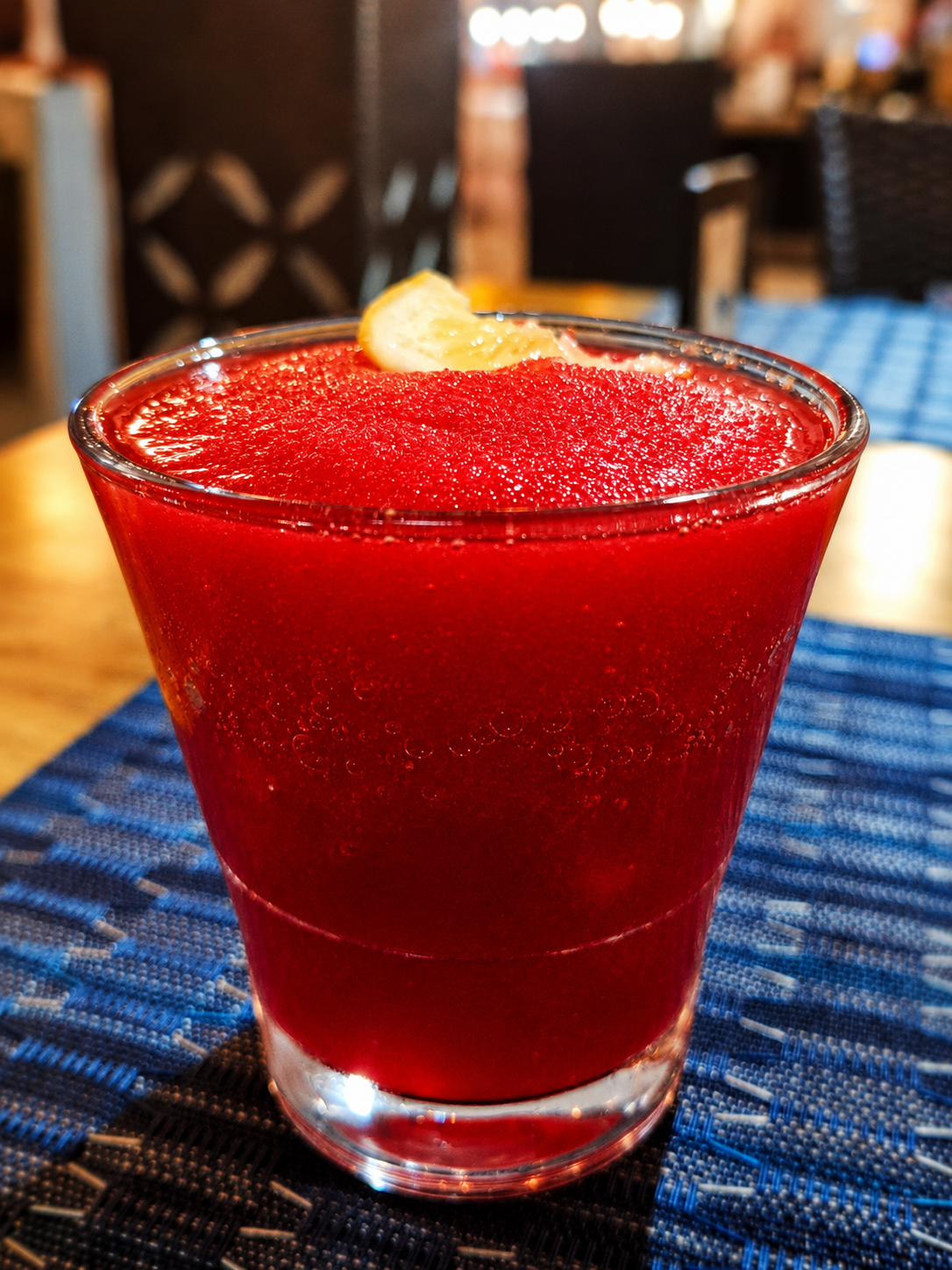
Back in Paphos, we stopped at Captain’s Bistro for frozen daiquiris in red and orange—colours that appeared to belong to fruit only after significant laboratory assistance.
Then music began near the harbour.
By complete accident, we had returned on the evening Despina Vandi was performing beside Paphos Castle. The concert marked the opening of a new restaurant, with sponsorship proceeds directed to charity.
Vandi is a major Greek pop singer, which meant considerably more to much of the audience than it did to me.
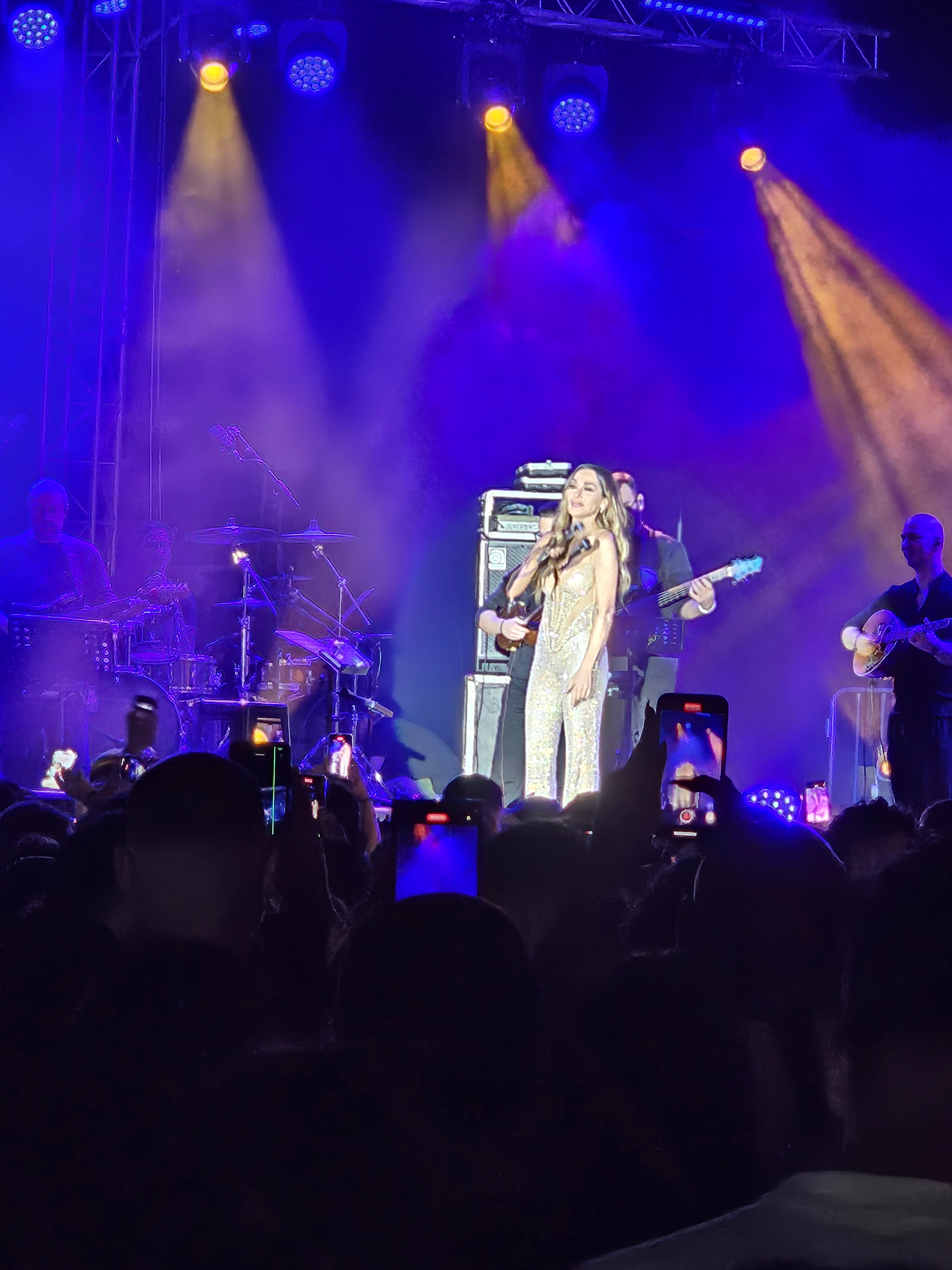
My preferred concert format involves classical music, an assigned chair and the reasonable expectation that the audience will not spend two hours holding phones above its head. Outdoor pop concerts require standing, crowds and an acceptance that several hundred people will record the same song vertically.
Still, it was not bad.
It was energetic, professionally produced and a generous addition to an evening that had already included a goddess, partial nudity and frozen alcohol.
We stayed for a while and accepted that the itinerary had officially lost control of itself.
By the end of that day, it had contained Limassol, a Blue Lagoon, a Serbian waiter, a Crusader castle, a Roman theatre, lamb chops beside the sea, negotiations with Aphrodite, motorway driving in underwear, daiquiris and Despina Vandi.
The system was indefensible.
It was also working.
One Hour of Conventional Holiday
On Saturday morning, I went to the hotel pool.
This was not surrender.
It was scheduling.
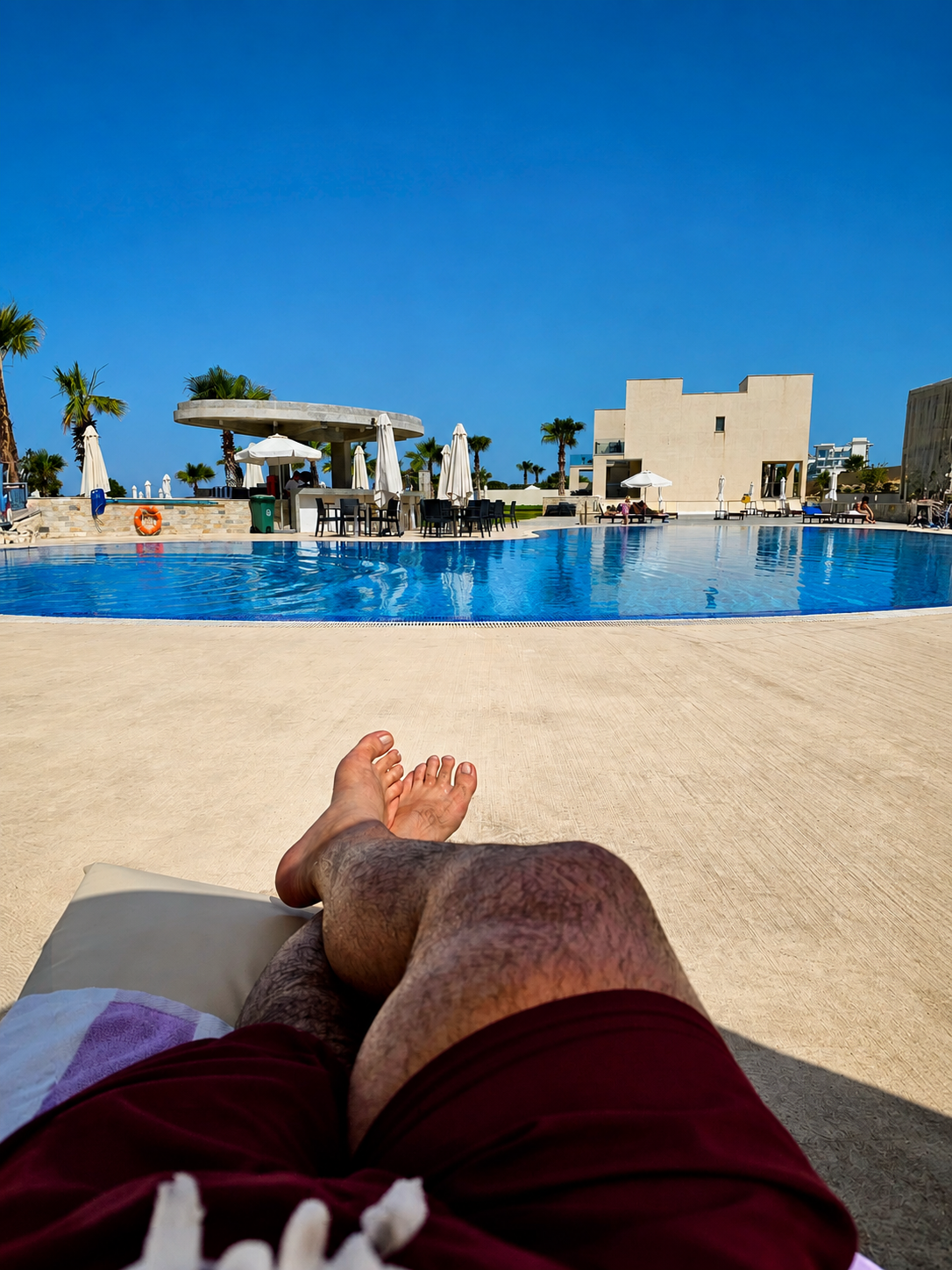
After two days of almost continuous movement, the Amphora had earned the opportunity to function as a resort. I lay beside the water with the low pale buildings behind it and the Mediterranean beyond, briefly participating in the kind of holiday other people appear capable of maintaining for an entire week.
Nobody expected me to inspect a mosaic.
For approximately one hour, this seemed sufficient.
Then we got back into the Suzuki.
Banana Country
North of Paphos, broad banana leaves appeared beside the road, creating sudden dense pockets of green in the dry landscape.
Large bunches hung beneath the plants, some exposed and others wrapped for protection. Bananas are not inherently exotic when arranged beneath supermarket lighting. Still attached to a plant under the Cypriot sun, they regained their ability to impress.
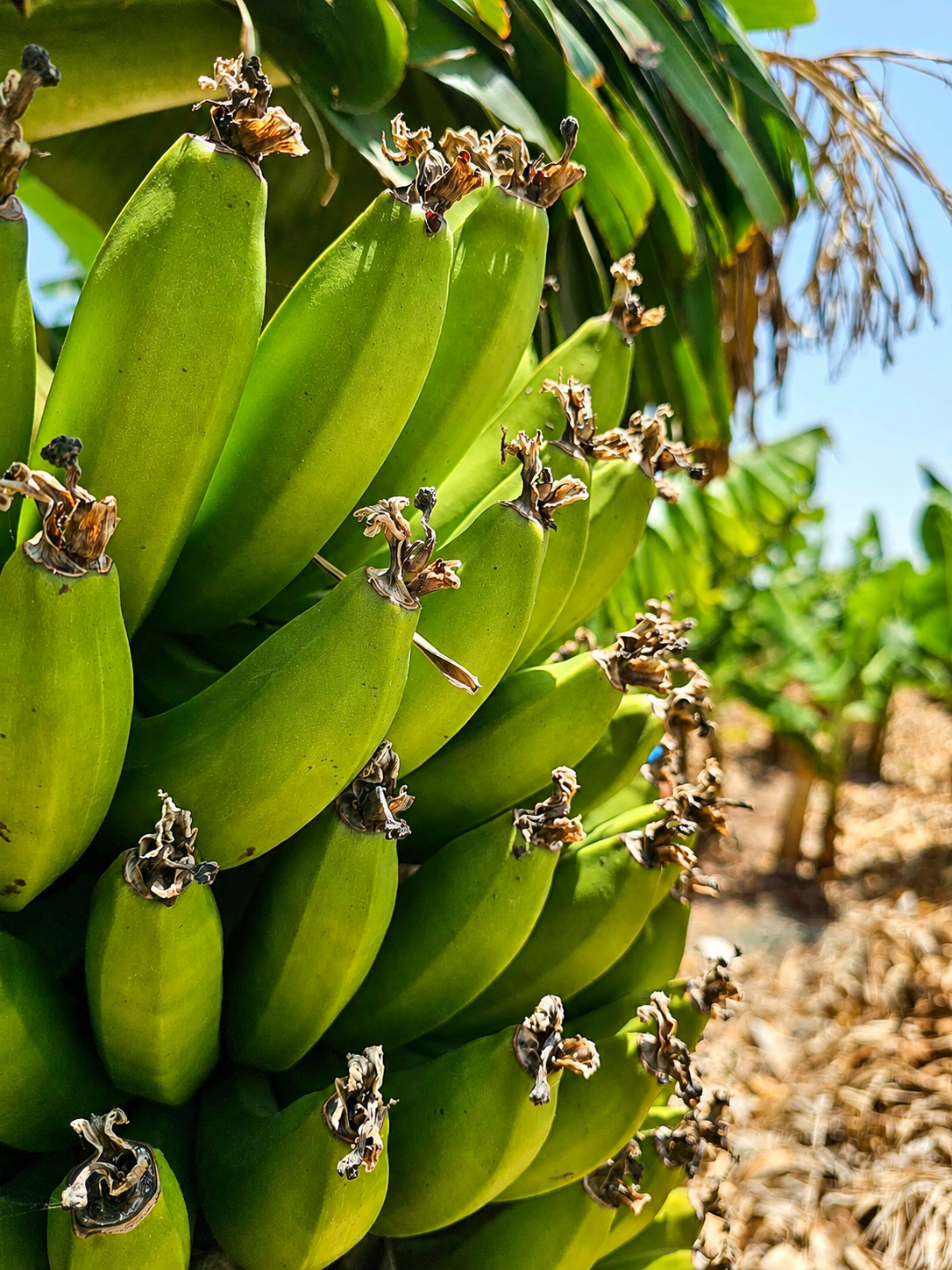
We stopped to photograph them and behaved for several minutes as though none of us had previously understood where bananas came from.
Travel regularly restores drama to ordinary objects simply by relocating them.
The next destination was far less ordinary.
We had discovered it almost accidentally on the map.
Adonis, Compression Socks and Suspicious Water
The road to Adonis Baths began normally and then gradually abandoned the concept.
Asphalt narrowed, deteriorated and became a pale, rough track full of bends, dust and opportunities to question the decision. Driving on the left was familiar enough after Cornwall. Doing it on a road that increasingly resembled infrastructure provided for goats pushed the adrenaline considerably higher.
At certain points, choosing the correct side became theoretical because the road barely possessed one.
Eventually, we arrived at what describes itself, accurately, as the Adonis Baths Waterfalls Theme Park.
Then the phalluses began.
Not restrained classical references or discreet symbols of fertility, but enormous anatomical declarations installed around the site with complete confidence.
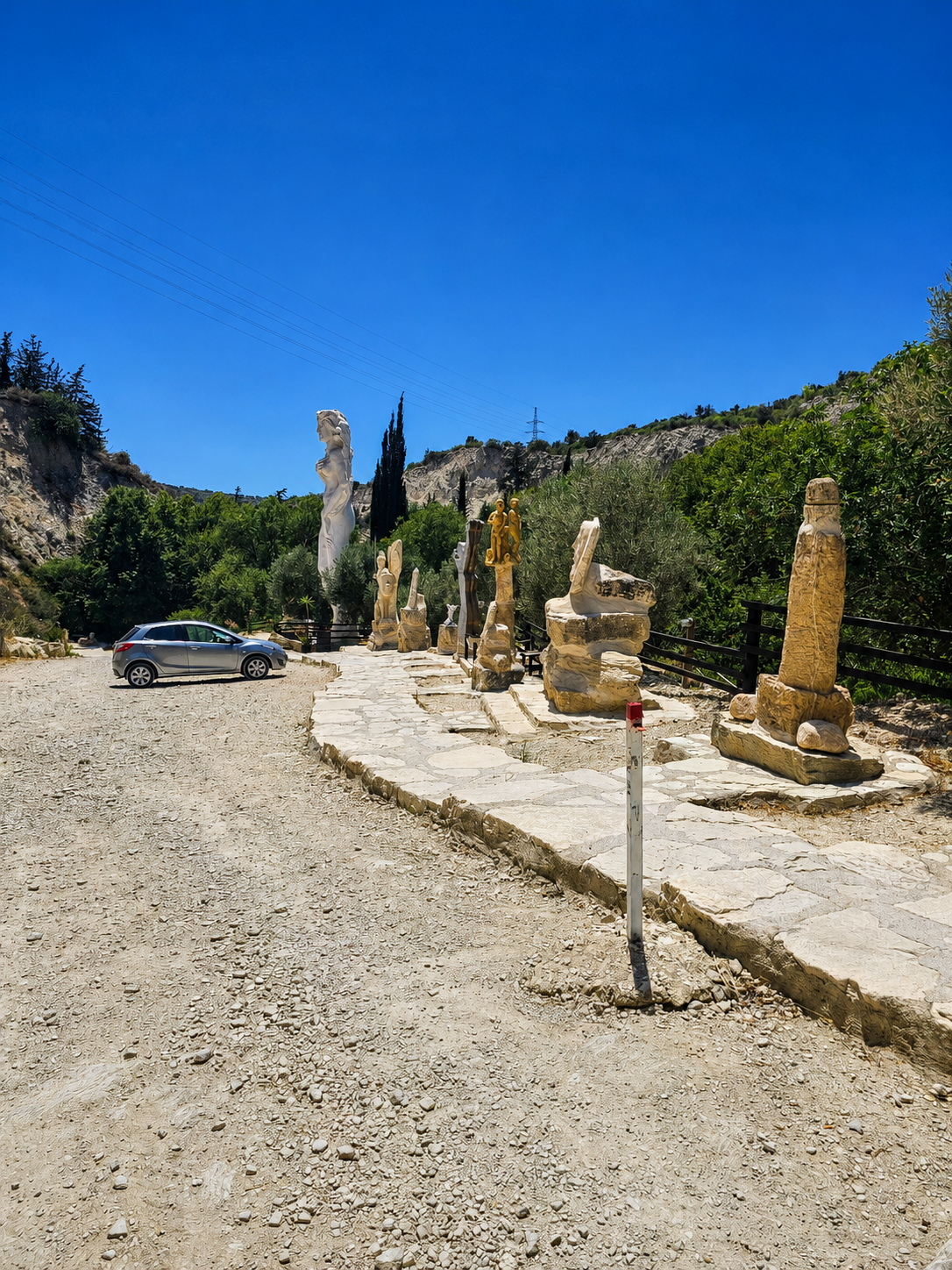
After the first few, confusion gave way to admiration for the refusal to compromise.
The path descended towards a natural pool beneath a small waterfall. The attraction combined the water, a traditional museum and a collection of mythological statues, including Aphrodite and Adonis presented with considerably less modesty than most public parks would permit.
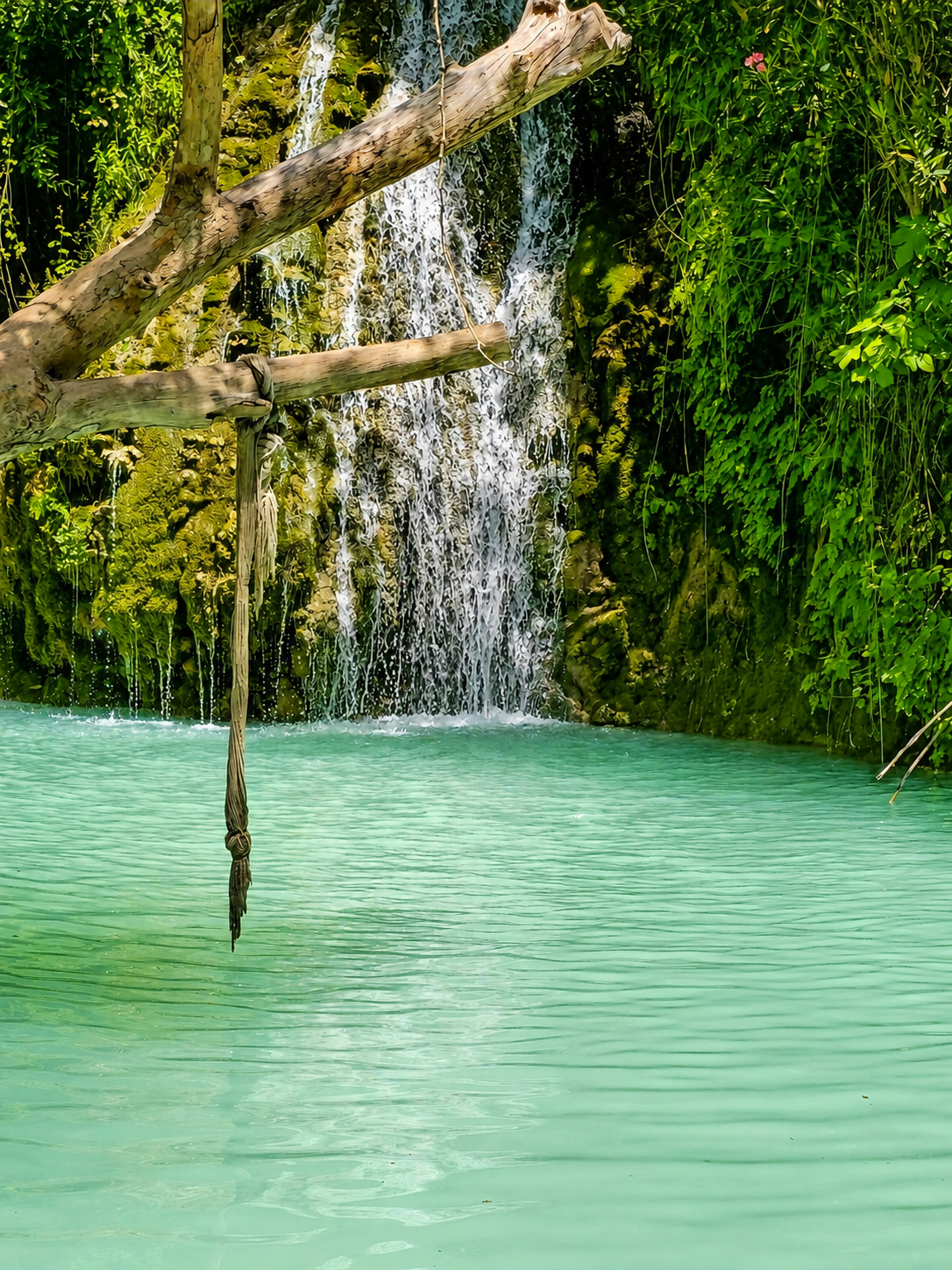
The water changed character with the light.
At one angle it was magnificently emerald, almost persuasive enough to contain genuine magic. At another, it became the sort of green that suggested a highly successful frog habitat.
I could almost have been convinced that it possessed rejuvenating powers.
There were, however, administrative complications.
I had already negotiated a partial arrangement with Aphrodite the previous evening, and I was now wearing compression socks for the flight home. Beginning a second anti-ageing ritual would have required removing them and then forcing them back on—an effort that rather undermined the entire claim to youthfulness.
The medical professionals in the group also raised several sensible questions concerning the cleanliness of the water and the possible consequences of testing the mythology too literally.
Adonis therefore remained a visual experience.
Part magical retreat, part frog sanctuary, part monument to anatomical confidence.
The road had been absurd, the statues were gloriously excessive and the pool hovered somewhere between enchanted and questionable.
I liked the place enormously.
Aphrodite still had my application.
Adonis would have to wait.
One Final Beach
Coral Bay was the last proper stop of the trip.
Its curve of golden sand lay between two limestone headlands, with generally calm and shallow water. After the rough access road, mega-phalluses and uncertain ecology of Adonis Baths, it looked almost suspiciously conventional.
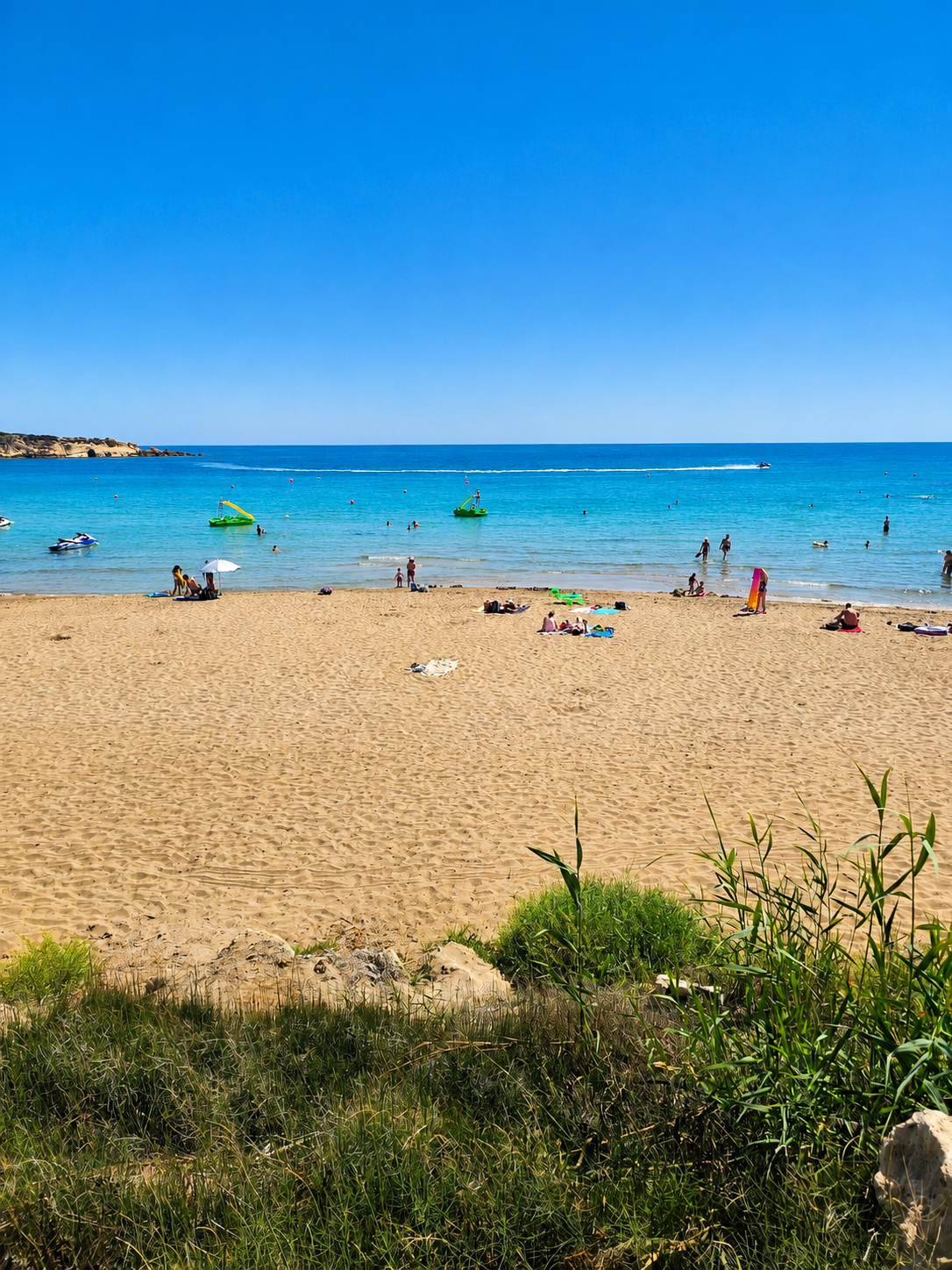
No mythological explanation was required.
It was simply a very good Mediterranean beach.
We stayed briefly because everything during those sixty-one hours was done briefly. There was always one more place, one more photograph and one more logistical problem waiting to become part of the narrative.
After Coral Bay, I left the others in central Paphos and drove back to the Amphora to return the Suzuki.
Its red plates had spent the final two days warning local motorists that patience might be required. Somehow, both the vehicle and Cyprus had survived me.
I rejoined the others in town and we finished with gyros.
It was not particularly good.
This felt almost useful. After mosaics, castles, goddesses, waterfalls, shipwrecks and cocktails with the colour saturation of warning labels, the final meal had no need to compete.
The airport bus remained available.
I had already completed that branch of the budget travel experiment on arrival and saw no scientific value in repeating it. A taxi was negotiated instead.
At Paphos Airport there was shopping and a lounge, reassuring evidence that my transformation into a backpack traveller had not become permanent.
Our flight left almost an hour behind schedule, long enough to make the lounge feel less like an indulgence and more like essential infrastructure.
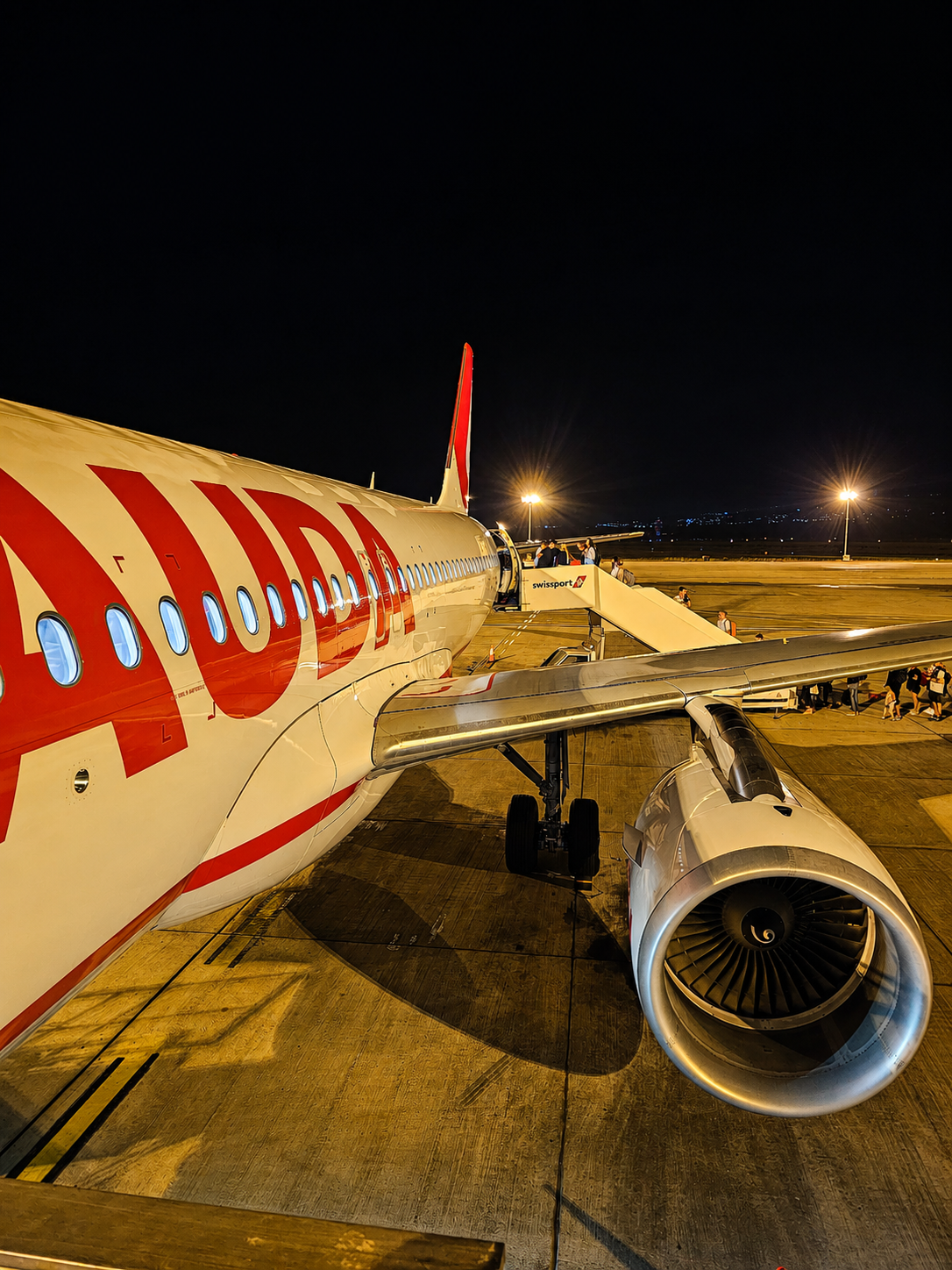
Eventually, we boarded.
The Barber Can Handle the Rest
By the time we landed in Zagreb, midnight had long passed.
I still had the standard drive back to Rijeka ahead of me.
The complete weekend had begun with a midnight drive to Zagreb, continued with an early flight and sixty-one scheduled hours of Paphos, archaeology, castles, Limassol, Kourion, beaches, a shipwreck, suspicious water, unnatural cocktails and two separate negotiations with ancient mythology.
It then ended with a delayed night flight and another drive home.
Somewhere in the planning, this had been described as a weekend break.
I had gone to Cyprus amused by the promise of eternal youth and willing—very quietly—to consider whether Aphrodite’s foam might accomplish something expensive cosmetics had not.
The ritual remained incomplete.
But perhaps I had been examining the wrong evidence.
I had crossed the island at a pace that would exhaust plenty of considerably younger travellers. I had walked through Roman cities, descended into tombs, driven on the left, navigated a goat track, entered the sea fully dressed, returned in my underwear and remained capable of driving from Zagreb to Rijeka after a delayed night flight.
Perhaps Aphrodite’s intervention was not yet urgently required.
The crisis appeared to be primarily cosmetic.
Aphrodite could wait.
The grey in my beard was my barber’s problem.
