
 Plovdiv, Bulgaria
Lost photographs from a 2007 trip to Bulgaria bring back Plovdiv, Bachkovo, a global conference and a suitcase misrouted to Tirana.
In 2026, while looking for photographs for a completely different blog, I found an old compact camera. I had assumed that whatever remained on it had disappeared from my life years ago, yet its memory card still contained 139 photographs from a journey I had barely thought about for almost two decades. They followed an unnecessarily complicated route through Budapest, Plovdiv, the Rhodope Mountains and Vienna, leaving a conspicuous gap in the photographs where Sofia ought to have been. That 2007 journey remains my only visit to Bulgaria.
The photographs were taken with a three-megapixel camera and many of them had survived badly: low resolution, soft focus, noise, washed-out skies and several creative interpretations of the correct orientation. For this post, I used AI-assisted reconstruction to upscale them and recover as much visible detail as possible while retaining the original scenes and framing. Small reconstructed details inevitably carry less documentary weight than the photographs as a whole, but every location, person and improbable piece of luggage began with a picture I actually took in August 2007.
Some memories returned before I had finished looking through the first folder. I immediately remembered the missing suitcase, the bus from Sofia and a Bulgarian first-class compartment occupied by an elderly woman with two live chickens. A photograph of a waterfall produced no recognition whatsoever, even though I must once have stood directly in front of it, camera in hand, so the card had preserved at least one part of the journey more reliably than my brain.
The trip had taken me to the Fourth International Conference of Applied Mathematics and Computing in Plovdiv, held from 12 to 18 August 2007. I was twenty-seven, still close to the beginning of my academic career and travelling with far more enthusiasm than experience. Looking at these photographs now, I can see both Plovdiv and the traveller I was before lost luggage, airline routines and years of professional trips taught me what should go into hand baggage.
My trip to Bulgaria began with an unnecessary railway detour
I loved trains in 2007 with a degree of commitment that occasionally interfered with efficient travel. Three years earlier, I had reached Amsterdam after two consecutive nights on trains, so my conviction that getting there could matter almost as much as the destination was still firmly intact. The most direct railway option from Croatia to Bulgaria would have meant changing trains in Belgrade and travelling part of the route at night.
Relations in the region still felt slightly tense to me, the trains did not have a particularly reassuring reputation, and I had heard enough stories about smugglers using that route to make the whole idea far less romantic. I abandoned the Belgrade route and redirected my railway enthusiasm towards Budapest, the nearest useful airport with a practical connection to Sofia.

My alternative began with a train from Rijeka to Graz and a night there, followed by a direct train to Budapest and another overnight stop. I already knew Budapest from one earlier winter visit, probably around New Year, so passing through it again felt like a bonus. The new part of the experiment was the direct railway connection from Graz.
The train from Graz to Budapest was slow, uncomfortable and remarkably short on scenery capable of justifying either quality. It answered my question about the route, although the answer did not encourage a repeat performance. I still regarded the experiment as legitimate travel research, because at twenty-seven I could turn almost any train journey into a project if I stared at the timetable for long enough.
I had already travelled to professional meetings in Klagenfurt, Schwäbisch Gmünd, and Brno: by train to Klagenfurt, by a combination of plane and train to Schwäbisch Gmünd, and by car to Brno. Even so, I can no longer decide whether this was only the second or third trip of my life that involved flying. Airports had not yet become a familiar sequence of lounges, boarding groups and security trays. Every stage required attention, which may help explain why the first serious disruption dismantled me so efficiently.
Sofia, mostly seen through a baggage-tracing screen
Sofia Airport made an unexpectedly modern first impression. There was a good reason for that: its new Terminal 2 had opened in 2006, just before Bulgaria joined the European Union on 1 January 2007. I arrived the following August and moved from a bright new terminal into a city whose vehicles, signs and general rhythm seemed to belong to a much earlier period.
My reaction came from a Croatian visitor with very limited travel experience, and a few hours in Sofia hardly qualified me to assess an entire country. At the time, however, I genuinely felt that I had travelled twenty or thirty years into the past. The smartest car I remember noticing was a Hyundai Accent, which says at least as much about the things I was looking at as it does about Sofia.
My suitcase failed to arrive with me. Online baggage tracking eventually showed that it had travelled to Tirana instead, an adventurous decision for a bag checked through to Sofia. I had packed books in my hand luggage because my academic priorities were already fully developed, while my blood-pressure medication, underwear and spare shirts were enjoying Albania.
I checked into a cheap, depressing hotel and spent most of the night refreshing the tracking page. Marriott hotels, status benefits and the useful habit of keeping essential medication close to me all belonged to a future version of my travelling life. At that point I had a bed, an internet connection and enough anxiety to turn baggage tracing into an overnight occupation.
Sunday morning began with the practical consequences. Replacing my hypertension medication proved surprisingly easy in the first pharmacy I entered, but buying underwear and at least one clean shirt required more determination. I had learned Cyrillic at school and could still decipher it, although years without using it had transformed reading into a slow process of assembling letters and hoping the result resembled a word I knew.
Any intention of sightseeing disappeared during those hours. The folder recovered from the camera contains Budapest, Plovdiv, Bachkovo and Vienna, yet Sofia is absent because I hardly looked at it. I was physically in the Bulgarian capital, but the suitcase occupied most of the available space in my head.
The conference organisers were meeting participants at the airport, so I later returned there and joined the group. Until then I had been alone; from that point, at least somebody knew where we were supposed to go. Their help became particularly valuable at Sofia's bus station, where numerous companies sold tickets from separate counters. The Cyrillic I still remembered from school helped with individual words, but there were hardly any useful signs explaining where to go.
Without the organisers directing us towards the right counter, I am not sure how long the process would have taken. The bus itself looked as though it had escaped from Who's Singin' Over There?, the old Yugoslav comedy built around a decrepit vehicle and a journey that steadily loses dignity. The air conditioning dripped, the interior smelled unpleasant and somewhere between Sofia and Plovdiv I began to question the chain of decisions that had brought me there.
Dollars in a cardboard box, five stars upstairs
Registration took place at the faculty hosting the conference. If my memory is reasonably accurate, the combined conference fee and accommodation came to roughly 150 US dollars, an extraordinarily low amount even in 2007. Payment, however, had to be made in cash and specifically in dollars, which I had not expected from a newly admitted member of the European Union using the Bulgarian lev.
The accounting system consisted of a piece of paper torn from something resembling a notebook and a cardboard box into which the organisers dropped the banknotes. Nobody had warned me about the hotel arrangements either, so I handed over my dollars while still having little idea where I would sleep. By then the cardboard box had acquired enough cash to look more like a minor customs incident than conference administration.
Participants were divided between two of the city's leading hotels: the modern-looking five-star Novotel Plovdiv and the more classically styled Trimontium Princess. A surviving photograph shows the latter with its name and casino sign stretched across the roof. My impression at the time was that delegates from Western countries generally went to the Novotel while many from Eastern countries were placed at the Trimontium, although I never established whether this was an actual policy or simply the pattern I happened to notice.


The uncertainty had generated another unnecessary round of anxiety, but the Novotel turned out to be genuinely good. I was not yet experienced enough with five-star hotels to know how widely that label can stretch, and my judgement today might be more demanding. For the price included in the conference package, though, the room and facilities were excellent.
There was a huge indoor pool that guests could use without paying extra, along with a spa whose prices seemed almost fictional. A massage cost the equivalent of around seven euros, so I booked at least one on most days. When I settled the spa account, the receptionist observed that I had spent almost her entire monthly salary, a comment that made the economic difference behind those attractive prices uncomfortably visible.
That exchange also captured something about the service. Staff members were helpful and generally did whatever was requested, but assistance often arrived with a comment, an observation or a slightly barbed aside. The food was mostly local, with a narrower choice than I expected from a five-star property, and remained one of the weaker parts of an otherwise very comfortable stay.
The suitcase reached Plovdiv on the second day and was waiting at reception. Its arrival solved the practical problem immediately and released enough mental capacity for me to notice the city around the hotel. After a pharmacy, emergency underwear, a dripping bus and a cardboard box full of dollars, an ordinary clean shirt felt like a serious improvement in the conference programme.
A much larger world than I had packed for
The event was FICAMC, the Fourth International Conference of Applied Mathematics and Computing, held in Plovdiv from 12 to 18 August 2007. My lecture concerned an approximate solution for a one-dimensional compressible viscous micropolar fluid model, based on joint work with Nermina Mujaković. Micropolar fluid models extend classical fluid mechanics by allowing fluid particles to possess their own microscopic rotation. That is the travel-blog version; the conference audience also got the equations.
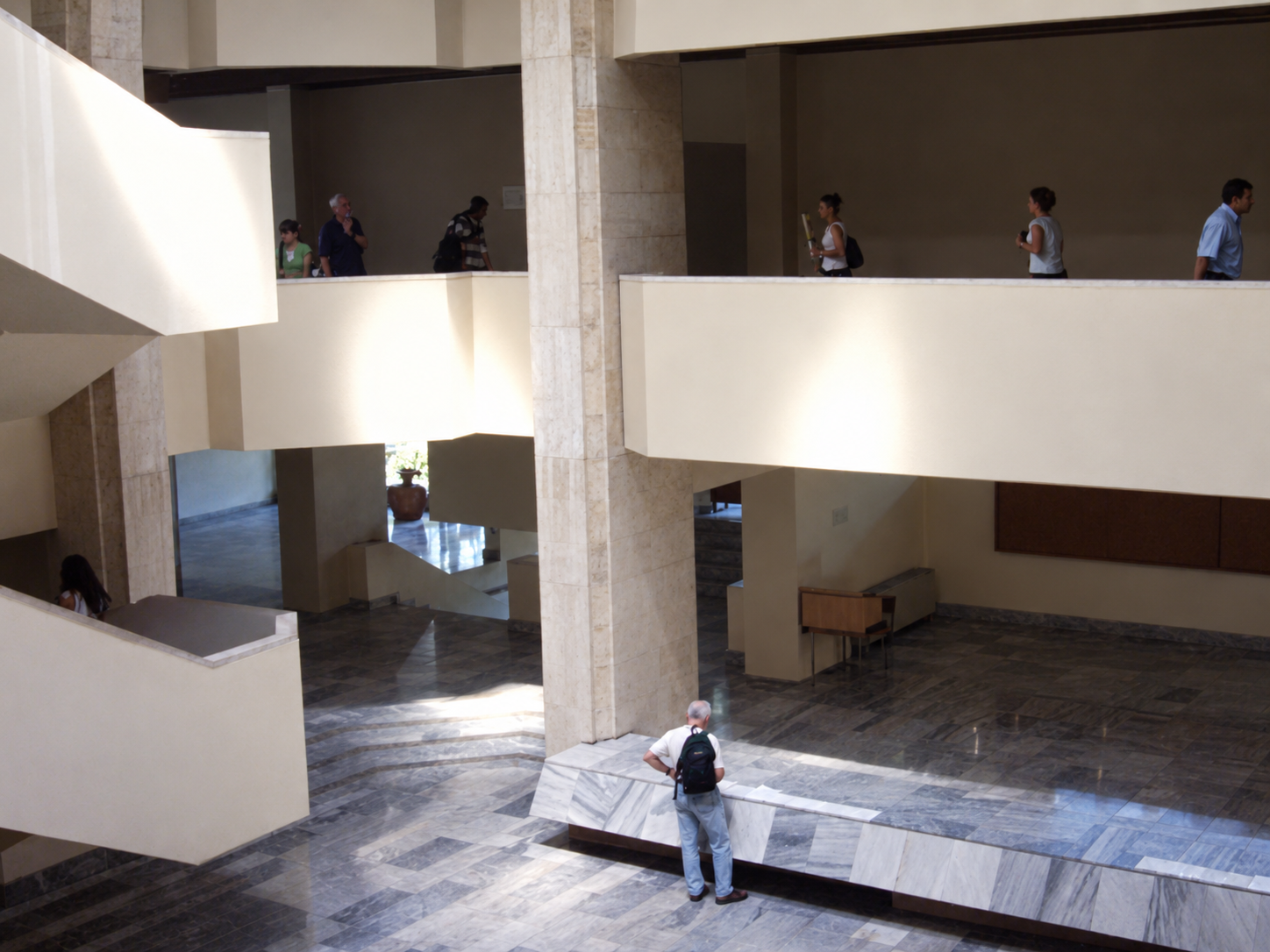
The conference was international on a scale I had never experienced. Participants seemed to have arrived from almost every part of the world, bringing languages, clothes, professional habits and social assumptions that rarely occupied the same building in my earlier academic life. I had attended conferences abroad before, but this was the first one that made the term international feel like something more substantial than a list of countries printed in a programme.
The opening ceremony produced my first lesson in informal diplomacy. Organisers called representatives of each country to address the audience, and almost everybody carried some form of gift for the hosts. This expectation had never appeared in the written instructions, leaving the colleague from Zagreb and me to walk forward empty-handed while the organisers watched us with the hopeful expression of people waiting for a present to materialise from an internal pocket.
We greeted the audience, said the appropriate polite things and behaved as though nothing unusual had happened. I still regard it as poor diplomatic preparation on our part, even if the relevant diplomatic protocol had been withheld from us. I have attended many international conferences since then and have never again encountered a ceremony in which every national delegation was silently expected to arrive with tribute.
The informal conversations were even more memorable. One Japanese participant arrived late for a lecture, became intensely distressed and began speaking about having betrayed his employer; several of us had to calm him down. A colleague from another cultural and legal setting spoke quite matter-of-factly about plural marriage and said he could not imagine limiting himself to one wife, a position that sounded extraordinary to my Croatian ears without needing to become a theory about everyone from his country.
I remember these encounters as individual conversations, and twenty years later I have no interest in converting one person's behaviour into a national character study. People with very different conventions around work, family and dress shared lectures, buses, meals and the same occasionally improvised organisation. My previous professional travel had remained mostly within Central Europe, so Plovdiv expanded the map abruptly.
Plovdiv after the suitcase
Bulgaria had been an EU member for only seven months when I reached Plovdiv; Croatia would wait almost another six years. That political fact sat oddly beside my first impression of a streetscape which sometimes seemed decades behind what I knew at home. Beneath it all lay much older layers: Roman remains frequently appeared under streets and later buildings without waiting for a museum entrance, while the Roman name Trimontium referred to the three hills at the centre of the settlement.
The monument I remember most clearly is the Ancient Theatre of Philippopolis. Built in the late first century AD and capable of holding around 6,000 spectators, it sits between the old houses with a view across the modern city towards the Rhodope Mountains. Restored and once again used for performances, it feels less like an isolated ruin and more like an old venue that has survived an exceptionally long interruption.

My photographs show that I walked around it repeatedly and from several levels, although memory has compressed those visits into one general image of pale stone, columns and the city behind them.
The Roman Stadium was woven into the city in a different way. Constructed in the second century, it once extended for approximately 240 metres beneath what is now Plovdiv's main pedestrian area and may have accommodated around 30,000 spectators. Only the curved northern section is fully exposed, so the modern street continues above most of a structure considerably larger than the part a visitor can see.

That arrangement was probably what interested me most. The living city simply continued above the Roman one, with shops, pavements and ordinary movement sharing the same ground. After the carefully isolated monuments I knew elsewhere, finding a stadium partly under a shopping street felt pleasantly untidy.
The Old Town climbed away from the commercial centre through cobbled streets and Bulgarian Revival houses. Hisar Kapia, the medieval form of an eastern gate whose foundations reach back to Roman times, framed one of the most recognisable approaches. Old cars parked near the stone arch in my photographs now reinforce the period almost as effectively as the architecture.

Nearby, the richly decorated Kuyumdzhieva House gave me one of the strongest façades in the recovered set. Built in 1847, it later became the home of Plovdiv's Regional Ethnographic Museum, whose collections contain more than 60,000 objects connected with crafts, clothing, domestic life, music and art. I remember the exterior much better than anything that may have been inside, which is hardly surprising when the building itself behaves like an exhibit.

One small souvenir shop produced a more personal connection with the city. The owner and I managed a short conversation by leaning on the similarities between Bulgarian and Croatian, after which she warned me not to turn towards a particular part of town because tourists were robbed there. Her directions were more specific than my memory, but the seriousness of the warning survived.
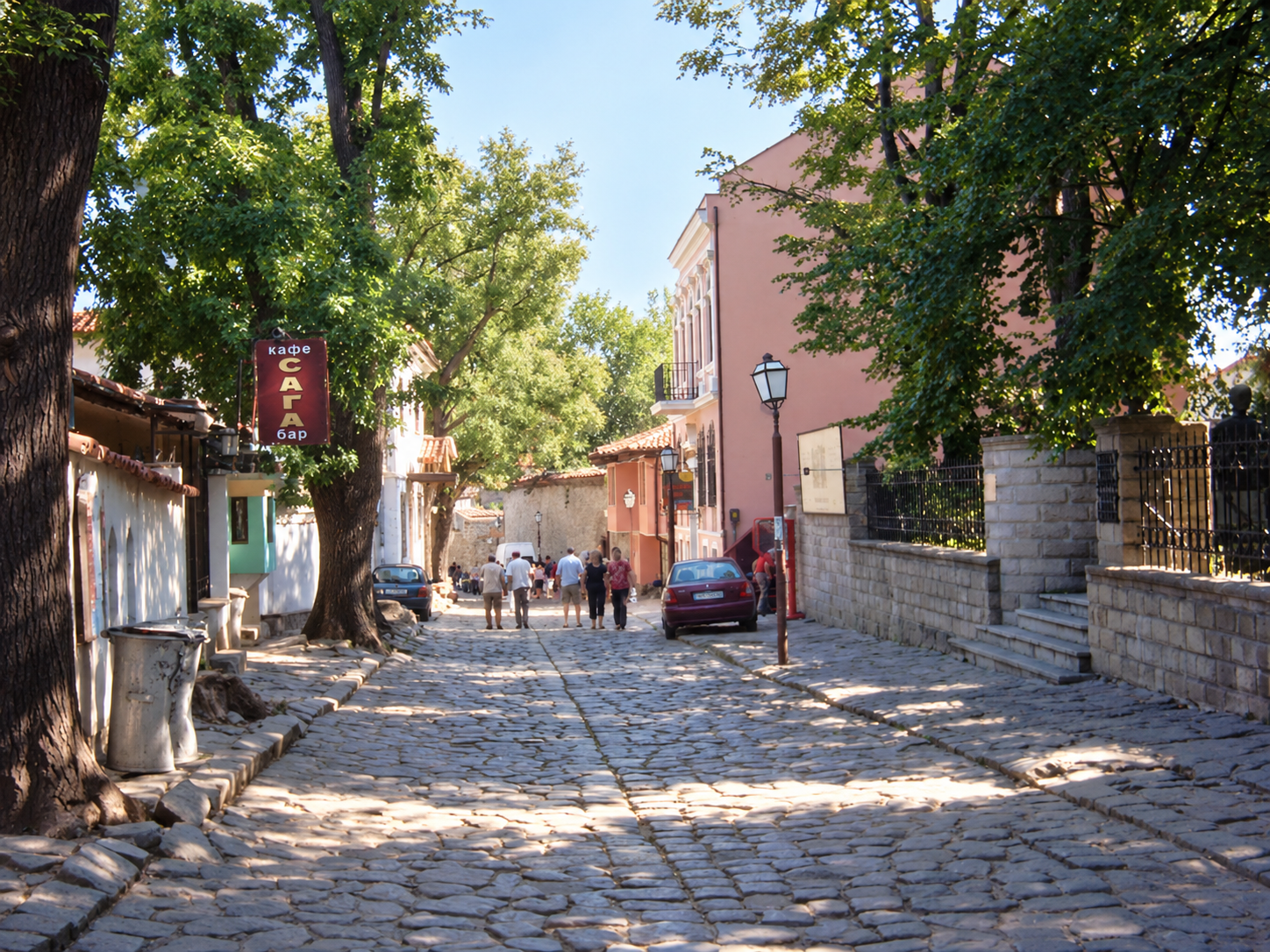
I bought rose water, a thoroughly Bulgarian souvenir that had disappeared from my memory until the shop photograph brought it back. Local clothing also surprised me because Bulgarian brands offered conventional shirts and other items for a fraction of Croatian prices. A colleague bought something by card and discovered that payment required his passport and a form, turning an ordinary retail transaction into paperwork substantial enough to suggest that he was importing the shirt personally.
The overall impression still felt like a journey into an earlier version of Europe. Infrastructure, prices and the post-socialist streetscape all contributed, and my limited experience magnified what I saw. Looking back, I see a city already changing and a young traveller who was still learning how quickly a first impression can turn into a broad conclusion.
Bachkovo, figs and a waterfall I had erased
The official conference excursion took us south from Plovdiv towards Bachkovo through the Rhodope foothills. I remember the climb, the roadside stalls and women from the group buying figs. The photographs add pottery, umbrellas, parked buses and a mountain landscape that had survived in my memory only as a general sense of going uphill.

At some point during the bus ride, several women urgently asked the driver for a toilet. He pointed towards the forest with complete confidence, and they initially assumed that some vital part of the explanation had been lost in translation. No building appeared, the bus was not approaching a service station and the gesture genuinely meant that the forest was the available facility.
They looked at him, looked at the trees and eventually accepted that the situation offered no better option. I suspect several members of an international mathematics conference discovered a new category of fieldwork that afternoon. The driver waited with the patience of someone who had solved the problem the moment he pointed through the window.
The market near Bachkovo Monastery provided a more conventional stop. Stalls sold fruit, souvenirs and brightly coloured pottery, including rows of orange and yellow vessels displayed against green-painted wood. At least some of the figs went back onto the bus, hopefully after everybody had considered the available toilet infrastructure.

Bachkovo Monastery lies in the Rhodope Mountains near Asenovgrad and was founded in the eleventh century. Its history connects Byzantine, Georgian and Bulgarian traditions, while later churches, frescoes and monastic buildings accumulated around the surviving medieval elements. I knew little of that during the visit, but the enclosed courtyards and painted entrance made an immediate impression even without historical preparation.

The monastery is one of the places from this trip that I would happily revisit with more time and a better camera. In 2007 the excursion timetable, the group and my limited background knowledge determined how I saw it. The reconstructed photographs now show enough of the frescoes and architecture to explain why the place stayed in my memory when many other details did not.
Then there is the waterfall. When I first reviewed the recovered files, I doubted that we had visited one because I retained no memory of water, rocks or the restaurant tables visible beside it. The photograph settles the matter more convincingly than I can: there was a waterfall, I stood close enough to photograph it and my mind later deleted the entire stop.

That image probably justifies the whole exercise of returning to an old camera. Memories usually feel complete until evidence reveals the missing sections. I had preserved the forest toilet with unnecessary clarity while discarding the waterfall, which may say something unfortunate about the hierarchy my brain applies to natural beauty and logistical disaster.
First class required the station director
After the conference I travelled back from Plovdiv to Sofia by train. Buying a ticket became a small administrative expedition because I wanted first class, a category everyone at the station knew existed while nobody seemed certain how to sell it. I moved between counters until I was eventually sent to the station director, who possessed either the correct tickets or the authority required to make one appear.
The staff on the train faced a related problem. My first-class compartment was locked, and finding the key took long enough to suggest that nobody had used it recently. Once opened, it proved dusty and unpleasant, with seats only slightly softer than those elsewhere in the carriage, so the upgrade delivered exclusivity mainly by neglect.
Then an elderly woman entered carrying two live chickens. Even I occasionally wonder whether memory added them over the following two decades, because they now sound suspiciously like a detail invented by a travel writer in need of an ending. Unfortunately for the credibility of this story, they were genuinely there. She had no interest in the class printed on my ticket, and the conductor showed equally little enthusiasm for enforcing it. By that stage, first class described an administrative category on the ticket more accurately than anything inside the compartment.
The chickens settled the argument more effectively than any complaint could have done. I had worked hard to buy the correct ticket, found the official capable of issuing it and waited while the crew located the key, only to discover that the railway's final interpretation of premium travel included poultry. Even during the years when I loved unusual train routes, I never managed to reproduce that particular combination.
Three countries, three versions of first class
From Sofia I flew back to Budapest and continued by train to Vienna. The change between Bulgarian, Hungarian and Austrian railways over roughly two days was extraordinary, especially because I was deliberately travelling first class wherever possible. Cleanliness, seating and the general confidence that the advertised service would actually exist improved with each border.
On my 2025 journey from Shanghai to Hangzhou, Business Class included a proper lounge, a lie-flat seat and slippers. Remembering the locked Bulgarian compartment and its two chickens would have made that upgrade even more absurd, but these photographs were still buried inside the old camera.

The airport supplied one final scene from the conference's cultural mixture. Several Indian women entered the toilets wearing jeans and emerged in saris before travelling home. The change was completed with such efficiency that it felt entirely routine to them, while I was still inexperienced enough to register it as another reminder of how many different worlds had temporarily met in Plovdiv.
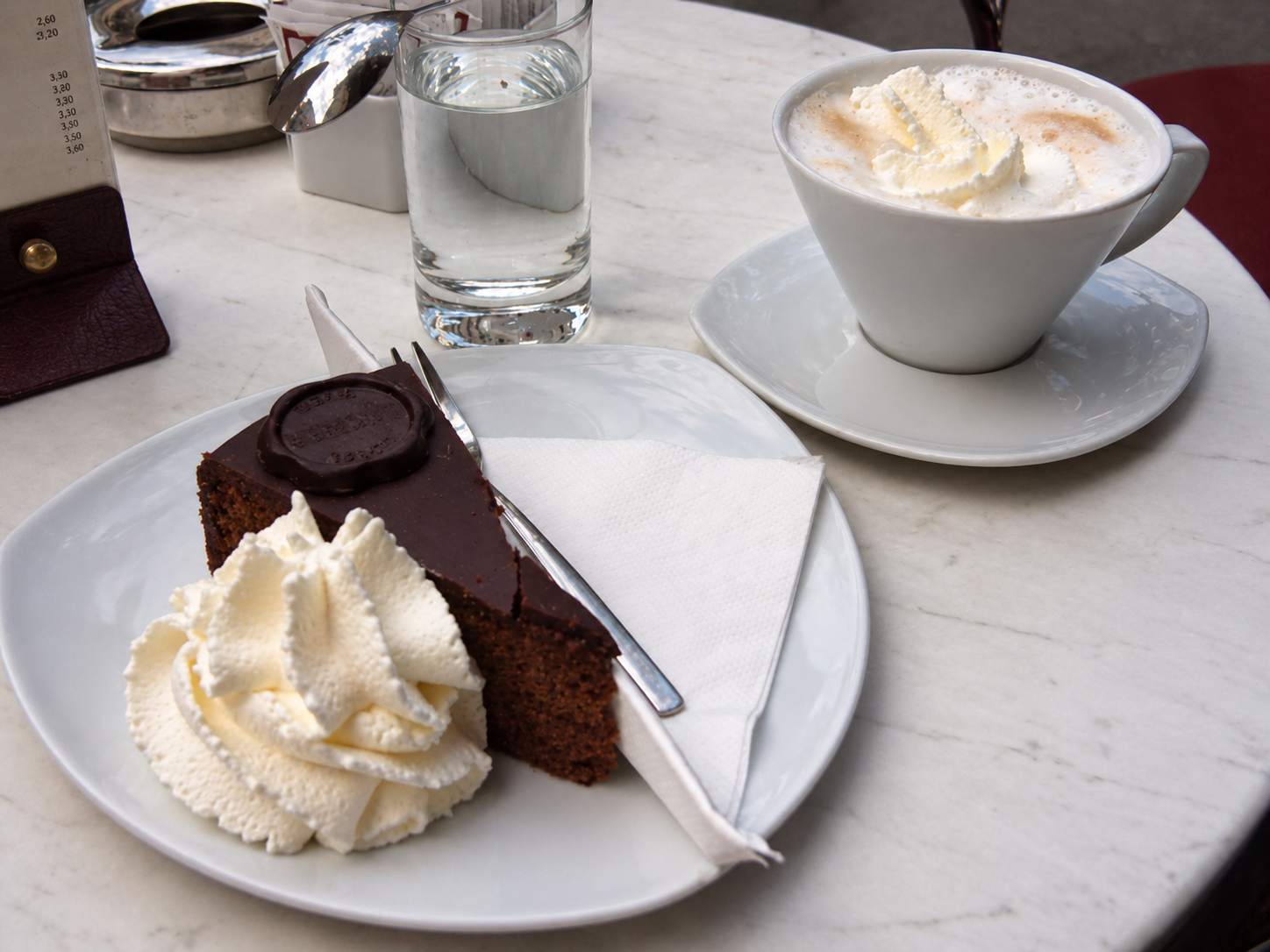
I slept in Vienna and apparently made it to Schönbrunn the following morning. The photographs and a few returning fragments also place me at Sacher and in the railway lounge before the final journey through Zagreb to Rijeka. After the improvisations of the previous week, Austrian first class felt almost indecently clean and correctly labelled.
The luggage photograph shows how thoroughly Tirana had altered my behaviour before the trip was even over. On the return journey I wrapped the smaller case in plastic and checked it, while keeping the larger one with me as hand baggage. This arrangement made little objective sense, but it ensured that the bag containing the things I cared about remained where I could see it.
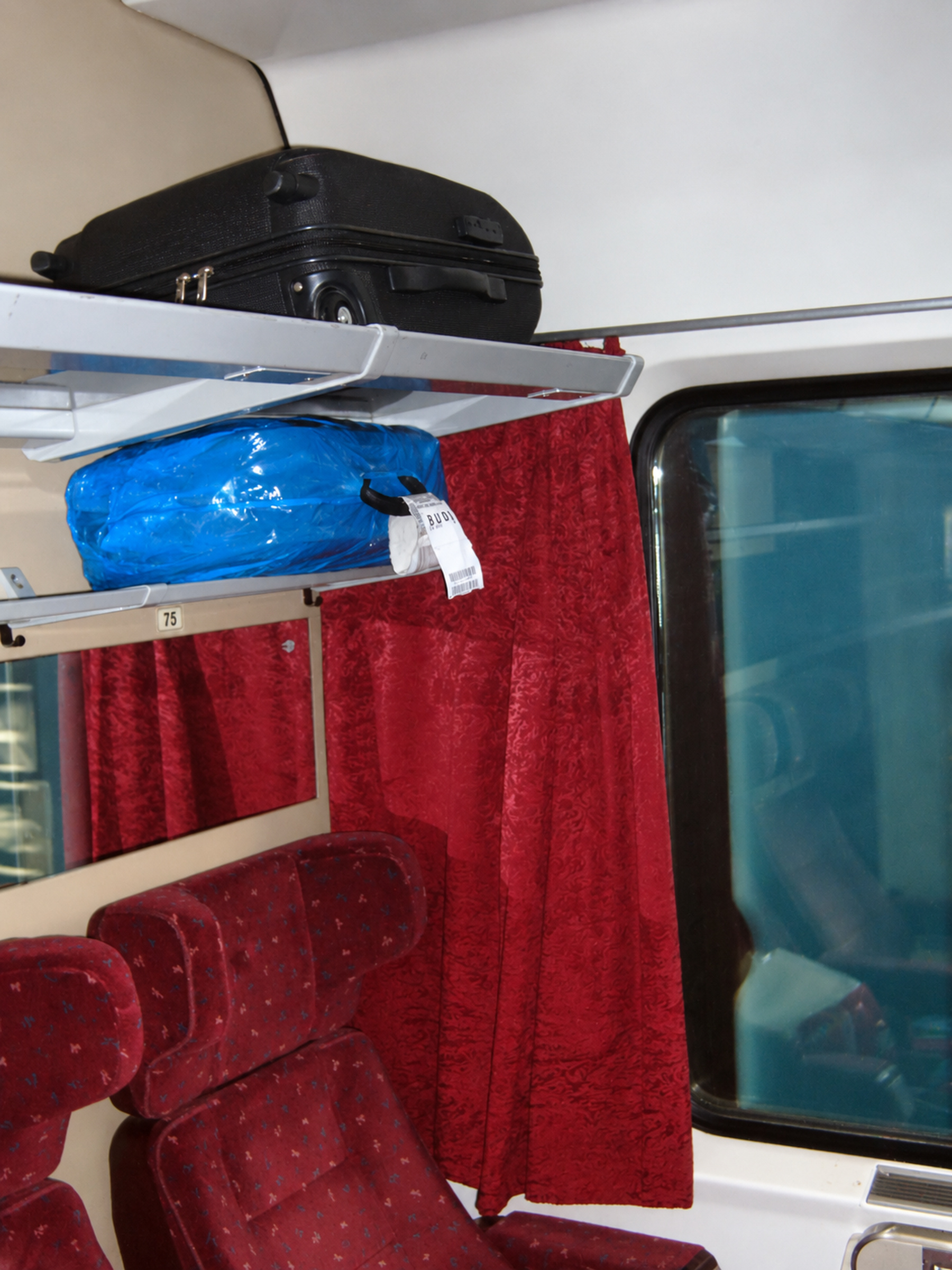
Years later, an airline lost my suitcase again on a trip to London. I was irritated, but I did not unravel because medication, underwear and basic clothing were already in my cabin bag. Bulgaria had provided a practical lesson that no packing guide had managed to make equally memorable.
What the camera returned
Looking through the recovered photographs, Sofia remains as vague as it was when I left. Too little of the city reached either the memory card or my attention, and most of what I remember belongs to a pharmacy, a cheap hotel and a baggage-tracing page. I may return one day and see Sofia properly, but this journey cannot pretend that I did.
Plovdiv occupies most of the card and much more of the story. The theatre, old houses, Roman stadium, rose-water shop, monastery and forgotten waterfall now have visible form again, joined by the parts no camera caught: dollars dropped into a cardboard box, an unexpected comment about a receptionist's salary, a station director searching for first class and two chickens that recognised no railway hierarchy.
The camera also returned a younger traveller who planned routes for the pleasure of making them complicated, carried books more carefully than medication and could be psychologically dismantled by one missing suitcase. I am better prepared now, although I suspect I would still try to buy first class even after everybody at the station had warned me that nobody knew how it worked. That part of my travelling education may never be completed.
