
 Meknes, Fez-Meknes, Morocco
I was staying in Fes, but Meknes gave me my first medina — and the first lesson that Morocco is rarely as simple as the guidebook version.
My first serious day of sightseeing in Morocco did not begin in Fes, even though that was where I was staying. It began about fifty-five kilometres away, in Meknes.

The hotel had organised everything: a driver would take me there from Fes, and a local guide would be waiting for us in Meknes. I had no real idea what I was going to see and had made almost no attempt to construct an itinerary of my own. For once, I was perfectly happy to let somebody else decide.
There was a practical reason for that. I speak English and German and can stumble through a little Italian, but I do not speak French at all, and my Arabic was equally nonexistent. In Morocco in 2018, that mattered. French was still far more useful for everyday communication than English, and I was not particularly interested in testing how far hand gestures could take me. Private tours were reasonably priced, so hiring a driver and guide seemed an easy decision.
Only later did I realise another advantage. A licensed Moroccan guide carries a visible professional badge, and travelling with one seemed to make sellers considerably less interested in pursuing me. I noticed the effect mildly in Fes and understood its value much more clearly later in Marrakech. Meknes was my first hint that having somebody official beside you could make browsing a souk considerably more relaxed.
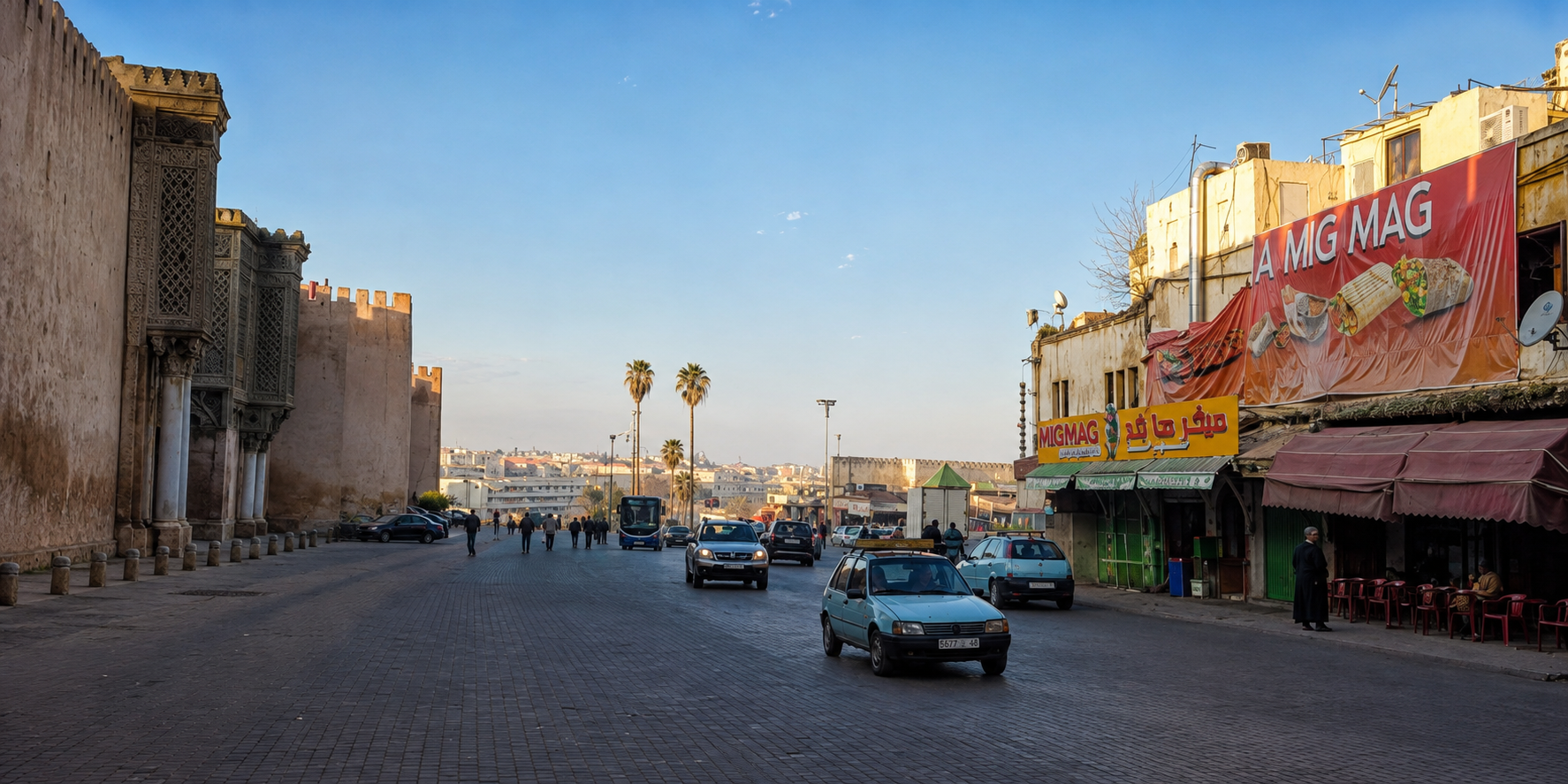
At first sight, Meknes did not overwhelm me. That would come later in Fes and, in a completely different way, in Marrakech. Looking back, I understand why Meknes is overshadowed by its more famous neighbour. To me, it felt smaller, more compact and less glamorous, without an immediately iconic sight comparable to the tanneries of Fes. I do not mean that as criticism. Meknes simply does not shout quite as loudly.
Its history is considerably louder. The city began as an 11th-century military settlement of the Almoravids, a Berber Muslim dynasty that also founded Marrakech. Six centuries later, Morocco was ruled by the Alaouites — the dynasty that still sits on the Moroccan throne today — and Sultan Moulay Ismail chose Meknes as his capital.
Before the Alaouites came the Saadians, the dynasty responsible for some of Marrakech's most spectacular architecture. Their El Badi Palace had been built as an extravagant statement of royal power. Moulay Ismail later stripped it of valuable marble and other materials, some of which were reused in his enormous building programme at Meknes. Recycling expensive material made practical sense, but the symbolism is difficult to miss: the new dynasty was building its imperial capital partly from the remains of the old one's monument.
That is where the comparison with Versailles comes in. Moulay Ismail and Louis XIV were contemporaries, and both understood architecture as a language of power. I have encountered the more entertaining version in which Moulay Ismail was essentially challenging Louis XIV to an architectural penis-measuring contest. History does not support anything quite that neat, but the comparison survived for a reason.
While Meknes was waking up
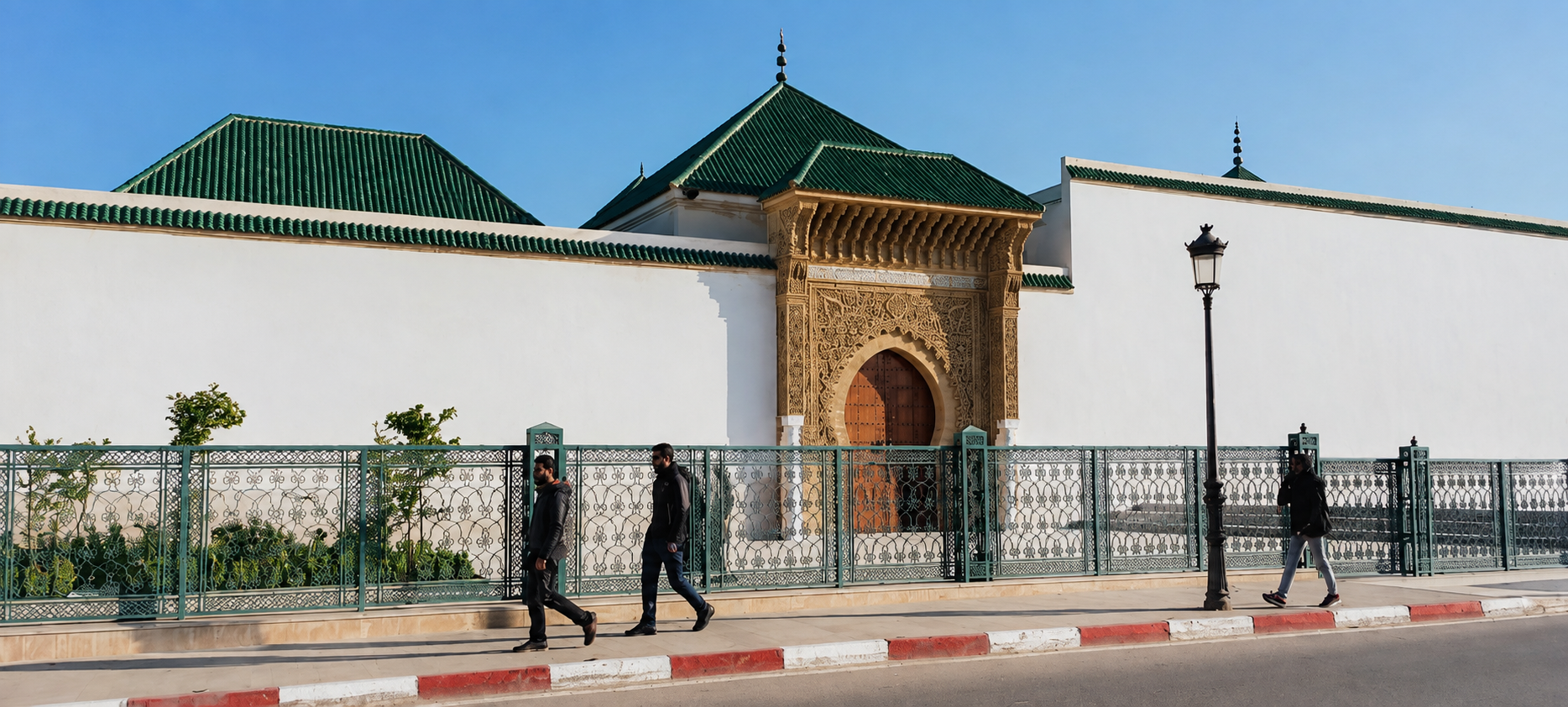
My driver left me beside the Mausoleum of Moulay Ismail, where we had about fifteen or twenty minutes to wait for the local guide. The mausoleum itself was closed for restoration at the time, so there was little to do beyond walking around it and photographing the exterior.
While we waited, he suggested I have a look at several nearby shops selling local handicrafts, particularly metalwork. The timing felt just coordinated enough to make me suspect that my twenty-minute wait had been designed with shopping in mind. Whether there was actually an arrangement between anyone involved, I have no idea. It made little difference because I was not looking to buy anything. In retrospect, the prices were perfectly reasonable and the sellers surprisingly polite — a useful comparison I would only be able to make after considerably more aggressive encounters later in Marrakech.
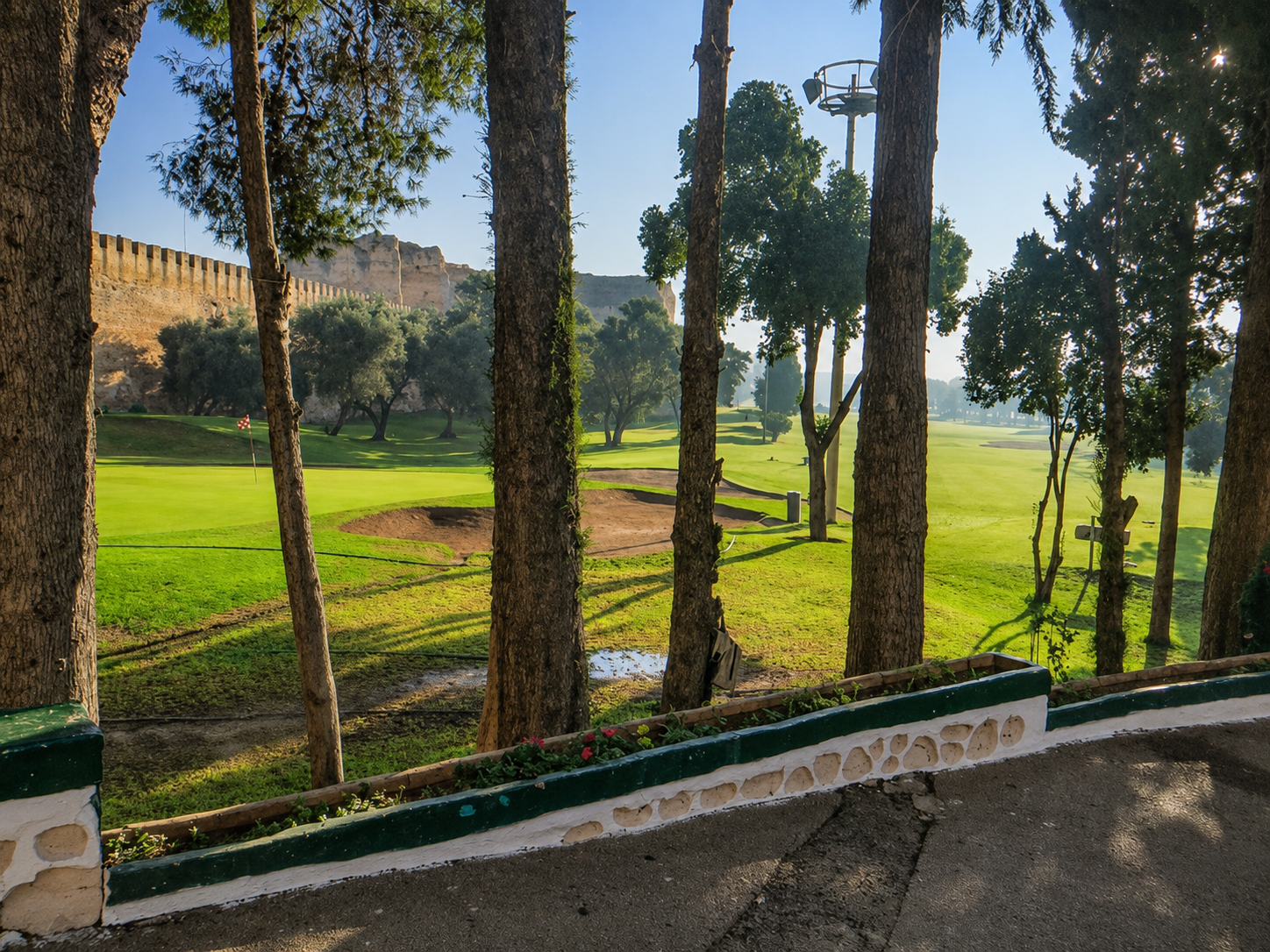
Nearby was one of those combinations that initially seemed almost absurd: royal walls, palm trees and an immaculate golf course. The Royal Golf de Meknès occupies part of the historic royal precinct and is completely enclosed by its walls, yet it is not some private playground hidden away for the palace. Created in 1969 and opened to local golfers, the nine-hole course remains publicly playable — even after dark, under floodlights.
There was something wonderfully Moroccan about the contrast. I had come to see the remains of a 17th-century imperial capital and found a functioning golf course tucked inside them.
The guide arrived soon afterwards and proposed starting with the medina. Our route took us first to Place el Hedim, the broad square between the old medina and Moulay Ismail’s imperial city.
A gate built for an empire
At that hour, the square was only beginning to wake up. Place el Hedim is often described as Meknes’s answer to Djemaa el-Fna, Marrakech’s famous main square — one of those Moroccan public spaces associated with crowds, food stalls, performers, colour, noise and an almost chaotic amount of life. Fes has its own version of that urban energy around Place Bou Jeloud, although Djemaa el-Fna remains in a category almost of its own.
At that early hour, however, the comparison required some imagination. Stalls were only beginning to open, people crossed the enormous square without having to negotiate much of a crowd, and the atmosphere was still restrained. Nothing about it resembled the sensory overload I would later encounter in Marrakech. It was not less Moroccan, just a very different Morocco — one that had not yet turned the volume up.
The geography also explains why Place el Hedim matters. The square sits between two very different parts of historic Meknes: the medina on one side and the imperial city created by Moulay Ismail on the other. Bab Mansour, the monumental gate dominating the square, does not lead into the medina. It opens towards the former royal complex, making the square almost a hinge between the everyday city and the sultan’s deliberately theatrical one.

At the opposite end of the square, right on the edge of the medina, stands the 19th-century Dar Jamai Palace. It was still an ethnographic museum when I visited in 2018; today it houses Morocco’s National Museum of Music. Its richly tiled façade and monumental fountain were among the first details I photographed before we disappeared into the medina.

Begun during Moulay Ismail’s reign and completed in 1732 under his son Moulay Abdallah, Bab Mansour was designed to make an impression before anyone passed through it. Its enormous horseshoe arch, geometric decoration, green zellige (glazed mosaic tilework) and marble columns turn the entrance itself into a statement of royal power. More than three centuries later, that intention is still perfectly obvious.

Our route, however, went in the opposite direction. We turned away from the imperial gate and entered the medina.
My first medina
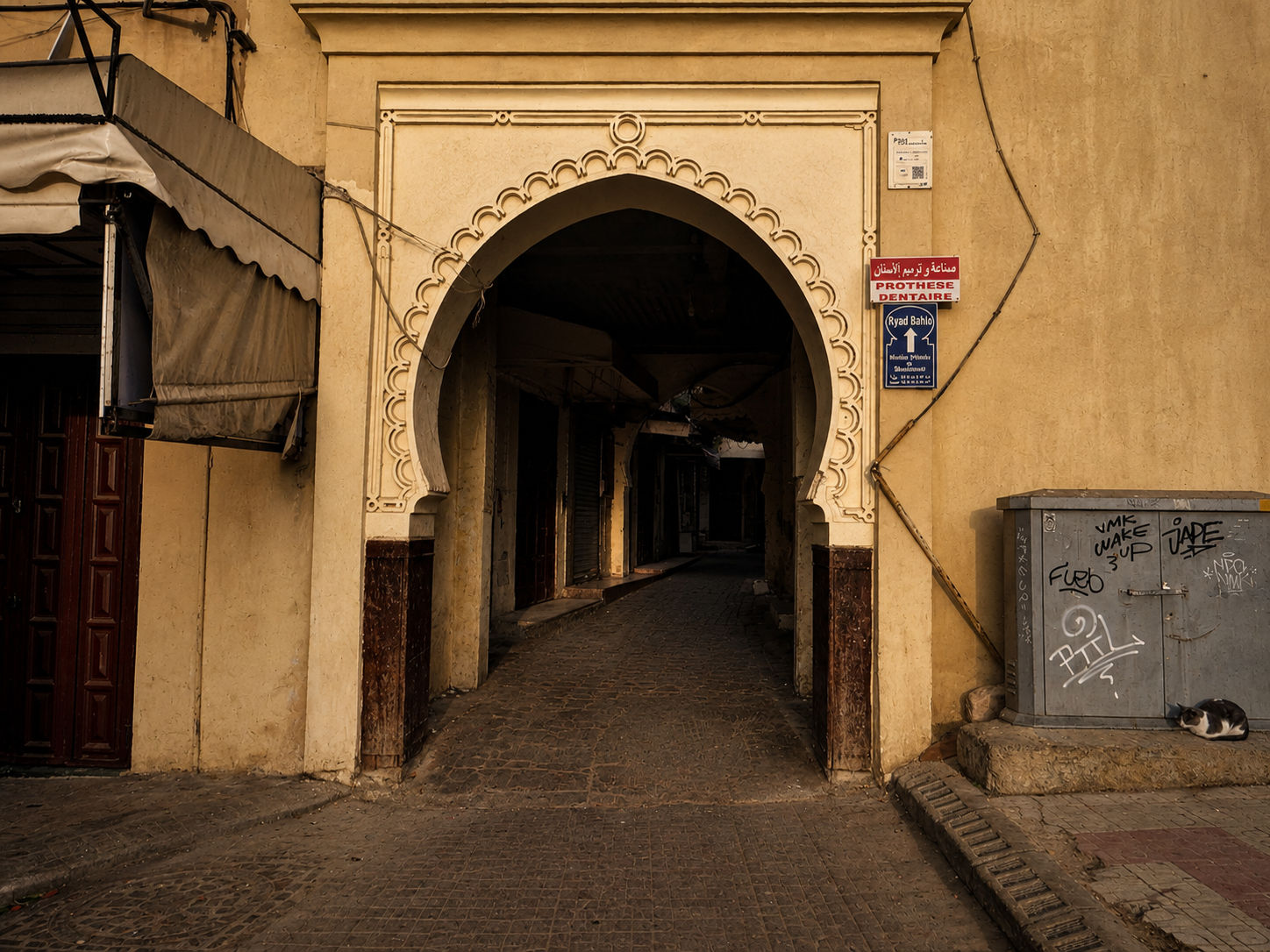
I had never been inside a medina before. I had, of course, seen photographs of Morocco and expected narrow streets, old walls and the occasional souk spilling into the passage. What I had not expected was the feeling that came with actually stepping inside one. Within minutes of leaving the openness of Place el Hedim behind, the city seemed to close around us and the familiar rules of space began to dissolve.
The streets narrowed into passages, some of them slipping beneath buildings and almost disappearing into darkness before opening again a few metres later. The colours changed with the light: ochre, dusty pink, burnt orange, faded red and brown, sometimes glowing warmly and sometimes sinking almost completely into shadow. People in hooded djellabas appeared from those darker spaces, their faces occasionally little more than silhouettes, crossed a strip of light and vanished again around another corner. None of this was frightening in any conventional sense, yet I remember feeling both fascinated and strangely unsettled.
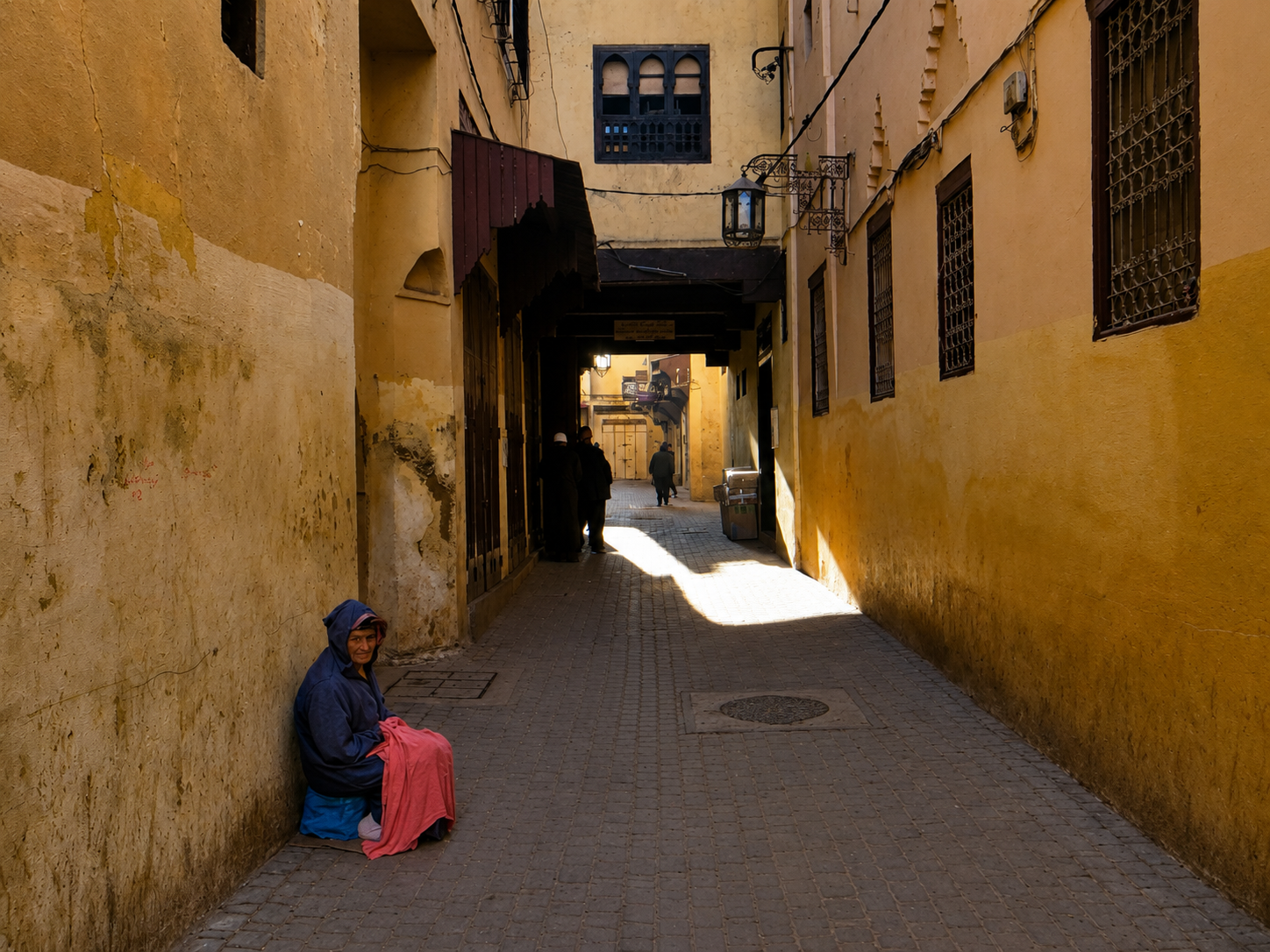
There was an energy to the place that I still struggle to describe without making it sound more mystical than it actually felt — except that, to me, it really did feel mystical. The medina was quiet in a way I had not expected. Its walls and covered passages seemed to absorb sound, and after a while I had the peculiar sensation that they were absorbing some of my own energy as well. I admired the place, wanted to keep walking deeper into it, and at the same time felt slightly intimidated by a world whose logic I could not begin to understand.
One photograph from that walk has remained particularly vivid in my memory.
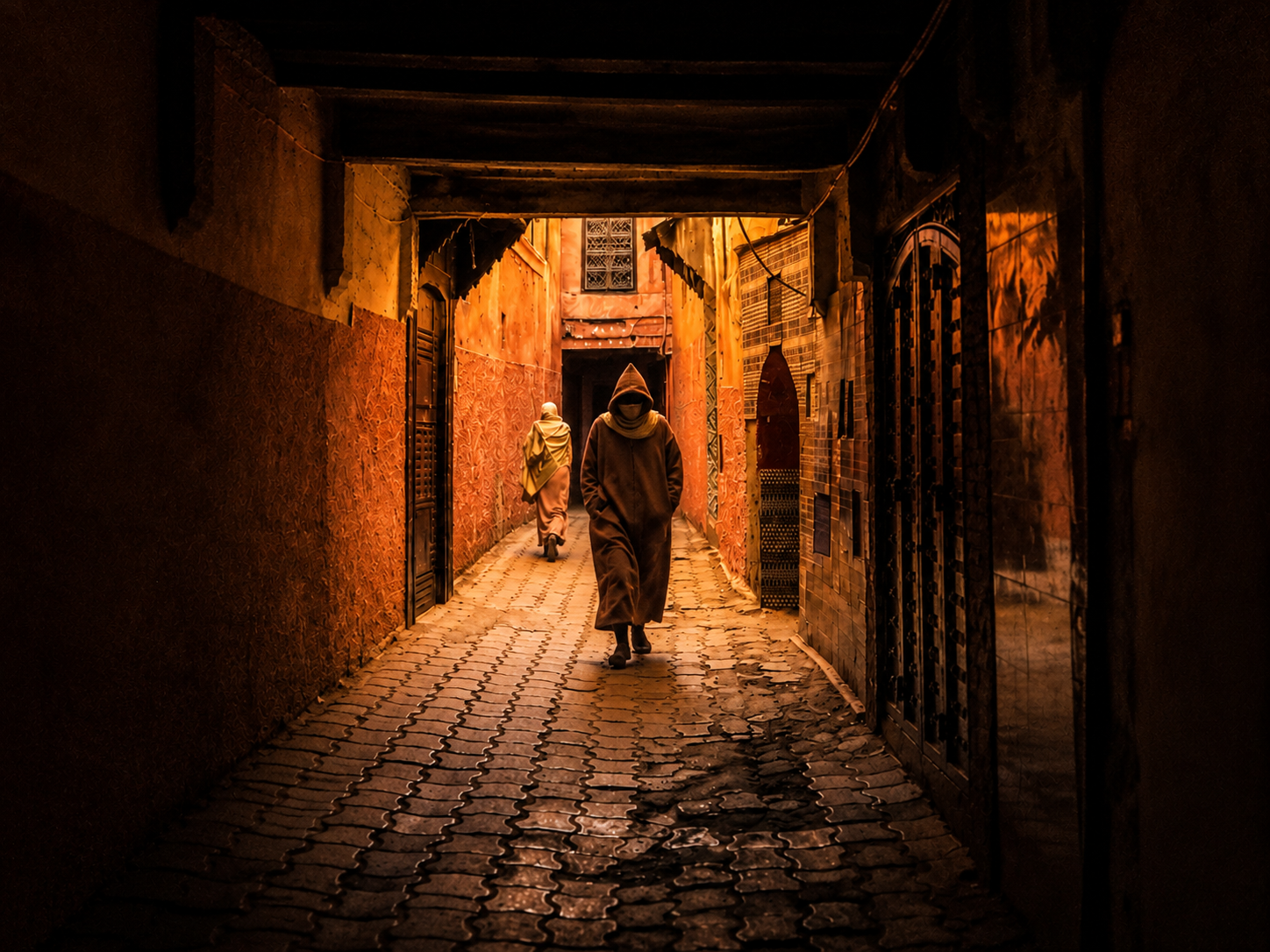
I am writing this in 2026, eight years later, and I can still remember what I felt while taking it: darkness around me, warm orange light further down the passage, two almost faceless figures and a street that seemed to lead somewhere beyond the normal geography of the city I had just entered. The closest comparison I can find is one of those hidden streets in Harry Potter — a place existing right beside the ordinary world but somehow belonging to a different dimension of it. The comparison is irrational, but so was the sensation, and that does not make it any less real.
I would later walk through much larger, busier and more famous medinas, but none reproduced quite the same emotional depth. Fes would overwhelm me with density, movement and complexity. Marrakech would be louder, brighter and more theatrical, full of colour and commerce. Rabat, which I would visit the following day, would feel more composed and almost stately.
Meknes was something else entirely. It was quieter and darker, less immediately spectacular, but for those first moments it seemed to possess a gravity of its own. I did not experience it as ugly or depressing; I was deeply drawn to it. The fascination came precisely from the fact that I could admire this world without feeling that I would ever fully understand it.
Looking through the photographs years later, I realised that I had instinctively been trying to capture that sensation rather than any particular monument. Again and again, I photographed thresholds, shadows, half-open doors, people disappearing into passages and bright fragments of another street visible somewhere beyond the darkness. The camera kept returning to the same idea: there was always another layer just beyond the one I could see. Before medinas became something I knew how to navigate, this first one still had the power to feel as though it occasionally bent the normal rules of space and time.
That is why translating medina simply as “old town” has always seemed inadequate to me. It is technically correct in roughly the same way that calling an opera house a building with chairs is technically correct. A medina is the historic urban core of a North African city, but walking through one means moving through a dense fabric where homes, workshops, shops, religious buildings and everyday traffic are compressed into the same space. Streets can contract almost into corridors. Shops spill directly into the passage. Even a donkey makes perfect practical sense as transport in a street network created centuries before anyone imagined a car.
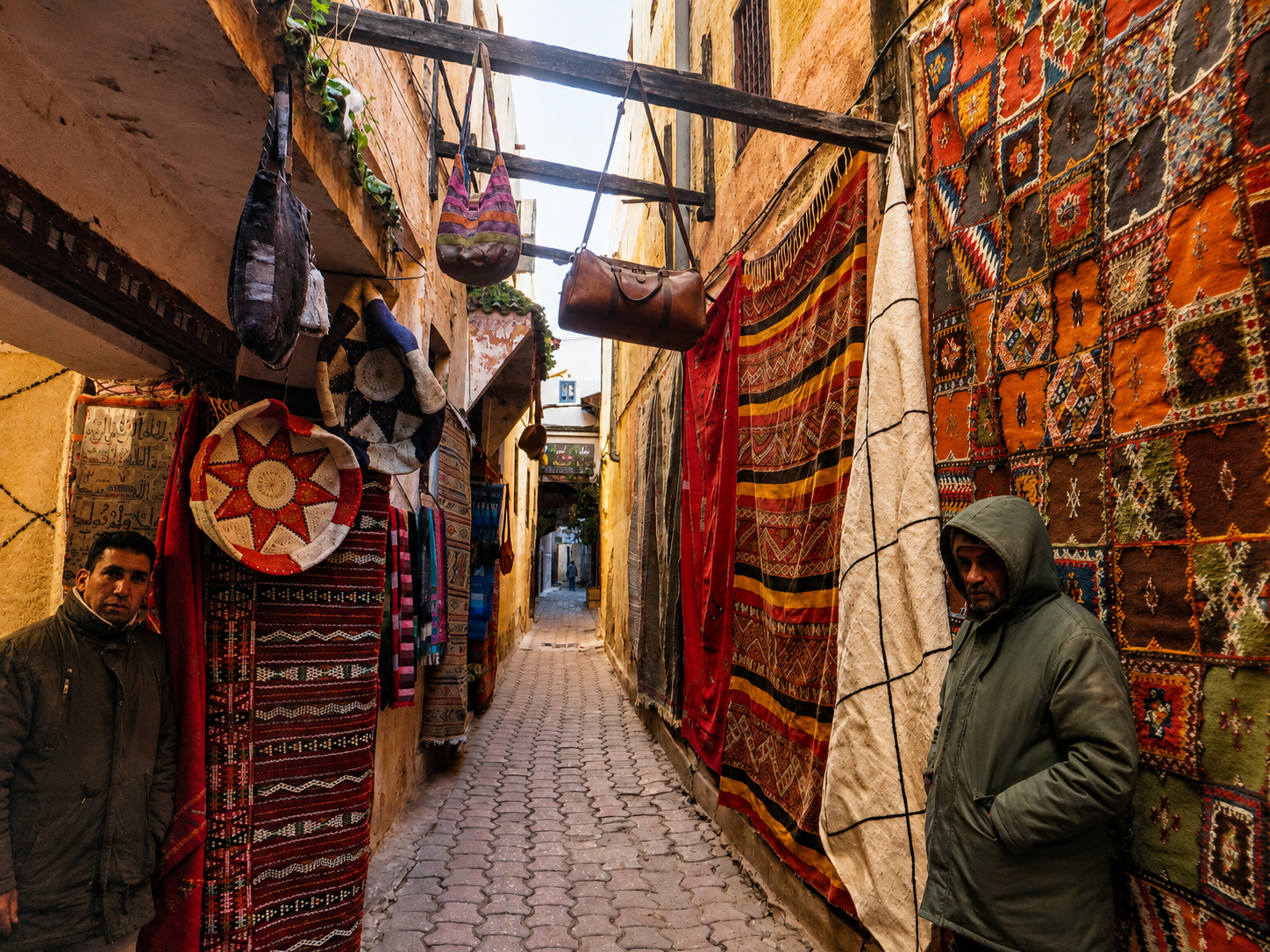
Tourism was certainly present, but it had not swallowed the place. The medina still felt primarily like somebody else’s functioning world through which I happened to be passing rather than a performance arranged for visitors. We passed souks, mosques and the Bou Inania Medersa — which I incorrectly came away believing I could not enter as a non-Muslim — but none of those individual sights explains why this walk has remained so vivid in my memory. What stayed with me were the spaces between them: the colours, the silence, the shadows and that almost impossible feeling that, for a short while, I had stepped sideways out of the Morocco on the map and into another version of it entirely.
The houses that seemed to have no windows
At one point, my guide took me inside a traditional house that had been converted into a small hotel. Until then I had been looking at the almost blank façades of many buildings in the medina and wondering why anyone would voluntarily live in a house that seemed to have forgotten windows.
The answer was behind the door. Traditional Moroccan houses are usually organised inward, around a central courtyard rather than towards the street. A dar is the broader term for this kind of courtyard house, while a riad, more strictly, refers to one whose central space is laid out as a garden. Tourism has blurred that distinction considerably, and today almost any atmospheric traditional guesthouse seems capable of acquiring the label “riad”.
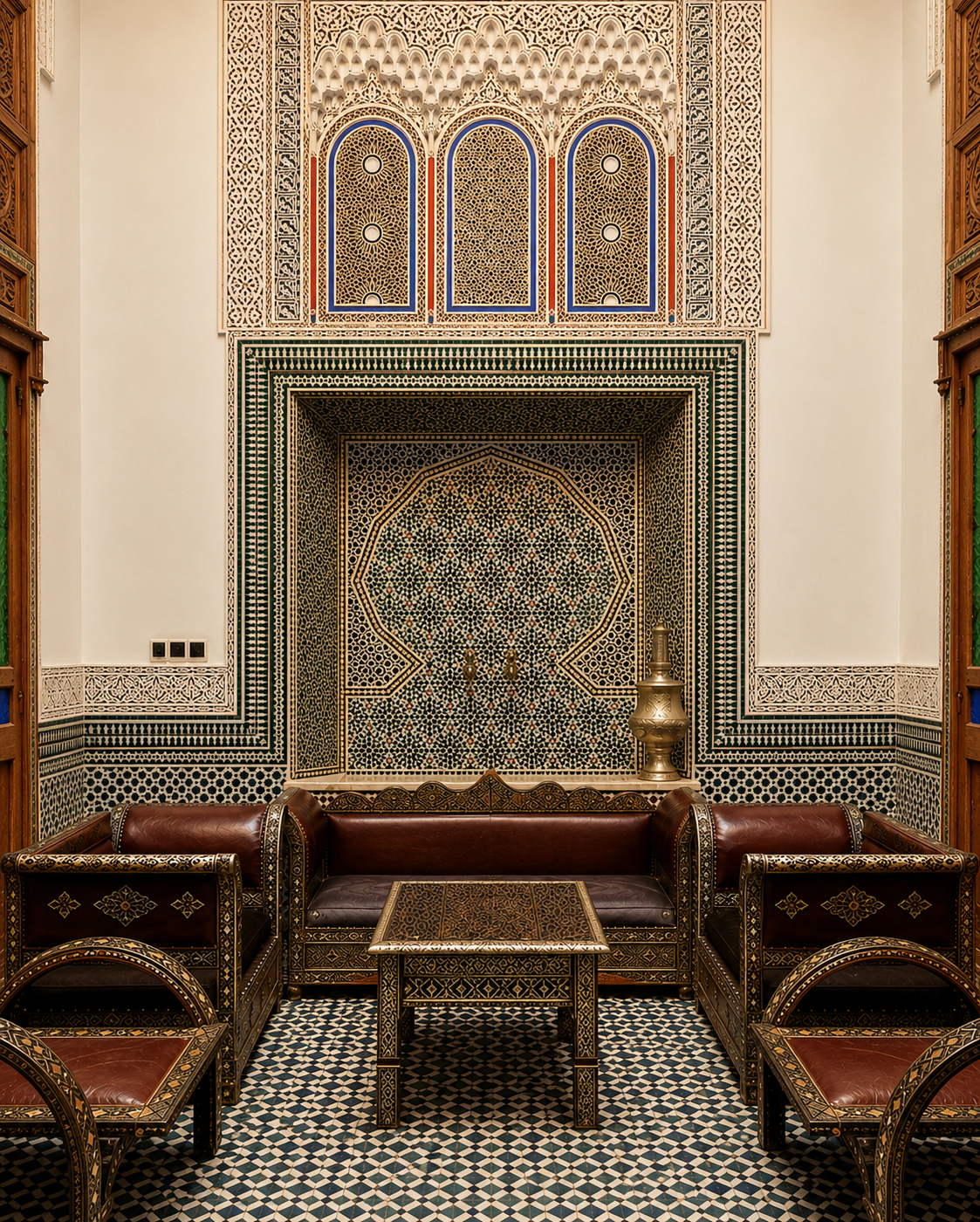
Once inside, the architectural logic became obvious. Light, air and domestic life were concentrated around the central space, while the street façade could remain remarkably plain. Tiles, carved plaster, woodwork and decorated rooms appeared where, from outside, there had seemed to be almost nothing. Privacy was not created by curtains; it was built into the architecture.
My guide contrasted this with the mellah, the historic Jewish quarter, where windows and balconies facing the street became more common. The neat formula I absorbed that morning — Muslim houses inward, Jewish houses outward — is too simple to be literally true, but as a first architectural lesson it worked. Suddenly those apparently blind walls made sense.
What it did not do was turn me into a riad convert. Later in Fes I would watch tourists dragging suitcases through the medina, over paving and through passages that had clearly never been designed with wheeled luggage in mind. I understood the appeal of staying inside that historic fabric — the intimacy, the architecture, the sense of waking up in the middle of the medina — but the logistics looked decidedly less romantic.
Perhaps a riad with a designer donkey to carry my suitcase could persuade me. I have yet to encounter one.
Back in the imperial city
After the medina, the imperial city felt almost shockingly open. The passages disappeared, the walls moved away from me and suddenly there was sky again. I remember something close to relief — not because I had disliked the medina, quite the opposite, but because that strange, heavy energy seemed to vanish the moment we stepped back into open space. It felt almost like returning to the normal dimension.
The scale changed with it. Moulay Ismail’s imperial city was built to impress through space as much as decoration: long walls, ceremonial buildings and enormous open areas that made the compressed medina seem even more distant. One of those spaces lies in front of Qubbat al-Khayyatin, the Pavilion of the Ambassadors, where the sultan received foreign envoys.
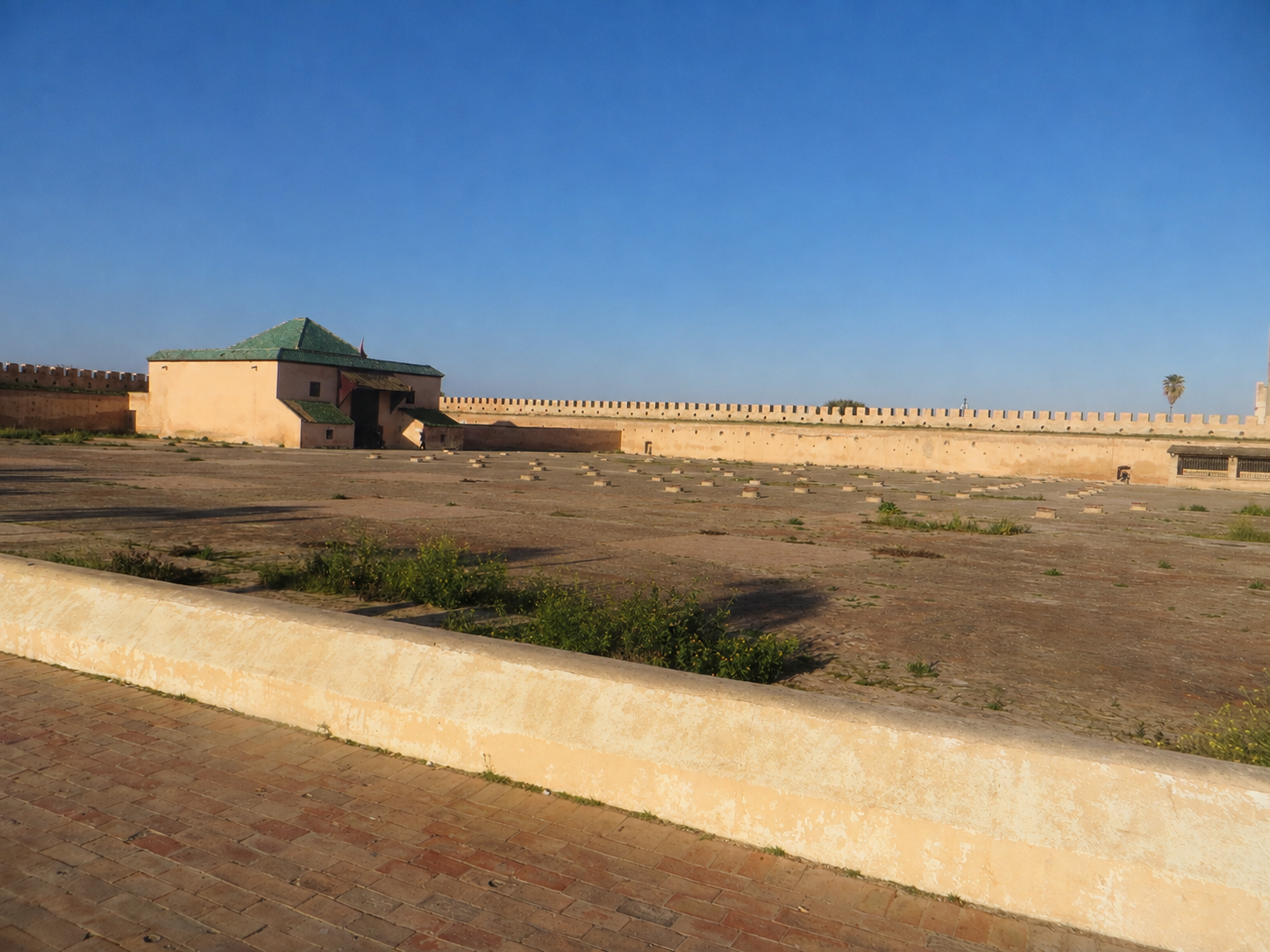
Somewhere beneath that square lies Habs Qara, traditionally described as Moulay Ismail’s underground prison for Christian captives. The story is much less certain than the tourist version suggests; the underground chambers were probably part of the vast storage and logistical system of the imperial complex and may only later, or occasionally, have been used for detention. At the time, though, I was far less interested in debating its exact function than in the simple fact that I could breathe again.
That contrast is probably what I remember most clearly now. The medina had felt like a world folding in on itself, full of shadows, silence and passages that seemed to lead somewhere beyond ordinary space. The imperial city did the opposite. It opened everything up again — sky, distance, geometry — and with it came the feeling that I had finally stepped back into a world whose rules I understood.
The machinery behind Moulay Ismail’s fantasy
We had already explored one part of Moulay Ismail’s imperial city on foot, but its sheer scale soon made the car useful again. We drove farther into the enormous complex, towards Dar al-Ma, Heri Souani and Sahrij Souani — the less ceremonial side of Moulay Ismail’s project, where monumental architecture gave way to the infrastructure required to keep an entire imperial city functioning.
Dar al-Ma — literally the “House of Water” — contained wells and water-lifting installations that supplied the imperial complex. Beside it stood Heri Souani, a vast complex associated with the storage of grain and other provisions needed by the palace city, while nearby Sahrij Souani served as its enormous reservoir. Together, they reveal the machinery behind Moulay Ismail’s imperial ambitions: water, food and storage organised on a scale almost as extravagant as the palaces themselves.
I cannot pretend that the engineering made a particularly deep impression on me at the time. What I remember vividly are the extraordinary rows of arches at the part of the complex my guide called the Rouah and described as Moulay Ismail’s royal stables.
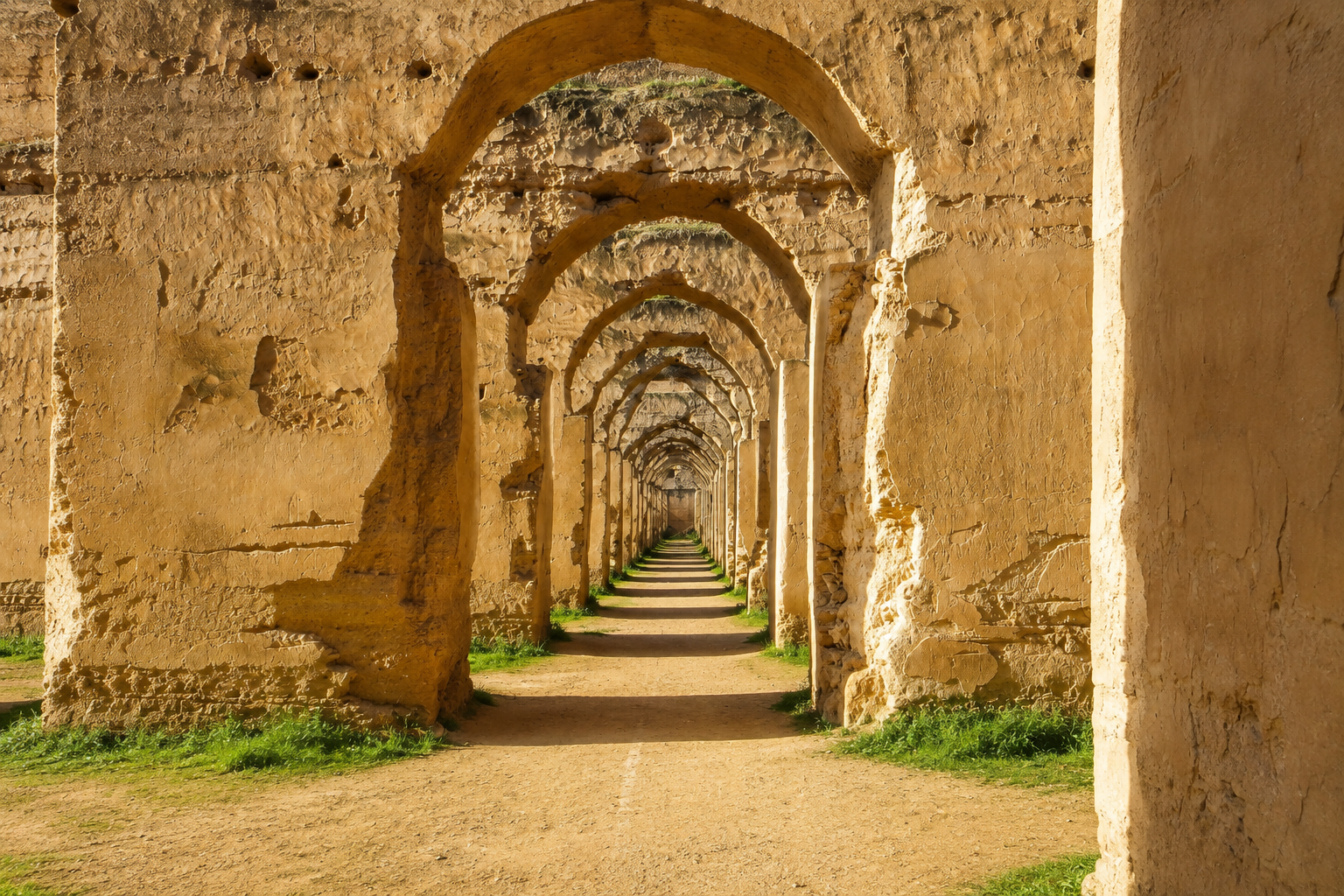
That explanation stayed with me, although the history turns out to be more complicated. The surviving arcaded structures are now generally identified as part of Heri Souani’s granary and storage complex, while the actual royal stables extended farther south and have largely disappeared. The distinction mattered much less to me that morning than the architecture itself.
The arches were spectacularly photogenic. One framed another, then another, producing an almost obsessive rhythm of repetition, symmetry, light and shadow that seemed to continue indefinitely. I remember spending considerably more time trying to find the perfect angle than absorbing whatever explanation of imperial logistics accompanied them.
Their repetition also did something interesting to scale. A person standing among them suddenly looked temporary and almost insignificant, while the architecture seemed to continue indefinitely. Whether or not that effect was intentional, it communicated Moulay Ismail’s appetite for monumentality rather effectively.
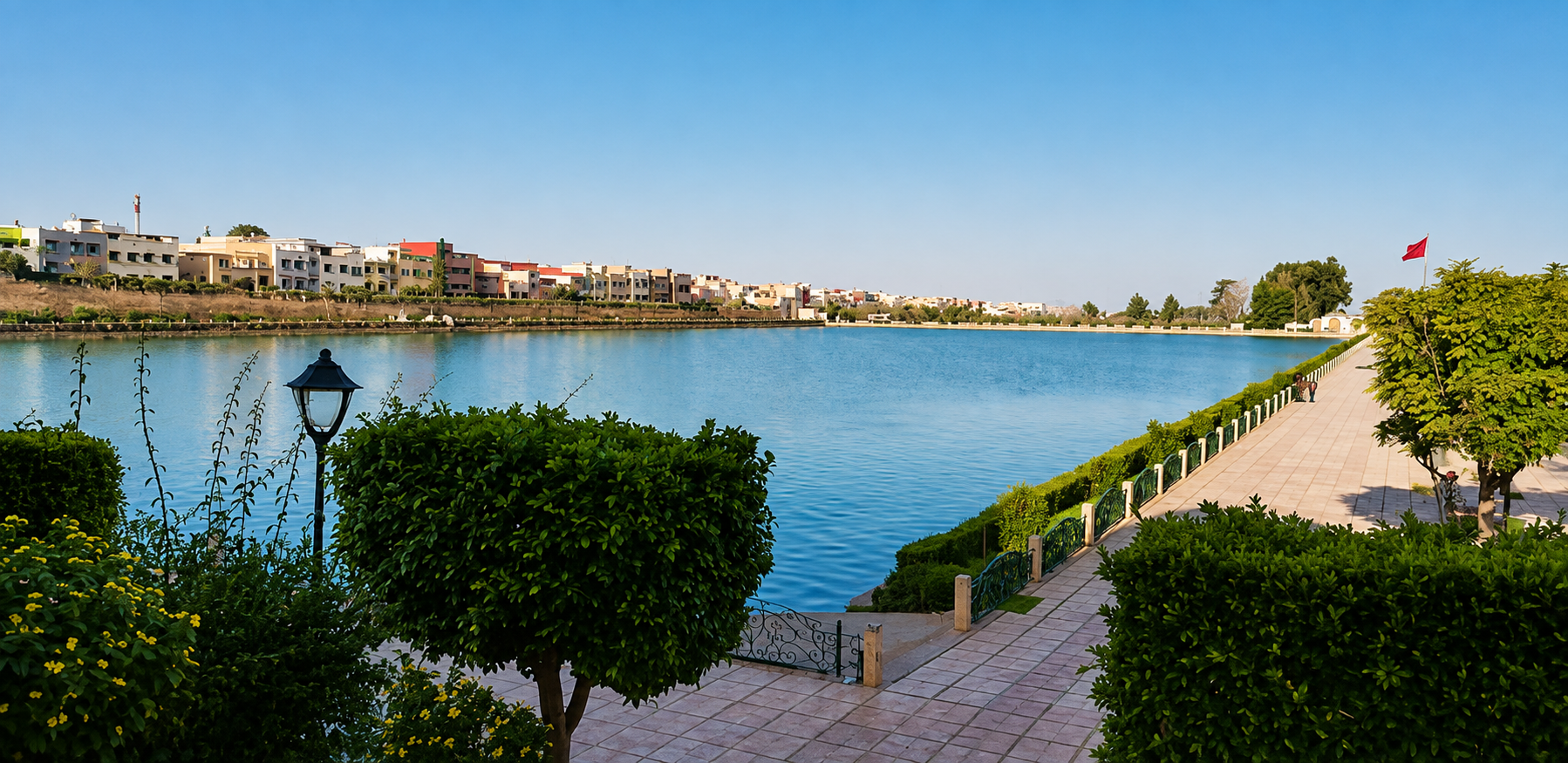
Nearby, Sahrij Souani — which I had rather casually written down in my notes as the “Agdal pool” — introduced another part of the same system. Its broad sheet of water looked almost recreational, and the area around it had become a pleasant place for walking and sitting, but its primary purpose was practical: it was a vast reservoir connected to the hydraulic infrastructure serving the imperial city and its gardens.
Beyond the arches, relatively little from this stop has remained in my memory. The infrastructure behind Moulay Ismail’s imperial fantasy was undoubtedly impressive, but eight years later what survived was something much simpler: those repeating arches, perfectly aligned and ridiculously photogenic. Apparently imperial logistics needed symmetry too.
The city that did not need to shout
Meknes had not overwhelmed me in the way Fes soon would, nor did it have the colour and theatrical chaos I would later associate with Marrakech. It was smaller, quieter and less obviously spectacular. Yet it had given me something neither of those cities could repeat: my first medina, and that strange few minutes in which Morocco seemed to open into a world I could admire without beginning to understand.
Perhaps that was enough. Moulay Ismail’s imperial project had long since fragmented, Meknes had lost its political centrality, and what remained was a city that no longer needed to advertise what it had once been. My driver started the engine and we left for Moulay Idriss, a small hill town whose importance to Moroccan religious history is wildly disproportionate to its size.
That was the next story.

