
 Shangcheng District, Zhejiang, China
I arrived knowing almost nothing about Hangzhou. Between water lilies, pagodas, Buddhist temples and old streets, I found the China I had imagined — and discovered that reality was even more captivating than I had expected.
I arrived in Hangzhou from Shanghai on the afternoon of 15 May, after less than an hour on the high-speed train from Shanghai Hongqiao to Hangzhou East. The conference was the reason for coming; the Courtyard by Marriott Hangzhou Wulin, in the modern commercial centre, would be my base. Until then, Hangzhou had existed in my plans almost entirely as a logistical necessity. I had chosen Shanghai for the international flights, and Hangzhou was simply where I needed to be next. I stepped off the train having done remarkably little research and with almost no idea what kind of city was waiting for me.
In retrospect, that ignorance seems almost absurd. Hangzhou is not simply a large modern Chinese city. In 1138, after the Song court had been driven south from northern China, Hangzhou became the imperial capital under the name Lin’an and remained so for more than a century. From Lin’an, the Southern Song ruled much of southern China through one of the most prosperous and culturally sophisticated periods of Chinese history. Even after the Southern Song fell to the Mongols in the late thirteenth century, Hangzhou remained an important centre of trade, helped by its position at the southern end of the Grand Canal, the vast waterway linking northern and southern China. Today, Hangzhou is home to Alibaba, the technology giant best known for e-commerce, cloud services and digital platforms, and has become one of China’s major centres for the digital economy and artificial intelligence.
And I had arrived knowing almost none of it.

West Lake
With the afternoon still free, I left the Courtyard on foot and headed south towards West Lake, the only sight I intended to visit that evening. From Wulin it was an easy walk through the city to the eastern shore, and the lake seemed the obvious place to begin exploring Hangzhou.
Calling West Lake a single attraction is slightly misleading. The lake itself covers about 6.5 square kilometres, but what makes it exceptional is the much larger landscape that has grown around it: wooded hills, causeways, islands, pagodas, Buddhist temples, gardens and pavilions shaped together over more than a thousand years. In 2011, UNESCO recognised the entire West Lake Cultural Landscape as a World Heritage Site. The point was not simply that the lake was beautiful. For centuries, people had been actively shaping that beauty — dredging the water, creating islands and causeways, planting trees and placing temples, pagodas and pavilions so that architecture and nature became part of the same composition.
A particularly Chinese expression of this idea is the tradition known as the Ten Scenes of West Lake. Despite the name, it was never simply an ancient tourist “top ten”. First established during the Southern Song period, each scene combines a particular place with the conditions in which it was considered most beautiful — a season, a time of day, weather, sound or quality of light. Leifeng Pagoda in Evening Glow is therefore not just a pagoda, but a pagoda seen as part of an evening landscape; Evening Bell Ringing at Nanping Hill is as much about the sound of Jingci Temple’s bell travelling across the lake as it is about the place itself. Others evoke spring on Su Causeway, lotus flowers, autumn moonlight and snow on Broken Bridge. Over the following days I would encounter several of these places without initially realising that people had been admiring essentially the same combinations of water, architecture, vegetation and atmosphere for centuries.
West Lake is not a place you really understand from one viewpoint. You walk its shores, cross its causeways, climb the surrounding hills and, sooner or later, take a boat out onto the water. I would do all of that two days later. That first evening, however, my plan was much simpler: reach the lake, see what I could see, and walk back to the hotel.
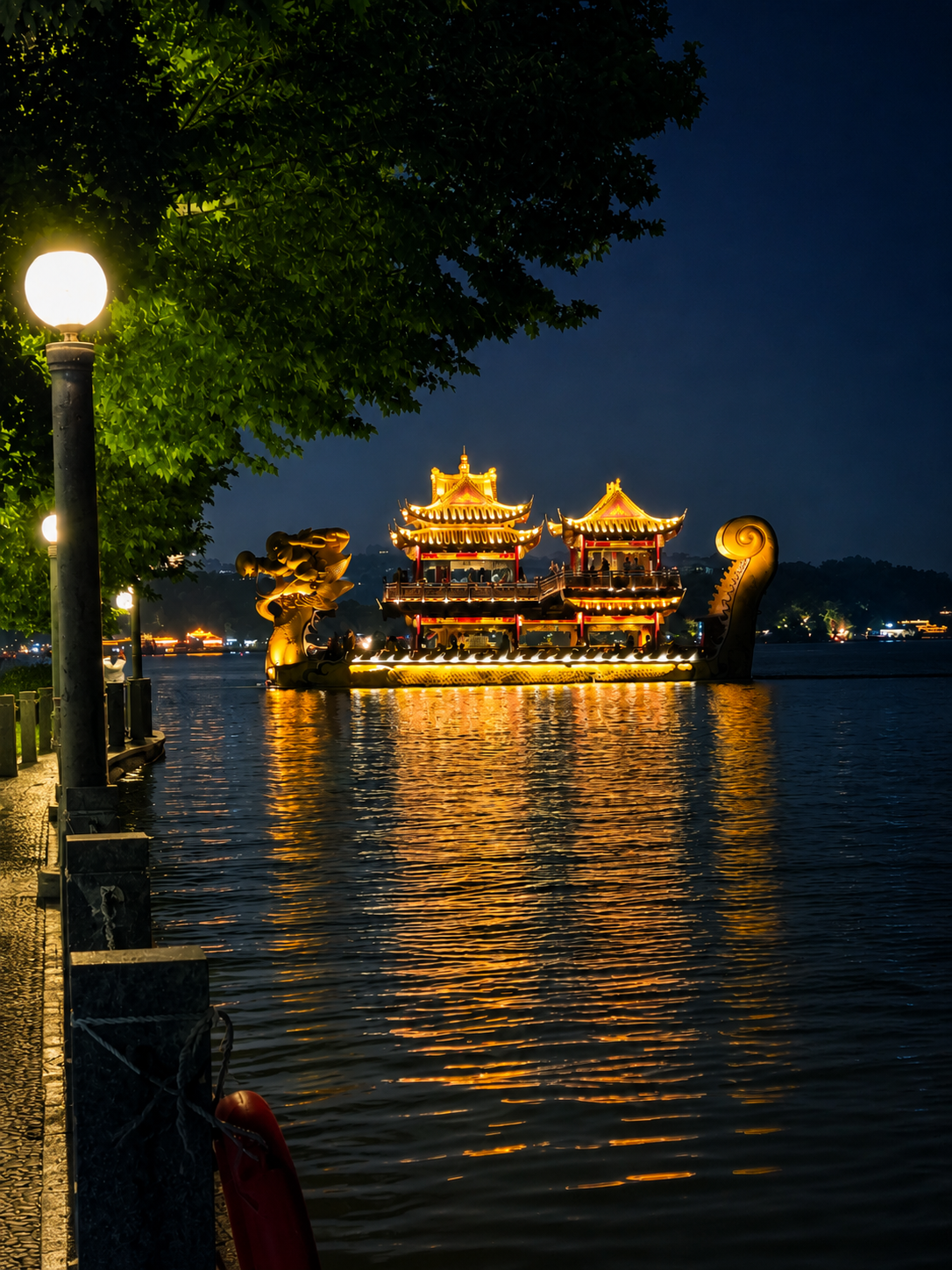
By the time I reached the shore, almost everything had disappeared into darkness. People were still strolling along the waterfront and the lights of the city were close behind me, but the landscape itself was mostly invisible. Then, out on the black water, a traditional pleasure boat appeared in a blaze of light.
It was almost ridiculously satisfying.
Shanghai had already impressed me enormously, but its international character and European architecture had made my first encounter with China rather different from the images I had carried with me for years. That glowing boat, however clichéd it may sound, was the first moment when something clicked. There it was: a fragment of the China I had imagined before coming here.
The lake itself would have to wait for daylight. But Hangzhou had already begun to work on me.
Finally, China
The next day belonged largely to the conference. By the time the formal programme and dinner were over, however, there was still enough evening left for one proper excursion. I took a taxi to Wushan Hill, immediately south-east of West Lake, where Chenghuang Pavilion rises above the trees. The moment it appeared, illuminated in red and gold against the dark hillside, something finally fell into place.
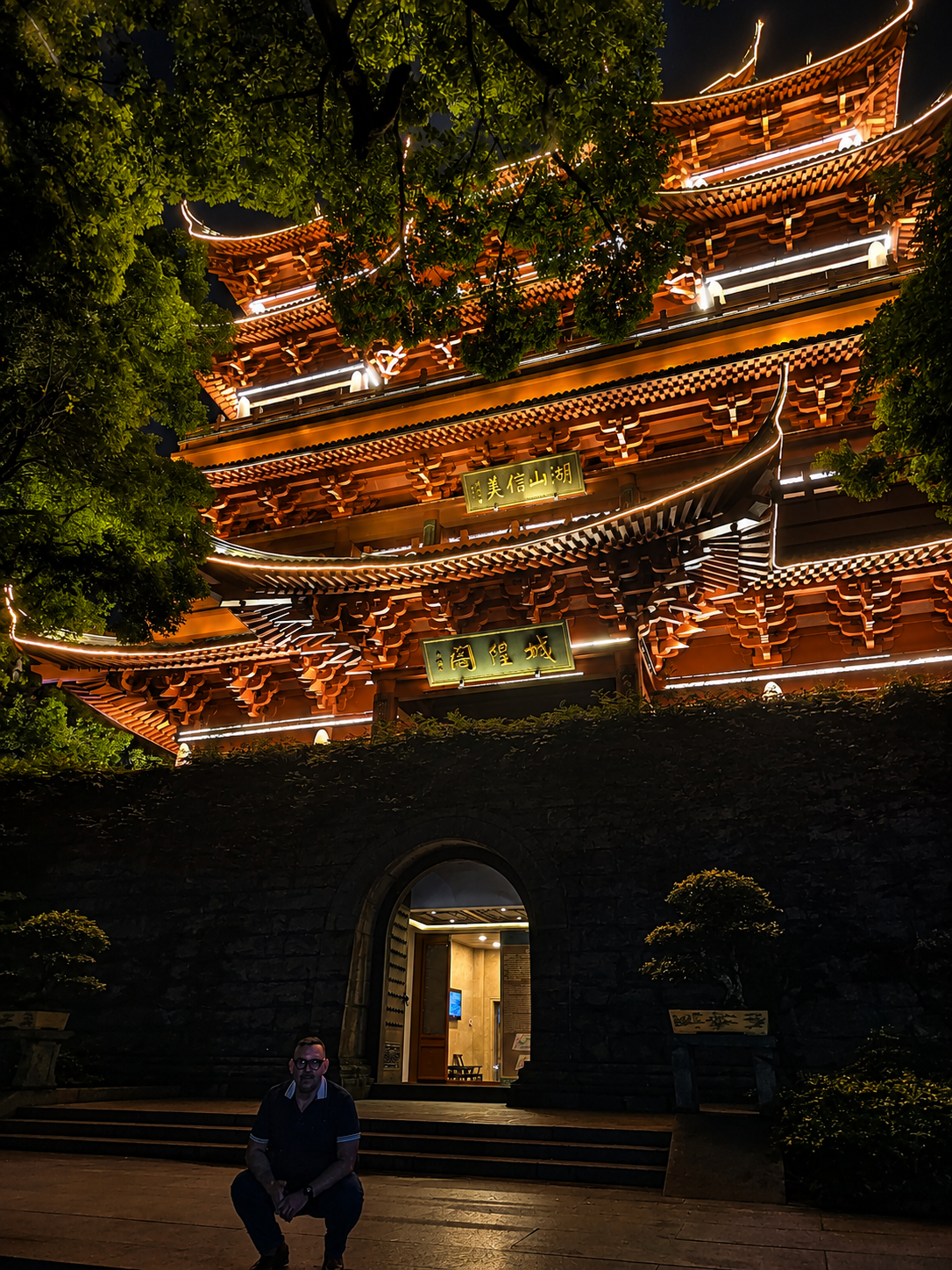
With its tiered roofs, elaborate eaves and saturated colours, the pavilion looked convincingly ancient. It is not. The present Chenghuang Pavilion was completed only in 2000, on the site of Hangzhou’s former City God Temple. Chenghuang means City God, a protective deity from Chinese folk religion, a tradition that blended local beliefs with elements of Daoism, Buddhism and Confucian ideas. In Hangzhou, that tradition became closely linked to Zhou Xin, a Ming official remembered for his integrity and sense of justice.
The building I had entered, however, was not really a temple. Today it is a paid cultural and sightseeing attraction, built in a deliberately historic style and used for exhibitions, panoramic viewing, tea, performances and other events. A memorial temple dedicated to Zhou Xin survives within the wider complex, but the great illuminated pavilion above it is essentially a modern celebration of Hangzhou’s history and traditions.
That explained something I had noticed while walking through it: for all its religious symbolism and ancient appearance, parts of the building felt almost like an elegant cultural venue rather than a sacred space. They were.
That mixture of ancient meaning and surprisingly recent construction was something I would encounter repeatedly in Hangzhou.
Impressive as the pavilion was, the real reward of Wushan Hill was the view. From the terraces, Hangzhou and West Lake opened up below me, their lights scattered between dark hills and stretches of almost black water.
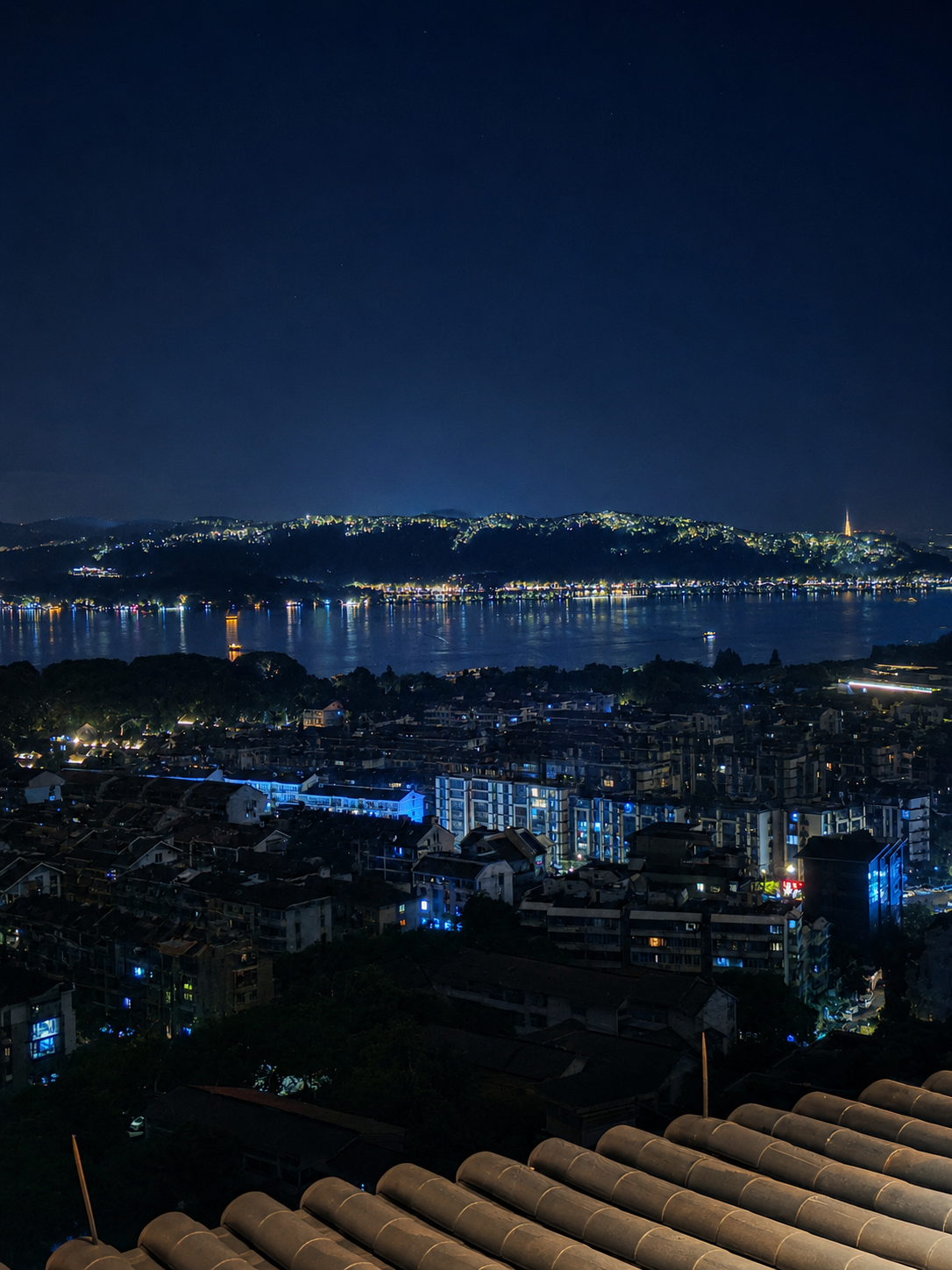
Far across the lake, a single glowing pagoda rose above the southern shore. I photographed it several times, having no idea that the following day I would be standing directly beneath it.

But that evening, its name hardly mattered. What mattered was the whole scene: the dark lake, the hills, the glowing roofs and the city spreading beyond them. The fragment I had glimpsed the night before had suddenly become a landscape.
This time there was no hesitation. This was the China I had come hoping to find.
Down the hill to Wushan Night Market
From the pavilion I continued downhill towards Wushan Night Market. Despite the name, the market is not actually on Wushan Hill but in the streets below it, around Renhe and Huixing Roads.

It struck me as a surprisingly good compromise between a local market and a tourist attraction. Tourism clearly dominated, but not so completely that the place felt staged. Stalls sold clothes, food, tea, souvenirs and everyday goods, while enough local shoppers moved among the visitors to keep it from becoming just another tourist shopping street.
I bought some green tea and, for myself, a silk scarf. More memorable was the durian. Its reputation had reached me long before its smell had, and I vaguely remembered stories about it being “banned”. The fruit itself is not generally illegal, of course; it is the notorious smell that gets it barred from many hotels and enclosed forms of public transport across Asia. Nobody around me appeared remotely troubled by this. People were buying it quite happily.
I decided cultural immersion did not require participation in everything.
By the end of the evening, Hangzhou had changed character completely. The dark lake of the night before now had hills, glowing roofs, a distant pagoda and crowded streets below them. The city that had seemed almost anonymous when I arrived was beginning to reveal itself.

A museum, a pagoda and the place between them
The following morning began at the China National Silk Museum, which became important enough to deserve a separate story. From there I intended to walk directly to Leifeng Pagoda. On the map the distance looked manageable; what I had not expected was that the walk between the two would become one of my favourite parts of Hangzhou.
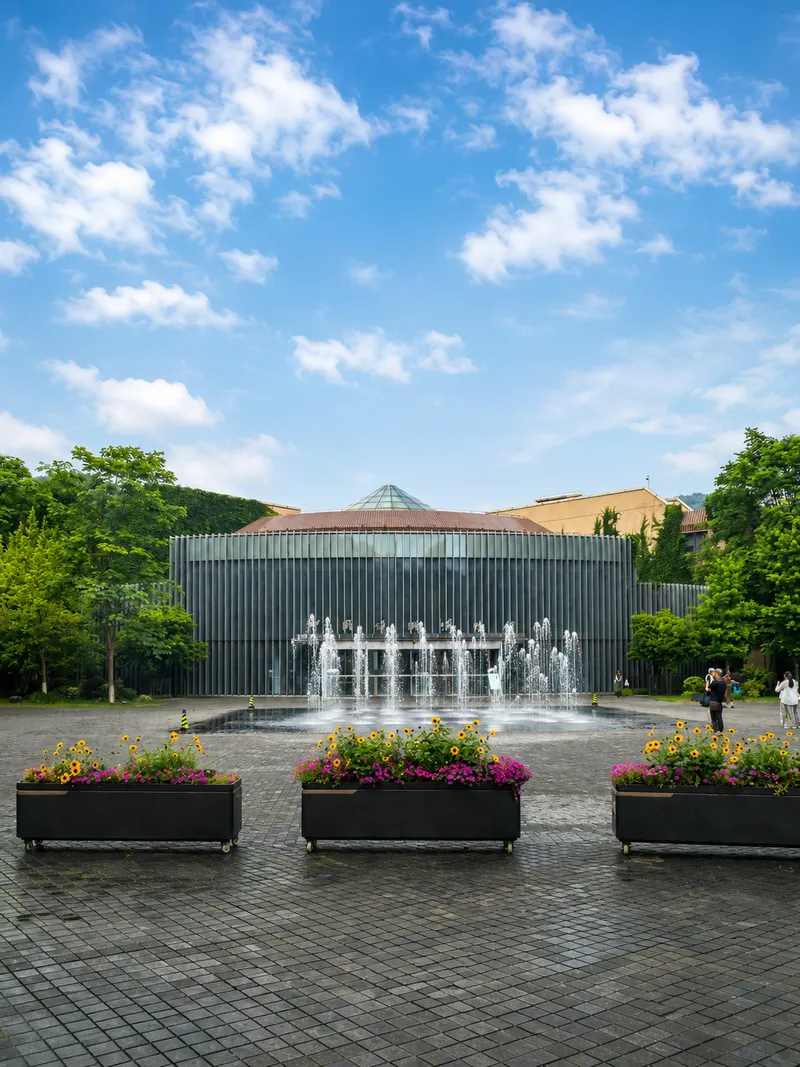

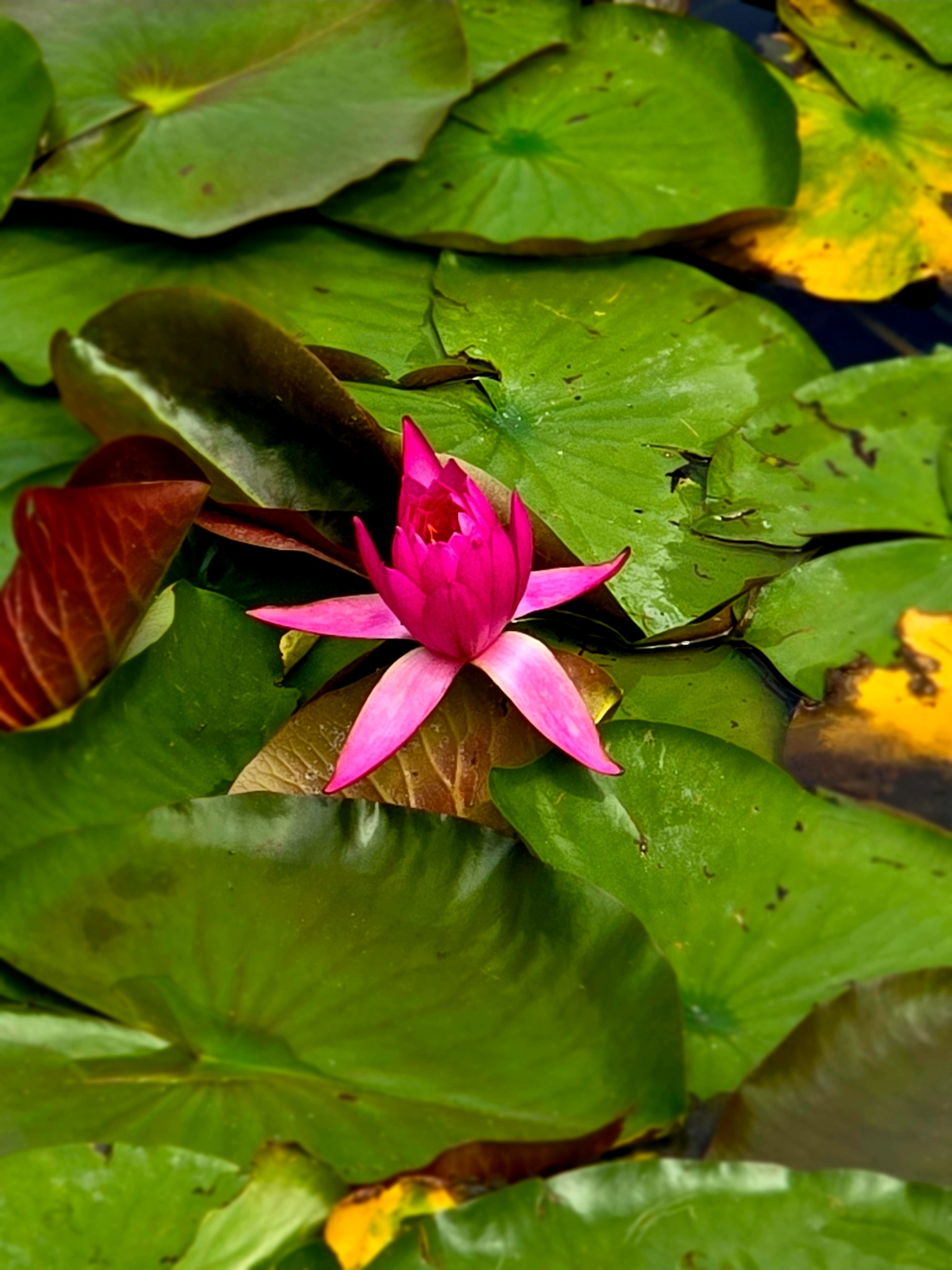
Soon after leaving the museum, I entered a green network of narrow waterways, wetlands and paths almost swallowed by vegetation. Water lilies floated across the surface, larger leaves rose above the water further away, and channels disappeared beneath layers of green. Almost nothing in the view suggested that I was still inside one of China’s largest cities.
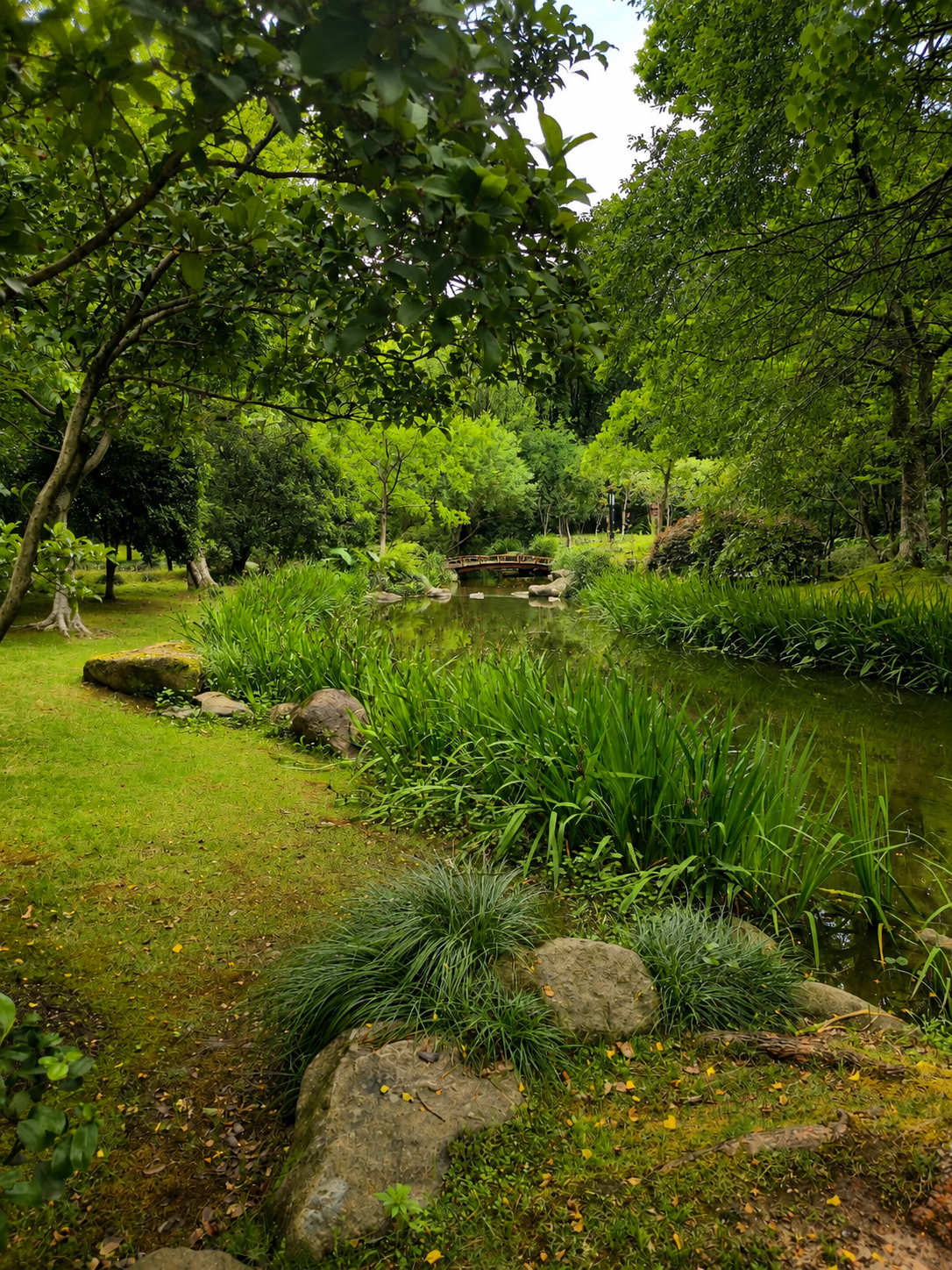
At the time, I mentally filed almost everything growing in the water under one convenient label: lotus. It seemed obvious. If there was one flower that belonged in the China I had imagined before the trip, surely it was the lotus.
The photographs later proved that my botany needed some work. Lotuses and water lilies are not the same plant at all. Water lilies belong to the genus Nymphaea: their rounded leaves usually float directly on the surface and have a characteristic slit running towards the centre, while their flowers sit on or just above the water. The sacred lotus, Nelumbo nucifera, behaves differently. Its large, almost perfectly round leaves have no such slit and often rise well above the water on long stalks; the flowers do the same.
Looking back at my photographs, I had actually been walking through both. The pink and white flowers resting among floating leaves were water lilies, while elsewhere large stands of lotus leaves were already lifting themselves above the ponds.
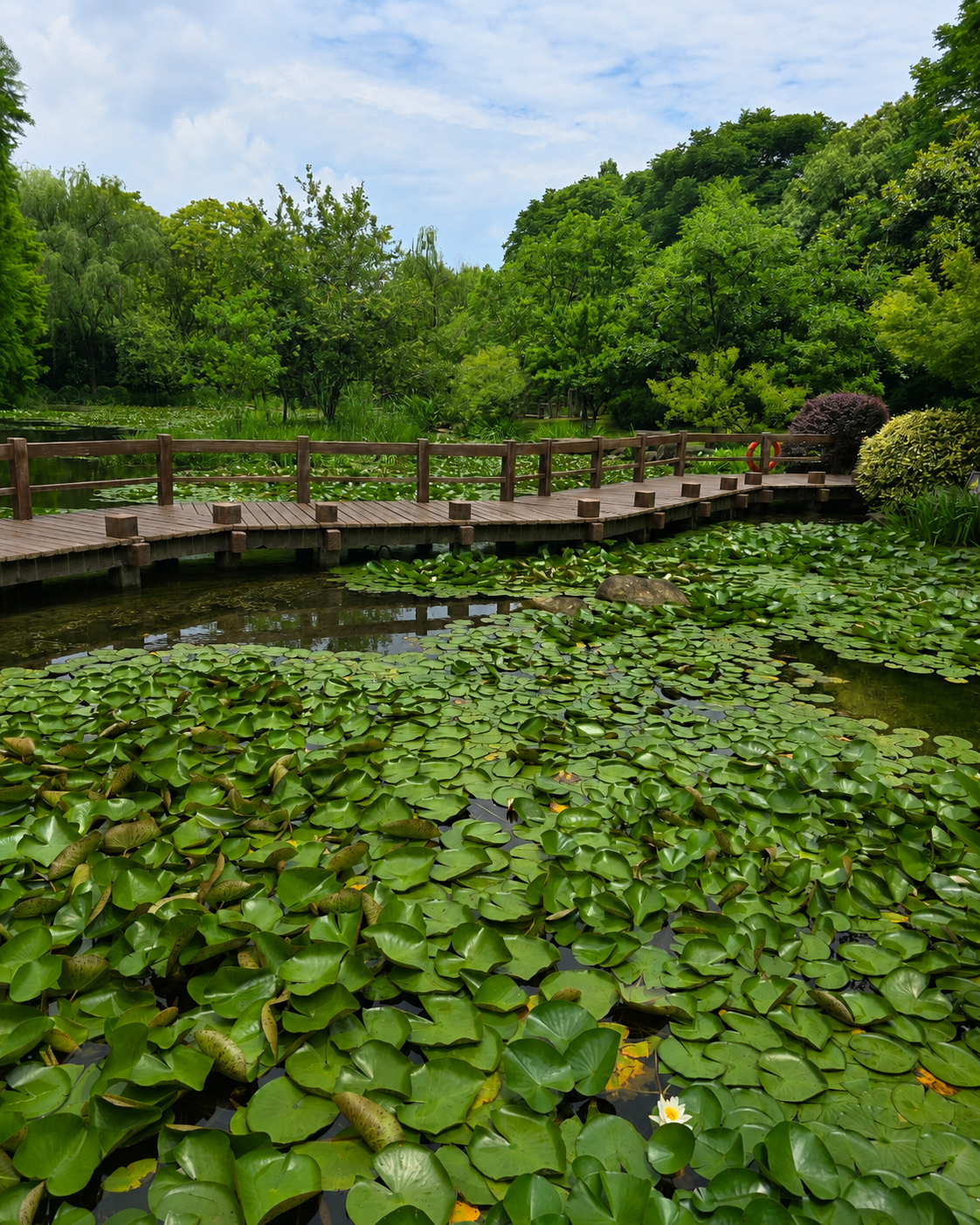
My confusion was not entirely accidental. Of the two plants, the lotus occupies a particularly deep place in Chinese culture. In Buddhist imagery, its ability to rise clean from muddy water made it a powerful symbol of purity. Over centuries it also came to represent qualities such as integrity and elegance, appearing repeatedly in Chinese painting, ceramics, textiles, poetry and religious art.
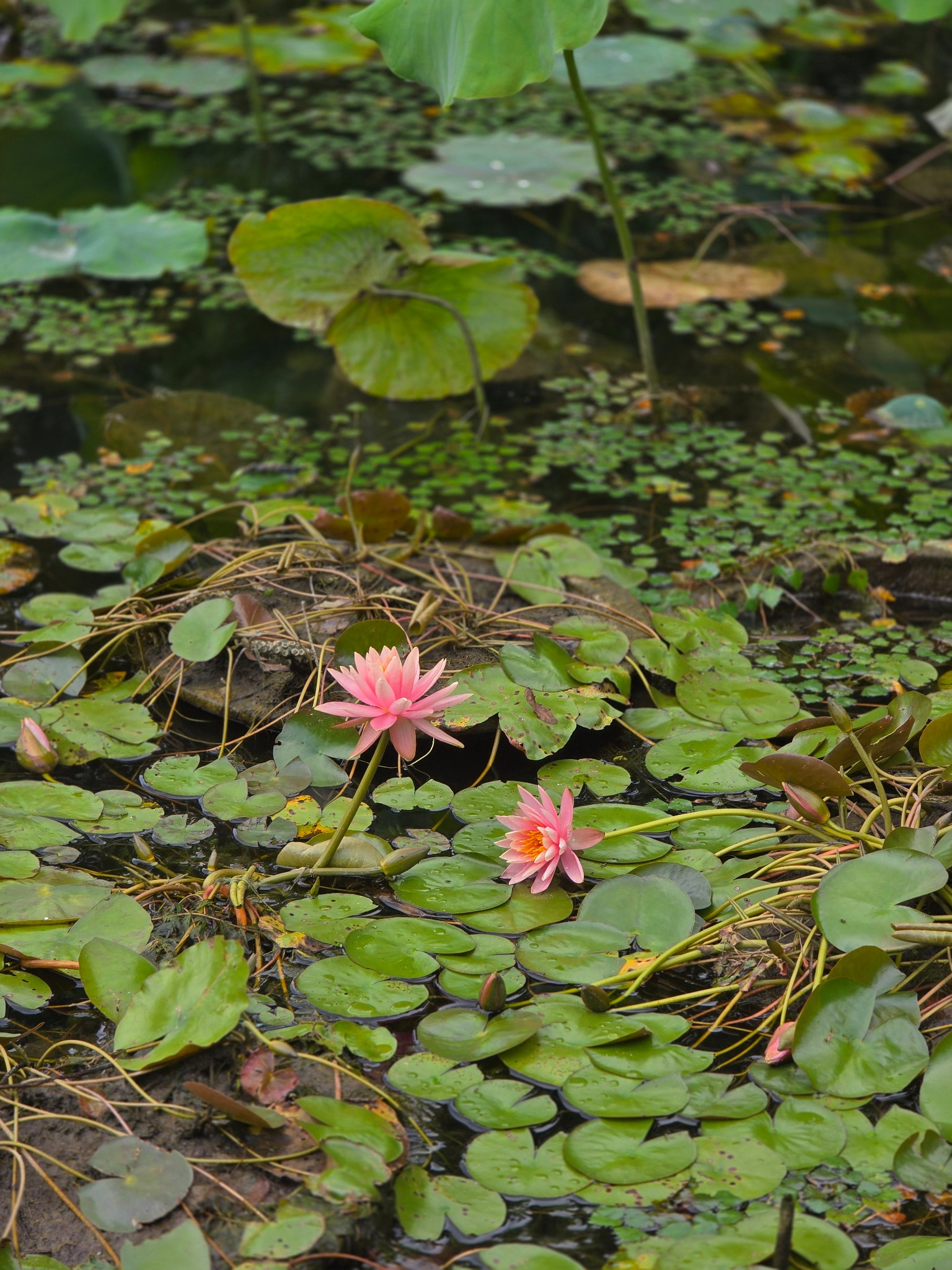
The distinction between lotus and water lily turned out to extend beyond botany. Lotus is also very much part of Chinese cuisine. Its crisp, perforated rhizome — usually called lotus root, although technically it is not a root at all — appears in soups, stir-fries and cold dishes, while the seeds are used in both savoury and sweet preparations. I am fairly sure I had already been served lotus root at the hotel before I understood what it was. I remember those unmistakable slices full of neat little holes rather better than the taste: it was perfectly edible, but I cannot pretend I particularly liked it.
Water lilies are a different story. Some species do have edible rhizomes or seeds, but they do not occupy anything like the same everyday culinary place in China. The lotus, in other words, managed to be a religious symbol, a landscape motif and something I had already pushed around my plate.

There was another correction waiting for me. This lush landscape was not an ancient ornamental garden. Changqiao Creek Water Ecological Restoration Park is modern environmental infrastructure disguised extremely well as scenery. Before its restoration, Changqiao Creek carried polluted water towards West Lake. In the early 2000s, the area was transformed using a combination of water-treatment systems, sedimentation and constructed wetlands, with aquatic plants helping to clean the water before it continued towards the lake.
In other words, one of the most traditionally Chinese-looking landscapes of my trip was also part of a modern water-treatment system.
That made the place more interesting, not less. I had walked into what looked like a timeless Chinese garden, stopped to photograph what I thought were lotuses, and eventually discovered that I had misunderstood both the plants and the landscape.
The beauty, it turned out, was also doing a job.

Leifeng Pagoda — A Legacy from Before Hangzhou Became Lin’an
The landscape around Leifeng belongs to a chapter of Hangzhou even older than the Southern Song capital I had introduced earlier. Between 907 and 978, this region formed the Kingdom of Wuyue, one of the states that emerged during China’s fragmented Five Dynasties and Ten Kingdoms period. Its capital was Qiantang, the city that would eventually become Hangzhou.
Wuyue left a particularly strong mark on the landscape around West Lake. Its rulers were major patrons of Buddhism and invested heavily in temples, pagodas and water management. The kingdom’s final ruler, Qian Hongchu, chose submission to the Song dynasty in 978 rather than risk a destructive war. Two monuments directly on my route traced their origins to his reign: Jingci Temple and Leifeng Pagoda.
The original Leifeng Pagoda was built in the 970s as a Buddhist monument connected with sacred texts and relics. It was first known as Huangfei Pagoda; the name Leifeng came later, from the hill on which it stood.
But the pagoda rising in front of me was not that tenth-century building. Not even close.
A Tenth-Century Pagoda Completed in 2002
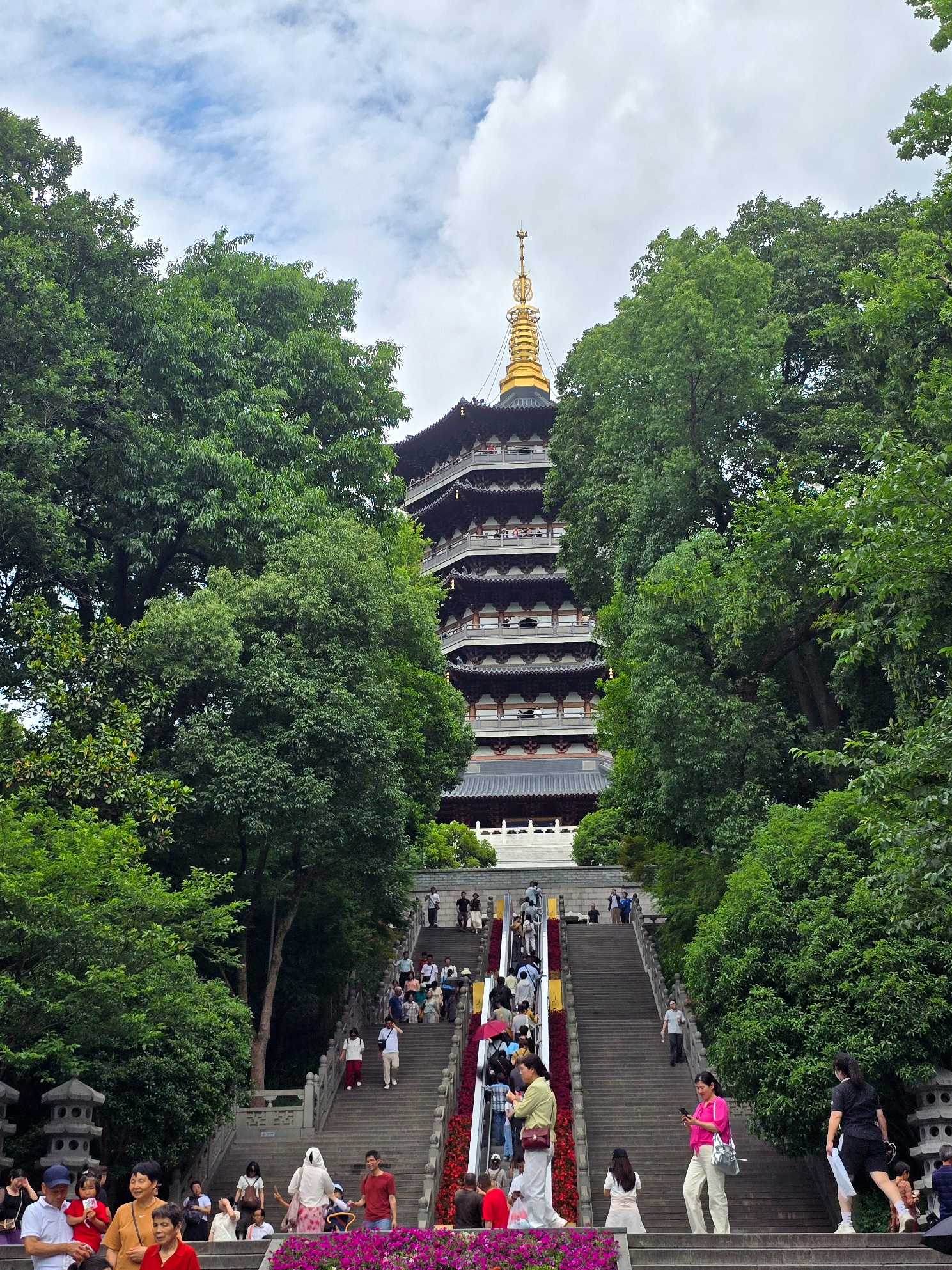
The original structure survived for centuries, but not intact. Fire and conflict destroyed its wooden elements, leaving the brick core exposed, while generations of visitors carried away bricks believed to have medicinal or protective powers. By the early twentieth century, what remained had become dangerously unstable. On 25 September 1924, Leifeng Pagoda finally collapsed.
The structure standing here today was completed in 2002, built directly above and around the archaeological remains of its predecessor.
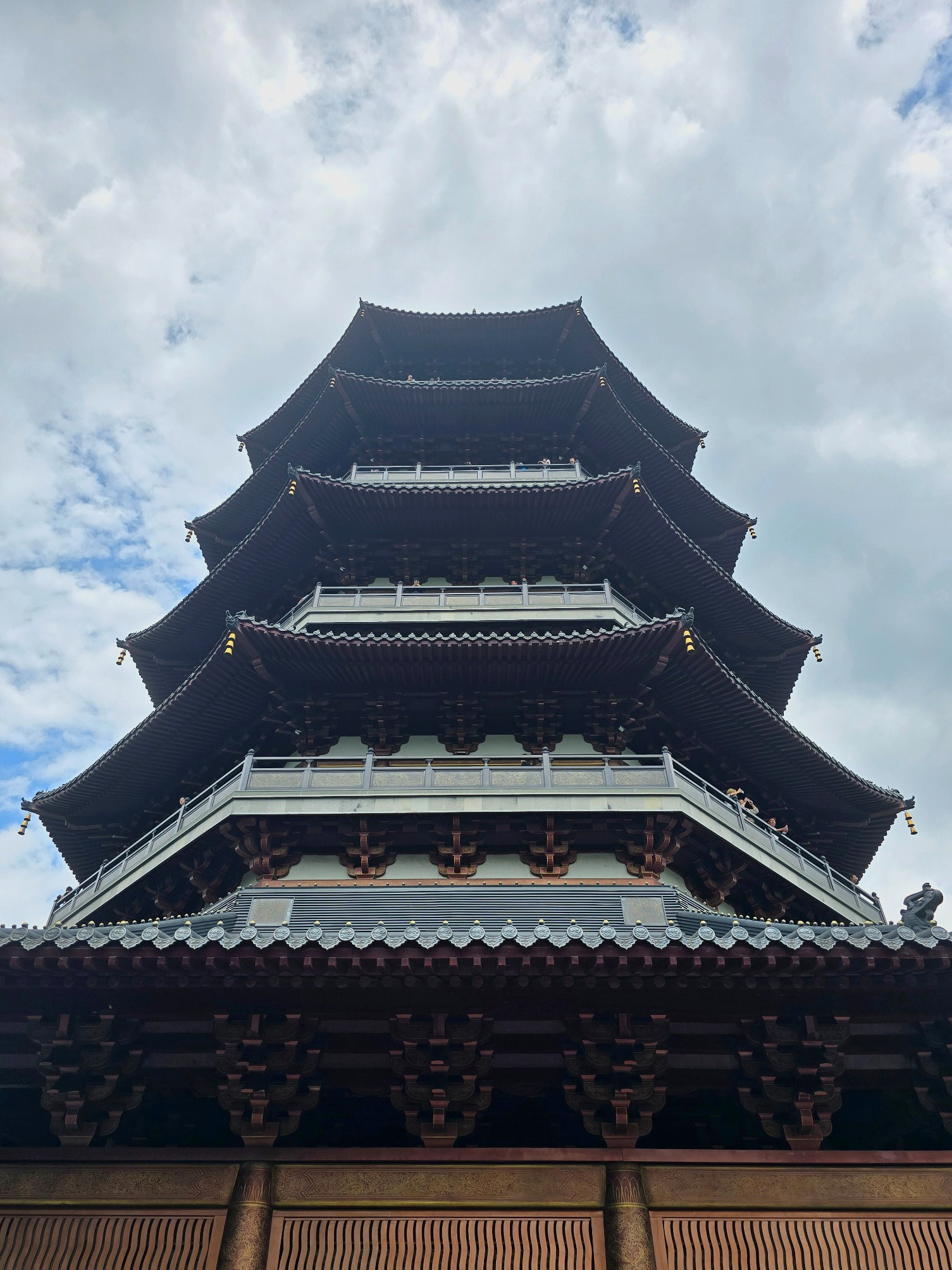
Excavations of the original foundations uncovered Buddhist texts and important religious objects from the Wuyue period, including a gilded silver Ashoka-style pagoda associated with a sacred relic. The modern building protects those remains while reconstructing the silhouette of the historic monument above them.
From the outside, it looks convincingly traditional. Step inside, however, and lifts, exhibition spaces and modern visitor facilities make it immediately clear that this is a twenty-first-century interpretation of a tenth-century monument.
I liked it. It is handsome, theatrical and — there is really no better word for it — extremely Instagrammable. But the best part was not the pagoda itself. It was the view from the top.
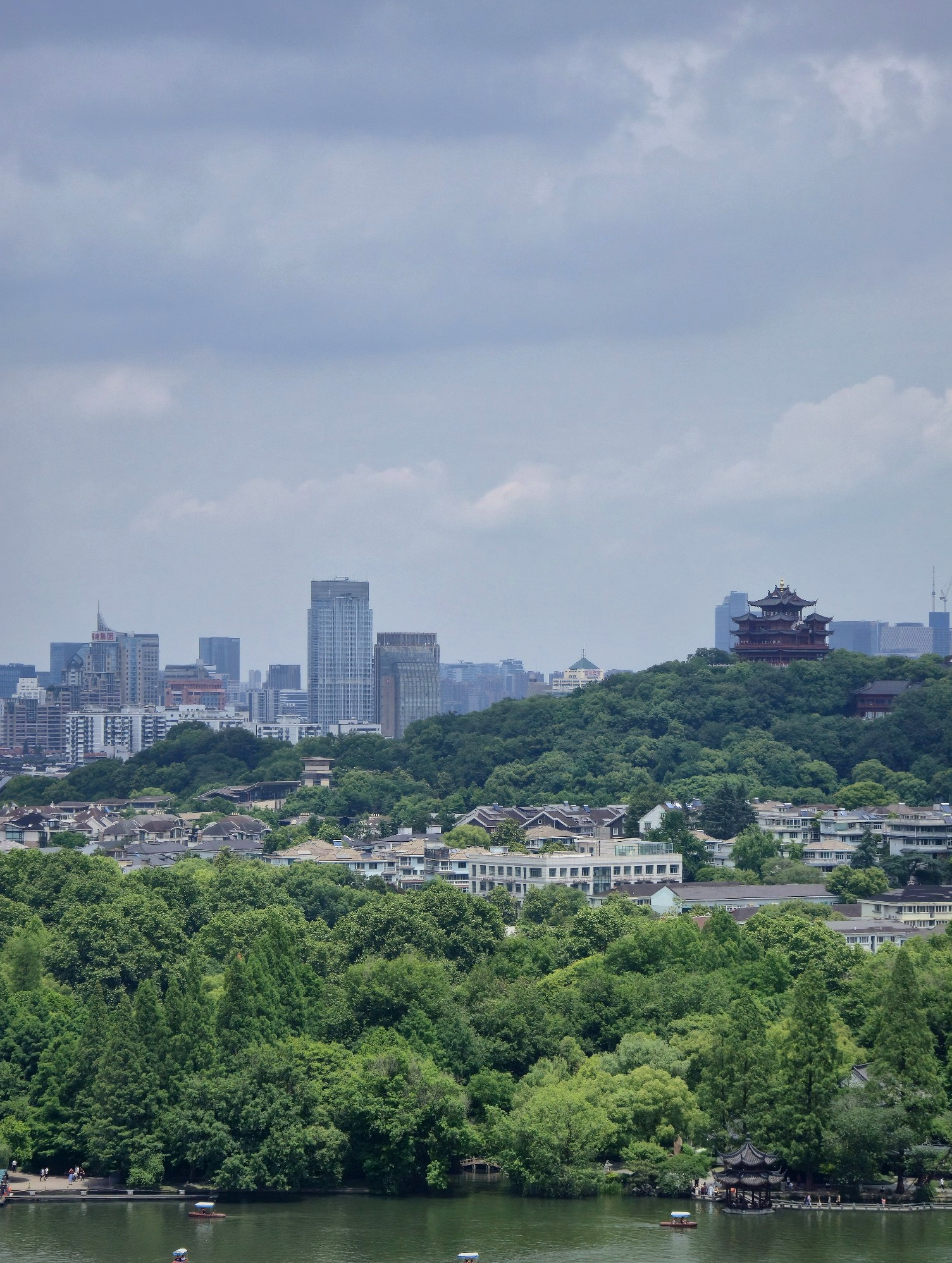
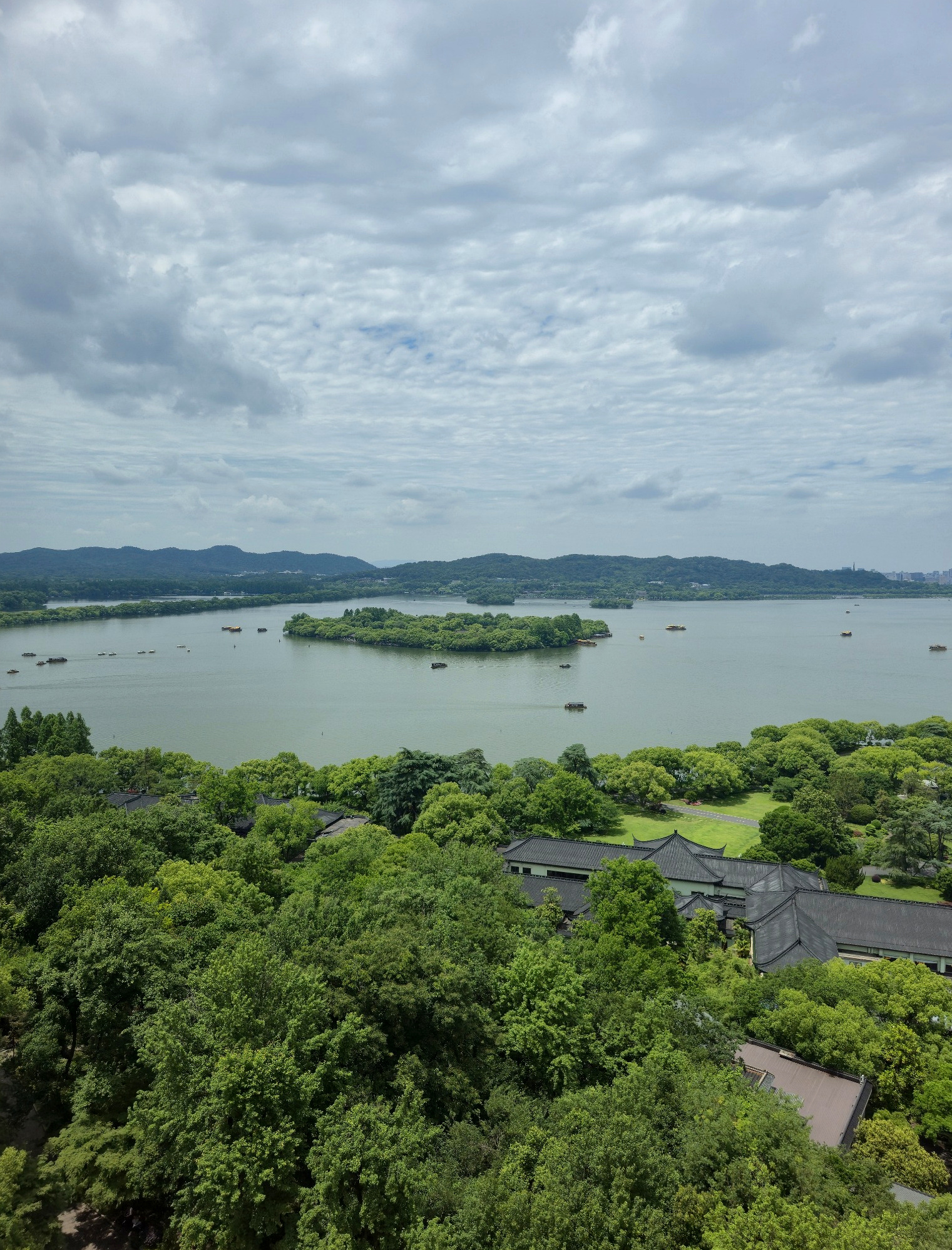
From the upper levels, the southern part of West Lake unfolded below as water, islands and dense vegetation, with the modern city appearing beyond them. Across Nanshan Road, another Buddhist complex climbed into the greenery beneath Nanping Hill.
That was Jingci Temple.
The Buddhist temple that lost to the temperature
Jingci was founded in 954, also during the reign of Qian Hongchu, making it older than Leifeng itself. Originally called Huiri Yongming Temple, it became an important Chan Buddhist monastery and, like many old religious sites in China, has been damaged and rebuilt repeatedly over the centuries.

It was exactly the sort of place I wanted to visit. Unfortunately, by this point I had already spent hours walking in the heat, and the temple continued inconveniently uphill. My interest in Buddhism remained genuine; my willingness to climb another slope did not. I photographed it from Leifeng and moved towards the lake.
Jingci is connected with Evening Bell Ringing at Nanping Hill, one of the Ten Scenes of West Lake introduced earlier. The famous “scene” is therefore not simply the temple itself but the experience of its bell carrying through the landscape towards the water. The present large bell is modern, but the cultural association between Jingci, Nanping Hill and the evening sound of the bell is centuries old.
Missing the interior consequently became one of the few decisions in Hangzhou that I would genuinely like to correct on another visit.
A white snake beneath Leifeng
Leifeng has also acquired a cultural life completely separate from its Buddhist origins through The Legend of the White Snake, one of China’s best-known traditional stories. In its familiar versions, Bai Suzhen, a white snake spirit who takes human form, falls in love with the mortal Xu Xian. Their relationship is opposed by the Buddhist monk Fahai, and Bai Suzhen is eventually imprisoned beneath Leifeng Pagoda.
The story also connects with Broken Bridge on the northern side of West Lake, another famous location in the legend. Its different versions evolved through storytelling, theatre, opera and literature over many centuries.
Historically, however, the sequence is important: Leifeng Pagoda was not built because of the White Snake. The pagoda was already centuries old when the legend became attached to it.
I retained almost none of this while standing there. What remained with me was much simpler: Leifeng was photogenic from close range, the view from its upper levels was excellent, and the pagoda looked even better once I was back at water level.
The one place that still wanted cash
The next stage required a boat, and the peaceful image of West Lake briefly collapsed at the pier. This was where the largest crowds of the day seemed to have concentrated, all attempting to board within the same limited area.
The ticket also produced one of the stranger payment moments of the trip. After days in China during which Alipay seemed to have made physical cash nearly obsolete, the boat was one of the few places where cash suddenly became useful. I did not have the right amount, so the seller solved the problem by having me transfer money to his private Alipay account, after which he paid for the ticket himself.
Even the cash-only transaction had somehow become digital.
Once the boat moved away from the pier, the crowd disappeared from the experience almost immediately.
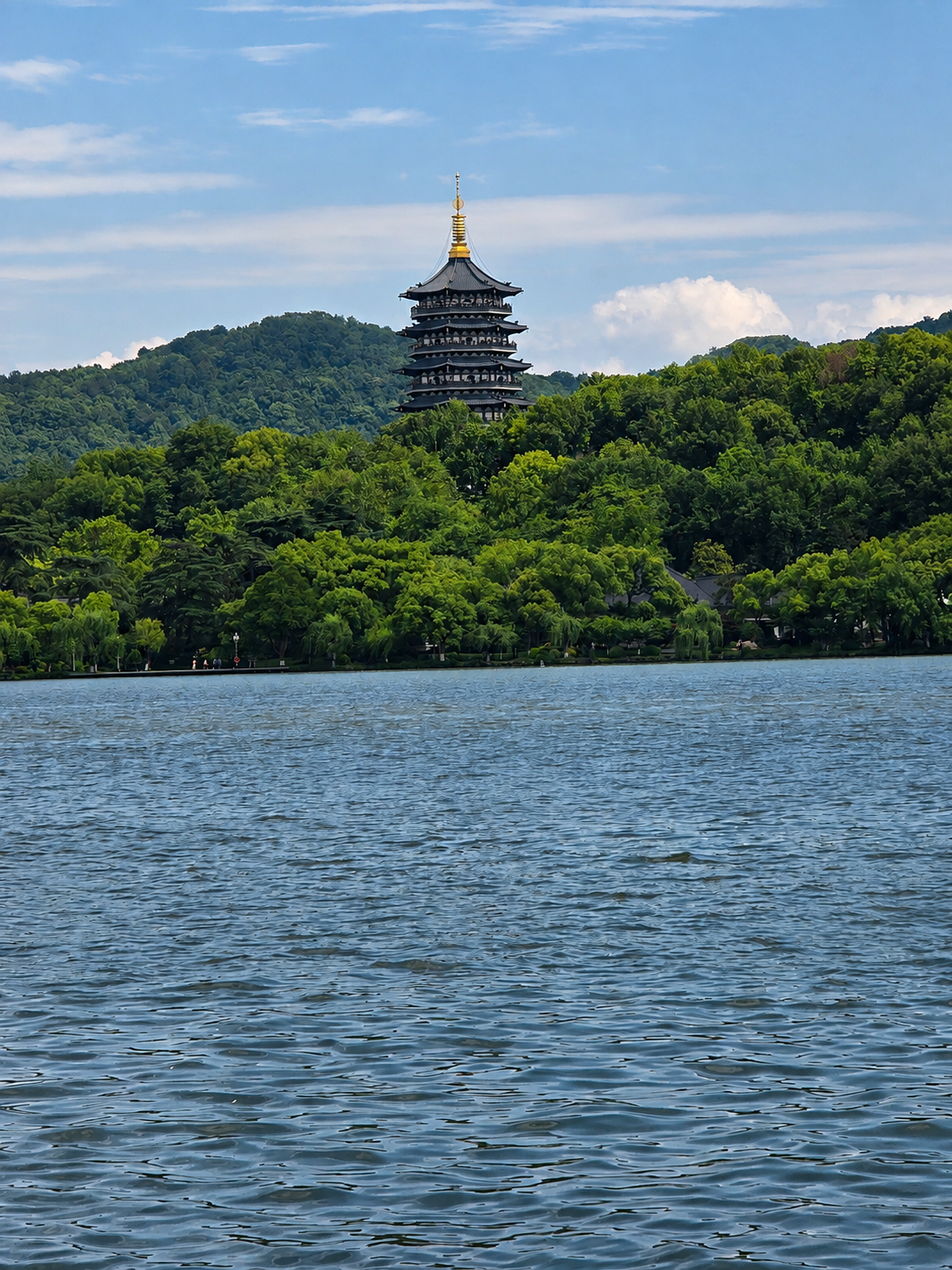
This was the point at which I stopped concentrating on the next attraction and simply looked. Leifeng returned to the green hillside, Jingci settled beneath Nanping Hill, islands interrupted the water and the skyline appeared only intermittently beyond the vegetation.
For the first time, Hangzhou felt like a single landscape rather than a succession of sights. What had looked impressive individually became more convincing when seen together. The pagoda was better from the lake precisely because it was no longer just a building; it had become part of the composition that West Lake had been designed to create.
Despite the crowds on shore, the water itself felt unexpectedly calm.
Three Pools Mirroring the Moon
The boat brought me to Xiaoyingzhou, one of West Lake’s three principal islands and the setting of Three Pools Mirroring the Moon, another of its Ten Scenes.
The island is itself a piece of landscape engineering. Paths and embankments divide internal ponds and create the often-described effect of “a lake within an island and an island within a lake.” Seen from above, parts of the layout roughly resemble the Chinese character 田.
I had expected something rather more mystical. What I found was attractive, green and pleasant, but not immediately transcendent. Its significance became clearer only after I learned the history behind the three small stone towers standing in the water nearby.
That history leads to Su Shi, also known as Su Dongpo, one of China’s most famous poets and a Song official who served in Hangzhou. In the late eleventh century, he organised major dredging of West Lake to combat silting and excessive aquatic growth. Material removed from the lake helped form the Su Causeway, while markers were placed in the water to control where aquatic cultivation was permitted.
Those markers are usually regarded as predecessors of the Three Pools towers, although the existing stone structures are later rather than Su Shi’s originals. Their circular openings became associated with the famous moonlit scene: traditionally, lantern light inside the towers and the reflection of the real moon combine with the water to produce multiple glowing circles.
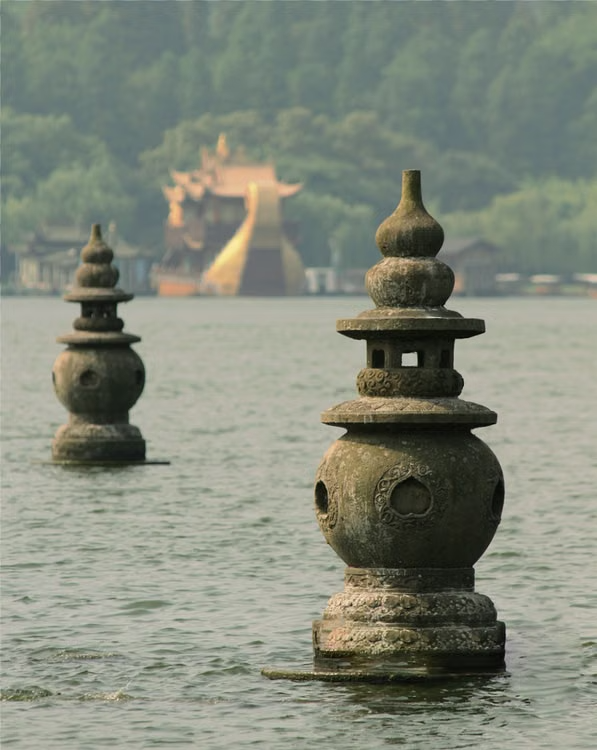
The exact optical interpretation varies between accounts, which is probably preferable to the suspiciously precise tourist claims about producing thirty-something moons.
One detail is indisputable: Three Pools Mirroring the Moon appears on the reverse of the one-yuan renminbi banknote.
I had arrived because the island happened to be a convenient boat destination and discovered afterwards that I had been walking through one of the most reproduced landscapes in China. At the time my verdict had been rather less ceremonial: it was nice.
Pagodas in the afternoon, Chanel at night
After returning to the hotel and recovering from the heat, I went out again in the evening. This time I stayed around Wulin, and the change of scenery could hardly have been greater.

Within a few hours, water lilies, Buddhist temples and pagodas had been replaced by illuminated towers, LED façades and international luxury brands. Yet Wulin did not make the historical Hangzhou I had spent the afternoon exploring feel false. It did the opposite: it confirmed that those landscapes belonged to a living metropolis rather than to an isolated historic town.
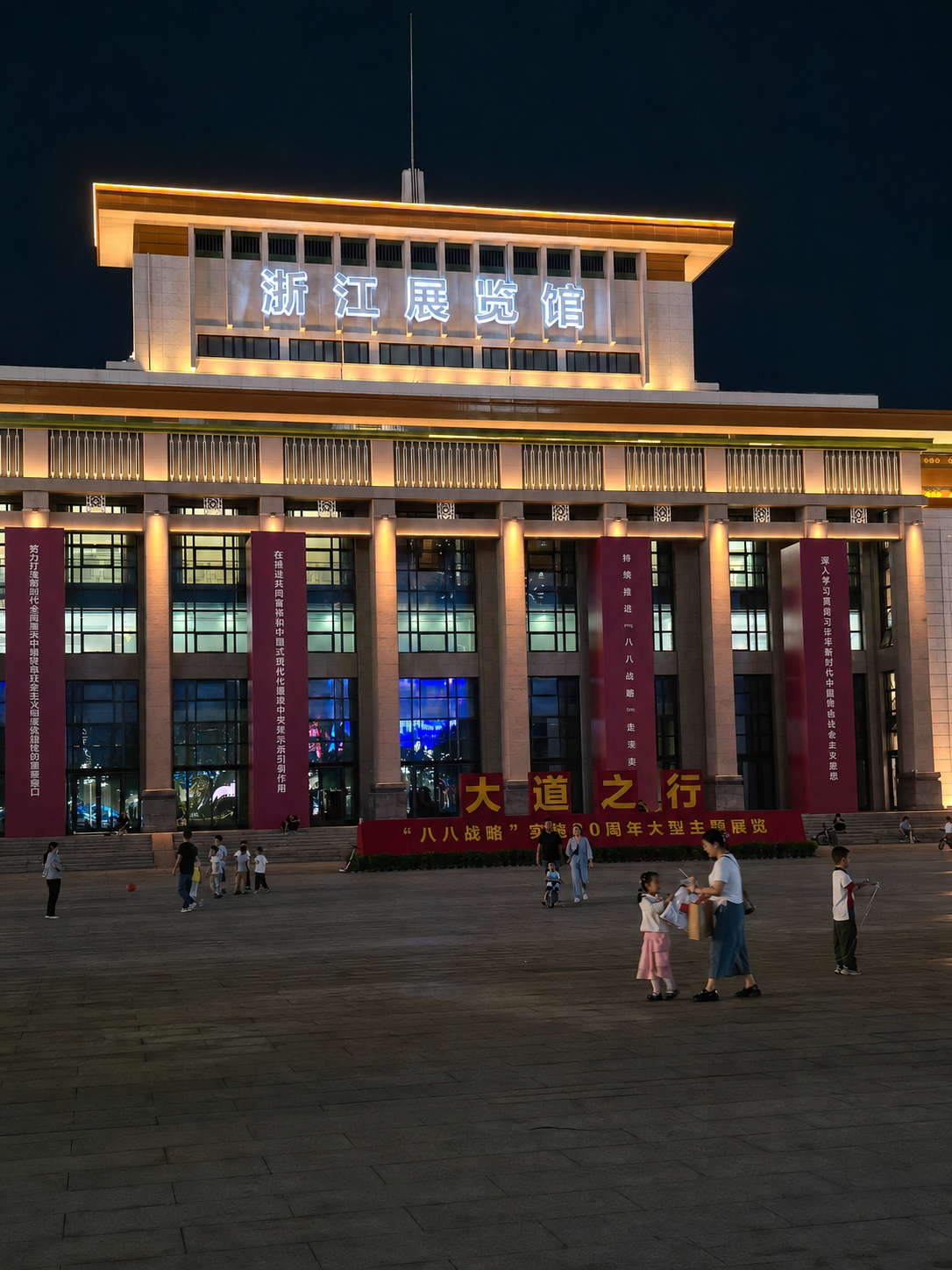
Around Wulin Square, the city presents several different stages of its modern development. The monumental Zhejiang Exhibition Hall dates from the 1960s, while the nearby Hangzhou Tower complex became one of the city’s established centres of luxury retail. More recent architecture includes GDA Plaza, with its rounded LED-covered tower.
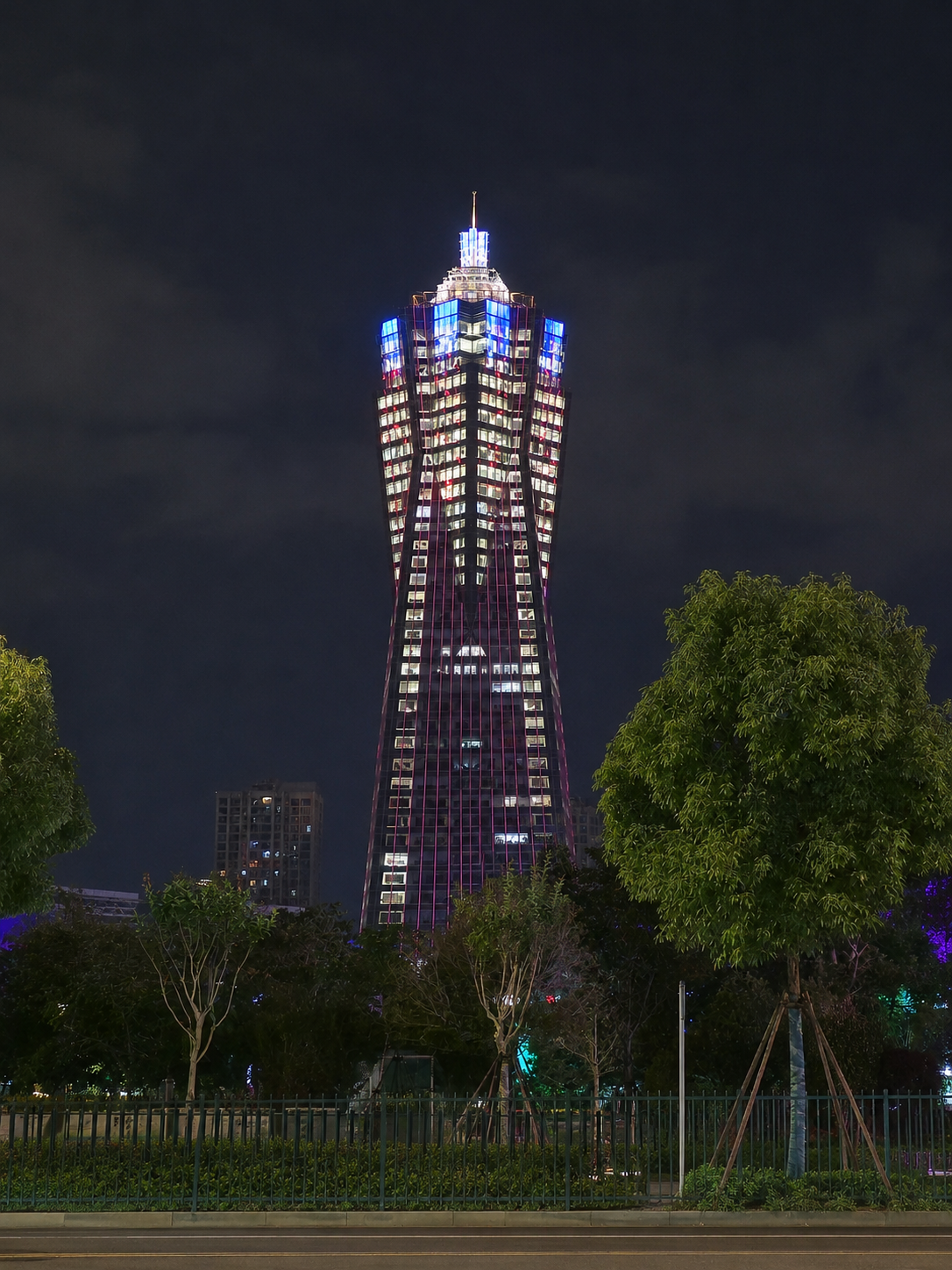
A little farther north lies West Lake Cultural Square, dominated by the roughly 170-metre Zhejiang Global Center, one of the most distinctive contemporary landmarks in this part of Hangzhou.
I liked the contrast. Hangzhou did not require a choice between historical China and contemporary China. Both were operating at the same time, sometimes only a few kilometres apart.
The capital hidden under the modern city
The conference occupied most of 18 May, leaving the evening for Qinghefang and the Southern Song Imperial Street.
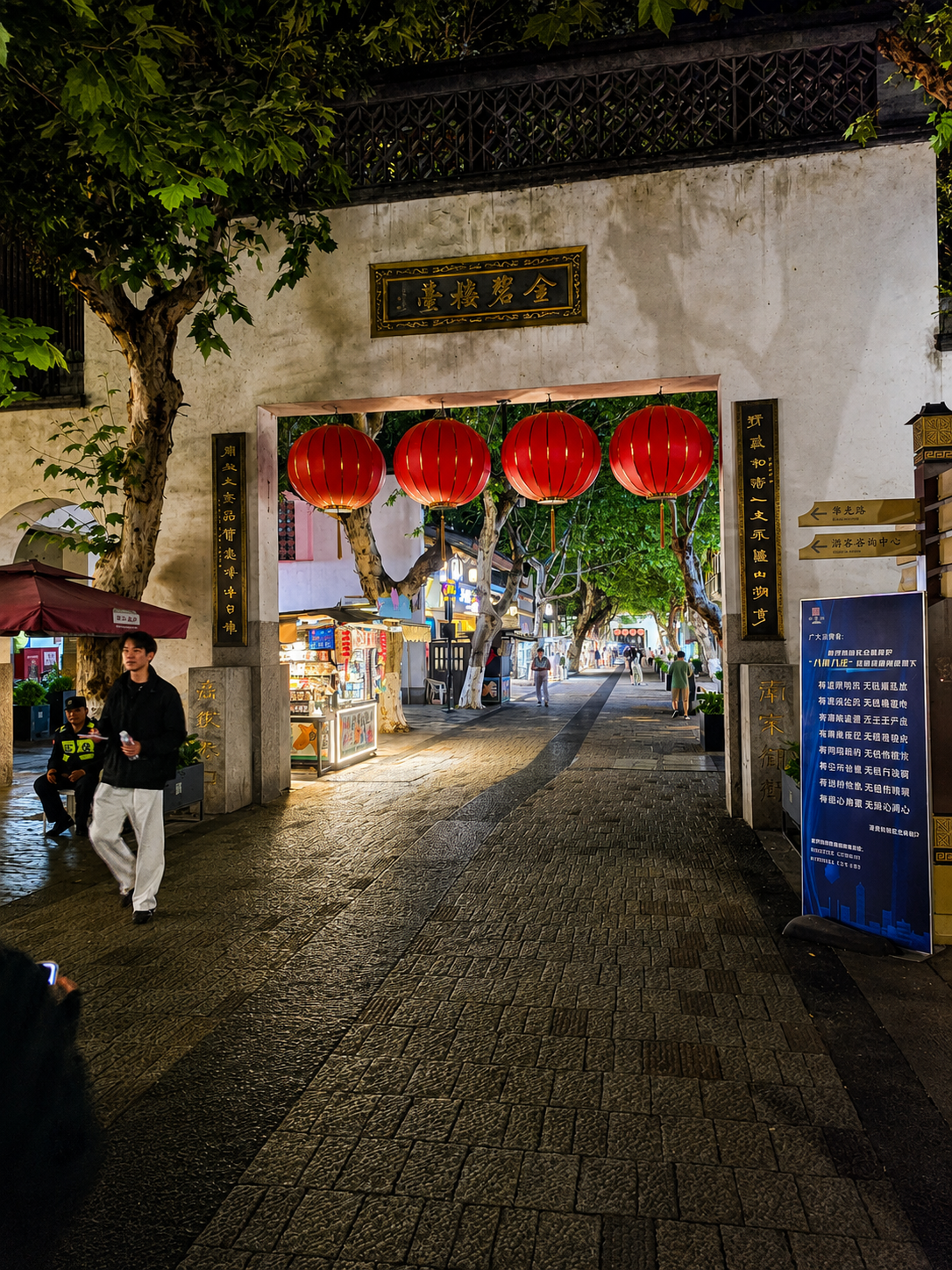
The first impression was somewhere between authentic old city and carefully restored tourist set. That turned out to be a surprisingly accurate description.
Qinghefang lies within the historic core of Southern Song Lin’an. When the imperial court established itself here in 1138, the city expanded into one of the greatest urban centres of the medieval world. By the thirteenth century, estimates suggest that its population may have approached two million. The imperial palace stood farther south around Phoenix Mountain, while a major north–south street linked the palace zone with the commercial city.
Today’s Southern Song Imperial Street follows part of that historic axis.
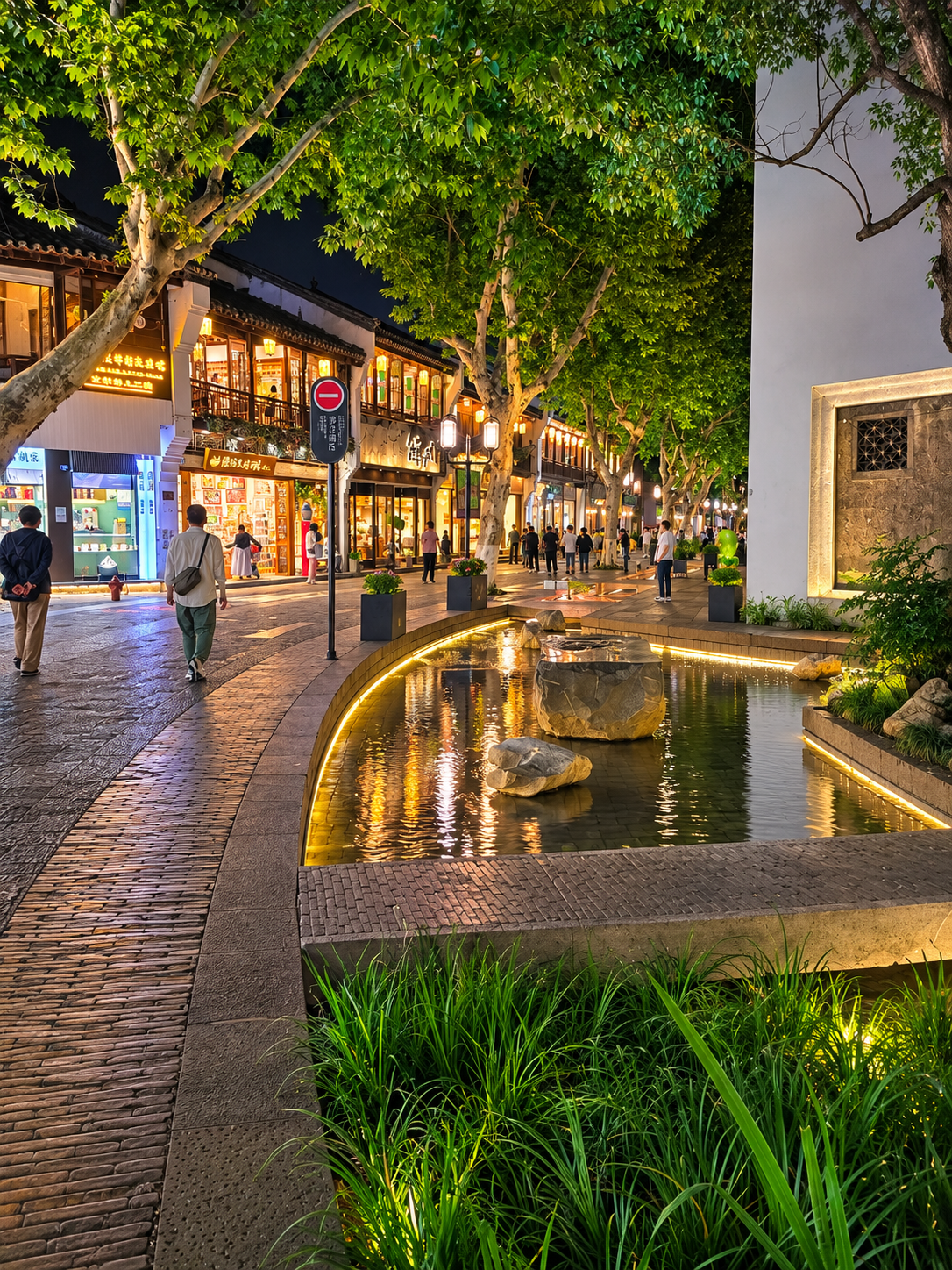
But this is not a preserved thirteenth-century street. Much of Southern Song Hangzhou survives below the modern city as archaeology: sections of walls and gates, roads, drainage and water systems, palace remains, temples, workshops and kilns have been excavated over time.
Qinghefang’s present appearance is itself layered. Major restoration and redevelopment around the turn of the twenty-first century preserved some older structures, reconstructed others and deliberately recreated the atmosphere of traditional Hangzhou. Parts of the Southern Song Imperial Street revitalisation were associated with Hangzhou architect Wang Shu, who later won the Pritzker Prize in 2012.
So the feeling that I was walking somewhere between history and reconstruction was not a failure of authenticity. It was essentially the story of the place.
Eight centuries of shopping
Perhaps the strongest continuity here is not architecture but commerce. The area around Imperial Street was already filled with merchants, workshops and services during the Southern Song era, and Qinghefang remained a commercial district under later dynasties.
Some businesses in the area genuinely have long histories. The traditional Chinese pharmacy Hu Qing Yu Tang, for example, dates from the nineteenth century, while other old Hangzhou businesses trace their origins even further back.
My contribution to centuries of commercial continuity was modest but respectable: magnets, a traditional Chinese hand cream and sweets to take home.
I liked Qinghefang precisely because it was not frozen into a museum. It was restored, commercialised and touristy, certainly, but people were still using the streets for essentially the purpose that had sustained them for centuries: walking, looking into shops and buying things.
Among all the historic façades, however, the architectural detail I remembered best was much less important.
The green doors
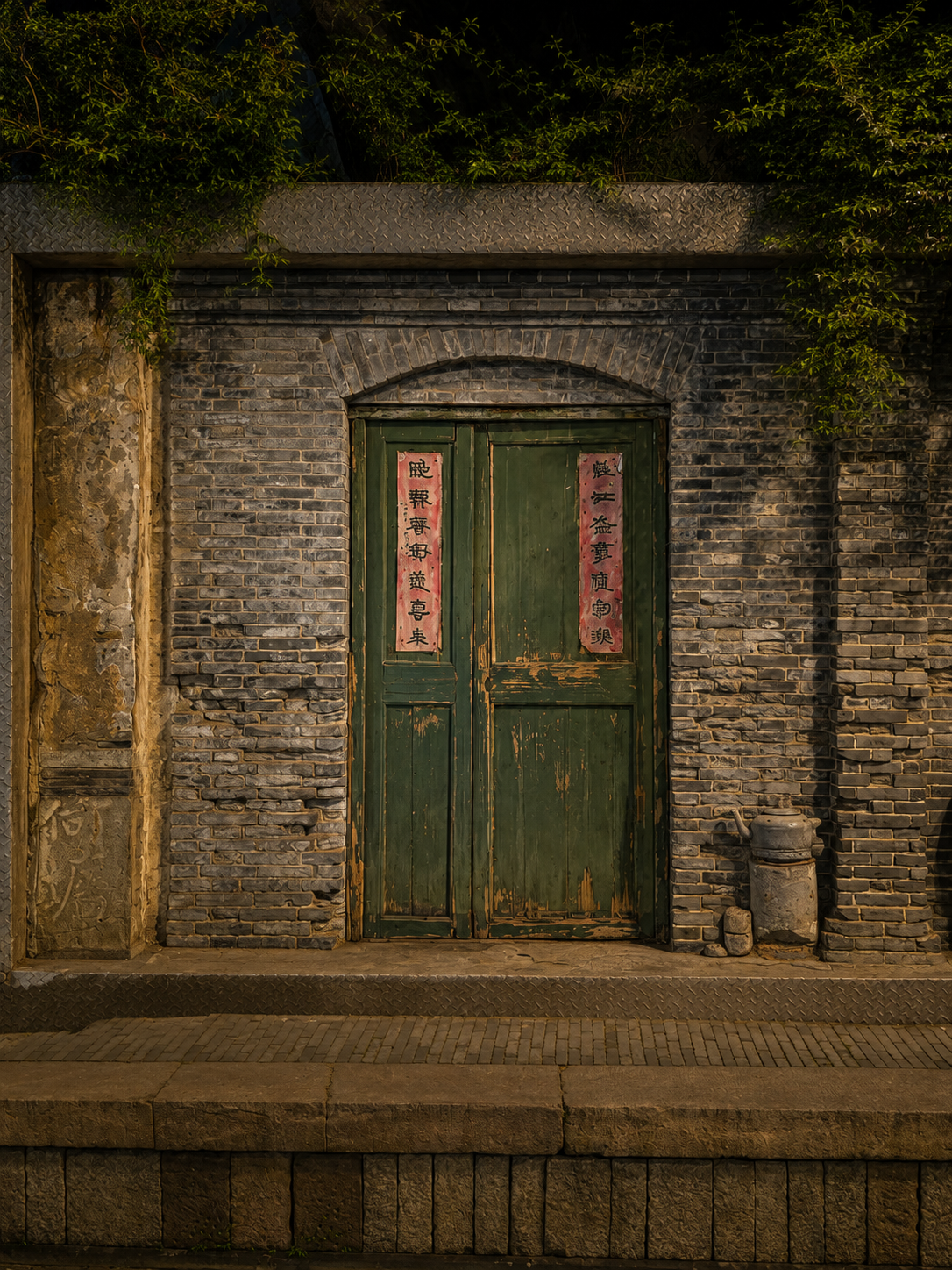
They were simply a particularly good pair of green doors.
I do not know whether they belonged to an important building, and I see no reason to manufacture a historical significance for them simply because I photographed them. I liked the colour, proportions and way they sat within the wall.
After Wuyue kings, Southern Song emperors, Buddhist relics and urban archaeology, several centuries of Chinese history had lost the battle for my attention to a pair of doors. Travel has its own hierarchy.
More China than Shanghai
By the time I left Hangzhou, the dark first evening on West Lake seemed very distant. Over only a few days, the city had revealed illuminated pavilions, Buddhist pagodas, wetlands, temples, islands, restored commercial streets and an urban skyline that could switch from tenth-century symbolism to Chanel without much warning.
Almost every place also turned out to be more complicated than its first appearance suggested. Chenghuang Pavilion looked historic but dated from 2000. Leifeng was a modern reconstruction protecting genuine tenth-century remains. The idyllic wetland near the Silk Museum was also a water-treatment system. Qinghefang occupied authentic historic ground while wearing substantial layers of modern restoration.
None of those discoveries made Hangzhou less convincing. They made it more interesting.
Shanghai had fascinated me, but its Bund, former concessions and strongly international architectural identity produced a very different first image of China. Hangzhou came much closer to the China I had imagined before arriving — and then complicated that image in ways I had not expected.
It also left several obvious reasons to return. I never properly explored the Buddhist temples around the lake, and I somehow managed to spend several days in Hangzhou without drinking a serious cup of West Lake Longjing, one of China’s most celebrated green teas. The tea-growing villages west of the lake, particularly Longjing and Meijiawu, therefore remain firmly on the list. Next time, the priorities are straightforward: temples and tea.
With Qinghefang, however, my sightseeing of Hangzhou was essentially over. The following morning brought one final stop, Hangzhou Silk City, but that belongs to a different story — the one in which a museum visit unexpectedly turned into an education in Chinese silk, neckties and shopping.
After that, I collected my luggage and returned to Shanghai, ready to pick up the sightseeing I had only begun before coming to Hangzhou.

I had come to Hangzhou because a conference happened to be there. I left wanting to return because the city had given me exactly the China I thought I had come to see — pagodas, temples, water, old streets and all — and then made almost every one of those images more complicated and more interesting once I understood what I was actually looking at.
