Search for travel blog examples and you get the same rounded-up giants every time — million-reader operations with staff writers and a decade of head start. They're pleasant to admire and useless to learn from, the way an Olympic final is useless as a training plan. This page goes the other way: four real, currently active travel blogs, ordinary size, one person behind each, with what every one concretely gets right and one lesson worth stealing.
Full disclosure before the list starts: all four run on TravelFeed, which is our platform. These are our members, we're showing our customers' work, and naturally we picked blogs that make us look good — read everything below knowing that. The lessons themselves transfer anywhere; steal them for whatever platform you end up choosing. Screenshots and details are current as of July 2026.

1. WandeRein — a diary with a voice
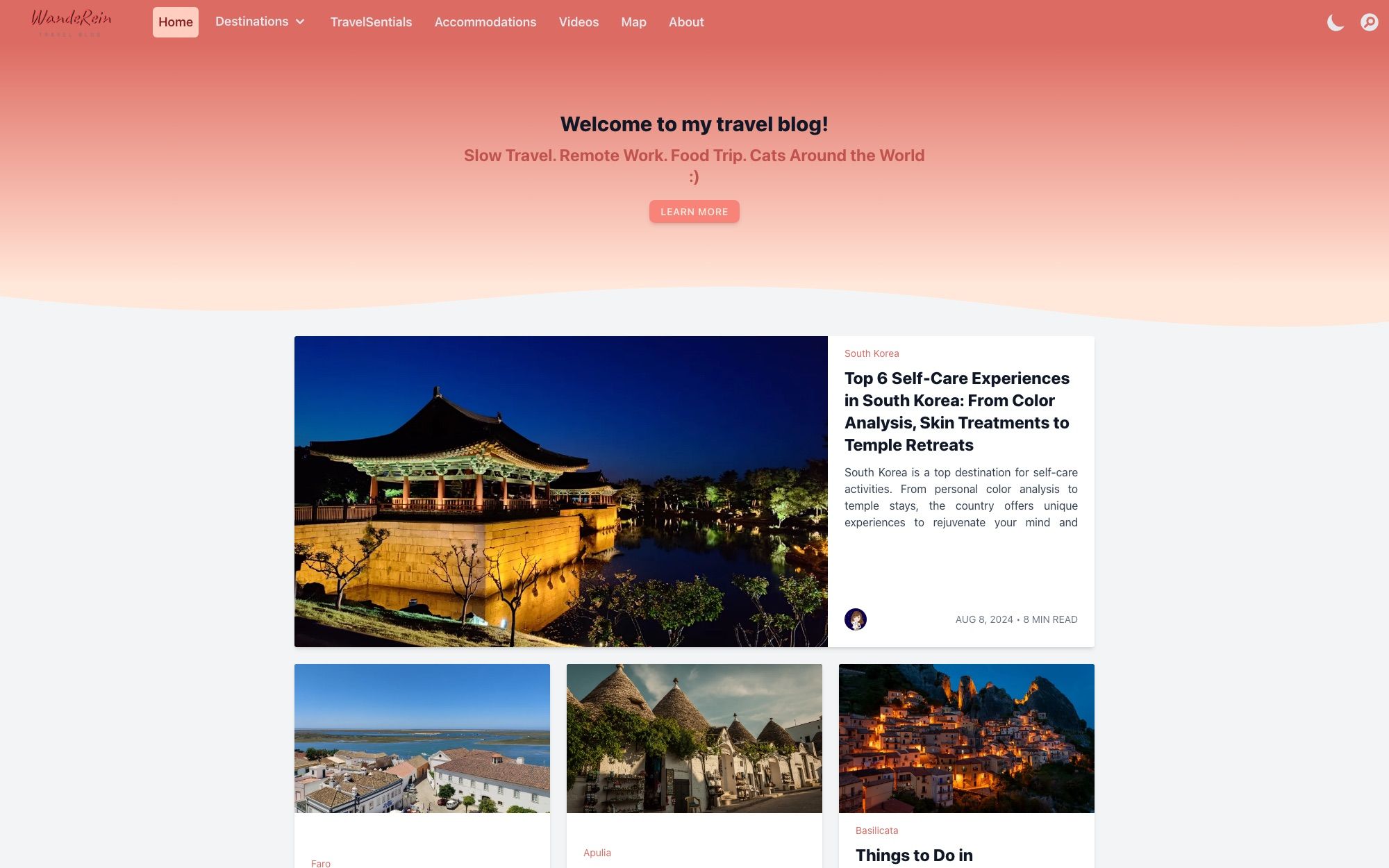
WandeRein is Rein's travel diary, and the tagline does more work than most about pages: "Slow Travel. Remote Work. Food Trip. Cats Around the World :)" — smiley included. That's an entire editorial policy in nine words. Before you scroll a single post you already know the pace will be slower than a bucket list, that food gets equal billing with sights, and that any cat encountered along the way will be documented.
The recent archive keeps the promise. There's a run of posts on self-care experiences in South Korea — a personal color analysis, skin treatments, a temple retreat — alongside Faro in Portugal, the trulli houses of Apulia, and Castelmezzano at night in Basilicata. A running "TravelSentials" section handles the remote-work logistics, a dedicated accommodations section collects the places she's stayed, and the blog itself lives on a custom domain with a warm coral wave hero and a dark-mode toggle. Rein moved here from WordPress after her old blog, in her words, "became unusably slow."
Steal this: the voice trio. Pick two or three obsessions, let them run through everything you publish, and keep one human tell (the cats). That combination is what makes an ordinary destination post read like a person instead of a guidebook — you could strip the header off a WandeRein post and still know who wrote it.
2. Klub Włóczykijów — a body of work in three languages
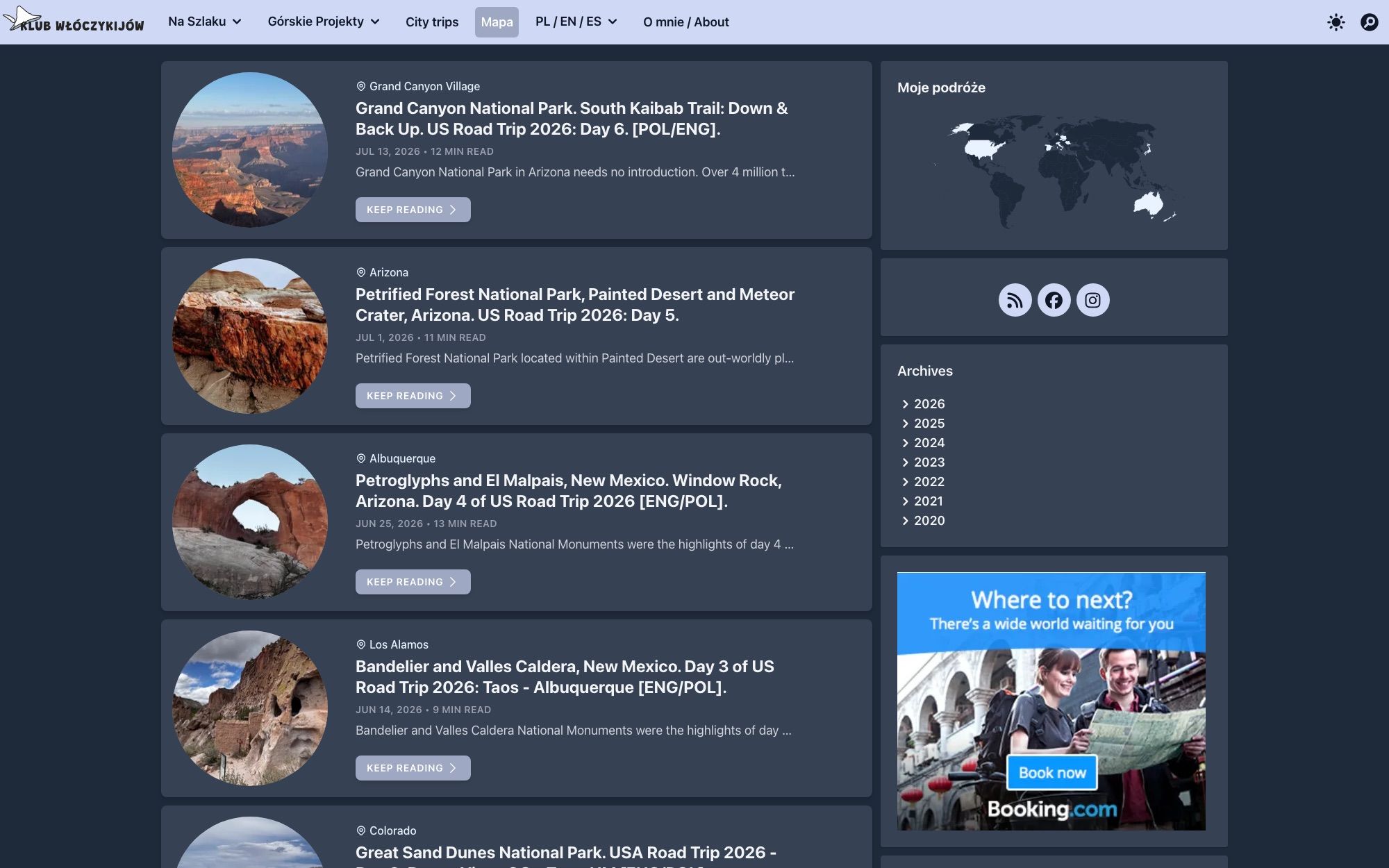
Klub Włóczykijów — Polish for roughly "Wanderers' Club" — publishes in three languages, with a PL/EN/ES switcher sitting right in the navigation. The blog is currently mid-series on a 2026 US Southwest road trip: the South Kaibab trail into the Grand Canyon, Petrified Forest and Meteor Crater, petroglyphs in New Mexico, Bandelier, the Great Sand Dunes. Titles carry a workmanlike [POL/ENG] tag, posts run nine to thirteen minutes, every one is geotagged, and a travel map widget ties the route together. The archives reach back to 2020.
Two honest details worth noticing. First, the whole operation runs on the truvvl.blog subdomain that comes included with TravelFeed hosting — no custom domain, six years in, and it plainly hasn't stopped anyone. Proof you don't need to buy a domain on day one. Second, there's a Booking.com affiliate banner in the layout: members monetize however they like, and this is what that looks like in the wild — the realistic economics behind it are in how to make money with a travel blog.
Steal this: cadence compounds. The impressive thing about Klub Włóczykijów isn't any one post — it's what the posts add up to: a running series with dates, a map that fills in as the trip progresses, and six years of archive behind it. That's what turns a blog into a body of work, and no single post, however good, can do it alone.
3. Beskidzkie Wędrówki — one mountain range, owned outright
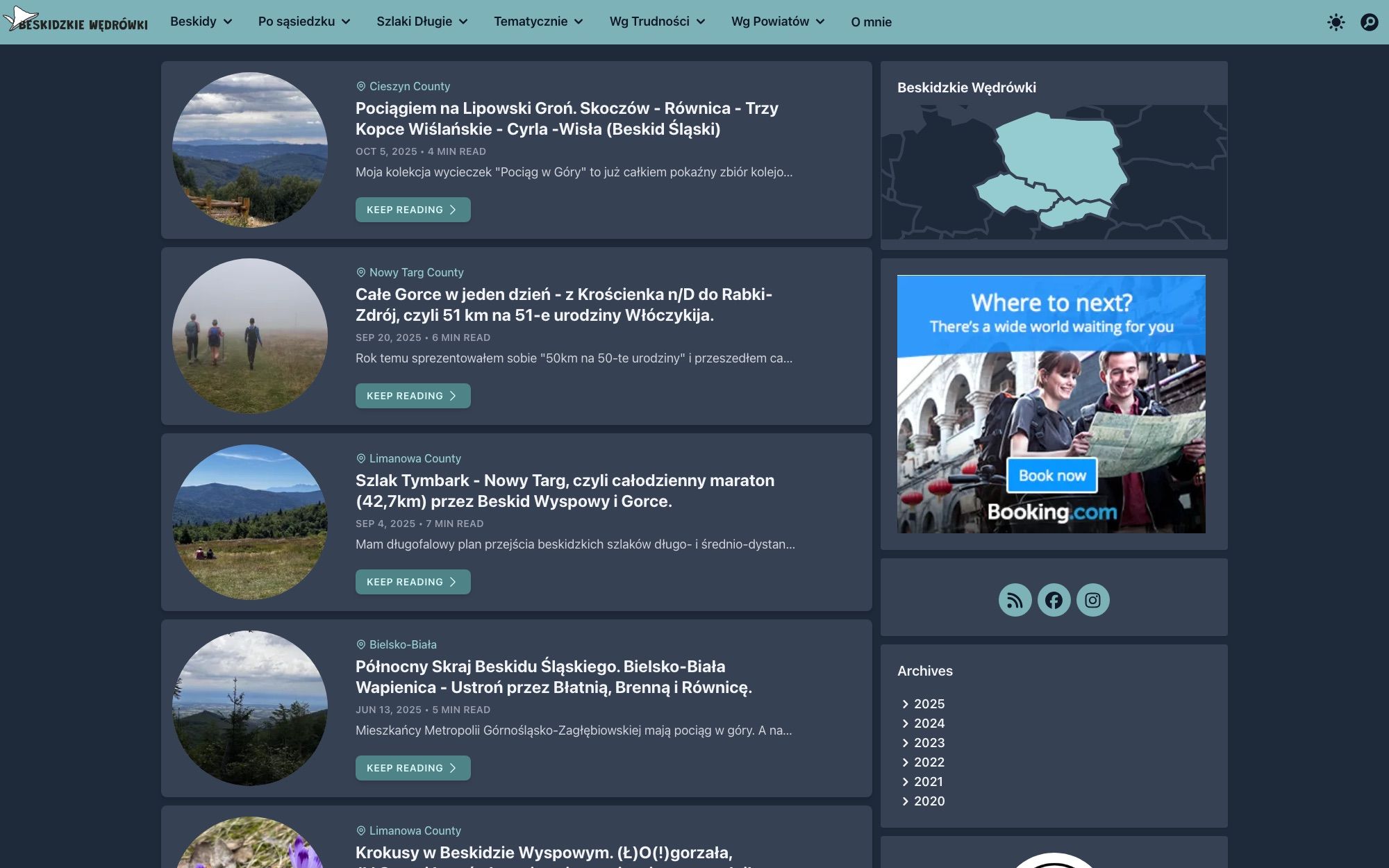
Beskidzkie Wędrówki — "Beskid Wanderings" — is a Polish hiking blog about essentially one mountain region, the Beskids, plus its immediate neighbors. That constraint produces the most interesting navigation of any blog on this page: posts are organized by mountain range, by county, by difficulty, and by long-distance trail. It's a taxonomy no general travel blog could sustain, because no general travel blog knows one place this well. The archives run 2020 to 2026, with entries like the whole Gorce range in a single day — 51 kilometers for the Wanderer's 51st birthday. Like Klub Włóczykijów, it runs happily on the included subdomain.
Steal this: niche down further than feels safe. "Hiking the Beskids" beats "travel blog" in every way that matters — it can own its topic completely, its archive gets deeper instead of wider, and a small-radius site is exactly what search engines and actual locals want to find. If your planned niche feels uncomfortably narrow, it's probably the right size; six years in, this blog has not run out of mountains.
4. Julian Peters Photography — the founder's own blog, judge accordingly
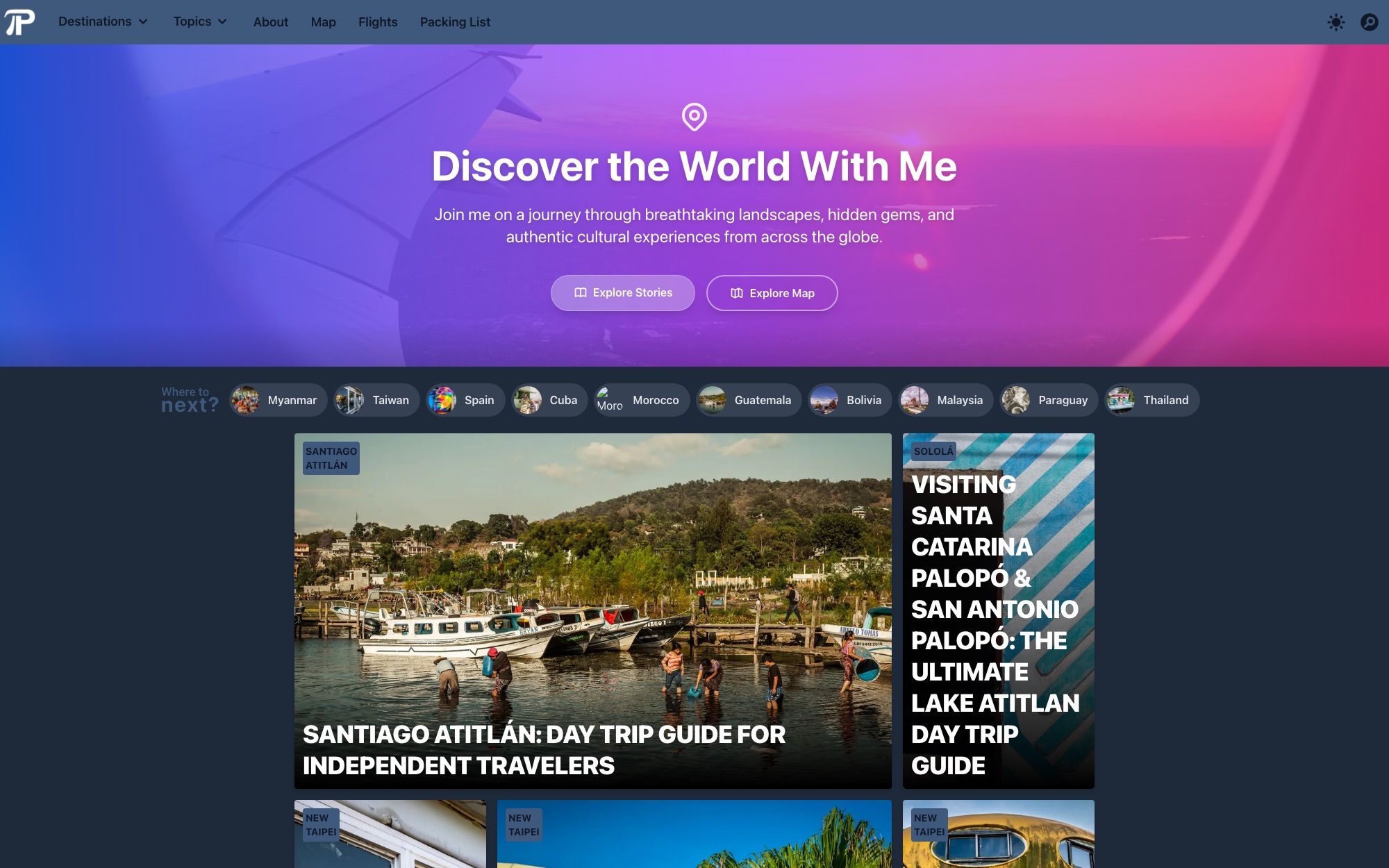
This one is mine, so hold it to a different standard: it's here because it shows what the platform does in the hands of the person who builds it, and you should grade it with that in mind. It's a photography-first blog — a gradient photo hero ("Discover the World With Me"), quick country chips for Myanmar, Taiwan, Spain, Cuba, Guatemala, Bolivia and others, day-trip guides written from Lake Atitlán, and dedicated Map, Flights and Packing List pages alongside the posts.
Steal this: photography-first blogs live or die by layout. Big images, magazine-style cards and a map are what turn an archive of trips into something a stranger will actually browse. If your photos are the product, the layout is the shop — a text-first template buries exactly the thing you're best at.
What these four blogs have in common
Different countries, different languages, different obsessions — but put them side by side and the same habits keep appearing:
- They own a niche. One region, one travel style, one persona. Not one of the four is a general "travel blog," and that's why each is findable.
- They keep a cadence. Series, archives going back years, trips documented as they happen. The compounding value is in the rhythm, not in any single post.
- They sound like someone. A tagline with a smiley, a birthday hike, a bilingual running series. The author is visible in every case — voice is a feature, not a liability, and being recognizably yourself is the one thing bigger travel sites can't copy.
- They put travel on maps. Geotags, map widgets, where-I've-been pages. Travel writing has a geography; blogs that expose it are more browsable and more useful.
- They started before they were ready. Two of the four still run on included subdomains instead of custom domains. None of them waited for a perfect setup to begin publishing.
- The name fits the blog. WandeRein, Wanderers' Club, Beskid Wanderings — you can guess what each one is about before your first visit.
None of this requires money or an audience to copy. All of it requires deciding what your blog is and then publishing like you mean it.
Start the fifth
One more disclosure that doubles as a lesson: every blog above got featured here because its owner kept publishing. TravelFeed's community curation surfaces members' work — that's the point of the platform. Write well and people see it from your first post, not after two years of shouting into a search index.
If you're starting from zero, how to start a travel blog is the full how-to. Still unnamed, the travel blog name generator checks the domain and username in one click, and there's a long list of travel blog name ideas if you'd rather browse than generate. If you're weighing where to build — our bias already on the table — the platform comparison covers ten options with real prices. And if what you actually want is family following one trip rather than a public blog, a tracker may honestly be enough: here's the Polarsteps head-to-head.
When you're ready, membership starts at $19/year. The next revision of this page will need a fifth example.
Frequently asked questions
What makes a good travel blog?
Three things show up in every blog worth reading. A niche small enough to own: one region, one style of travel, one obsession, rather than 'travel' in general. A voice that sounds like a person, not a tourism board — you should be able to recognize the writer with the header stripped off. And consistency: a posting rhythm kept up for years matters more than any single brilliant post. Design helps, but it's the least of the three.
What should my first travel blog post be?
Not an 'about me' page — nobody is searching for you yet, and the introduction post is the easiest to write and the least useful to publish. Start with one specific trip story or guide only you could write: a hike you actually did, the mistakes of your last trip, the neighborhood you know street by street. A specific first post gives readers and search engines a reason to arrive; write the about page once there's something to be about.
Are travel blogs still worth starting in 2026?
Yes, with expectations set honestly. A blog is the only travel channel you own outright: the archive compounds in search for years, and no platform's algorithm can take it away. What a blog will not do is deliver an overnight audience — the blogs on this page built theirs through years of steady publishing. If you need instant reach, short video is faster; if you want something still working in five years, write.
How do travel blogs make money?
Slowly, through affiliate links, ads and sponsorships — and all three follow traffic, which follows months or years of publishing. Treat income as a lagging reward, not a launch plan. TravelFeed adds one exception to the waiting: community rewards pay from your very first post, and we take no cut of your affiliate income. One of the blogs featured on this page runs a Booking.com affiliate banner — that's what the typical start looks like in practice.