Strictly speaking, you can't start a blog on Instagram. There are no posts Google can find, no archive a reader can browse by country, and no address with your name on it — a travel Instagram account is a feed of photos with captions, hosted on Meta's terms. It is also still one of the best free discovery channels travel writing has, which is why the question of how to start a travel blog on Instagram deserves a straight answer rather than a lecture.
So this guide does both halves. Steps 1 through 3 cover the Instagram half properly: the name, the content, the growth tactics that don't involve buying bots. Steps 4 through 6 cover the half most Instagram guides skip — why the writing itself needs a home you own, and how to run the two together. That pairing isn't our invention; it's how working travel creators operate in 2026.
1. Picking a Username that Shines
The username is the one decision on this list that's genuinely annoying to change later, so it earns ten extra minutes now. The bar to clear: someone hears the name once, spoken out loud in a hostel kitchen, and can find you.
- Keep it spellable and sayable. If you have to add "that's trail with no i," you'll lose a share of everyone who ever tries to look you up.
- Skip numbers, underscores and doubled letters. They exist to make taken names available, and they make yours forgettable.
- Don't anchor it to one trip, one country or your age. A handle built around Vietnam stops fitting the moment you're writing from Georgia, and anything with a year in it ages in exactly one year.
- Descriptive beats clever. A pun that needs explaining is a pun that fails in a search box.
Then the habit that prevents real regret later: check the name everywhere at once. A handle being free on Instagram means little if the matching .com is parked by a reseller — and since the whole point of this guide is that you'll want a website under the same name, the domain check isn't optional. Our travel blog name generator checks the username and the .com domain availability in one click. If you're staring at a blank field, our list of travel blog name ideas is a fair place to borrow a structure from.
Buy the domain as soon as you've settled on the name, even if the blog comes later. It costs about as much per year as one mid-range restaurant meal, and it's the cheapest insurance in this entire guide.
2. Content is King: Creating Captivating Instagram Posts
What stops a scroll is light and a subject, not gear. A phone shot at golden hour beats a mirrorless shot at noon, and nobody browsing a feed can tell what camera you carried up the volcano. Post your best work, not your most work — a travel Instagram account with forty strong posts reads better than one with four hundred fillers.
Captions are where most travel accounts go soft. The reliable fix is to make every caption say one specific thing: what the boat cost, which month to avoid, what went wrong at the border. "The night train was four hours late and the fine for the wrong ticket was $40" earns a save; a quote about wandering earns a scroll-past. Specific captions also do quiet double duty — they're the field notes your future blog posts get written from.
The rest is mechanics:
- Make Reels. Short video is the format Instagram currently favors, and you don't need to become a videographer — fifteen honest seconds of the market you were already filming is enough. Talking to the camera is optional; captions and location text carry a Reel fine.
- Pick a schedule you can hold for a year. Two posts a week you can sustain beats a heroic daily month followed by three silent ones. Consistency is a compounding habit, not a sprint.
- Keep the originals. Post the compressed version, archive the full-resolution files, and write down names, prices and opening hours while you still remember them. Feed compression eats detail, and the blog post you'll write in step 4 needs everything the caption didn't have room for.
- Reply to comments. Early on, every commenter is a person deciding whether this account is alive. Answer them.
3. Boosting Your Visibility: Instagram Growth Strategies
Growth advice for an Instagram travel blog mostly divides into things that work slowly and things that don't work at all. The slow ones:
- Use hashtags for discoverability, and let the specific ones do the work. A broad tag puts you in an ocean; a specific one (the dish, the neighborhood, the trail) puts you in front of people who actually care about that exact thing. Mix a few of each rather than maxing out the field.
- Tag the real location. People planning a trip browse location pages, and a tagged post is one of the few ways they can stumble onto you inside the app.
- Collaborate with accounts your own size. A joint post or a genuine shoutout swap with someone at your level shares an audience that actually overlaps with yours. Chasing accounts fifty times your size mostly produces unanswered DMs.
- Be a real presence in your niche. Thoughtful comments on accounts covering the same region get seen — by the account and by its readers. Ten genuine comments beat a hundred emoji.
- Finish the profile. The bio should state plainly what the account covers and where you are or headed next. Instagram gives you exactly one outbound link, in the bio — where it should point is the subject of step 5.
And the ones to skip: don't buy followers (an account with 20,000 followers and 40 likes per post reads as exactly what it is, to brands and to everyone else), and don't run follow/unfollow rounds — the people it attracts aren't readers, and the accounts it annoys are your future collaborators.
Set your expectations to lumpy. One Reel can do many times your average and the next ten can do nothing, and none of it is a verdict on your work. Which brings up the part of the system nobody puts in the brochure.
The Problem: Instagram Is Rented Land
Everything you build in steps 1 through 3 sits on property you don't own. That's not a reason to quit — it's a fact to plan around, and it has four concrete parts.
Nobody can search it. Every trip you take, thousands of people are planning the same one, and they're planning it on Google — "3 days in Oaxaca," "is the night bus to Luang Prabang safe." Instagram content doesn't meaningfully surface in those searches, so your best caption is invisible to the exact person who needs it. A blog post answering the same question can be found for years.
The feed has a short memory. A post gets its window of attention when it goes up, then effectively disappears into the grid. Nobody scrolls two years back through a profile to plan an itinerary. On a blog, the opposite: a post's readership usually starts small and grows as it ranks.
The account isn't yours. Accounts get locked by mistaken enforcement, hijacked, or restricted, and recourse is limited — support is an appeal form, not a phone number. Most people get their accounts back; some don't. Either way, the only copy of five years of travel writing shouldn't live somewhere you can be locked out of overnight.
Nothing transfers. You can't export your followers, and the relationship between you and them is mediated by a ranking system that changes without notice. When the format the algorithm favors shifts — and it has shifted before — your reach shifts with it, and there is nothing to appeal.
The conclusion isn't to abandon the platform; the first half of this guide would be strange advice if it were. It's to divide the labor: Instagram is where people find you, and a site you own is where your work lives. Setting up that second place is a smaller job than growing an account — the full walkthrough, from niche to first post, is our guide to how to start a travel blog.
4. Branching Out: Securing Your Own Domain
You bought the domain in step 1. Pointing an actual blog at it changes four things, in roughly ascending order of importance:
Room for the useful part. The 14-day itinerary, the honest cost breakdown, the transport details that saved your trip — the material people search for doesn't fit in a caption and shouldn't be split across nine carousel slides.
Work that compounds. A guide that ranks gets read next month and next year without you touching it. Feed posts expire; search traffic accumulates. This is the structural difference between the two platforms, and it's the whole reason the blog half of this guide exists.
Earning at realistic scale. On Instagram, income means sponsorships, and sponsorships want audience sizes that take years to reach. A blog earns earlier and smaller: affiliate links inside a ranking guide convert because the reader arrived mid-planning, and on TravelFeed you can earn rewards from your very first post. We wrote up the honest version of the economics in how to make money with a travel blog.
Insurance. If the account is lost, throttled or simply stops being fun, the archive and the address survive.
Where to host it is its own decision, and we compared the options honestly — including where ours is the wrong pick — in the best travel blog platforms. The short version of our biased entry: we build TravelFeed, the platform on this page, and it's the travel-specific option — maps, galleries and itineraries are built in rather than plugin projects, and you publish into an existing community of travel readers. Blog hosting on your own domain starts at $15 a month billed yearly (Pro at $25, VIP at $45), or the Starter membership at $19 a year publishes your blog on TravelFeed.com: ad-free, with optional cross-posting to the Hive blockchain that can earn rewards from your first post, plus 50,000 AI writing credits a month, which is around seventy passes of the AI editing tools. There's no free tier.
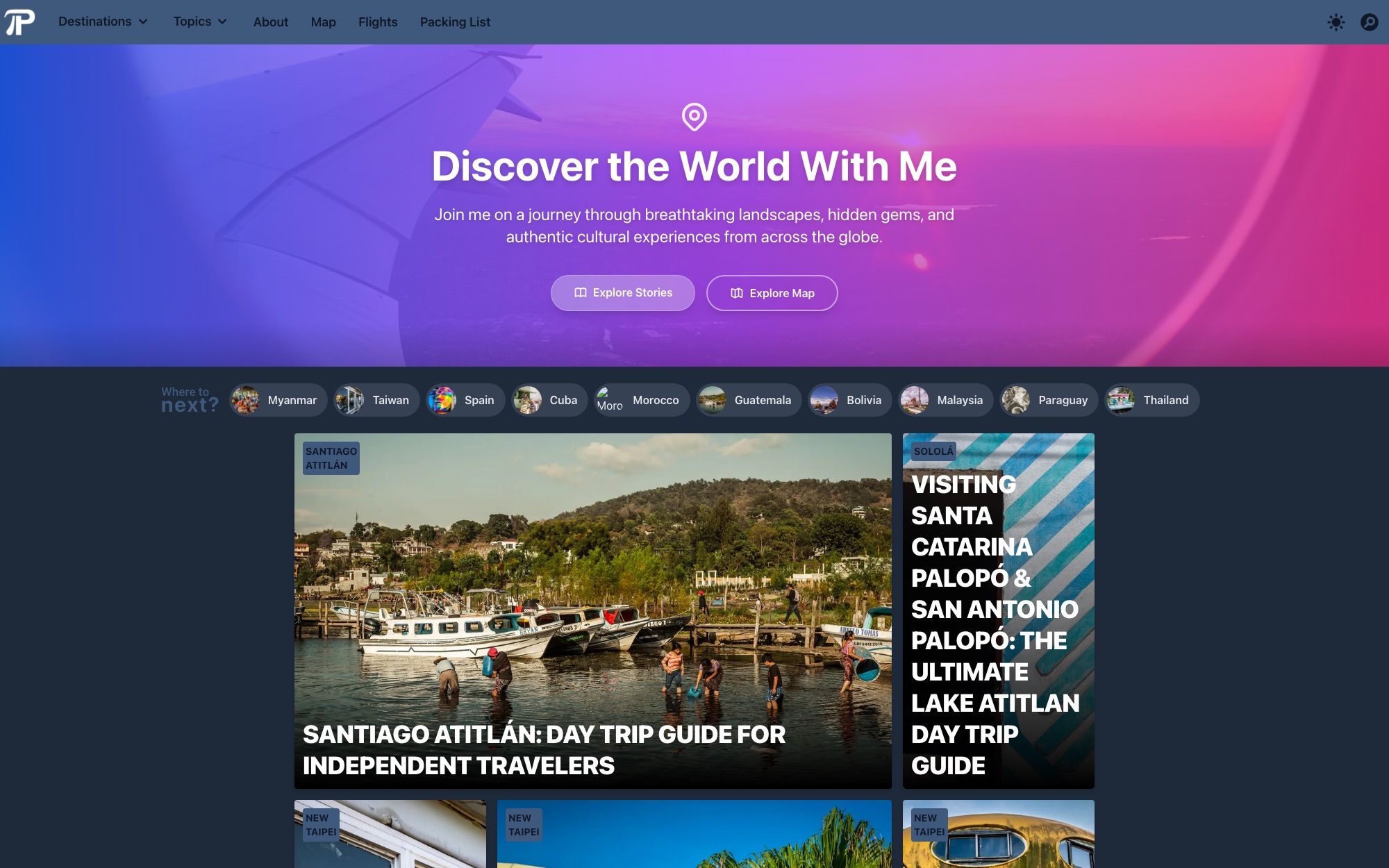
Here's what a member's blog looks like on their own domain — a photography-forward homepage that no square grid can match:
5. Cross-Promoting Your Platforms
Once both exist, the system is simple: the blog post is the master copy, and the Instagram travel blog is the highlights reel that points at it.
A workflow that holds up on the road: write the blog post first, while the details are fresh. Pull the three strongest photos for the feed, cut a Reel from the video you already shot, and write a caption that says one specific thing and mentions where the full guide lives. The blog post carries everything else — the maps, the prices, the photos that didn't make the feed.
The connective tissue:
- The bio link goes to your blog. It's the one outbound link Instagram gives you; pointing it anywhere you don't own wastes it. Send it to your homepage or your newest guide.
- Stories and a pinned highlight announce new posts. A "New on the blog" highlight gives the account a permanent signpost that outlives the 24-hour story window.
- Embed your Instagram posts in your articles. Instagram posts embed directly in TravelFeed posts — paste the link and the post renders inside the article. A reader who found your guide on Google ends it by following your account, which closes the loop in the other direction.
- Keep the name identical everywhere. This is step 1 paying rent: the reader who half-remembers your handle can type it into a browser with .com attached and land on property you own.
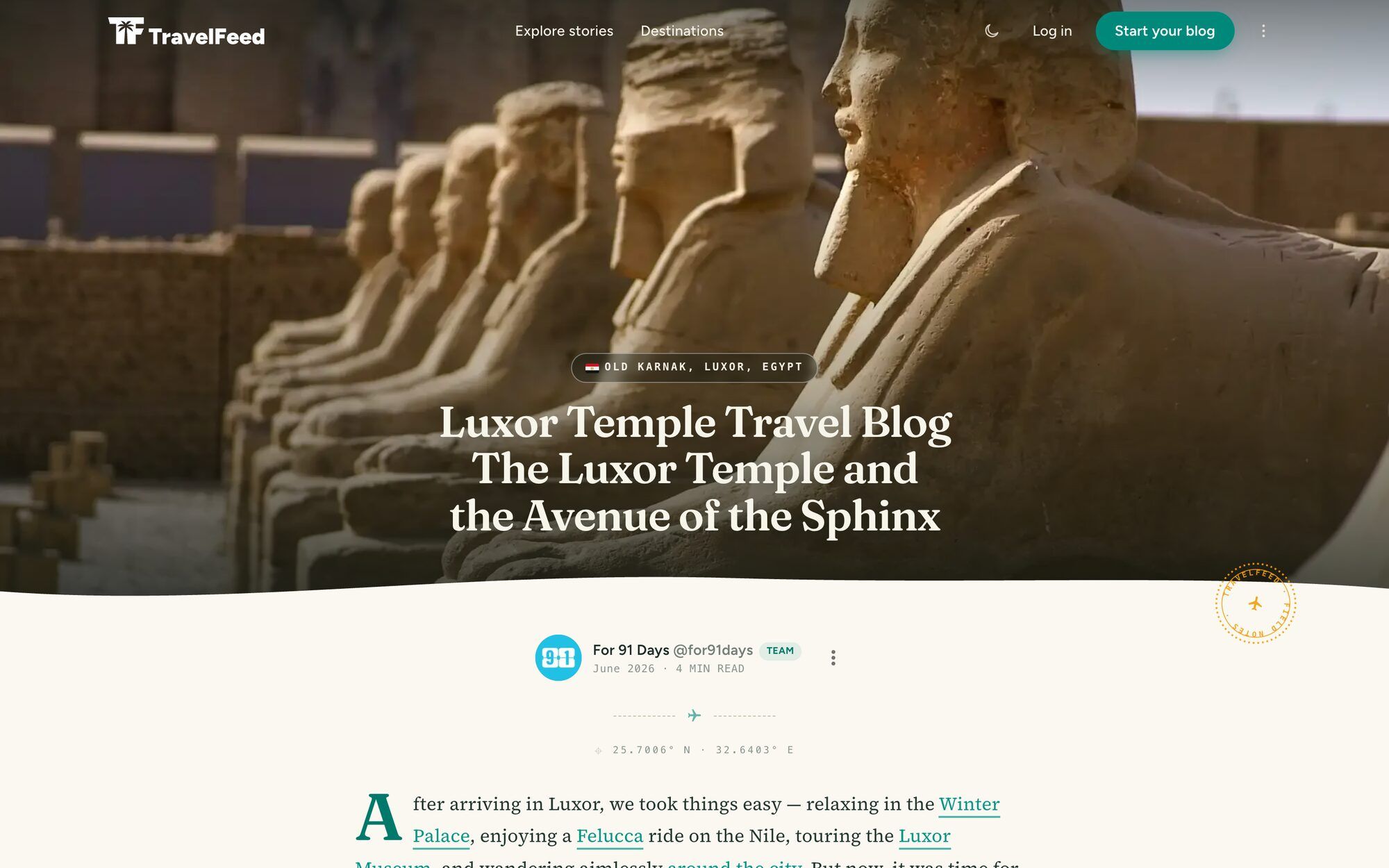
The same trip that made a nine-slide carousel becomes this on the blog:
6. Take the Leap: Start Your Travel Blog Today
The plan, assembled: a name that works as both handle and domain, a travel Instagram account that posts specific captions on a schedule you can keep, growth through the slow tactics that actually work — and the full archive on land you own, where search traffic can find it and no ranking change can take it away.
None of it requires an audience to start. That's rather the point: the blog post you publish this week starts earning its readership from zero, and it keeps earning it while you're busy filming Reels.
For the blog half in detail — choosing a niche, naming it, picking a platform, what to write first — start with how to start a travel blog. And if you want the shortest path to publishing: signing up for TravelFeed takes about two minutes with an email and a one-time code, or a Google account, and your first post can go up the same day.
Instagram will show that post to people for a day or two. Your blog will show it to people searching for it for years. Run both.
Frequently asked questions
Is Instagram enough for a travel blog?
No. Instagram content isn't meaningfully searchable on Google, the account can be locked or throttled with little recourse, and your followers can't be taken anywhere else. Treat Instagram as the trailer and a blog you own as the film: the account brings people in, the blog holds the archive that keeps being found for years.
Can you make money as a travel Instagrammer?
Eventually, maybe — sponsorships and brand deals generally want a large, engaged audience, and building one takes years. A blog earns at much smaller scale because search traffic converts: affiliate links in a guide that ranks can pay with modest monthly readership, and on TravelFeed you can earn rewards from your very first post. Most working travel creators earn through the blog and use Instagram to feed it.
Do travel bloggers still use Instagram in 2026?
Yes, nearly all of them — as a discovery channel, not the destination. The standard setup is an Instagram account that surfaces the highlights and a blog on the creator's own domain that holds the full stories, with the link in bio and stories pointing traffic at the site they own.
How many followers do you need to start a travel blog?
It's the wrong metric. A blog post that ranks on Google gets read whether you have 50 followers or 50,000, and it keeps getting read next year. Follower counts don't transfer to any other platform and don't compound the way searchable content does. Start both at zero: the Instagram account for reach inside the feed, the blog for people searching for the places you've been.