
 Tallinn, Harju County, Estonia
I arrived by ferry, walked through the Old Town at minus eighteen and discovered that a medieval capital could not compete with an excellent dinner and a warm spa.
Tallinn was not the main destination of this journey. It was one carefully chosen overnight stop on a long and deliberately indirect route home from an Erasmus visit to Tampere.
The journey had begun in Trieste and reached Finland through London, Bristol and Rovaniemi. On the way home, a colleague from my department and I continued through Helsinki, Tallinn and Kraków, spending roughly one night in each city before eventually returning to Trieste.
It was not efficient travel, but efficiency was never the purpose.
Across the Baltic
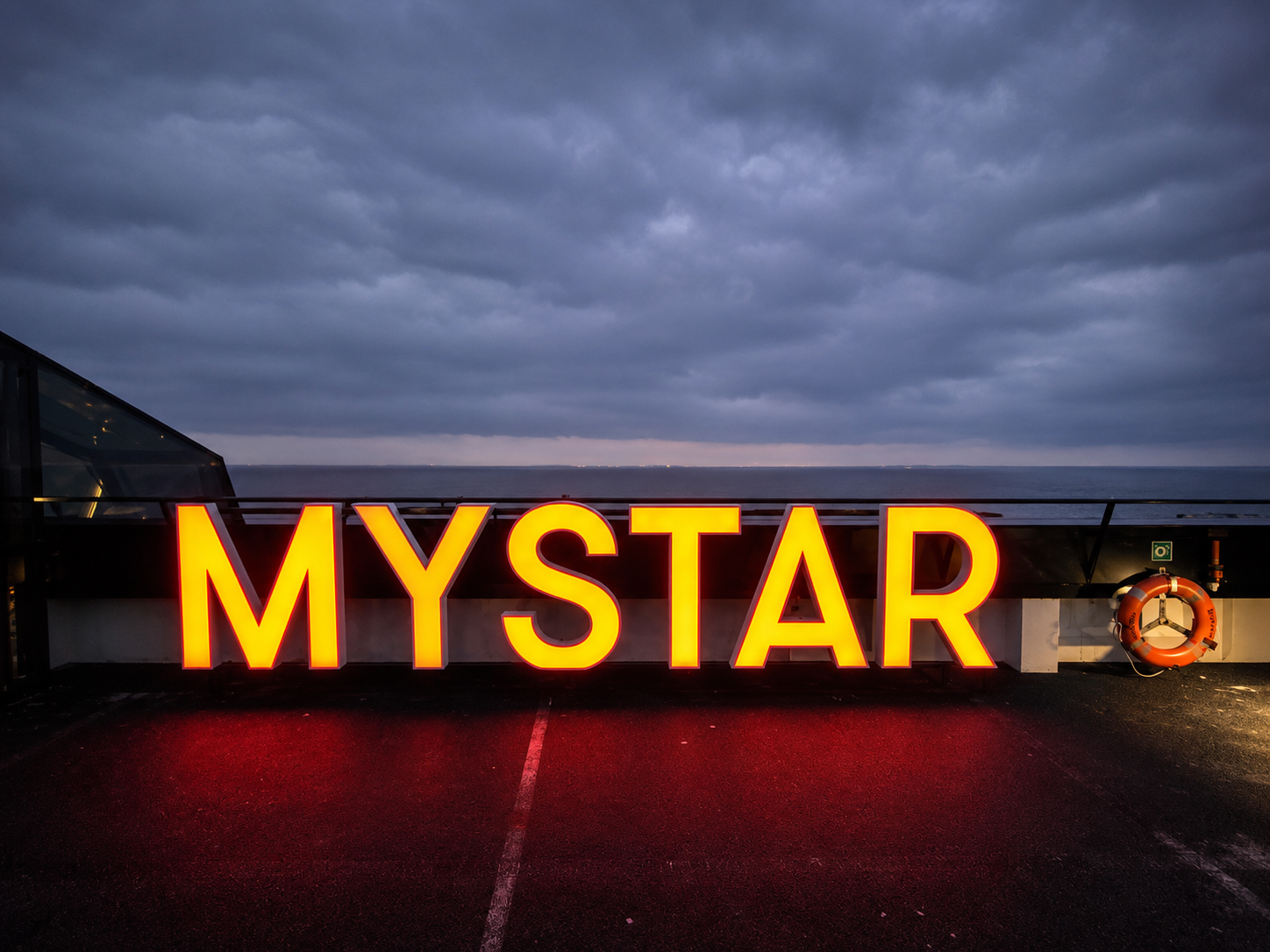
We kept our luggage with us throughout the crossing, rolling it aboard MyStar in Helsinki and eventually off again in Tallinn.
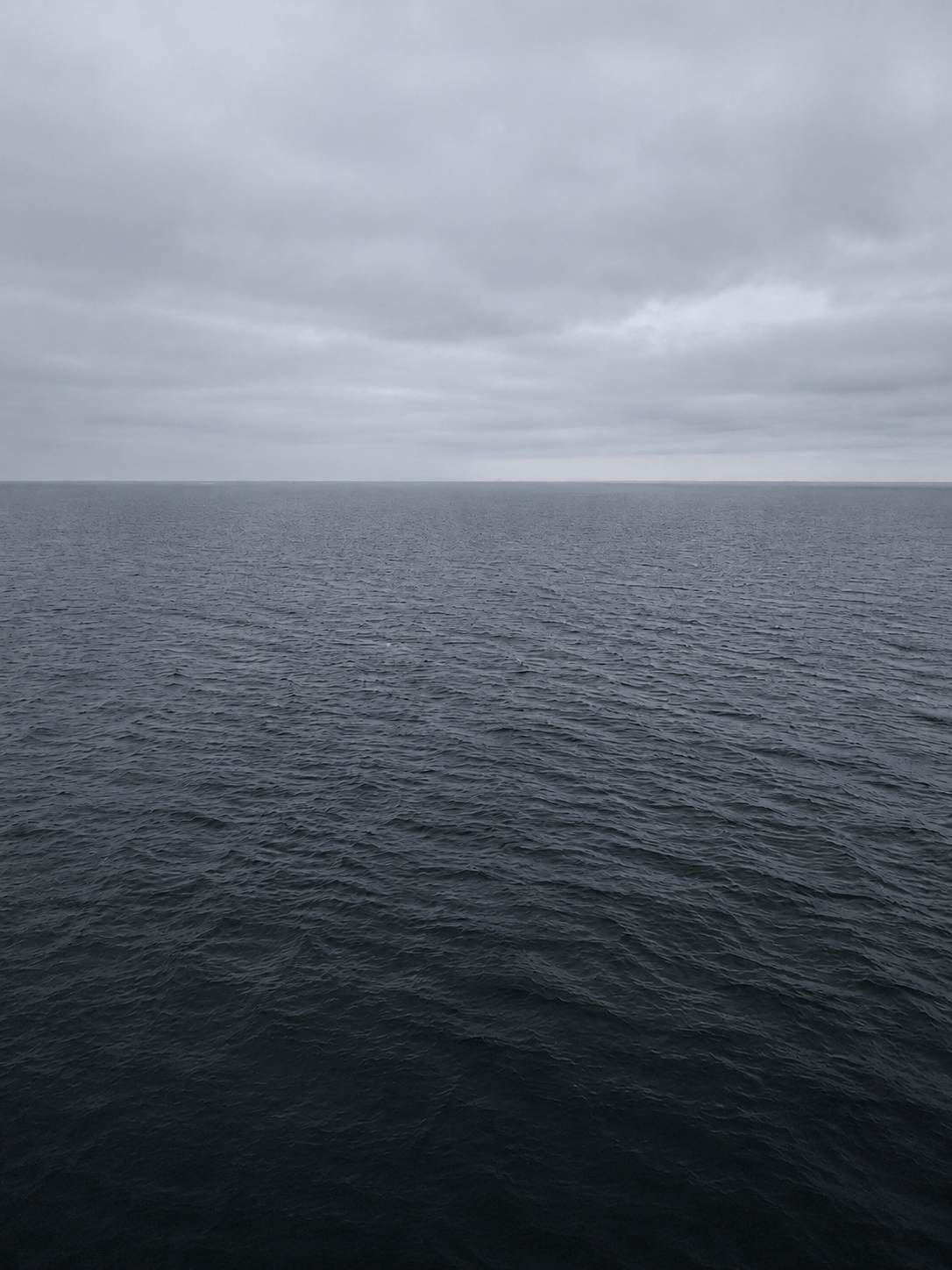
The ferry was modern, spacious and much closer to a floating shopping and dining complex than to the austere Baltic vessel I had imagined. Inside, everything was warm, polished and brightly lit. Outside, the sea and sky seemed to have agreed on the same shade of grey.
Shortly after four in the afternoon, I stepped onto the deck to take a few photographs. The Baltic stretched towards the horizon under heavy clouds, with almost no visible boundary between water and sky.
Somewhere between Finland and Estonia, colour had temporarily been discontinued.
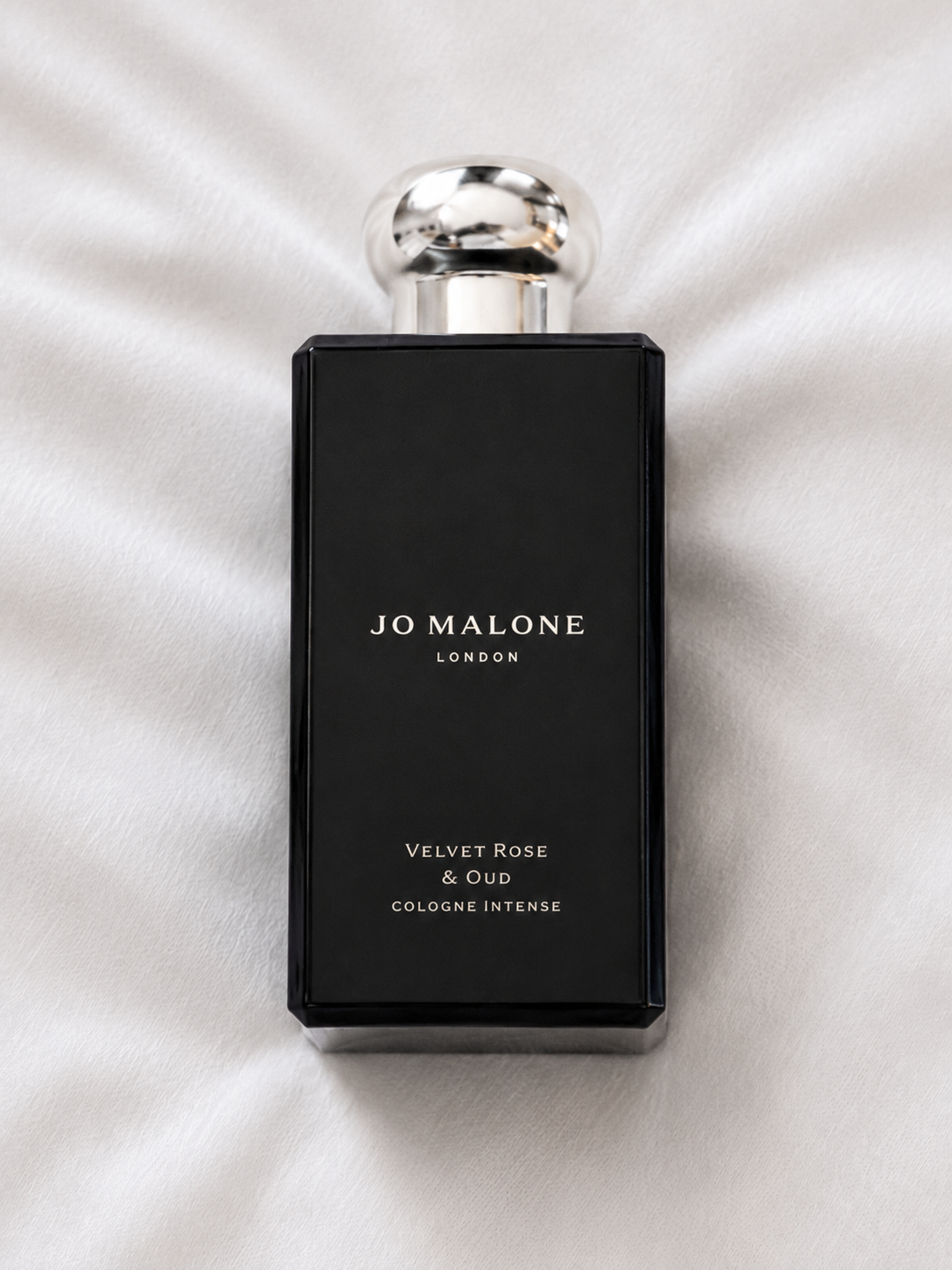
Jo Malone had already become something of a weakness. Before this journey, I had been wearing Cypress & Grapevine, a fresh, woody fragrance built around aromatic cypress, grapevine and amber. On MyStar, however, Velvet Rose & Oud stopped me almost immediately.
It was darker and more opulent: Damask rose wrapped in smoky oud, sharpened with clove and softened by a faint praline sweetness. I had not planned to buy another bottle, but this one seemed perfectly suited to a winter crossing of the Baltic—less Mediterranean garden, more dark velvet at sea.
The scent still brings back that grey afternoon more directly than most of the photographs. Cypress & Grapevine had been the fragrance I wore before Tallinn. Velvet Rose & Oud became the scent of the journey home.
By the time we approached Tallinn, darkness had already settled over the city. Port lights and reflections from the ferry interior overlapped in the windows as we prepared to disembark.
We rolled our luggage off the ship and headed directly towards Tallinn’s Old Town.
Hotel Telegraaf for 35,000 points
I had booked Hotel Telegraaf, part of Marriott’s Autograph Collection, almost entirely because of an unusually good points rate.
The night cost around 35,000 Marriott Bonvoy points. For a historic five-star hotel in the centre of Tallinn’s Old Town, it was an excellent redemption.
The hotel also delivered everything an elite member reasonably expects: recognition, an upgraded room, breakfast and late checkout without unnecessary negotiation.
Hotel loyalty is hardly a romantic travel philosophy, but on this occasion it produced a very comfortable room, an excellent restaurant and access to one of the most inviting spas I had seen in some time.
After several cities, flights, trains and a Baltic crossing, Telegraaf felt less like another overnight stop and more like a reward at the end of a complicated route.
The building had once housed Tallinn’s central telegraph office, and the hotel had incorporated that history into its identity without turning the property into a historical theme park.
Our room was elegant and restrained. From the window, church towers and snow-covered rooftops rose above the Old Town, illuminated against the dark sky.


Tallinn was directly outside, but after a long journey the warmth of the hotel was difficult to resist.
So was the restaurant downstairs.
Dinner at Tchaikovsky
Restaurant Tchaikovsky draws on the historical relationship between French cuisine and the culinary traditions of Imperial Russia and Eastern Europe.
Our waitress explained the concept far better than any printed introduction could have done.
Nothing in her appearance announced how completely she would take command of the evening. She seemed reserved and entirely uninterested in performing the polished charm often expected in luxury hotels.
Then she began speaking.
Her English was exceptional. More importantly, she understood the difference between listing ingredients and guiding someone through a meal.
She gave direct, honest advice, explained the reasoning behind the dishes and placed the restaurant within its historical context. She did not automatically steer us towards the most expensive choices, nor did she deliver rehearsed descriptions and disappear.
She set the pace of the evening almost invisibly.

The first major course was a version of Siberian dumplings, or pelmeni, filled with beef and wild mushrooms.
They arrived with mushroom purée, greens, Parmesan and a rich sauce. The presentation belonged to a fine-dining restaurant, but the central idea remained recognisable as northern comfort food: warm, filling and perfectly suited to a country where winter is not a decorative concept.
Our waitress had recommended them confidently.
She was right.

Between courses, we were served a small portion of mango sorbet.
It was not intended as dessert but as a palate cleanser, a brief and sharply flavoured pause before the meat course. Such rituals can become irritating when a restaurant takes itself too seriously. Here, it felt natural and well timed.
The beef fillet arrived pink, accompanied by potato purée and a dark, concentrated sauce.
What remained in my memory was the waitress explaining that the sauce contained an unexpected touch of chocolate. Chocolate was not presented as the central ingredient, and I can no longer reconstruct the precise composition. It may have been incorporated into the demi-glace or used as a subtle bitter element.
Beef and chocolate sounded suspicious.
On the plate, it worked.
The chocolate did not make the dish sweet. It deepened the sauce and added a slight bitterness that suited the meat and mushrooms.

The Pavlova was the most theatrical part of the evening.
Our waitress finished it at the table, pouring the final element over the dessert as vapour spread around the plate. For a few moments, it almost disappeared beneath the smoke.
She explained what she was doing without allowing the presentation to become forced or ridiculous. The effect was dramatic, but the performance remained part of the meal rather than replacing it.
The food was excellent, but the waitress was what made the dinner memorable.
Fine ingredients and elegant interiors can be purchased. The ability to understand guests, control the pace of a meal and give an evening coherence is much rarer.
She did not merely bring plates to the table. She conducted the experience.
Considering the name of the restaurant, the comparison was obvious—but deserved.
The same room, a different service
The following morning, we returned to the same dining room for breakfast.
The kitchen had maintained its standards. The food was excellent, with good ingredients, carefully prepared egg dishes and far more choice than we needed.
The service was different.
The young waiters seemed inexperienced, struggled with English and moved through even simple requests surprisingly slowly. Nothing was disastrous, yet the contrast with the previous evening was striking.
The same room and the same kitchen produced a completely different experience once confident service disappeared.


Minus eighteen
After breakfast, we finally went outside.
It was around minus eighteen degrees Celsius, with enough wind to make the temperature feel even more aggressive.
The cold was difficult to communicate through photographs. The sky was clear, the winter light was beautiful and the streets looked peaceful. Nothing in the images conveyed what happened once the wind found an opening between scarf, coat and collar.
Tallinn looked excellent.
It felt homicidal.

We walked through the Old Town towards Toompea, passing churches, narrow streets and sections of the medieval fortifications.
We entered nothing.
This was not a morning for museums, long explanations or contemplative visits. Our sightseeing method became brutally efficient: identify the building, take the photograph and continue moving before the cold reached another layer of clothing.
The Alexander Nevsky Cathedral appeared particularly impressive against the clear blue sky. Its domes, colours and elaborate façade looked almost unreal in the hard winter light.

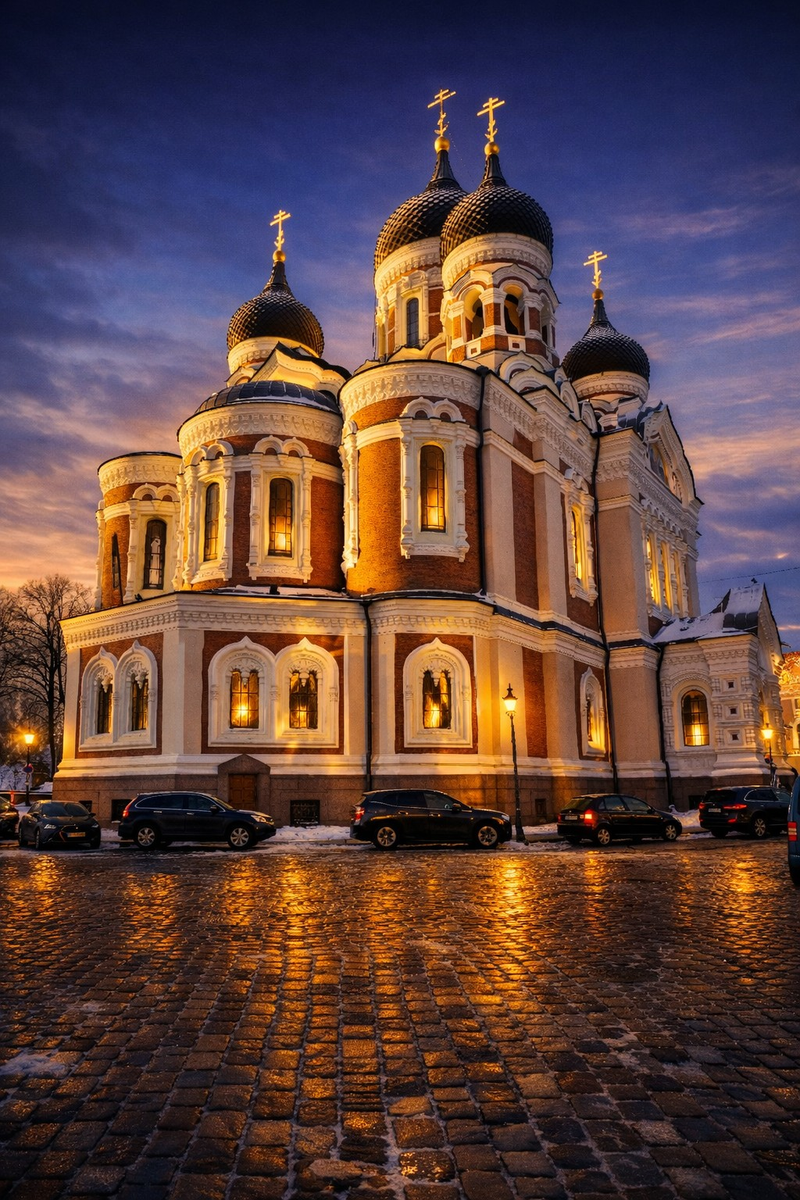
The original photograph recorded the building; a little digital excess came closer to recording the atmosphere.
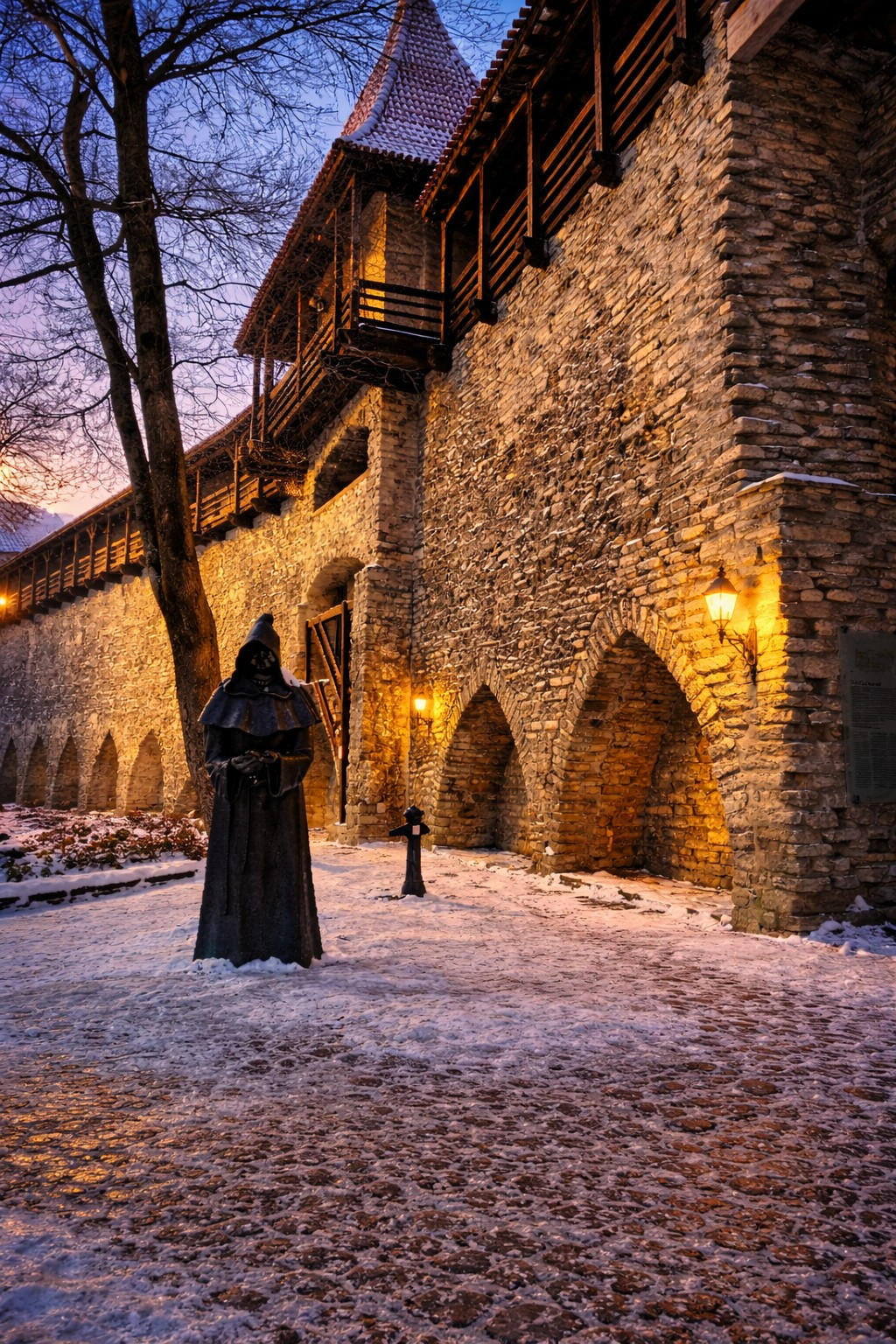
Near the old walls stood a dark hooded figure, motionless beside the stone fortifications.
Under different conditions, I might have stopped to investigate its meaning more carefully.
At minus eighteen, I mainly noticed that it was dressed more appropriately than I was.

The cold was not merely uncomfortable. My balls were freezing, and for once that was less a vulgar complaint than a reasonably accurate meteorological report.
We continued towards Town Hall Square, where a large Christmas tree still stood among the pastel façades.
The square was almost empty.
Without summer crowds, café terraces or market stalls, the centre of Tallinn looked like a stage waiting for an audience that had sensibly decided to remain indoors.


We had spent less than an hour walking around.
That was enough.
The hotel wins
The first photograph from our morning walk had been taken at 9:38.
By 10:29, I was in the spa.
Hotel Telegraaf’s spa was built beneath a glass roof and included a pool, saunas and a circular jacuzzi. Warm water filled the room with steam while the winter light entered from above.
Outside, Tallinn offered medieval walls, church towers, cobbled streets and centuries of history.
Inside, the hotel offered heated water.
At minus eighteen, the comparison was not particularly difficult.


Late checkout meant that we did not need to rush.
We stayed long enough for normal sensation to return to our hands, feet and other endangered parts of the body. Any guilt about abandoning Tallinn disappeared almost immediately.
Some travellers would have forced themselves back outside. They would have visited another church, entered a museum and extracted the maximum possible cultural value from every remaining hour.
I respect that approach.
I had already made my decision.
Travel is not an examination, and there are no additional marks for unnecessary suffering. Tallinn had shown us enough to make another visit desirable. The spa had shown us enough to make leaving it irrational.
By ferry in, by plane out
By mid-afternoon, we were at Tallinn Airport.
We had arrived in Estonia by sea and were leaving by air, flying to Kraków for another overnight stop before continuing to Trieste and finally driving home.
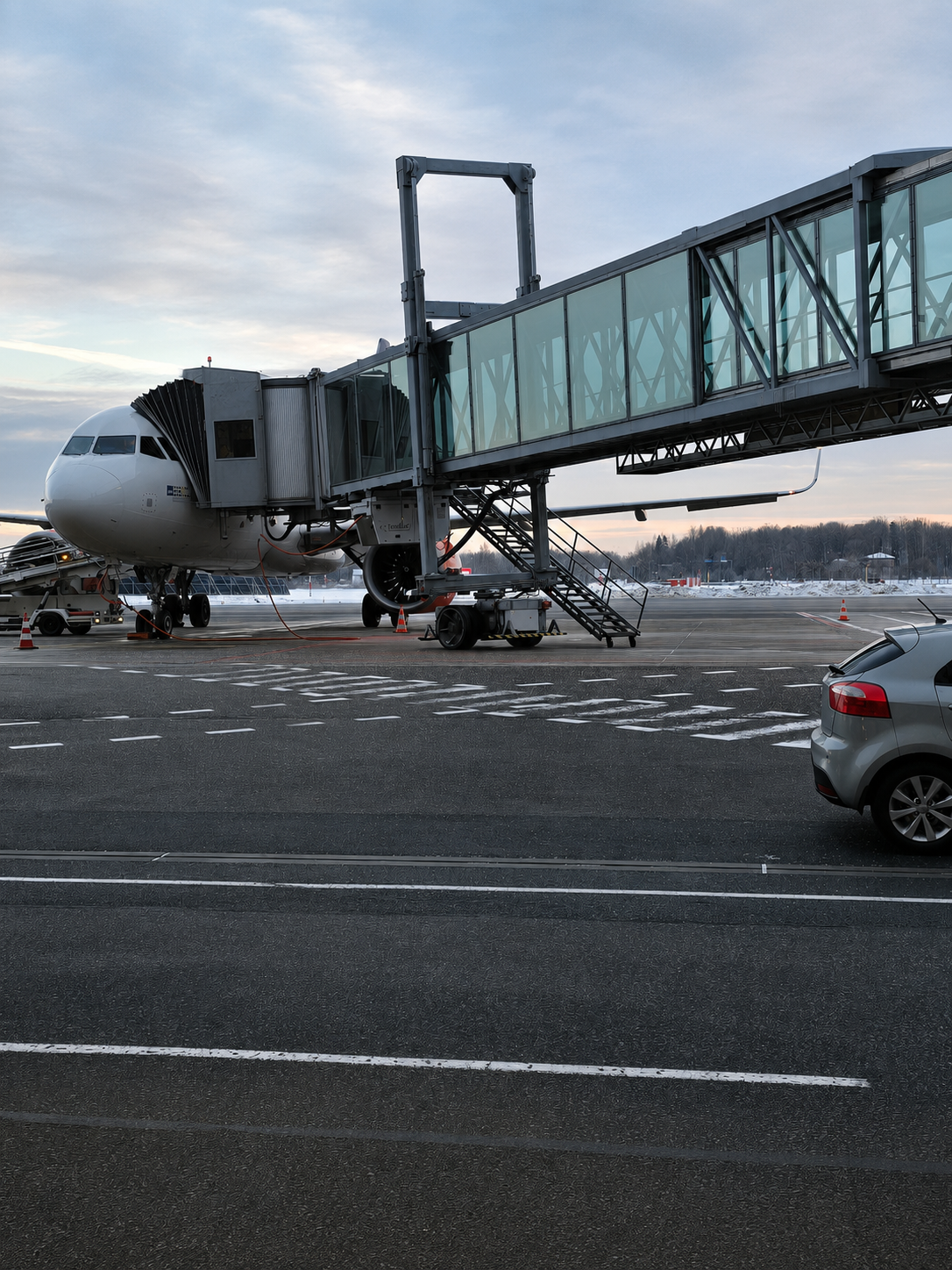
I cannot claim to have discovered Estonia. In less than twenty-four hours, I saw only a small part of Tallinn, almost entirely within walking distance of one exceptionally comfortable hotel.
But short visits are not necessarily meaningless ones.
Tallinn gave me an empty medieval city under clear winter light, a temperature that threatened important parts of my anatomy and one of the best examples of professional restaurant service I had experienced in a long time.
The person I remembered most was not a guide, chef or celebrity. She was a waitress who understood that hospitality is a skill rather than a rehearsed smile.
The place I remembered most was not the cathedral or Town Hall Square.
It was the warm spa beneath the glass roof.
Sometimes culture triumphs over comfort.
At minus eighteen, comfort deserved the victory.
