 St Andrews, Scotland, United Kingdom
Scotland’s Oldest University, Medieval Ruins and the Town Where William Met Kate
I had begun the morning at Dunnottar Castle.
By the time I returned to Aberdeen, travelled south to Dundee and checked into another hotel, the sensible interpretation was that I had already done enough for one day. Sensible interpretations have rarely exercised much influence over my travel planning.
St Andrews ranked too highly in every guide to this part of Scotland to be ignored. I had visited Dunnottar that morning for much the same reason: not because of a lifelong obsession, but because enough independent sources had agreed that missing it would be stupid.
Dundee had entered the itinerary through considerably less romantic reasoning.
I needed a stop between Aberdeen and Edinburgh. The railway connections worked, the Four Points Flex belonged to Marriott, and the room cost £64. It was travel planning reduced to an optimisation problem.
At that price, I expected competence rather than charm. Instead, the staff upgraded me to a much larger room on the fifth and top floor, then turned finding me the best available view into a small collective mission.
Through the window, Dundee railway station stretched below me towards the River Tay, with the bridge crossing the water in the distance.

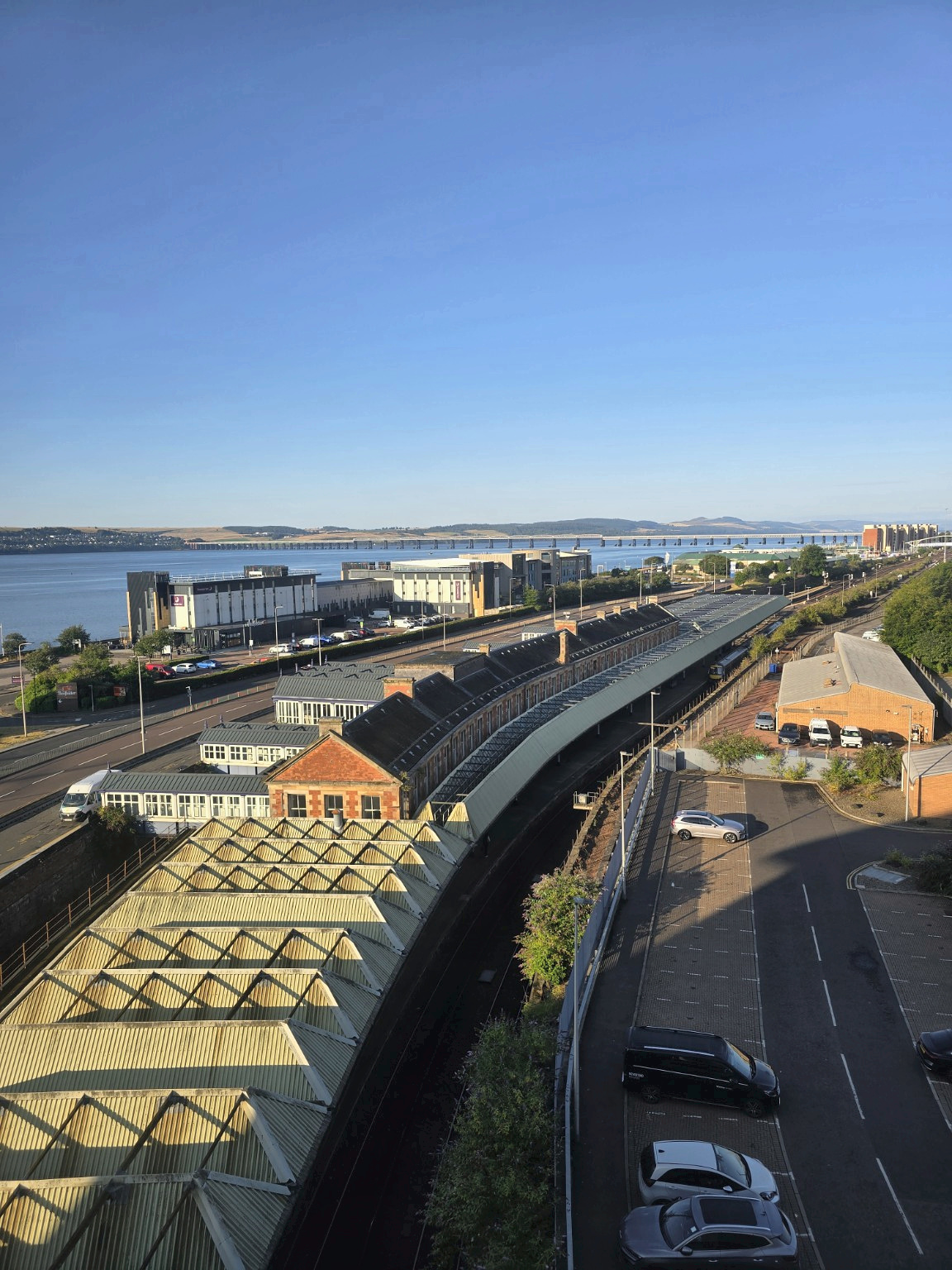
Expensive hotels are supposed to impress. A £64 hotel that gets the room, staff and view right is performing a considerably more interesting trick.
It also placed the bus to St Andrews almost outside the door.
A Bus into Another Century
There were no connections to coordinate, taxis to negotiate or elaborate transport plans to pretend I enjoyed making. I paid £8.20, boarded the number 99 and travelled directly from modern Dundee into a town that seemed to operate several centuries behind it.
My return journey later that evening would cost only £3.90.
For a place without its own railway station, St Andrews was almost indecently easy to reach.
I got off near South Street. The transition felt less geographical than chronological.
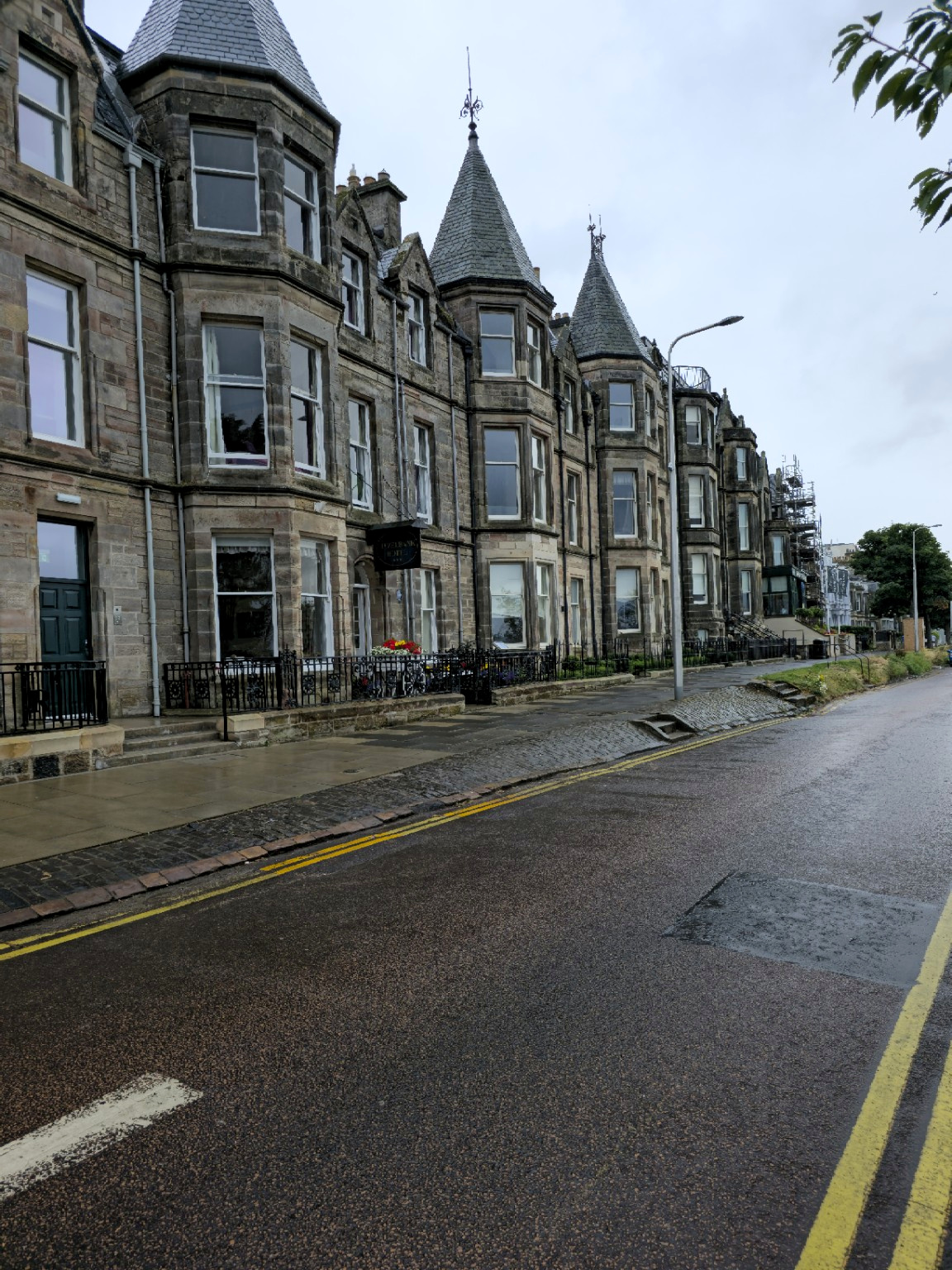
St Andrews is small enough to cross on foot without much effort, yet important for an almost unreasonable number of reasons.
Long before the university or golf, it was one of medieval Scotland’s great religious centres. According to tradition, relics of the apostle Saint Andrew were brought to this part of Fife, turning the town into Scotland’s leading pilgrimage destination and eventually the administrative centre of its medieval Church.
Teaching began in 1410, and papal authority formally established the University of St Andrews in 1413. It remains Scotland’s oldest university and the third oldest in the English-speaking world.
Golf later added another global identity. Then came William and Catherine, followed by Netflix’s reconstruction of their university romance in The Crown.
Religion, education, monarchy, television and sport had somehow accumulated in a town whose major sites could all be reached during one wet afternoon.
A University without Defensive Walls
South Street led me into the university quarter, although “campus” would be the wrong word. The university is woven through the town rather than separated from it.
Stone gateways opened into courtyards. Narrow passages ran between ancient buildings. Students, residents and visitors moved through them without the solemn choreography I had come to expect from famous British universities.
That openness fascinated me.
In Oxford and Cambridge, I had often felt that history was available on negotiated terms: gates, entrance fees, opening hours and porters deciding exactly how much of the institution a visitor deserved to see. Their colleges can be magnificent, but they frequently remind you that you remain outside.
St Andrews felt startlingly porous.
I walked through an arch and into the quadrangle almost without noticing that I had crossed a boundary. There was no ceremony, no ticket and no need to justify my presence. A university more than six centuries old had simply allowed the town to pass through it.
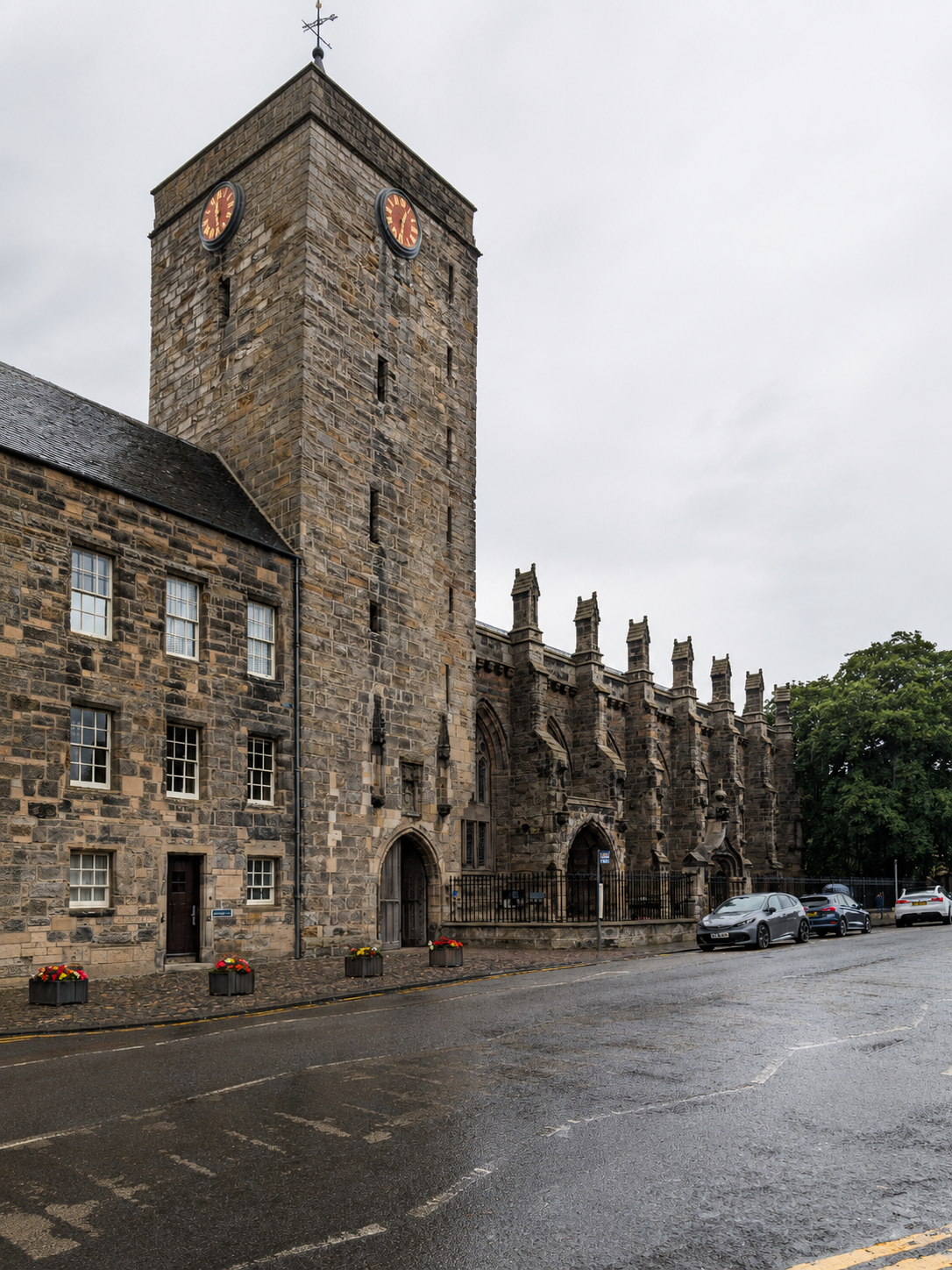
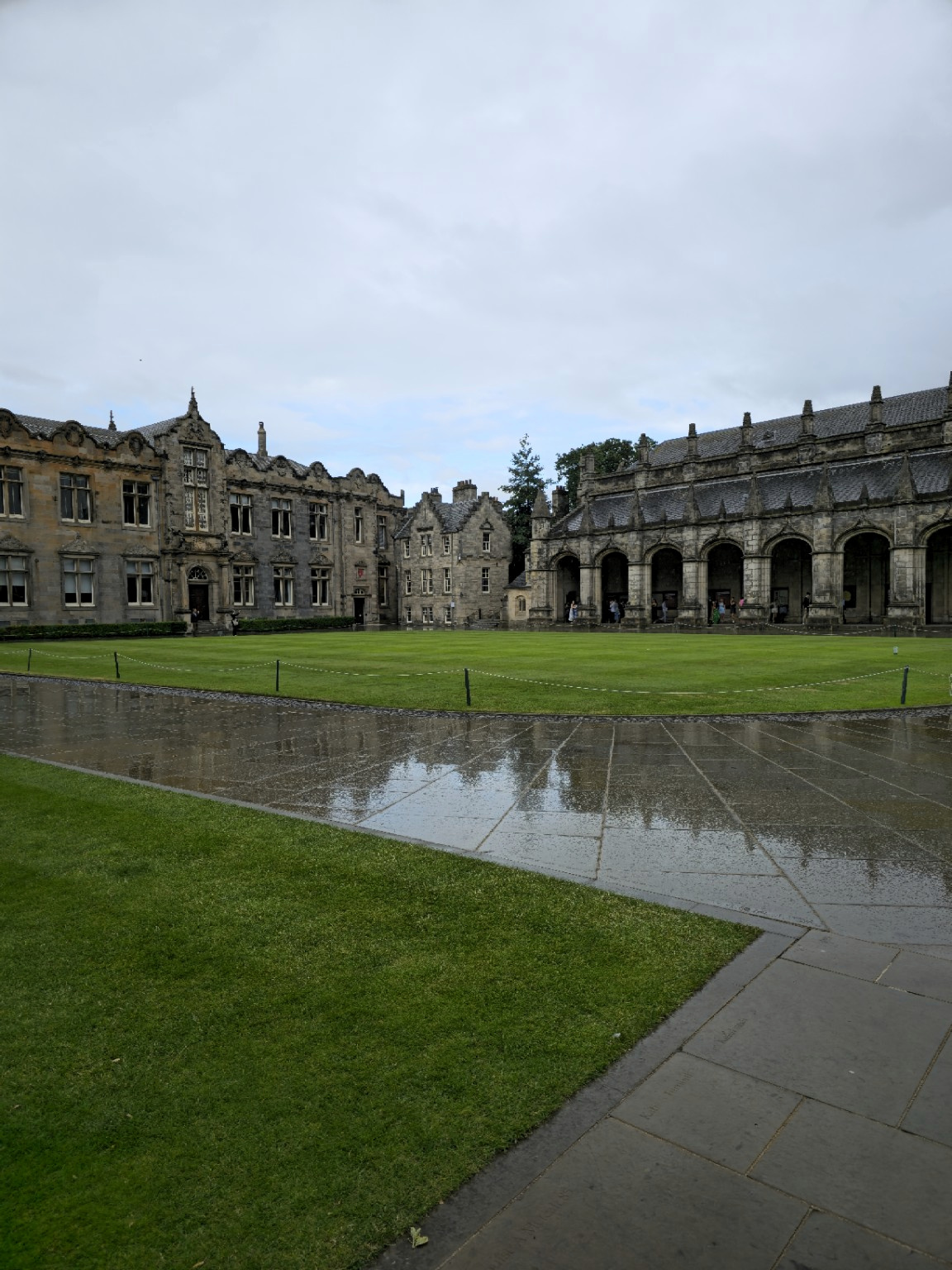
This did not make the university feel less exclusive academically. It made it feel less defensive physically.
History was not contained behind walls for scheduled public consumption. It remained part of the route people used to reach lectures, offices, shops and homes.
St Andrews did not make history feel preserved.
It made the present feel temporarily suspended.
The Bagpiper
The effect became considerably less subtle when I reached St Salvator’s.
A bagpiper stood outside the college buildings in full dress, playing beneath a heavy grey sky while rain darkened the stone and polished the paving around him.
In almost any other setting, the scene might have collapsed into the most predictable Scottish tourism imaginable.
Here, it worked.
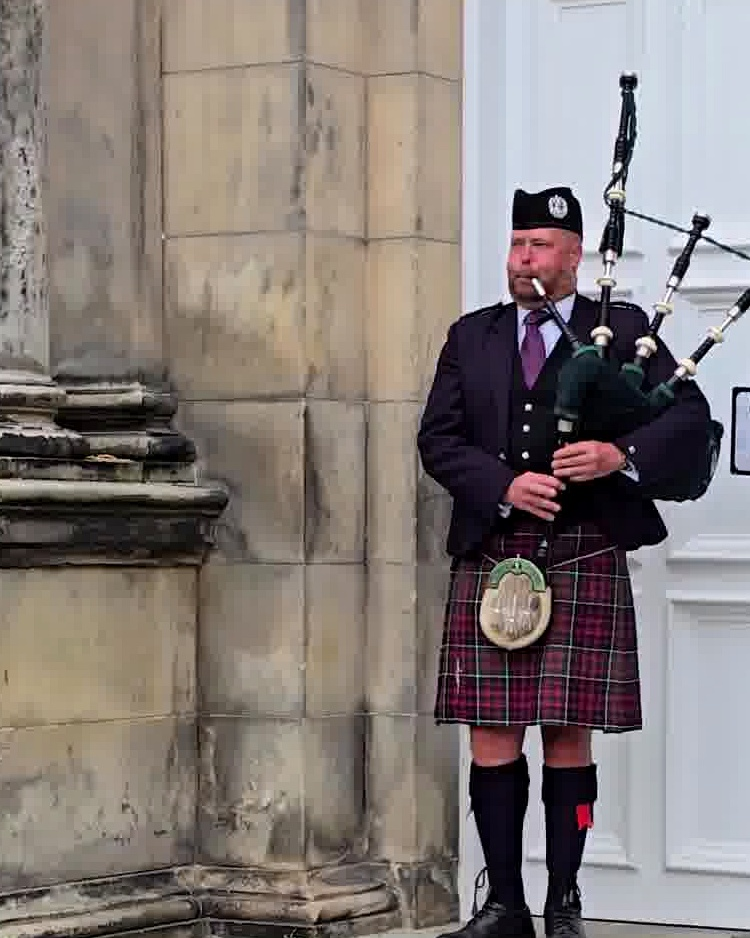
The enclosed quadrangle, chapel tower and ancient façades did not require a soundtrack. The pipes merely completed something already present.
As a university professor, I probably should have responded primarily to the institution’s scholarly heritage.
Instead, I stood in the rain watching a man in a kilt play bagpipes outside a fifteenth-century college.
Academic dignity has its limits.
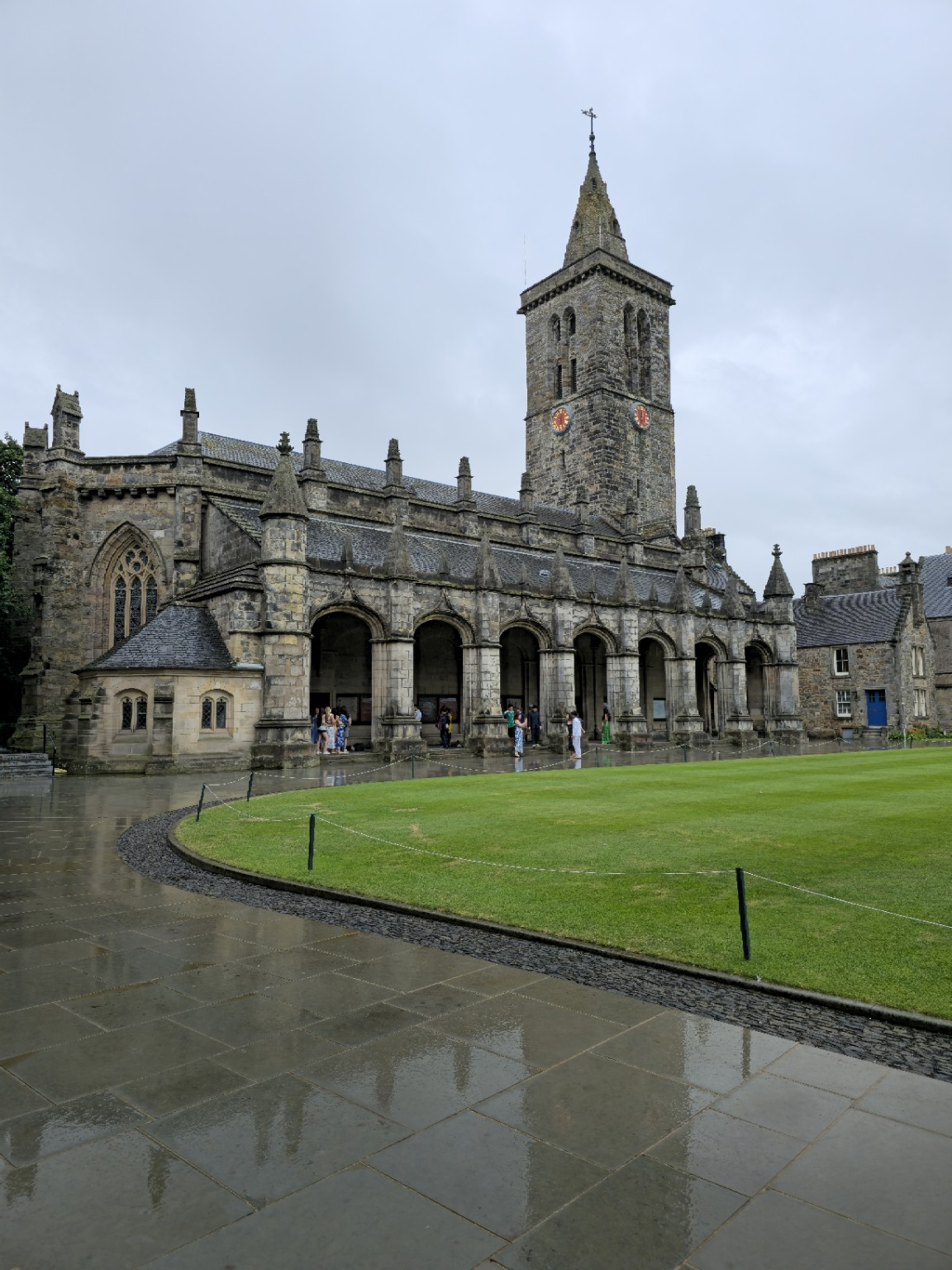
Why St Andrews Made Sense for William
The university’s most famous modern students are William and Catherine, who arrived in 2001 and initially studied history of art. William later changed to geography, while Catherine completed her degree in art history. They graduated in 2005.
There does not appear to be one definitive public explanation of why William originally selected St Andrews. The combination is nevertheless easy to understand: a university with exceptional academic prestige, a compact town far from London and a realistic possibility of living more like a student than a permanently exhibited member of the Royal Family.
Whatever the precise calculation, it worked.
At the end of his degree, William publicly thanked the town for allowing him to lead as normal a student life as he could have hoped for. He later described returning to St Andrews with Catherine as feeling like coming home.
Six centuries after its first students arrived, the university had produced a relationship that may eventually place two of its graduates on the British throne.
The final season of Netflix’s The Crown dramatised William’s arrival at St Andrews and the beginning of their relationship. The production even returned to parts of the real town, including the street where William and Catherine had shared a student house with friends.
Walking through the wet courtyards, I understood why.
St Andrews already looks like an expensive television reconstruction of an ancient British university.
The difference is that no production designer had needed to build it.
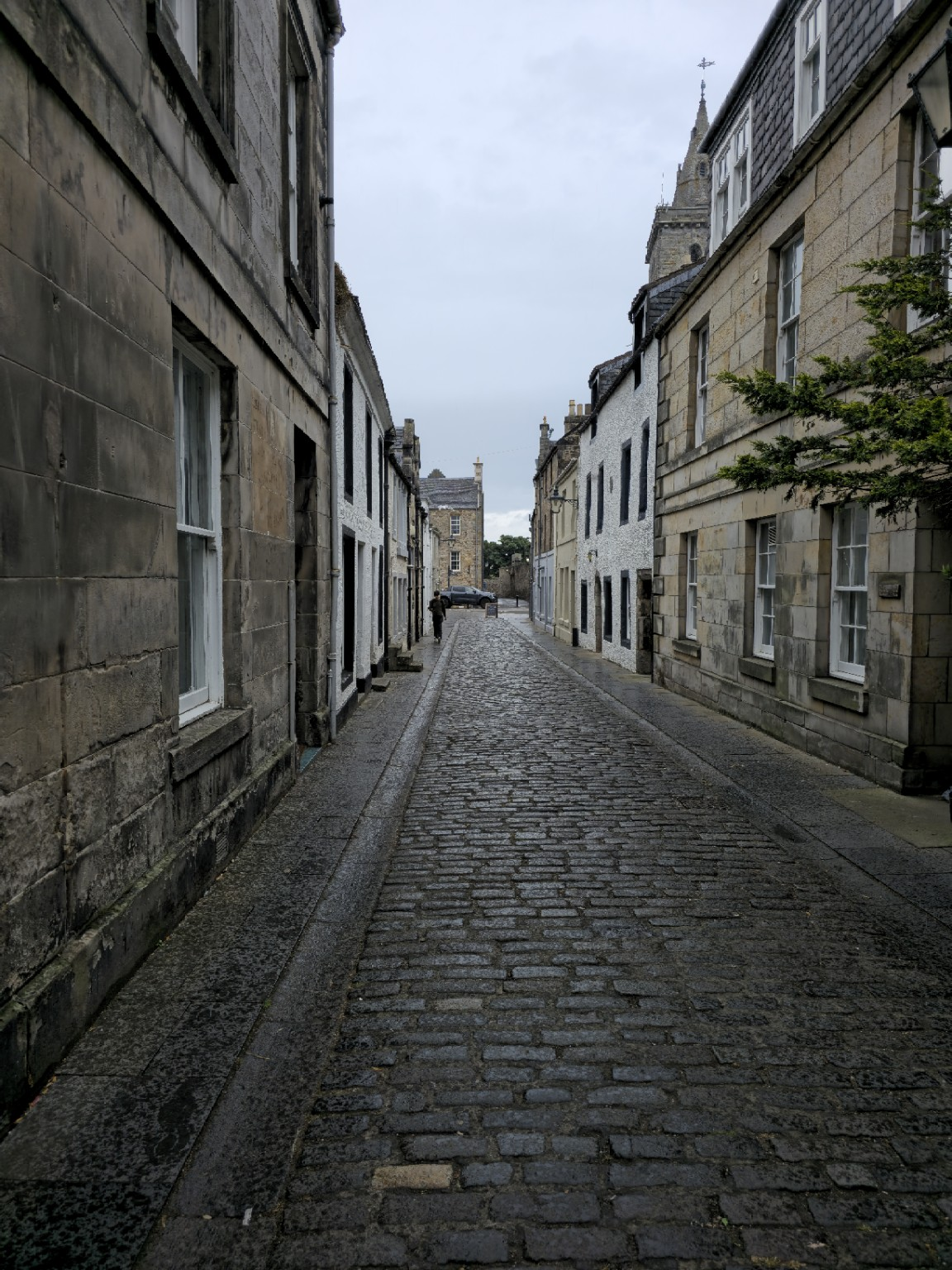
The royal connection offers an easy entrance into the story, particularly for anyone who watched The Crown.
Fortunately, the town does not need William, Catherine or Netflix to justify itself.
The World the Reformation Abolished
From the college buildings, I continued towards the remains of St Andrews Cathedral.
The surviving walls do not appear all at once. A tower rises above surrounding buildings, then an arch appears, followed by roofless walls and broad areas of grass. Only gradually does the scale of the lost structure become clear.
Construction began around 1160. The cathedral eventually became the largest church in Scotland, the headquarters of its medieval Church and the seat of its most powerful bishops and archbishops. Robert the Bruce attended its dedication in 1318.
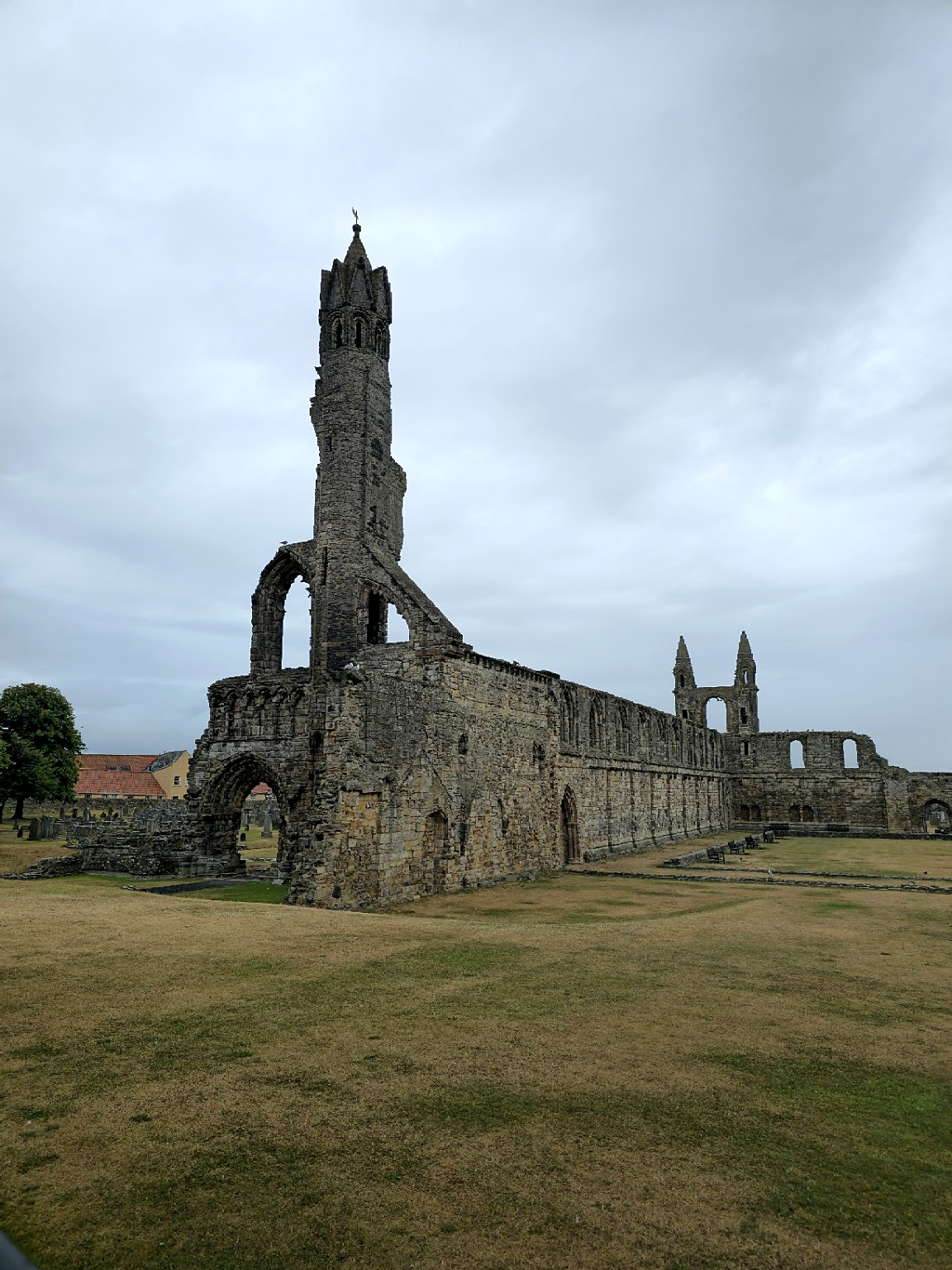
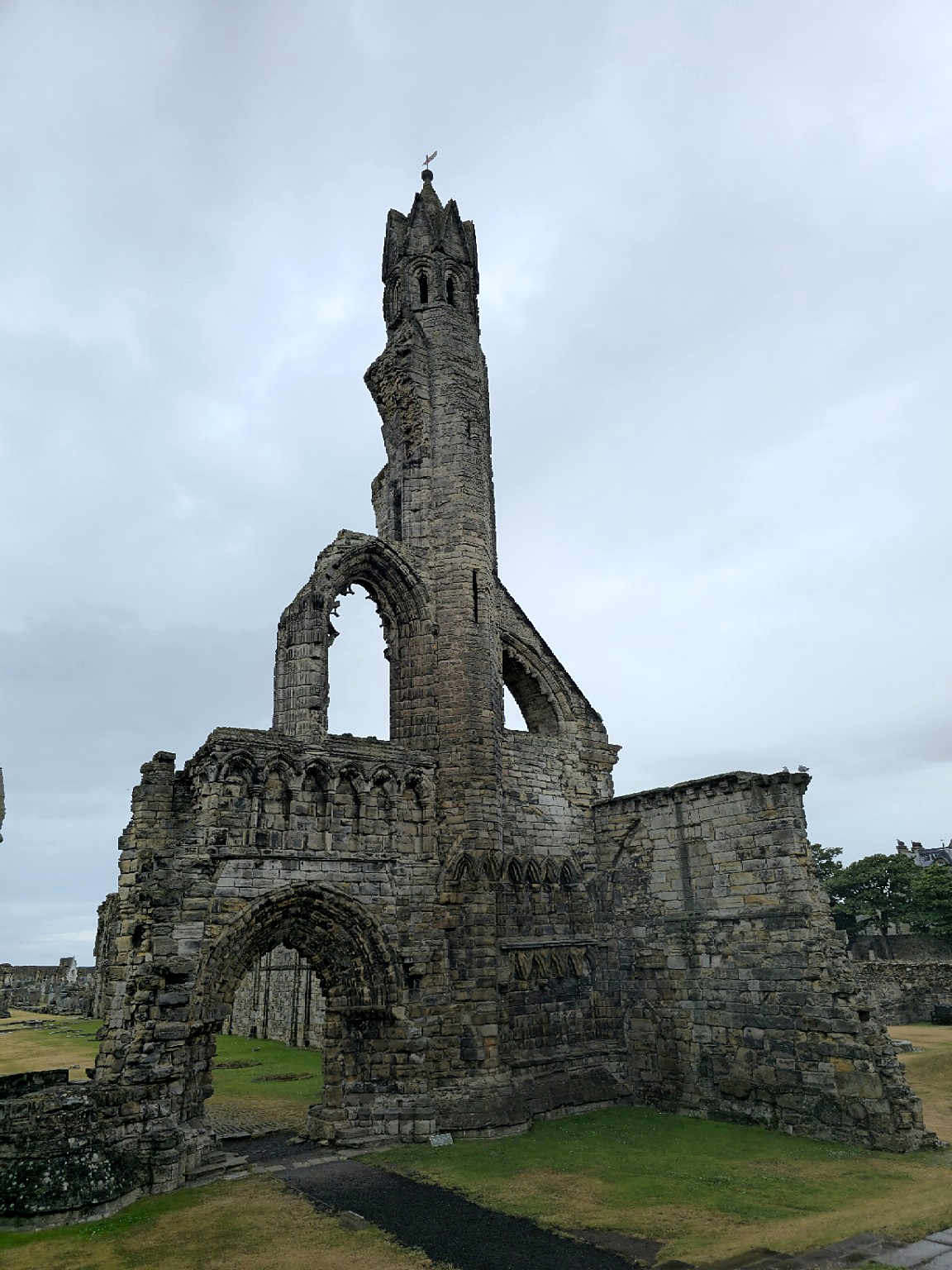
The ruins are so large that they initially resist being understood as ruins.
They look less like the remains of a church than the exposed skeleton of an entire age.
Walls end abruptly against the sky. Doorways lead into vanished spaces. Towers stand at distances that reveal the enormous volume once contained between them.
The obvious question is why Scotland’s greatest church was never rebuilt.
The answer lies in the difference between England and Scotland after the Reformation.
Medieval Scotland was Roman Catholic. St Andrews Cathedral belonged to a Church organised around the Pope, bishops, archbishops, relics and pilgrimage.
England broke from Rome but retained bishops in the Church of England, with the monarch eventually becoming its Supreme Governor. Scotland followed a more radical Presbyterian path. The national Church of Scotland, usually called the Kirk, was governed through ministers and elders rather than bishops.
The Scottish Reformation therefore did not merely replace one administrator with another. It rejected the religious system for which the cathedral had been built.
Catholic worship ended, the cathedral’s community dispersed and the immense complex was abandoned. Without an archbishop, clergy, pilgrims or ceremonies, there was no institution prepared to finance its survival. The new Presbyterian Church had neither practical use nor ideological enthusiasm for restoring a monumental Catholic cathedral centred on episcopal power.
The cathedral was not left ruined because Scotland lacked people capable of repairing stonework.
It was left ruined because the Reformation had abolished the world for which it had been built.
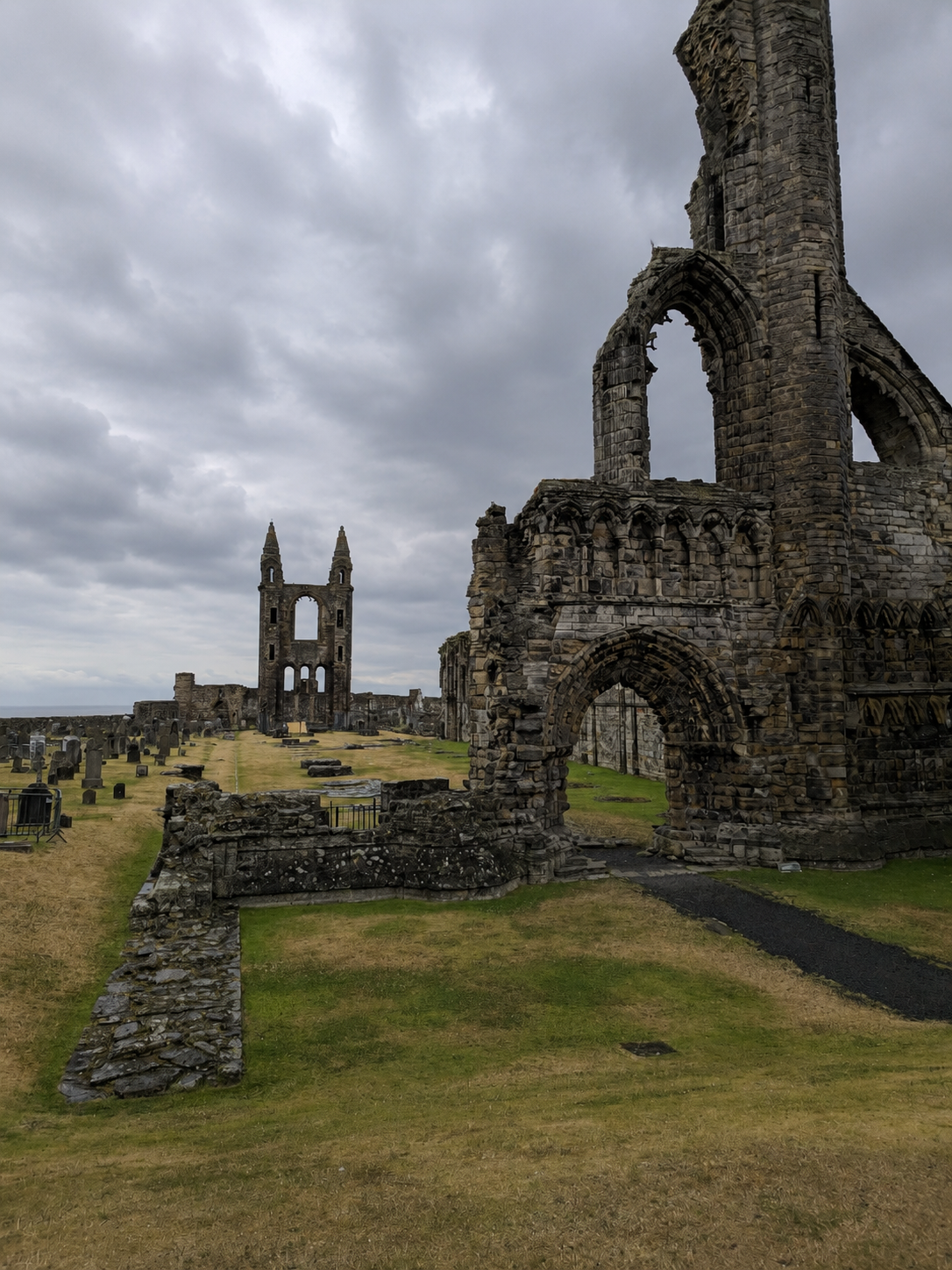
The weather was perfect for it.
Under bright sunshine, the grass might have softened the site into a pleasant archaeological park. Beneath dense cloud, with the stone darkened by rain, the place retained something closer to menace.
The college courtyards had represented continuity.
The cathedral represented rupture.
A short walk towards the sea brought me to St Andrews Castle.
I remained outside, viewing it from the coastal path rather than visiting the interior. The exterior was enough to show that this had not been a decorative royal residence.
The castle served as the home of the bishops and archbishops of St Andrews. It functioned as palace, fortress and prison, and witnessed several violent episodes surrounding the Scottish Reformation, including the murder of Cardinal David Beaton and the siege of 1546–47.
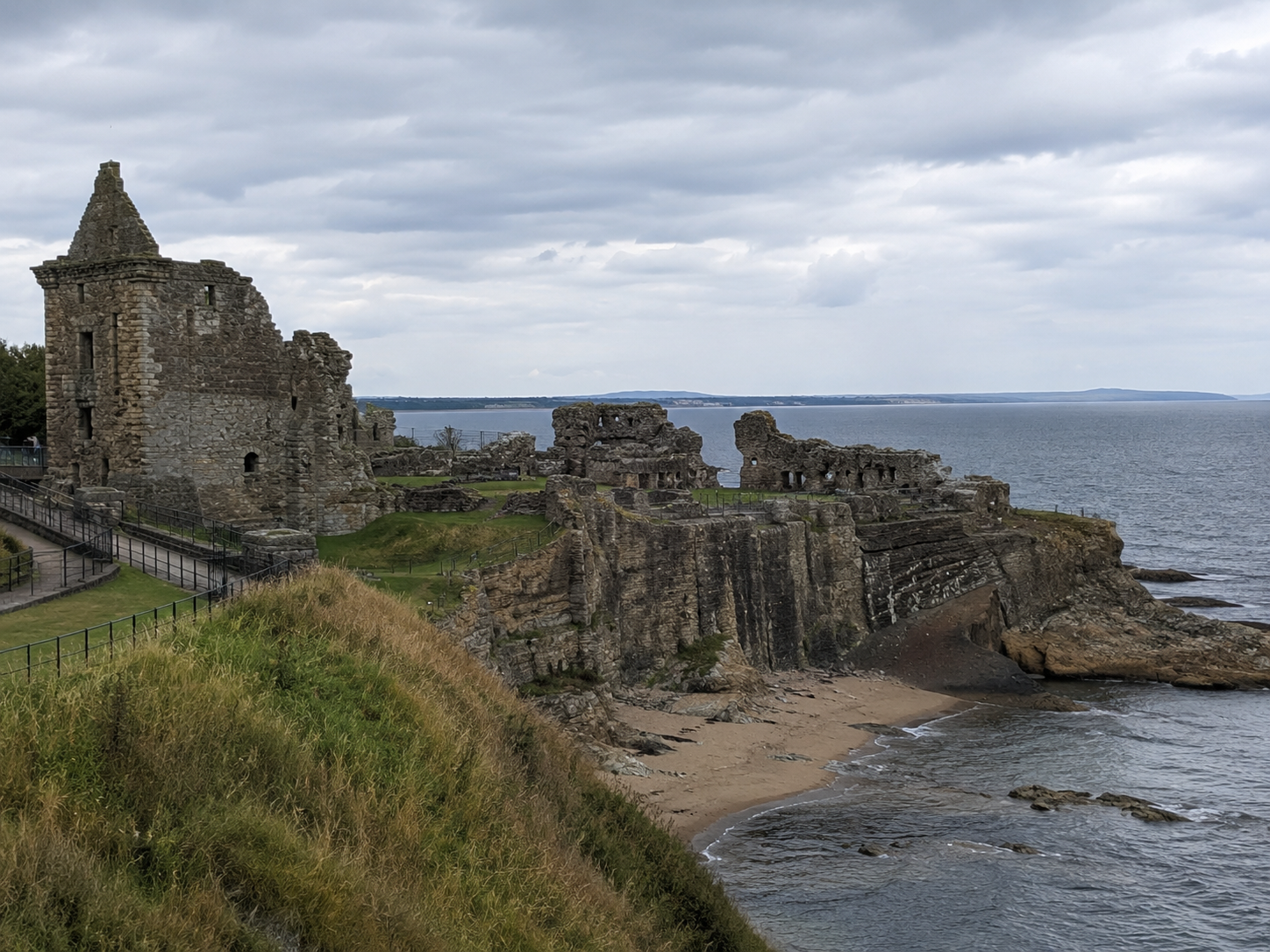
Like the cathedral, it declined not only because it had been damaged but because the authority it represented had vanished. Once the bishops and archbishops lost their position, the castle lost the institution that had occupied, defended and maintained it.
The Reformation had not merely damaged the cathedral and castle.
It had removed the people who might have rebuilt them.
Their survival as ruins now says more about the scale of that rupture than a polished reconstruction ever could.
Released into the Landscape
Beyond the castle, the coast opened towards the North Sea.
Dark shelves of rock extended into the water, divided by narrow channels and shallow pools. The sea was grey, the sky marginally darker, and the wind had begun preparing the attack it would later direct at my umbrella.
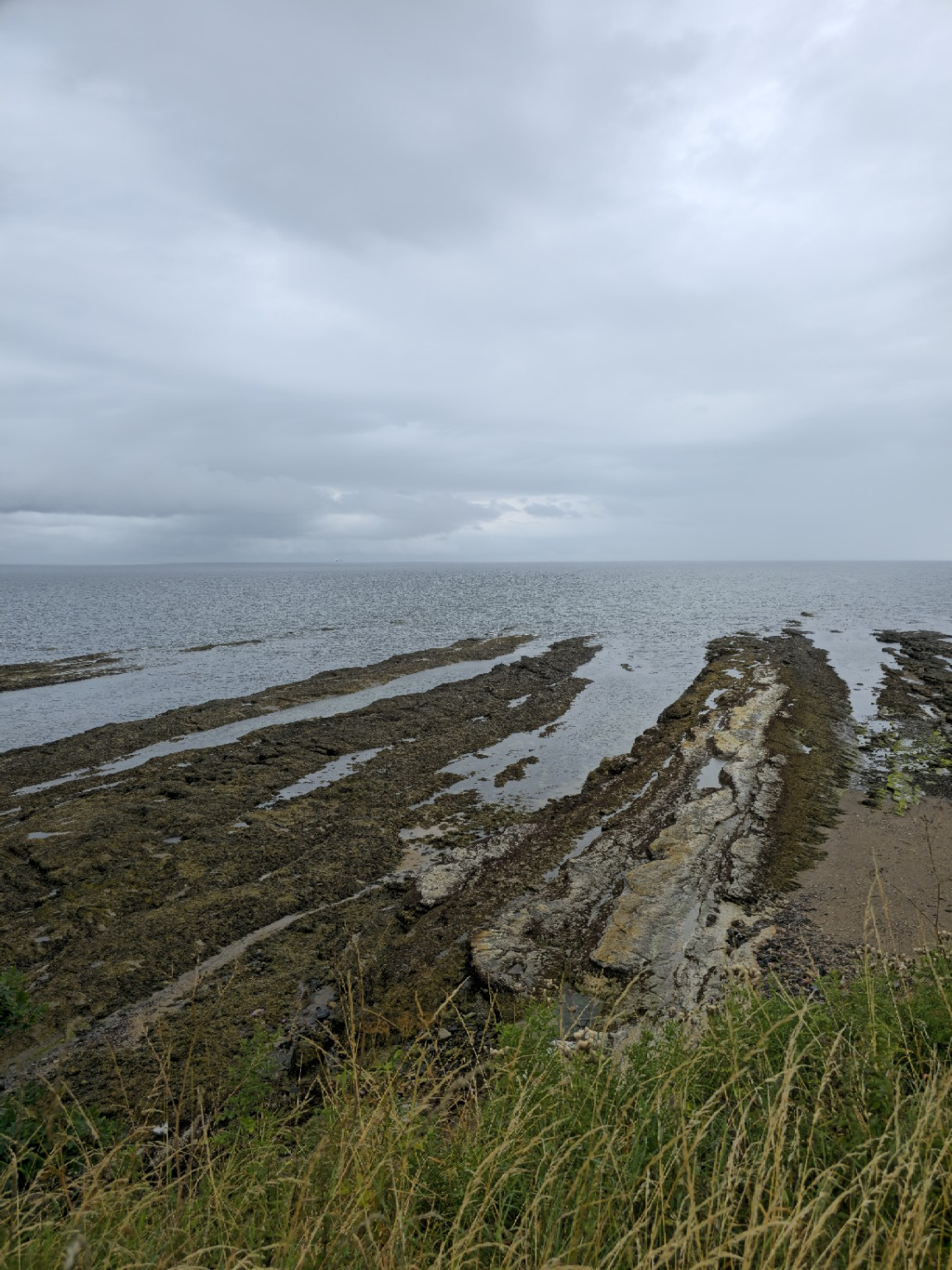
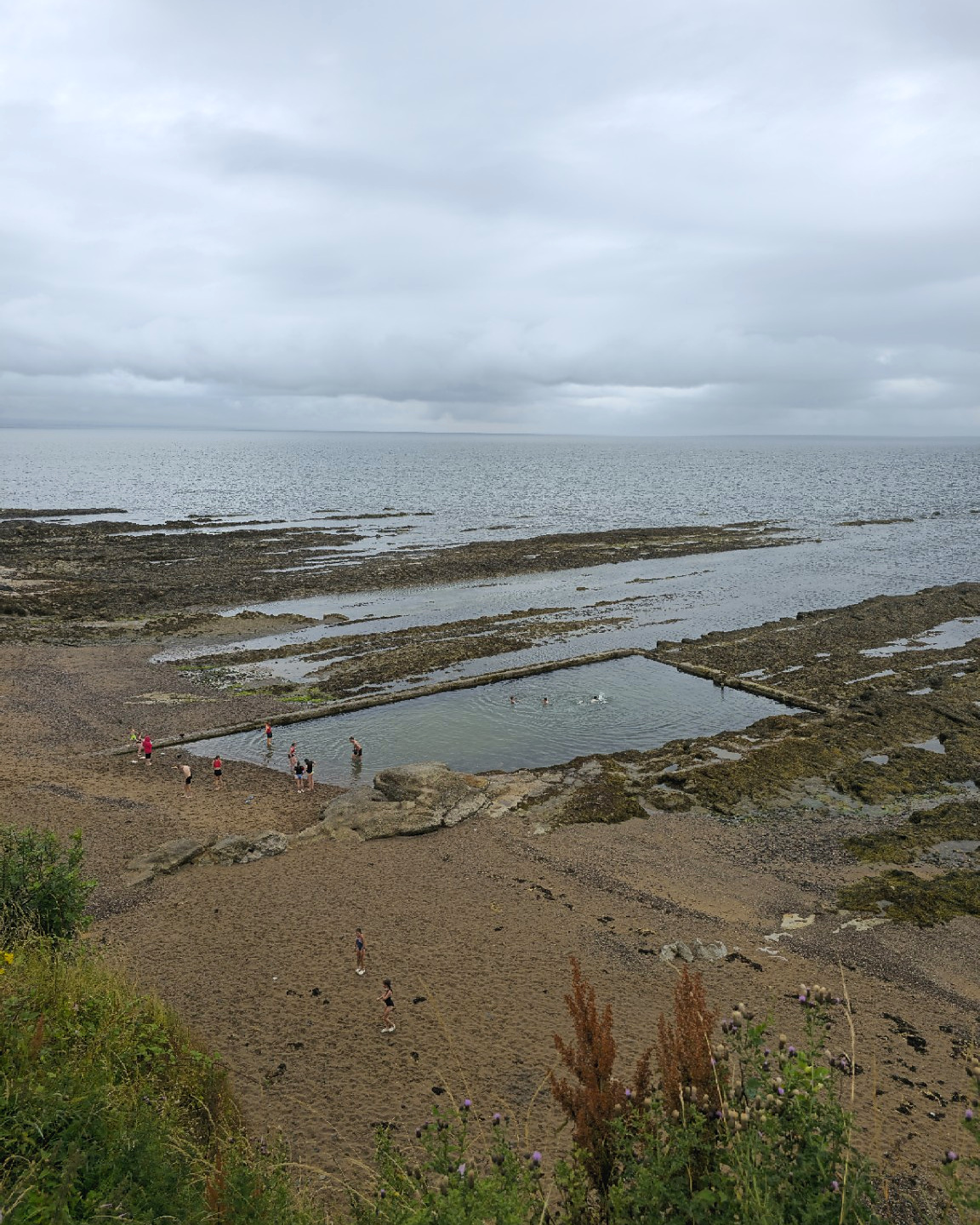
After the compact university passages and the dense history of the eastern end of town, the coastline provided a necessary release.
That release became complete at West Sands.
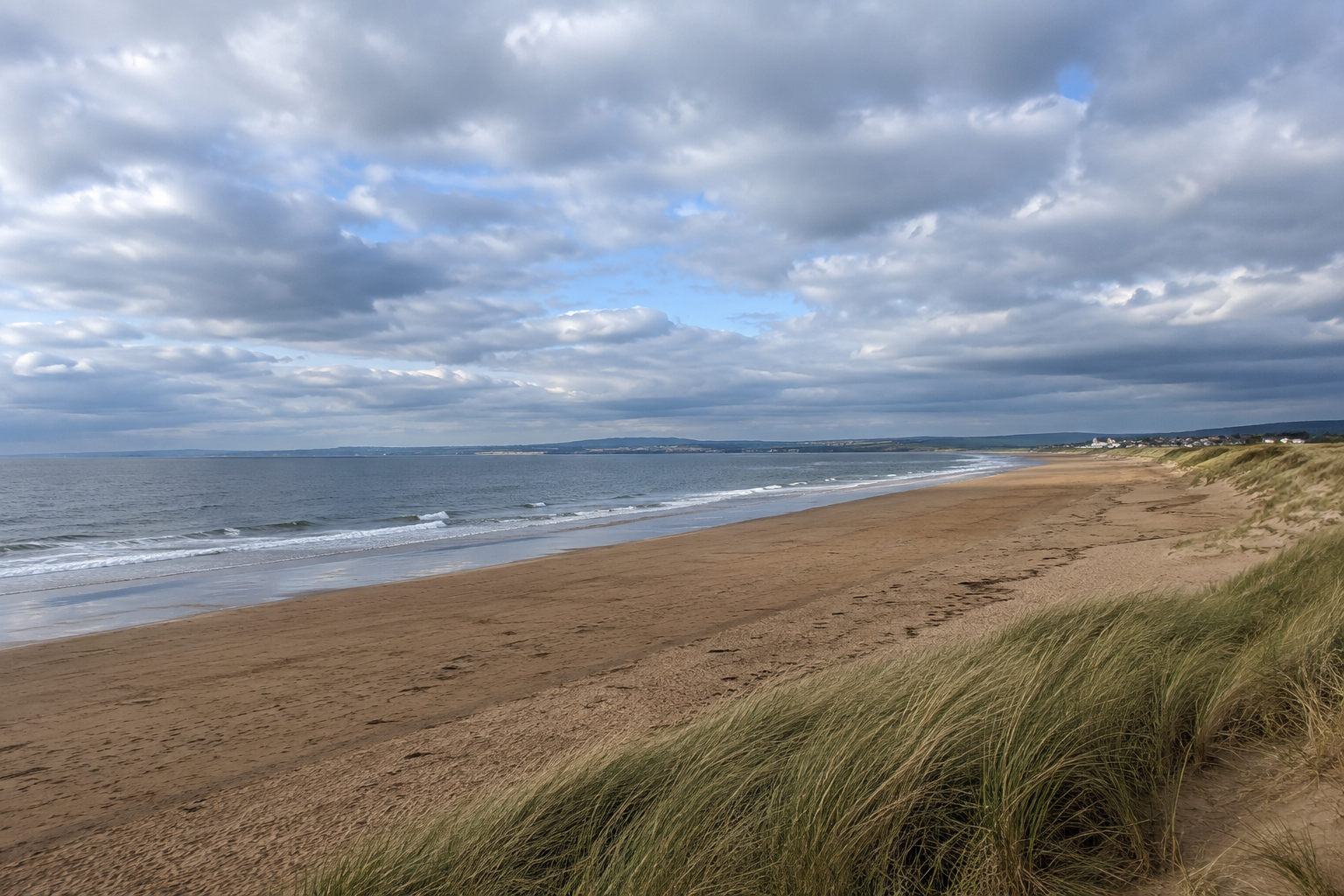
The beach stretches beside the dunes and golf links beneath an enormous open sky. It is also the beach used for the famous opening running sequence in Chariots of Fire.
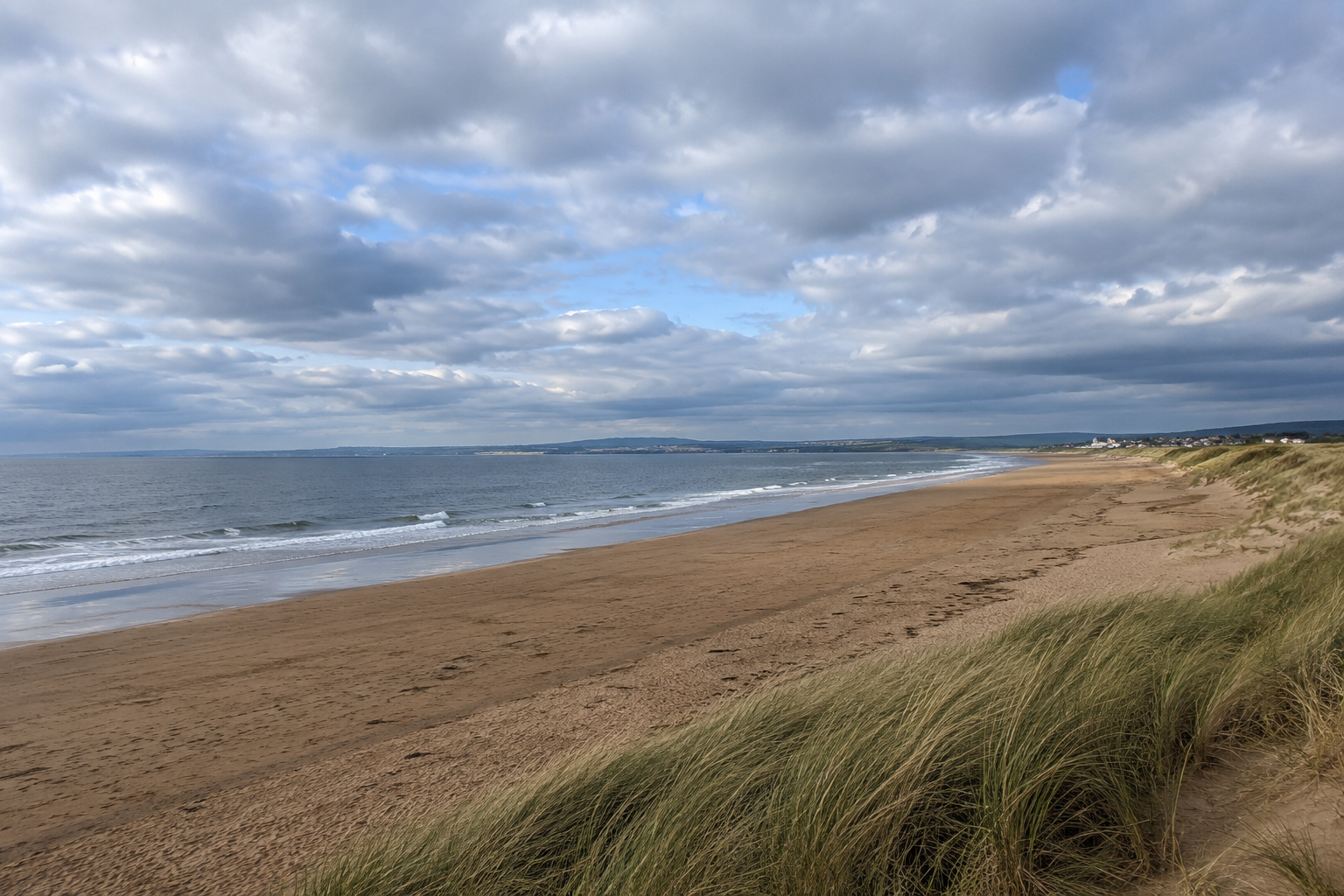
After so much stone, West Sands felt almost indecently spacious.
The town suddenly released me from arches, colleges and dead bishops into a broad strip of pale sand facing the North Sea.
It was not beach weather in any conventional sense, but it was beautiful in the harder Scottish way, where scale, emptiness and threatening weather perform most of the work.
The Most Famous Thing I Had Not Come to See
West Sands led naturally towards the golf links and the large hotel dominating the horizon.
Only then did I properly understand that I had reached the Old Course.
I knew St Andrews was associated with golf. I had not understood that I was approaching the oldest and most iconic golf course in the world, in the town universally marketed as the Home of Golf.
I had therefore arrived at one of the sport’s most sacred locations without possessing enough knowledge to be properly reverent.
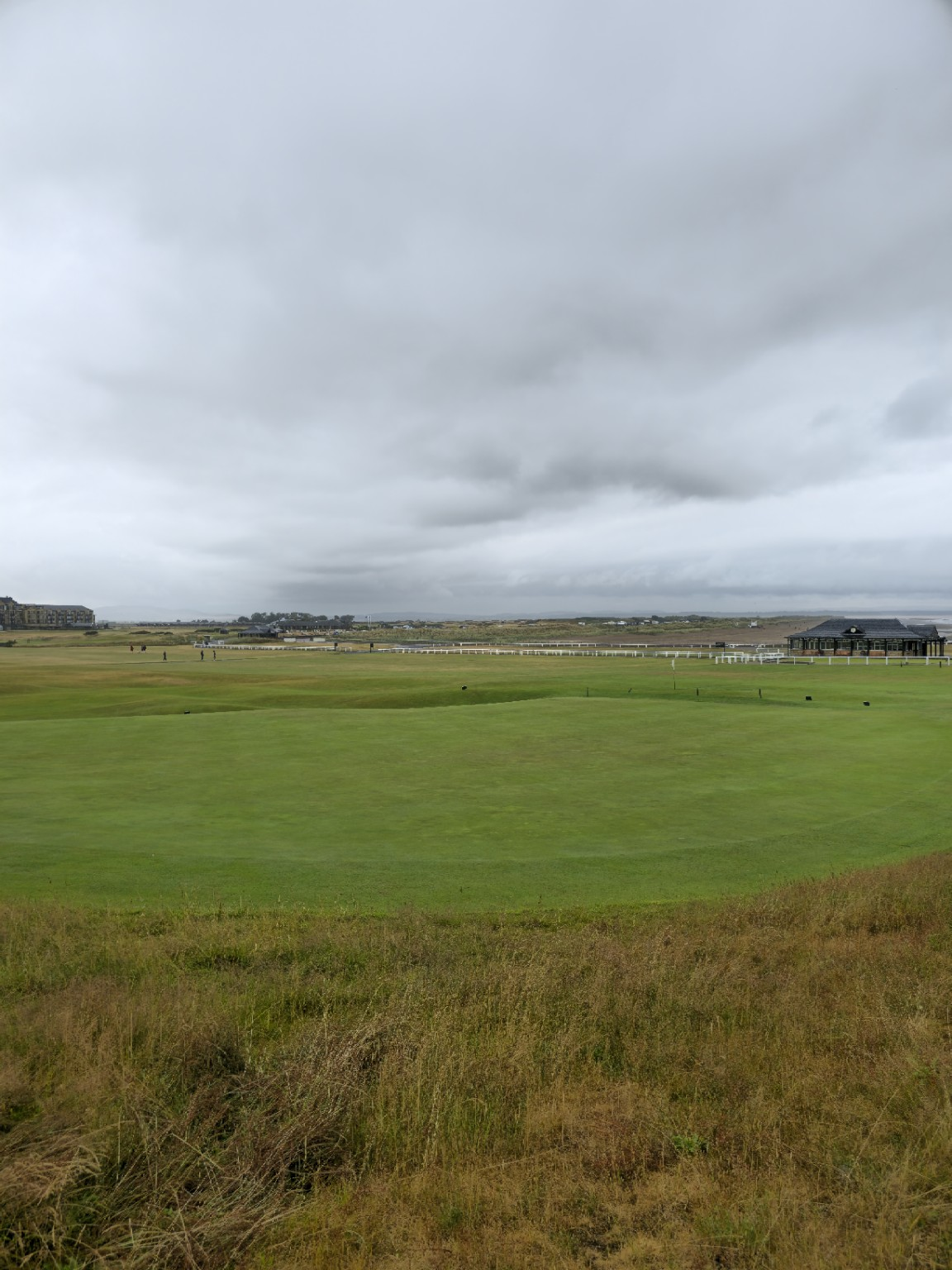
The name is wonderfully literal.
For centuries, this was simply the golfing ground at St Andrews. It became the Old Course only after the New Course opened beside it in 1895 and people suddenly needed a way to distinguish between them.
Apparently, originality was being conserved for the golf itself.
To a golfer, the landscape is saturated with famous holes, inherited ritual and moments of sporting history.
To me, it was an unusually large and immaculately maintained area of grass beside a very impressive hotel.
This is not a criticism. Golf and I have simply failed to establish a meaningful relationship.
The Old Course nevertheless completed the extraordinary collection of identities contained within the town. During one walk, St Andrews had moved from medieval pilgrimage and Catholic power to Scotland’s oldest university, royal mythology, Netflix and the spiritual centre of international golf.
St Andrews appeared almost careless about possessing all of them.
Scotland Claims the Umbrella
The rain had varied between light, persistent and briefly absent. The wind, by contrast, had shown unusual restraint.
It corrected that oversight as I returned towards the bus station.
Roughly two hundred metres from shelter, a gust caught my umbrella and turned it inside out. The metal frame emerged from the experience with a considerably more abstract understanding of geometry.
Scotland had allowed me the college, the bagpiper, the cathedral, the castle, the coast, the beach and the golf course before finally destroying the equipment I had brought to survive Scotland.
The timing was almost considerate.
I bought the £3.90 evening ticket and returned to Dundee wet, tired and entirely convinced that the afternoon had been worth it.
Tesco as Cultural Research
Under different circumstances, I would have been entirely capable of ending the day with whisky, a proper dinner and some prolonged reflection on medieval Scotland while looking across the Tay.
The schedule had other ideas.
I had started the morning at Dunnottar, travelled from Aberdeen to Dundee, checked into the hotel and then walked across several centuries of St Andrews in rain and wind. By the time the bus returned me to Dundee, sophistication had been overtaken by fatigue.
I went to Tesco.
Croatia has no Tesco, so I still enter one with the mild anthropological curiosity other travellers reserve for local markets. The shelves are hardly exotic, but they provide an efficient education in what Britain considers normal enough to place between two slices of bread.
On this occasion, Tesco finally produced something I had been seeking throughout the trip: a coronation chicken sandwich.
Coronation chicken combines cooked chicken with a mildly curried, creamy dressing and was originally created for the coronation festivities of Elizabeth II. In supermarket-sandwich form, its royal associations are considerably less apparent, but it remains one of my favourite distinctly British food inventions.
I carried it back to the upgraded room, ate it and fell asleep almost immediately.
The whisky had not been rejected on principle.
It had simply lost to the timetable.
South towards Edinburgh
The following morning, Dundee had changed character.
Sunlight entered the room and revealed the full view across the station, the River Tay and the bridge. Breakfast delivered almost everything I would expect from a conventional full-service Marriott despite the hotel belonging to a much more basic category.
There was no omelette station, but the selection was generous, there was proper filter coffee, and the staff continued to be almost embarrassingly kind.
After breakfast, I checked out and continued south towards Edinburgh.
Dundee had connected Aberdeen with the capital, provided an unexpectedly excellent £64 hotel and placed St Andrews almost outside my door.
The efficiency was admirable.
The fact that it had also delivered one of the most atmospheric afternoons of the journey was considerably more than the equation had promised.
The cathedral had collapsed. The bishops had left the castle. The university had continued for more than six centuries. William had met Catherine. Netflix had returned to reconstruct the relationship. Golfers still crossed the same ground with a degree of seriousness I normally reserve for hotel upgrades and breakfast coffee.
History had not ended there.
It had simply become crowded.
