
 Prague, Czechia
Fifteen stops, one phone, years of Prague experience — let the hunt for the best Prague photograph begin.
I have been to Prague enough times for another round of classic sightseeing to make very little sense. I know the major landmarks, I have photographed most of them before, and I certainly do not need another picture proving that Charles Bridge is still where I left it. Prague, however, remains ridiculously photogenic. So on this visit I gave myself a different task: forget the sightseeing checklist and start looking for photographs instead. After the rather overheated start to this Czech trip in Karlovy Vary, spending the next few days simply hunting for frames around Prague sounded like a considerably better idea.

I should probably clarify what kind of photographer is doing the looking. I do not arrange the light, carry a bag full of lenses or spend ten minutes adjusting settings. I walk, look and wait until something in front of me suddenly becomes a frame. Then I pull out my phone and click. For everything technical, Samsung deserves considerably more credit than I do. My part is simply to notice the moment before it disappears.
Some of the frames were planned, others came from familiar Prague landmarks I had seen many times before, and a few simply appeared when I happened to be in the right place at the right moment. That was probably the best part of the hunt: I knew Prague well enough to know where to look, but never quite knew what the city would give me once I got there.
Frame 01 — The Man Under the Lamp
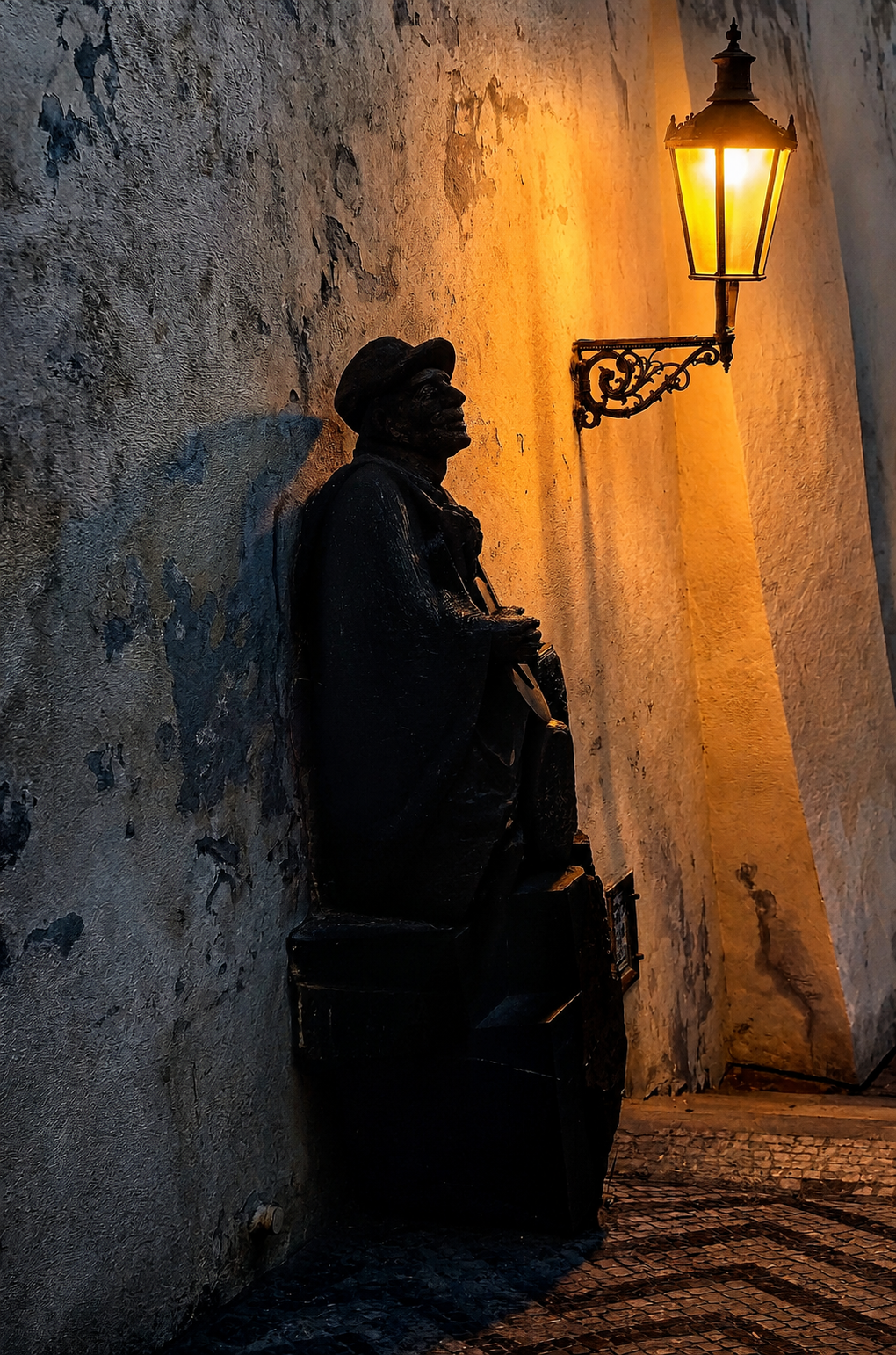
However good the photograph may look, I should admit that my first model was not exactly a professional. At least not one made of flesh and blood. The man sitting under the lamp is Karel Hašler, a Czech songwriter, singer, actor and director — and, as I discovered afterwards, about as appropriate a person as I could possibly have found on these particular steps.
Hašler had written a song called Po starých zámeckých schodech — Along the Old Castle Steps. His monument now sits on the very steps he once put into a song. There is also a much darker side to his story: he was arrested by the Gestapo and died in the Mauthausen concentration camp in 1941. I learned all of this only afterwards. When I stopped to take the photograph, he was simply an unknown figure sitting in the shadows under a lamp.
I had actually intended to walk down from Hradčany through Nerudova, which I remembered as one of those Prague streets where finding a decent photograph should not be particularly difficult. Somewhere along the way I simply took the wrong descent. Instead of Nerudova, I ended up on the Old Castle Steps.
By then the evening was taking over. The wall had gone cold and grey while the old lamps were beginning to throw warm patches of light across it. Then I noticed Hašler sitting almost completely in shadow, looking straight towards one of them. There was nothing clever to do. The picture was already there; I only had to notice it and press the button.
I had gone looking for Nerudova, missed it completely and came back with something better. For a hunt built around waiting for Prague to offer me a frame, that seemed like a pretty good place to start.
Frame 02 — St. Vitus Through the Arch
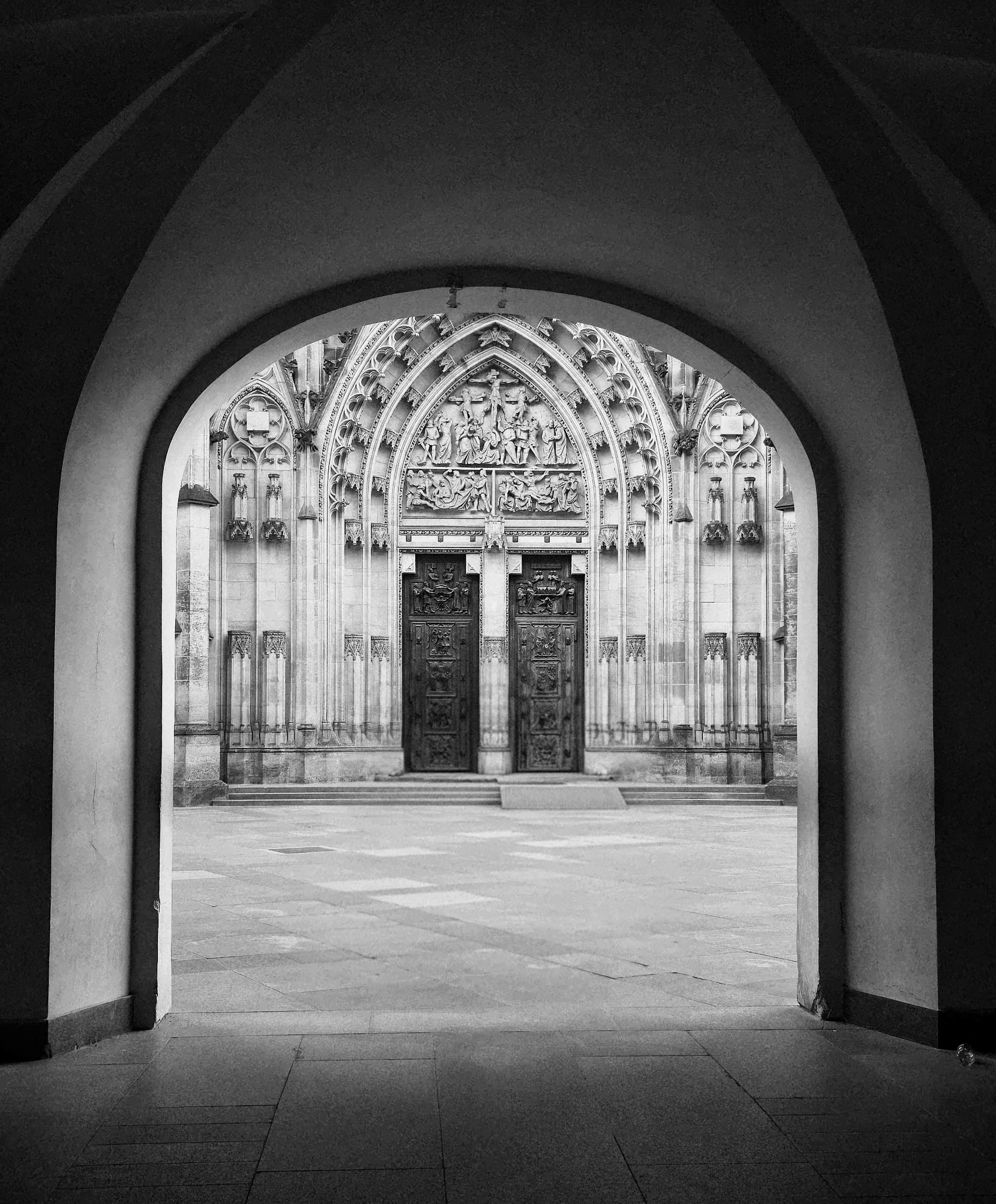
I reached St. Vitus in the early evening, not long before the walk down from Hradčany that would eventually produce Frame 01. The cathedral hardly needs help looking impressive: it is the dominant Gothic structure of Prague Castle, with a nave rising more than thirty metres and a façade packed with portals, tracery, sculpture and stained glass. Inside, some of its windows are almost attractions in their own right — including the famous Art Nouveau window designed by Alphonse Mucha. Outside, however, the photographs tend to repeat themselves: the monumental western façade, the towers squeezed into a vertical frame, or the entire cathedral rising above Prague from across the river.
I wanted something less obvious. Walking around the complex, I noticed that one of the surrounding passageways gave me a view of only the cathedral portal, enclosed almost perfectly by another arch. Suddenly the enormous building became much smaller and more controlled. The foreground arch created a frame within the frame, while the repeated Gothic shapes of the portal continued the same geometry inside it. There was only one problem: people. Quite a few of them. It took me much longer than expected to get those few seconds when nobody was crossing exactly where I needed an empty courtyard.
This is also one of the rare frames where I deliberately prefer black and white. The colour version is perfectly fine, but colour adds surprisingly little to this particular photograph. What matters are the shapes: the almost black foreground, the pale stone beyond it, the symmetry of the portal and the succession of arches pulling the eye towards the cathedral. Removing the colour makes that structure much more obvious and gives the image a slightly timeless quality that suits Gothic architecture rather well.
St. Vitus itself is therefore almost the least unusual thing in the photograph. Everyone comes to Prague Castle expecting to photograph it. What made this frame work for me was stepping away from the obvious view, finding another piece of architecture to hide most of the cathedral behind — and then having enough patience to wait until everybody finally got the hell out of my picture.
Frame 03 — When O2 Arena Gets the Sunset
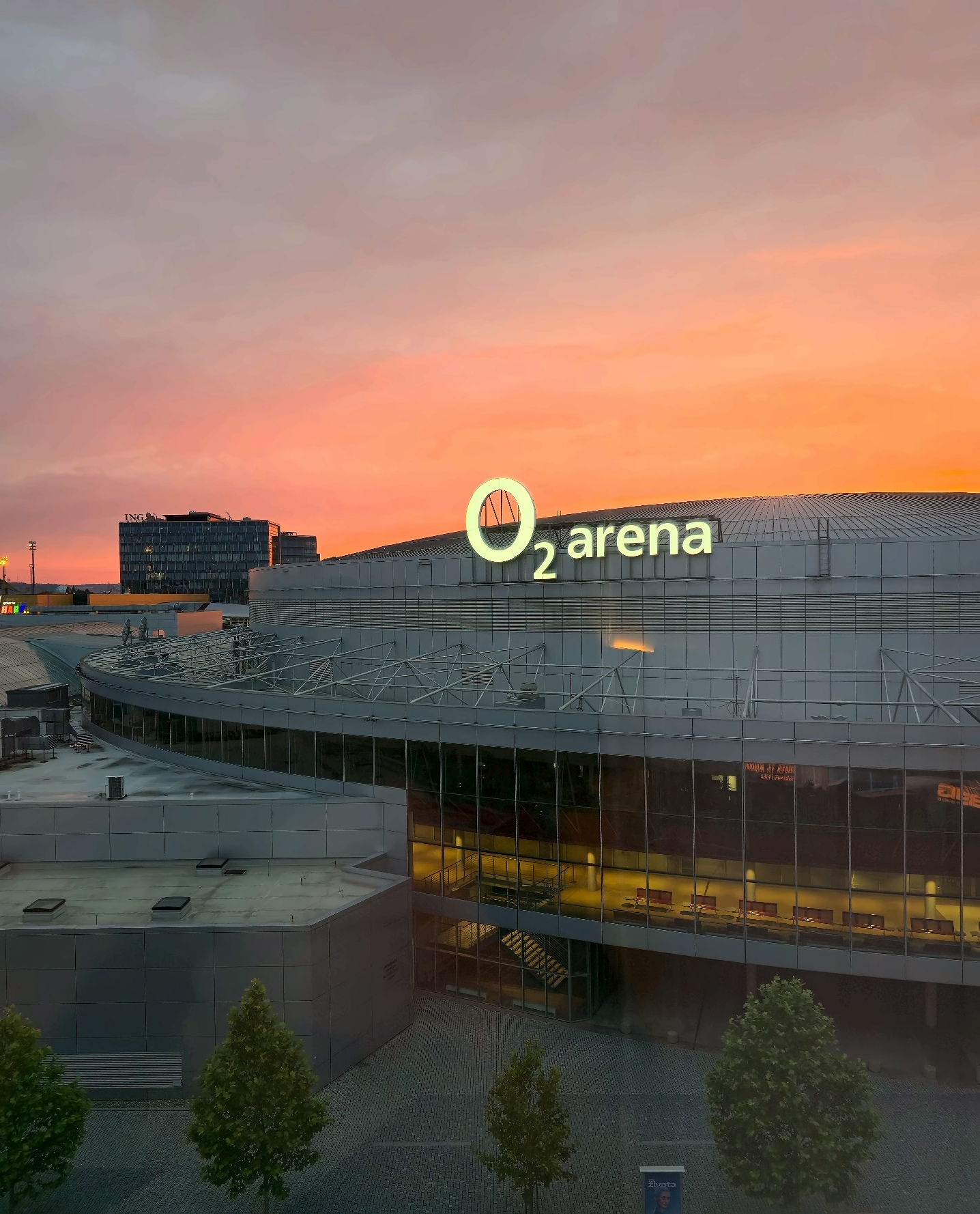
Prague’s O2 Arena is not exactly the first place that comes to mind when looking for the city’s best photographs. Opened in 2004, it is one of the Czech Republic’s major indoor venues, built primarily for ice hockey but now equally at home hosting concerts and other large events. Architecturally, it is big, metallic and functional — about as far removed from Gothic Prague as you can get.
The logistics for this frame could hardly have been easier. I did not travel across the city, search for a viewpoint or wait for somebody to move out of my composition. The arena was simply the view from my room at STAGES Hotel Prague. What changed was the sky. As sunset developed behind the building, an otherwise fairly ordinary view suddenly acquired bands of orange, pink and grey that worked surprisingly well against the cold curves and metal of the arena.
And that contrast is probably what made me like the photograph so much. The arena itself is almost brutally practical, while the sky behind it is doing everything it can to be dramatic. For a few minutes the two completely different moods somehow belong together. There is also something satisfying about getting one of the better frames of the trip without leaving the room, simply because I happened to look through the window at the right time.
That is exactly why I wanted this frame in the collection. Not every good photograph in Prague needs a medieval tower, a cobbled street or a carefully researched viewpoint. Sometimes the subject is something you would normally barely bother photographing. You just catch it during those few minutes when an ordinary place stops looking ordinary — and that is enough.
Frame 04 — When Prague Castle Starts to Glow
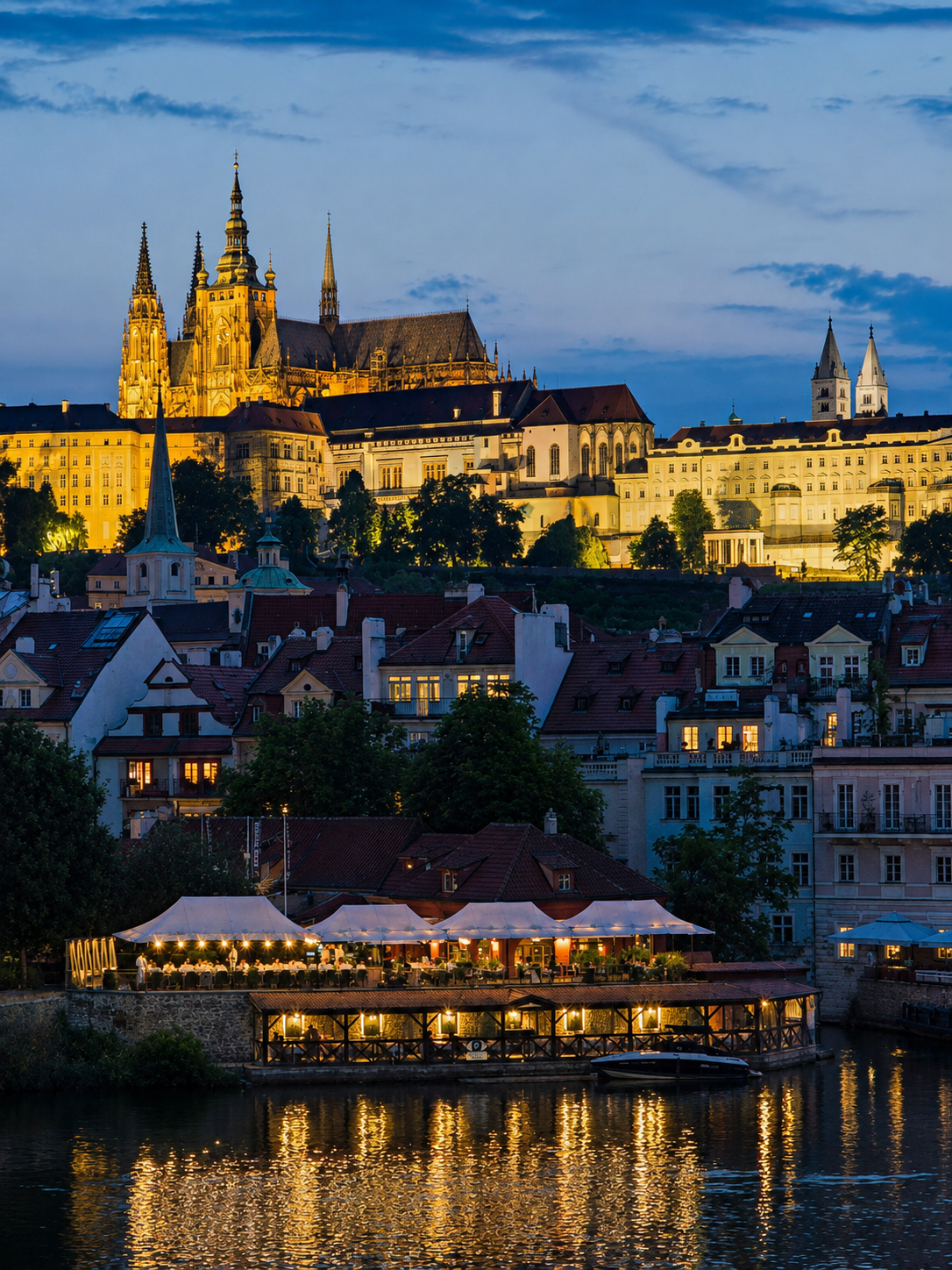
Some photographs are discoveries; this one is almost an obligation. If you are photographing Prague, the illuminated castle above Malá Strana is one of those frames you are supposed to bring home. I had tried before. More than once. And somehow the result had never quite matched what I was seeing with my own eyes.
Night photography was always where my usual photographic philosophy started to fall apart. In daylight I can wait for the frame, take out the phone and let Samsung deal with the technical side. Once the light disappears, that arrangement becomes considerably less reliable. Earlier Galaxy generations had given me enough noisy skies, muddy shadows and glowing buildings with all the subtlety of a nuclear explosion to know that simply pointing a phone at Prague Castle after sunset was not necessarily going to end well.
This time, however, I had a Galaxy S24 Ultra in my hand. If a night view of Prague Castle was still going to defeat me, I was quite prepared to blame Samsung rather than myself. The timing helped: I took the photograph from Charles Bridge just as the castle lighting was beginning to dominate, while enough blue remained in the sky to keep the scene alive. Prague Castle glowed above the darker roofs of Malá Strana, while the lights along the river were beginning to stretch into the Vltava below.
And that is why this very familiar view made the final selection. It is probably one of the least original motifs in the entire hunt, but it is also a photograph I had wanted for years and never quite managed to get. This time I looked at the result and, for once, did not immediately start thinking about everything the phone had ruined. The Ultra had finally done its part.
Frame 05 — Gulliver Airship at DOX
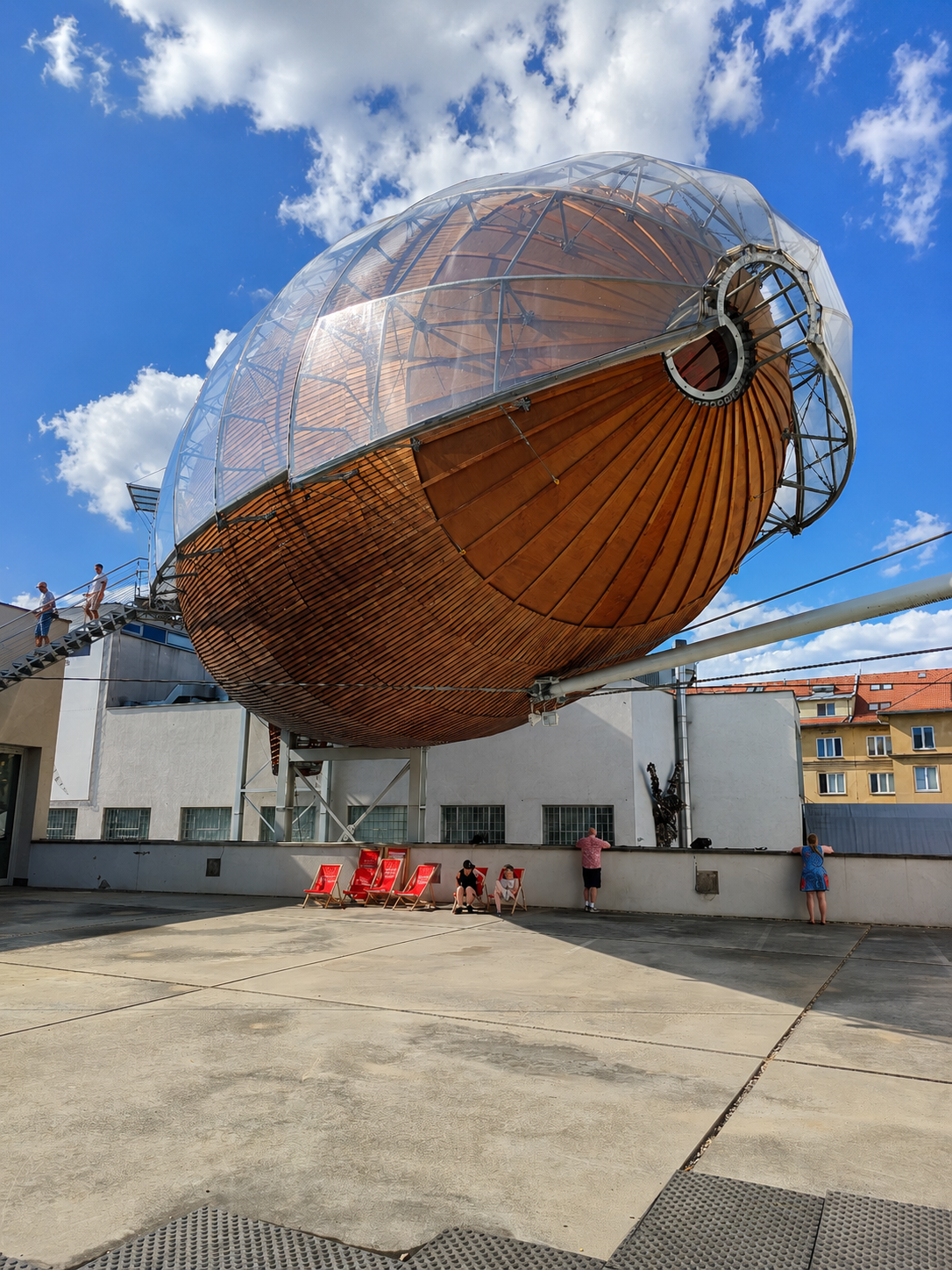
Gulliver was one of the few frames I actually went looking for. I found it online while searching for less obvious Prague photo spots and had never heard of it before. A 42-metre wooden airship sitting on a rooftop sounded weird enough to justify an Uber to Holešovice.
It has been part of the DOX Centre for Contemporary Art since 2016, designed by Martin Rajniš and built from wood and steel. The inside is even used for readings and other events, so it is more than just an oversized piece of rooftop decoration. Still, none of that was really why I was there. I wanted the photograph.
And the weather decided to cooperate. The sky genuinely was that blue, the clouds were already there, and the warm wooden hull looked fantastic against them. From low down Gulliver stopped looking like something attached to a museum and started looking, at least for a second, as if it might actually take off.
There was only one catch: normally you have to pay admission to reach the roof. I was perfectly willing to do that, except their card terminal had broken. I explained that I had come only to photograph the airship and promised to go up, take the picture and disappear again. They let me through. So this frame was supposed to cost money, but in the end all it required was good weather, an Uber and a conveniently dead POS terminal.
Frame 06 — A City of Rooftops
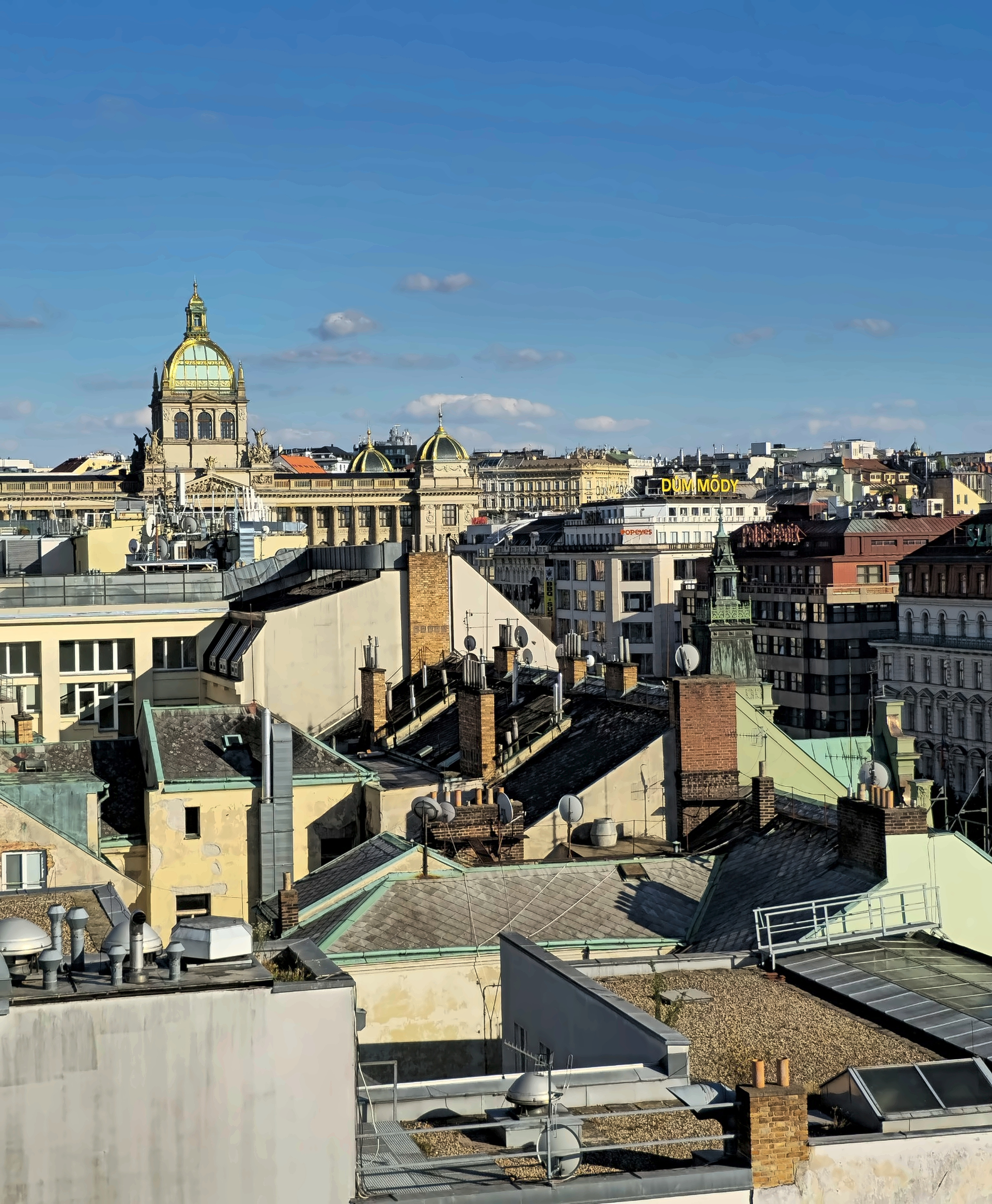
When W Prague opened in late 2024, I obviously wanted to try it. It is Marriott, it is W, and the revival of the old Grand Hotel Evropa on Wenceslas Square looked seriously tempting. Then I checked the prices. Four nights at STAGES, with my Bonvoy status still doing its job, cost less than one night at W. I like hotels, but not enough to suddenly forget basic arithmetic.
Still, W needed to be tested somehow, so I settled for a cocktail at ABOVE Rooftop. The cocktail was excellent, but the rooftop quickly became more of a photo studio than a bar. The first thing that caught my eye was not a single monument but the mess below: roofs, chimneys, antennas, technical installations, faded walls — and then, rising above all of it, the much more elegant dome of the National Museum.
I have rooftop photographs from all over the place — Portugal, New York, Seville, London and plenty more — so Prague deserved one too. No, this is not SUMMIT One Vanderbilt with silver balloons floating around Manhattan, and it certainly is not London from GŎNG on the 52nd floor of The Shard. Fine. It does not need to be.
What I like here is precisely that Prague is not behaving like a postcard. It is messy, layered and slightly chaotic, and the late-afternoon light somehow makes the whole lot work. Maybe not the most spectacular trophy of this photo hunt, but a damn respectable one.
Frame 07 — The Tower Prague Loves to Hate
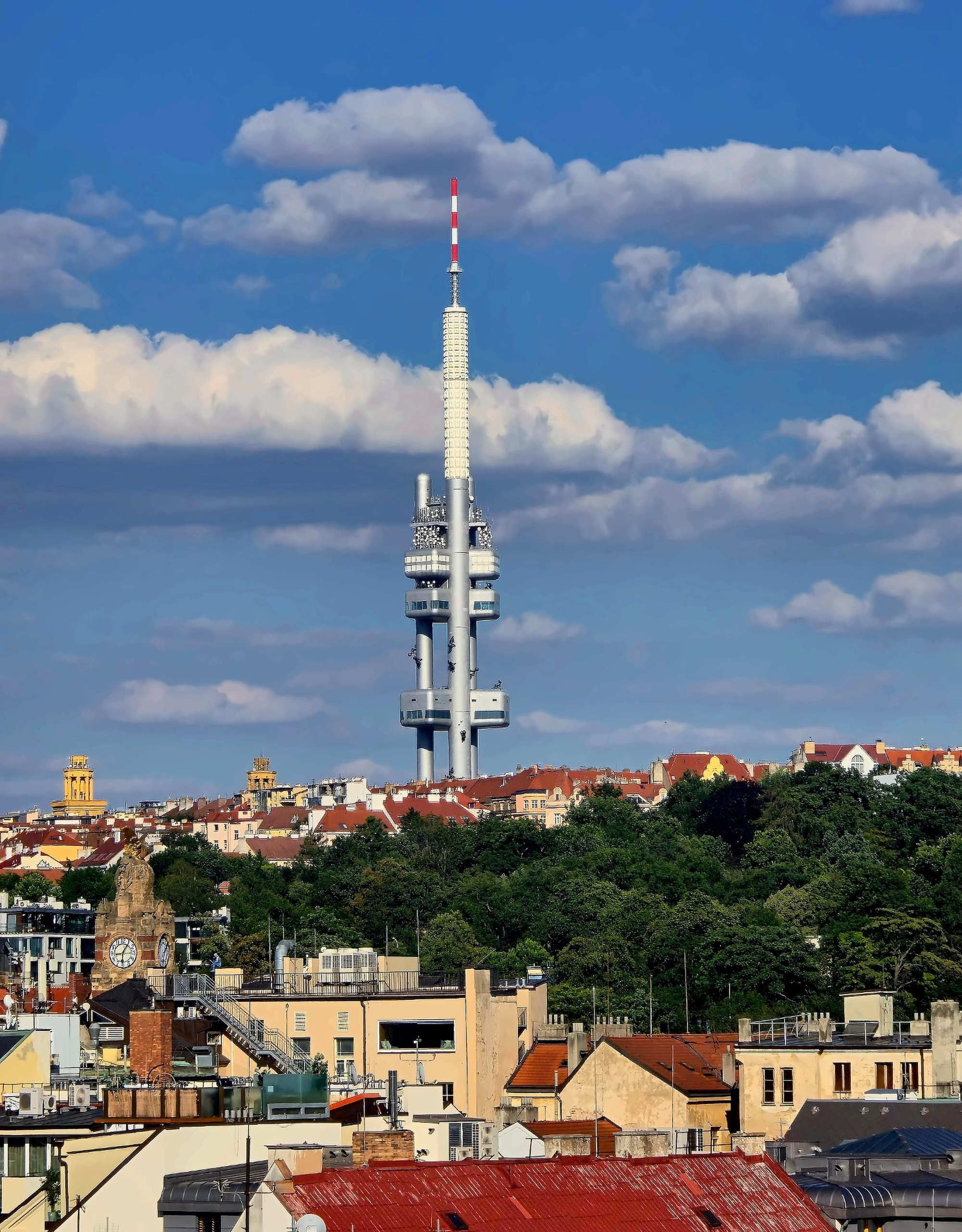
I was still on the rooftop of W Prague when I turned away from the jumble of roofs and noticed something much harder to ignore. Žižkov Television Tower rises 216 metres above the city, and from up there it looks almost ridiculous in scale — all red roofs and greenery below, then this huge piece of late-20th-century engineering sticking straight through the skyline.
The tower was controversial almost from the start. Built between the 1980s and early 1990s, it carried all the baggage of its communist-era origins, while its shape did not exactly help. For years it regularly appeared on lists of Prague’s ugliest buildings. Then David Černý’s giant crawling babies were added to it, which somehow made the whole thing even stranger. And yet Prague seems to have made peace with it over time. Maybe not love exactly, but the sort of relationship where removing it would now feel wrong.
From the W rooftop, I could suddenly see why it works so well photographically. Everything underneath looks reassuringly Prague — old roofs, trees, a few church towers — while Žižkov rises above it like it belongs to another city entirely. I am still not convinced the tower itself is beautiful. The photograph, on the other hand, I absolutely love.
Frame 08 — The Infinite Book Tower
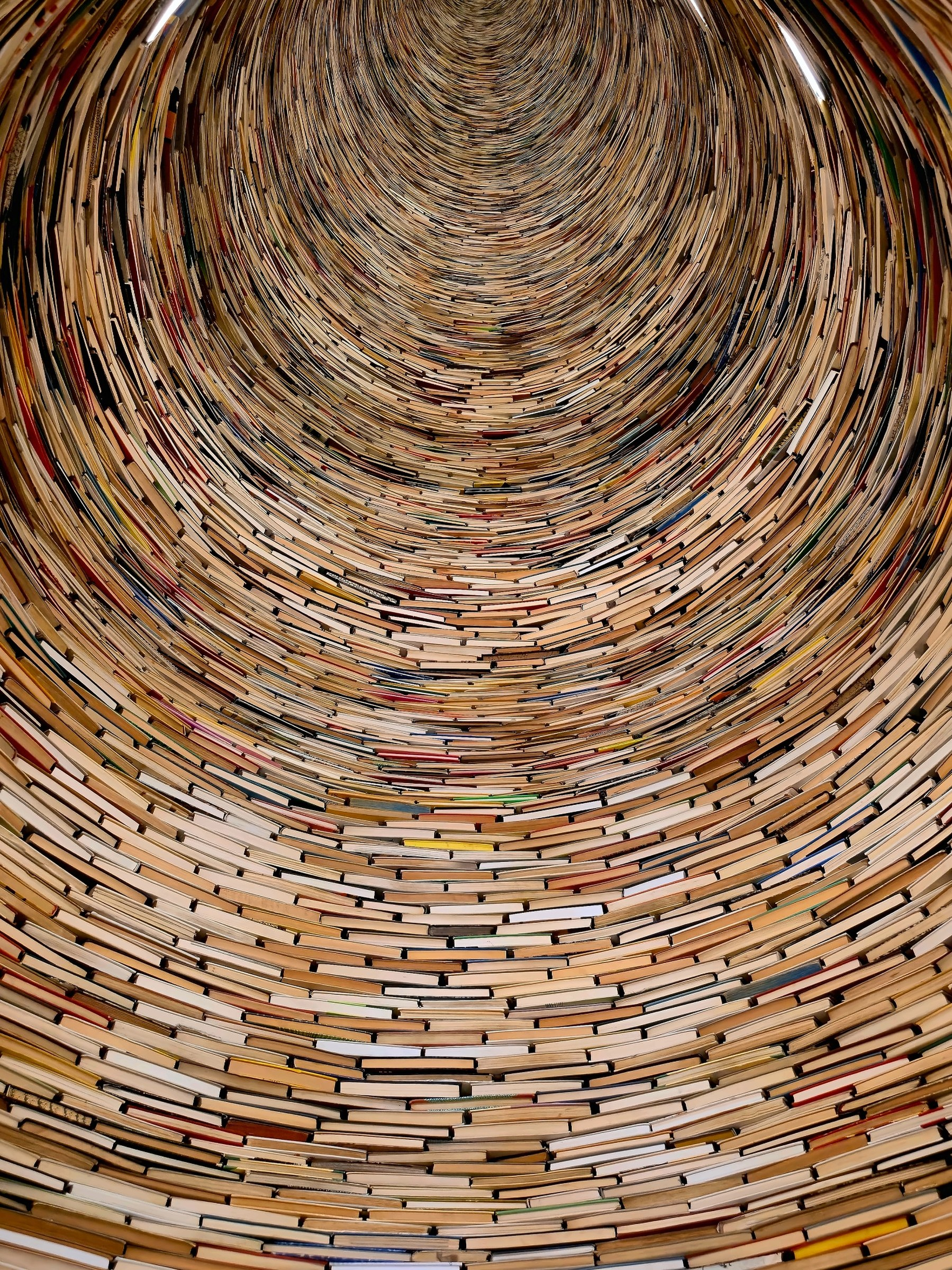
Like Gulliver, this was another Prague photo spot I had never heard of before I started digging around online. The difference was that this one required no Uber and no expedition to the edge of my usual territory. Idiom sits in the foyer of the Municipal Library on Mariánské náměstí, comfortably within walking distance of the places I would be passing anyway.
The installation is by Slovak artist Matej Krén and has been here since 1998. Thousands of books form a tall column, with mirrors at the top and bottom creating the illusion that the books continue forever. From the outside it is interesting enough, but the photograph is inside. Put the phone into the opening, get reasonably centred and suddenly the tower disappears into a vortex of pages, colours and lines.
The only problem is that everybody else has discovered the same trick. I waited around twenty minutes for my turn, basically watching people take variations of the photograph I was waiting to take myself. Still, once I finally got there, I understood the queue. The result is one of my favourite frames from this entire hunt and probably among the strongest photographs in the set. It hardly looks like a tower of books anymore, which is exactly why I like it.
So no, this was not some secret corner of Prague I heroically discovered. Quite the opposite. But originality of location and quality of photograph are two different things — and this one was worth the twenty-minute wait.
Frame 09 — Prague’s Rougher Passageways
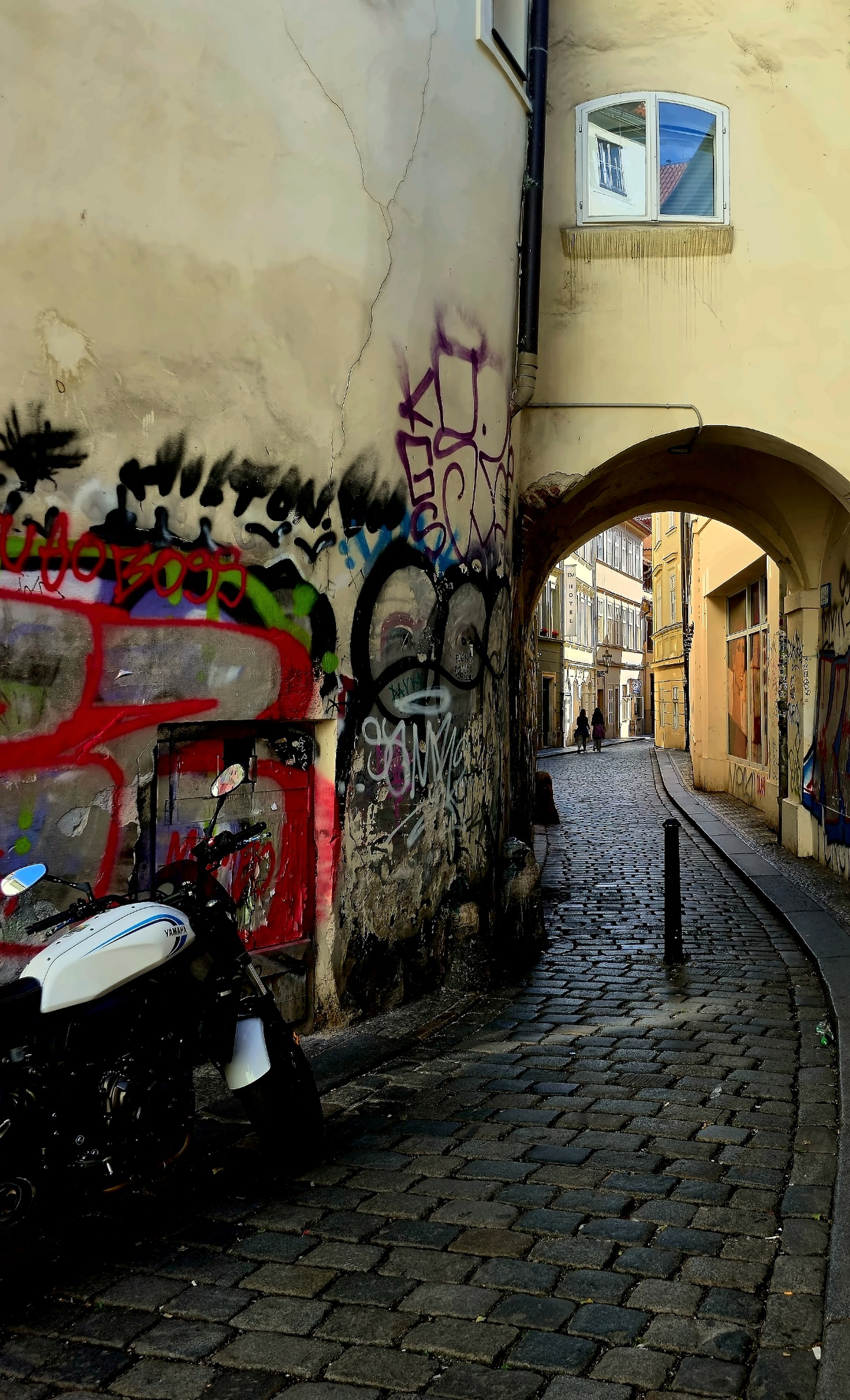
This one was not on any list. I had not found it online, saved it on a map or taken an Uber across town to get there. I was simply walking through Staré Město, passed Michalská 511/8 and saw the frame. That was it. Sometimes you search for a photograph; sometimes you just walk into one.
What stopped me was the contrast. Graffiti, cracked plaster, damp-looking walls, dark cobblestones and a motorcycle squeezed into the corner — hardly the polished Prague of postcards. Then the arch opens onto a much neater street beyond, almost as if somebody had drawn a line between two versions of the same city. The bike helped enormously. Without it, I probably still would have taken the picture; with it, the scene suddenly had some attitude.
There is no major history lesson hiding here and no landmark I need to explain. I just liked what I saw and took out the phone. And that is exactly why this frame belongs in the hunt. If every photograph had been researched in advance, the whole thing would have become a checklist. Prague occasionally deserves the chance to provide the subject itself.
Frame 10 — Where Prague Goes Quiet

Vyšehrad has always felt slightly different to me from the rest of Prague. I had been there before, and every time there was something slightly mysterious about the place — quieter, greener and somehow removed from the city below. On this visit I kept things simple: the Basilica of St Peter and St Paul and the cemetery beside it were enough.
The cemetery is the resting place of many important figures of Czech culture, including Antonín Dvořák and Bedřich Smetana. Cemeteries are definitely not among my favourite photographic subjects, so I was not expecting this to become one of the frames in the hunt. Then the sun came through the trees, lit the flowers and broke across the cobblestones, and the whole place suddenly became surprisingly photogenic. Apparently even a cemetery can occasionally convince me.
One practical tip: do Vyšehrad downhill. An Uber can take you right up to the cemetery, and from there it makes much more sense to explore on foot while gradually making your way back down towards the city.
Frame 11 — Charles Bridge Before Prague Wakes Up
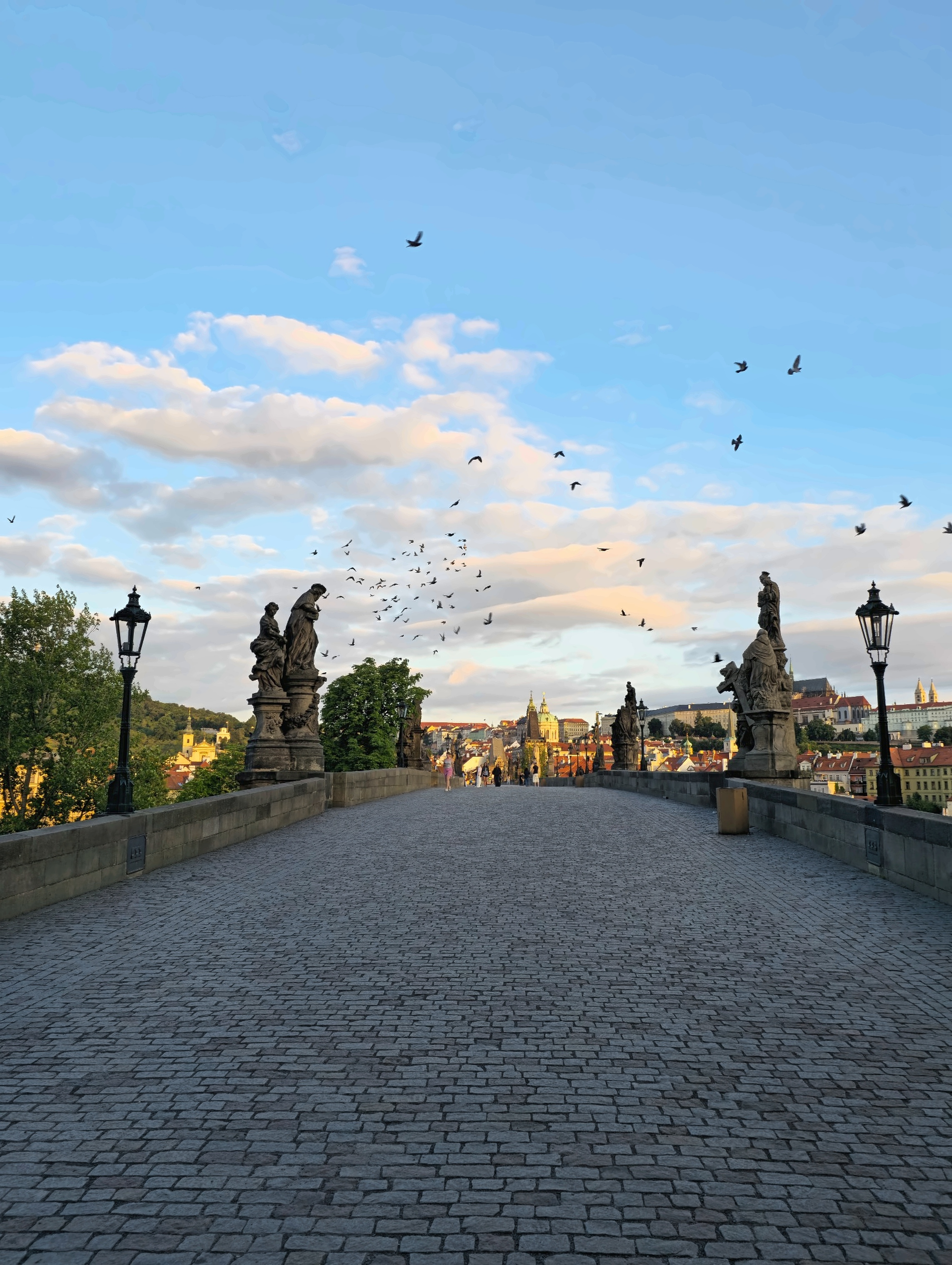
An empty Charles Bridge is not a secret photo spot. It is a timing problem. This photograph was taken at 5:35 in the morning, and that is pretty much the whole trick. If you want one of Prague’s busiest places to yourself, the price is sleep.
I was staying at Sir Prague, close to the Vltava near the Dancing House, so for once there was no reason to call an Uber. I simply walked from the hotel towards the bridge. At that hour even the route there was unusually empty, which produced a few potential frames of its own, but Charles Bridge was the real target.
And it worked. The cobblestones were almost empty, the statues and lamps finally had enough space around them, and the early light was beginning to warm the city in the distance. Then the birds flew into the frame. Obviously I had nothing to do with that part, but they turned a photograph I already liked into one of my favourites from the hunt.
There is no hidden viewpoint here and no clever photographic secret. It is the same Charles Bridge everyone photographs. You just have to get there before everyone else does — and occasionally Prague rewards the effort.
Frame 12 — The Clock Before the Crowd
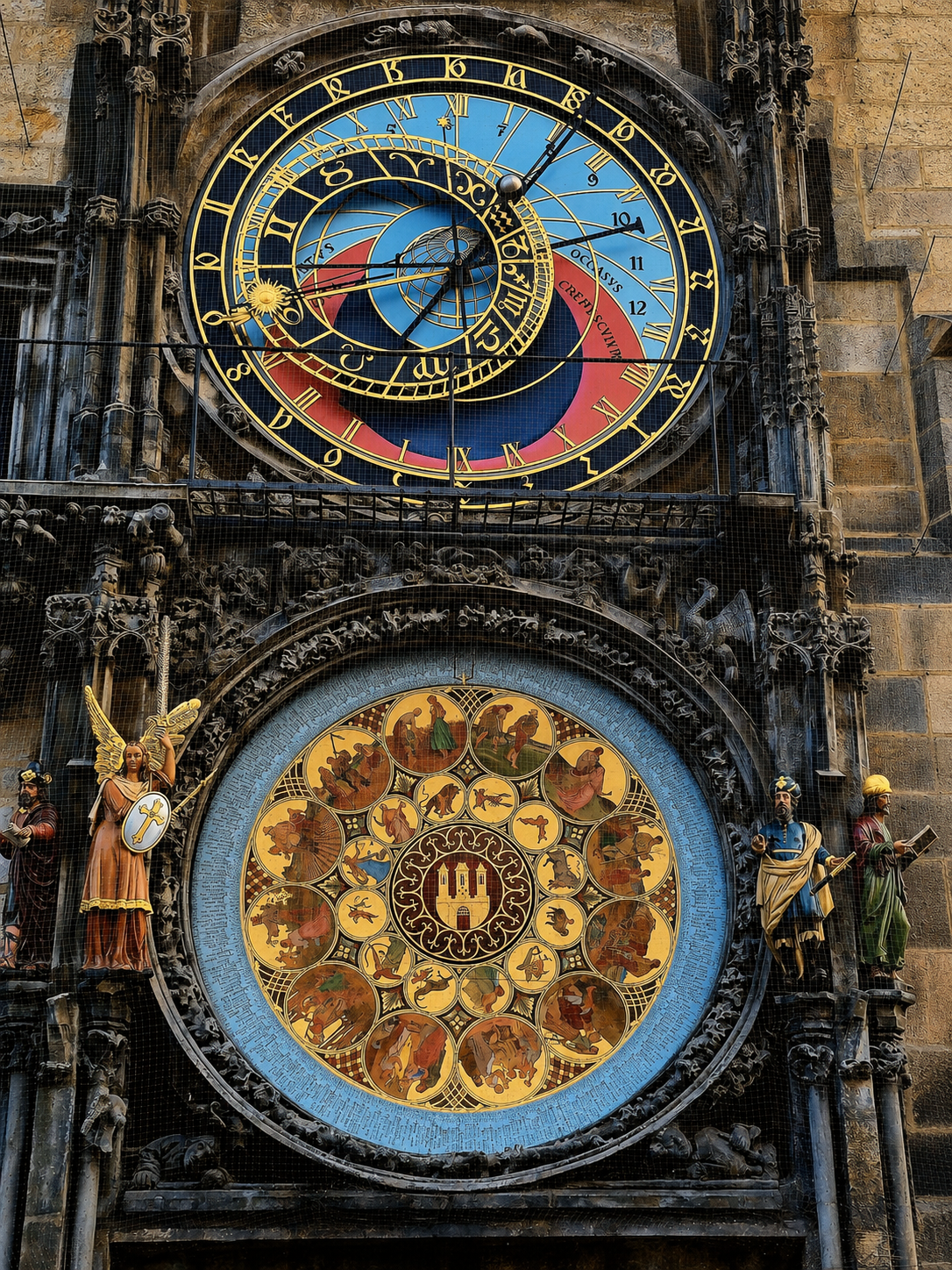
By the time I reached Old Town Square it was still not even six in the morning, which in Prague is apparently what it takes to make one of the city’s most photographed sights look as if everybody else has temporarily forgotten about it. The square was almost empty, there was nobody fighting for the same position, and for once I could simply stand in front of the Astronomical Clock and decide what I actually wanted in the frame.
What caught me most was the colour. Once you stop treating the Orloj as something you are obliged to photograph and actually look at it closely, it is almost ridiculously decorative: deep blue, black, gold, red, the painted calendar dial and all those figures packed into dark Gothic stone. I went much tighter than I normally would, because the details were far more interesting to me than another photograph of the whole façade.
It is hardly an undiscovered Prague motif, but that was never the point of this hunt. Sometimes the challenge is finding something nobody photographs; sometimes it is getting a familiar subject under conditions that make you want to photograph it again. At 5:54 in the morning, with an empty Old Town Square behind me, the clock finally earned its place in the final selection.
Frame 13 — The Castle Beyond the Square
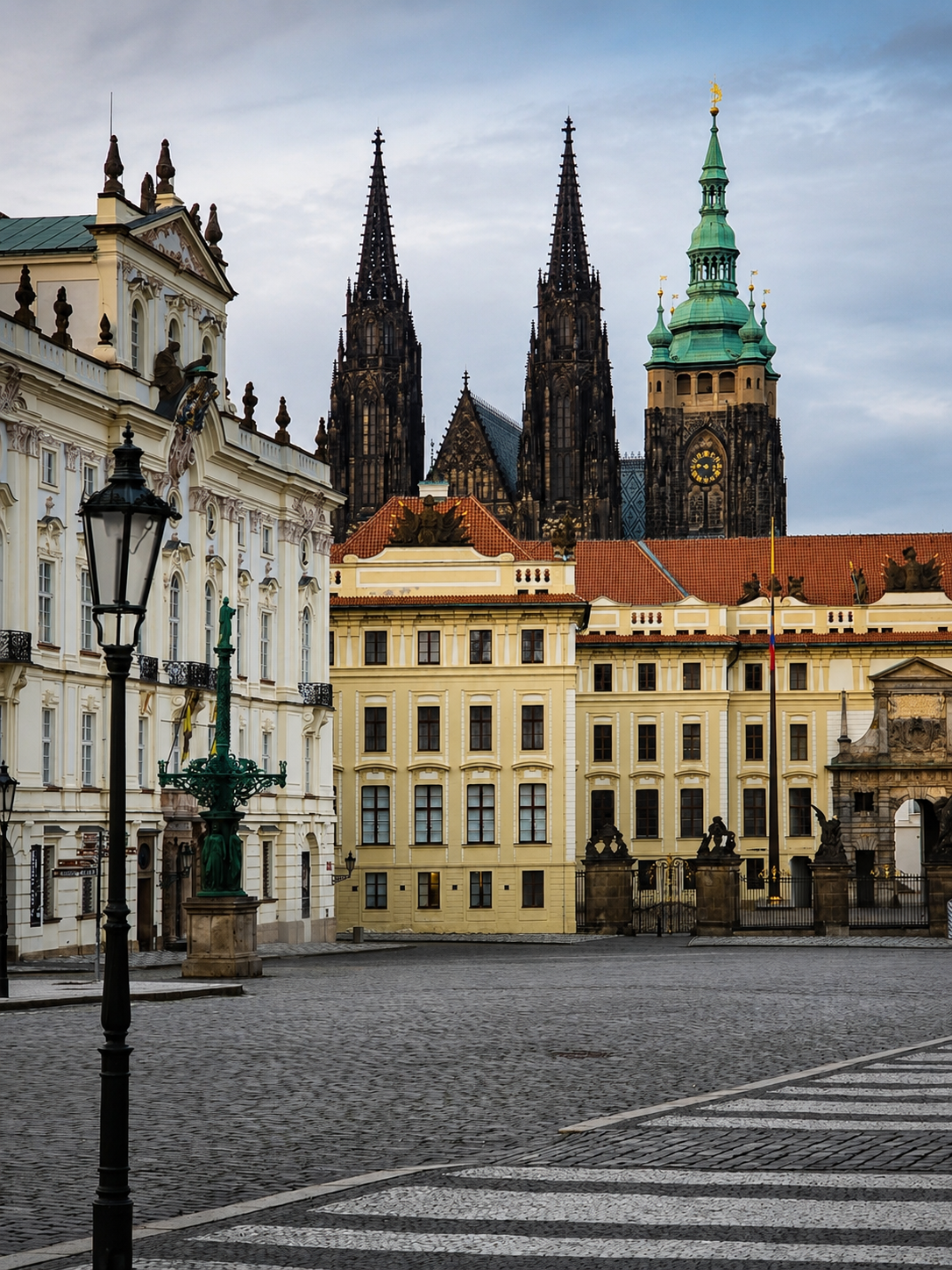
After all the odd corners, rooftop views and accidental finds, I wanted at least one photograph that was simply, unapologetically beautiful. This was it. From Hradčanské náměstí, St Vitus Cathedral rises behind the palace façades with an almost ridiculous amount of symmetry: the dark twin spires in the centre, the green tower to the right, pale buildings below, red roofs in between and that old lamp anchoring the foreground.
There is nothing particularly clever about the location, but the composition just works. Everything seems to fall into place exactly where it should, and the empty square gives the architecture enough space to breathe. It is probably one of the most classically aesthetic photographs in the whole set — not because Prague is doing anything unexpected here, but because for once it is behaving almost suspiciously well.
The only practical advice is not to rush straight towards the castle entrance. Stop on Hradčanské náměstí, turn around, move a few metres until the lines balance, and let Prague do the rest.
Frame 14 — Prague, Bridge After Bridge
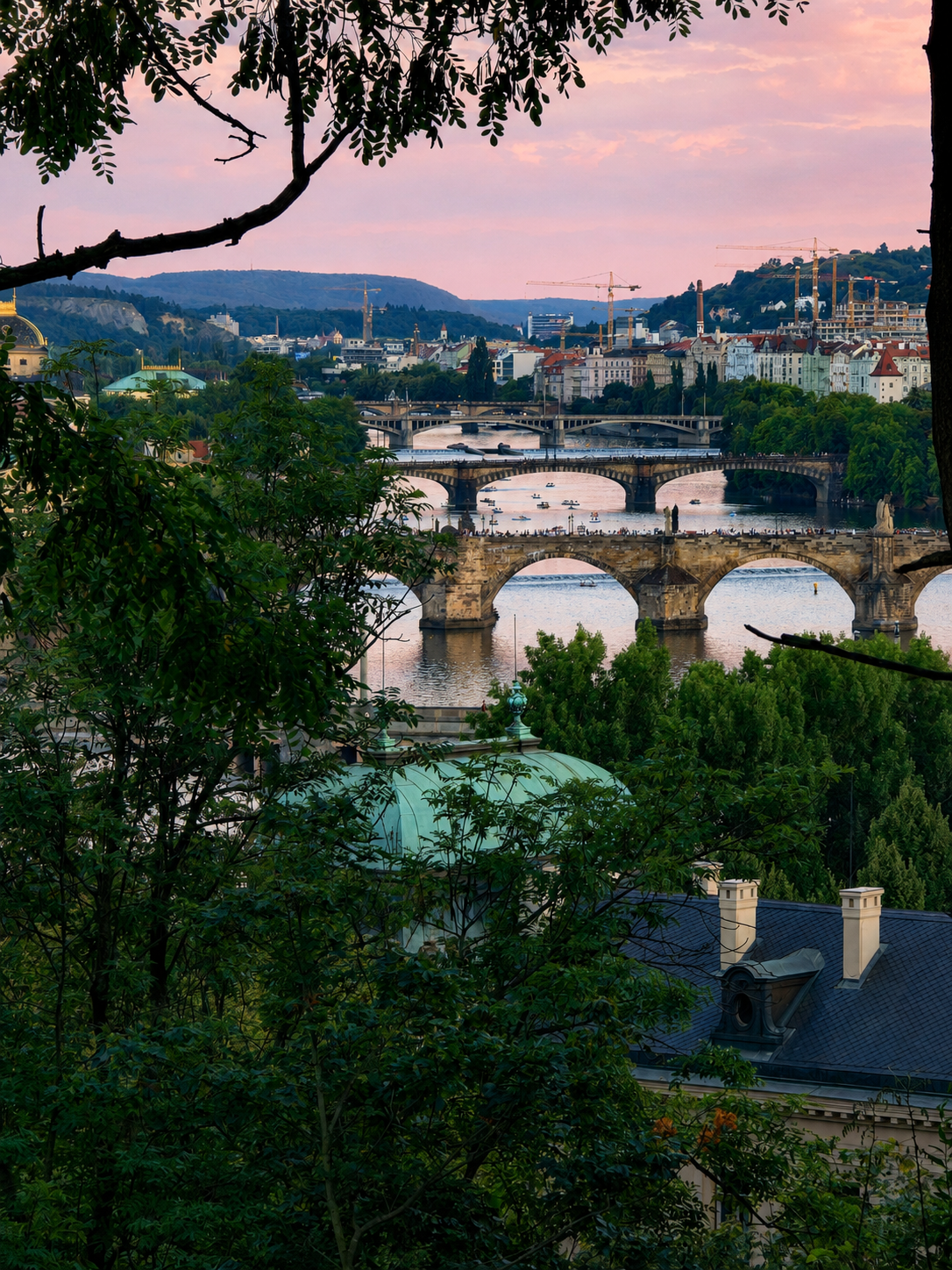
This one required a little more finding. Simply putting Letná Park into a map is not particularly helpful, because I did not take the photograph from the top of the park. Walking along the river towards Čechův Most, I turned onto one of the steep paths climbing the Letná slope before reaching the bridge. Somewhere halfway up, the trees suddenly opened and there it was: Prague arranged almost absurdly neatly along the Vltava.
This is one of those places where a bit of zoom does more than a wide panorama. Looking upstream from here, the bridges begin to stack behind one another: Mánes Bridge first, Charles Bridge behind it, then Legion, Jirásek and Palacký bridges progressively farther away. The compression makes the river look almost overloaded with bridges, which is precisely what I liked about the photograph.
I also got lucky with the timing. The last light had turned the sky pink while the Vltava was still bright enough to separate all those layers, and the trees provided a natural frame around the whole thing. Prague certainly has grander viewpoints, but very few explain the geography of the city this efficiently. Bridge after bridge after bridge — and suddenly the climb felt entirely justified.
Frame 15 — This Is Prague
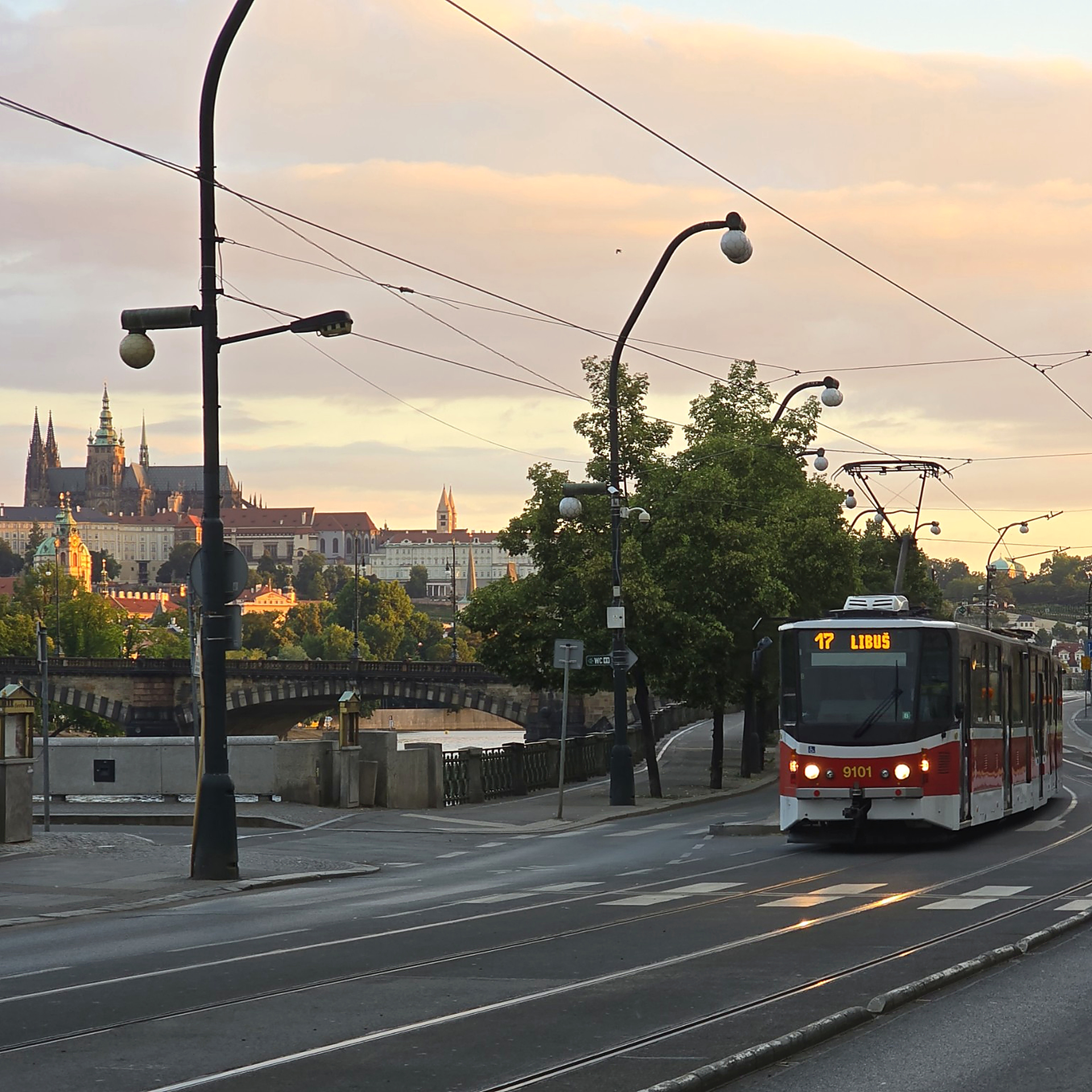
I took this at around five in the morning while walking along Masarykovo nábřeží towards Charles Bridge. I had got up that early for one very specific reason: I wanted the bridge before the crowds. Then tram 17 came along and temporarily changed the plan.
The street was almost empty, the Vltava was beside me, Prague Castle was already catching the morning light and the red tram landed exactly where it needed to be. I had enough time to take the photograph and then continued towards Charles Bridge. No special viewpoint, no waiting for twenty minutes and no complicated preparation this time. Just being awake at an unreasonable hour and looking in the right direction.
So, Did I Find My Best Prague Photograph?
There are technically better photographs among these fifteen. There are photographs with better colours, photographs for which I had to work much harder, wait longer, climb higher or simply be in exactly the right place at the right time. But when I look back at the whole set, two keep pulling me back.
Frame 01 is the photograph I suspect I will return to most often. There is something slightly unsettling about it: the dark figure of Karel Hašler, the old lamp, the castle walls and that evening light. It is Prague, but not the Prague of postcards. It is the historical, slightly mysterious Prague that seems to exist beneath the city everyone sees — almost Prague from another dimension. I did not go looking for that photograph, which probably makes me like it even more.
And then there is Frame 15. The Vltava, Prague Castle above it and a red tram crossing the frame. No Charles Bridge, no Old Town Square, no Wenceslas Square, and yet the photograph somehow screams Prague. And there is something satisfying about knowing that I had to get up at five in the morning to catch the city looking like this.
So those are my two winners: one shows the Prague beneath the surface, while the other simply shouts PRAGUE.
