 Prague, Czechia

Most of Prague's famous odd statues are still where trip reports left them. David Černý's crawling babies are on Kampa and on the Žižkov TV tower. Černý's rotating head of Kafka turns outside the Quadrio shopping centre every hour, and the artist's St Wenceslas still sits on a dead horse hanging from the ceiling of the Lucerna passage. The big exception is the one people search for most: the blue monkey with the golden testicles. It was a temporary festival piece, and it no longer stands in central Prague.
Below: where each statue is, which ones were only ever visiting, and how to link the central ones into a walk. A good part of the list comes from @phortun's photo tour of Prague's bizarre sculptures, shot in September 2019 by a Czech writer on a trip back to the capital, and still the best single round-up of these statues on TravelFeed. This guide checks where those statues are now, adds a few that post didn't cover, and draws on other TravelFeed trip reports for the places around them.
The monkey with golden balls: why it's not in Prague any more
The sculpture is called King Kong Balls, by the French artist Denis Defrancesco. When @phortun photographed it in 2019, it stood on Miloš Forman Square in the centre of Prague as part of Sculpture Line 2019, an annual international sculpture festival that places pieces around the city for a season. @phortun noted that the 2019 festival ran until the end of September, but that many pieces would stay where they were afterwards.
The monkey didn't stay. Later accounts say it moved to Beroun, a town southwest of the city, and a 2024 post on the Street Art Utopia blog shows it at a golf club there. None of them gives a date for the move. So don't plan a walk around Miloš Forman Square to see it, and treat any list that still puts it in the city centre as out of date. We found no official listing, so check its current spot before going out to Beroun.
The same goes for the other Sculpture Line piece @phortun included, Adam and Eve by Krystof Hosek on Jungmann Square. Don't count on it.
Head of Franz Kafka: the one that moves
Černý's mirrored head of Kafka is on the square in front of the Quadrio centre at Spálená 22, right by the Národní třída metro station (line B). Quadrio's own page on the statue gives the numbers: 42 stainless-steel layers, each turned by its own motor, about 11 metres tall including the pedestal, and 39 tonnes in all. @phortun dated the piece to 2014.
Timing matters more than anything else here. According to Quadrio, the head moves only during the first 15 minutes of every full hour, from 9:00 to 23:00. Turn up at twenty past and you'll get a still, shiny bust. Get there a few minutes before the hour and wait, and you'll see the layers separate, turn and slide back into a face. Viewing is free.
If you read older reports saying the head was gone, they were right for a while. Quadrio announced a full restoration for autumn 2023, with the head back in place before the end of that year. Its page now lists the normal rotation schedule.
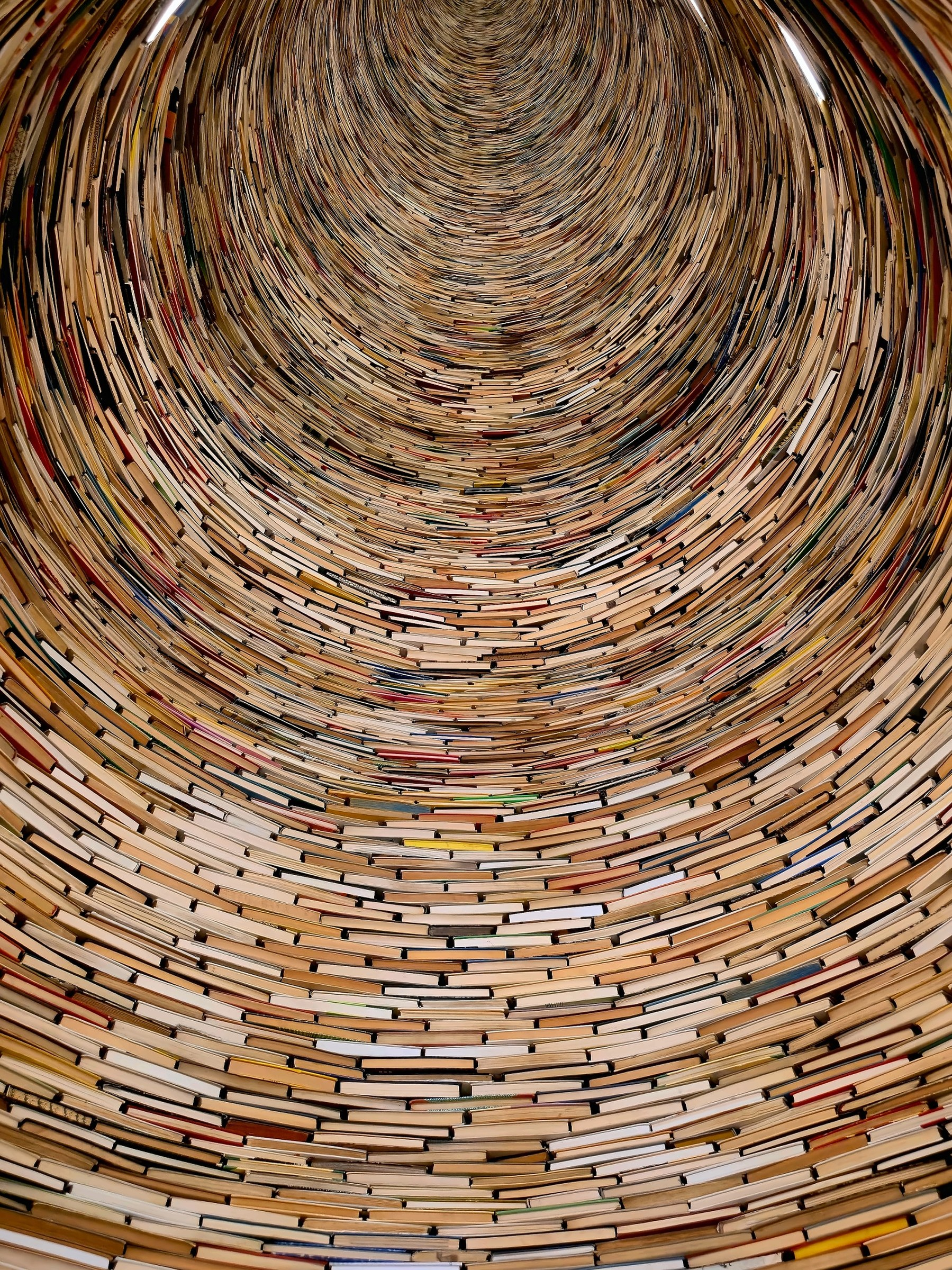
While you're in the Old Town, @ivan-drazic's hunt for the best Prague photograph points to another piece that plays with your eyes. Idiom by the Slovak artist Matej Krén has stood in the foyer of the Municipal Library on Mariánské náměstí since 1998: a column of thousands of books, with mirrors at the top and bottom that make it look endless. Expect to queue: the writer waited about 20 minutes to get a phone into the opening.
The babies with barcode faces: Kampa and the Žižkov tower
On @phortun's list, the babies are filed under creepy, and it's easy to see why. They're about 3.5 metres long and 2.6 metres tall, they crawl, and their faces are flattened into what look like barcodes. There are two sets, a long way apart.
The easy set is on Kampa, the riverside park on the Malá Strana side close to Charles Bridge. Prague's tourism board lists three bronze babies in the park next to the Kampa Museum, in place since 2008.
Kampa has a smaller oddity too. Near the Lennon Wall, @jjprac's Kampa walk stops at the Grand Priory Mill on the Čertovka canal, with its water wheel. Beside it sits Kabourek, a vodník, the water goblin of Czech folklore. Atlas Obscura names the sculptor as Josef Nálepa.

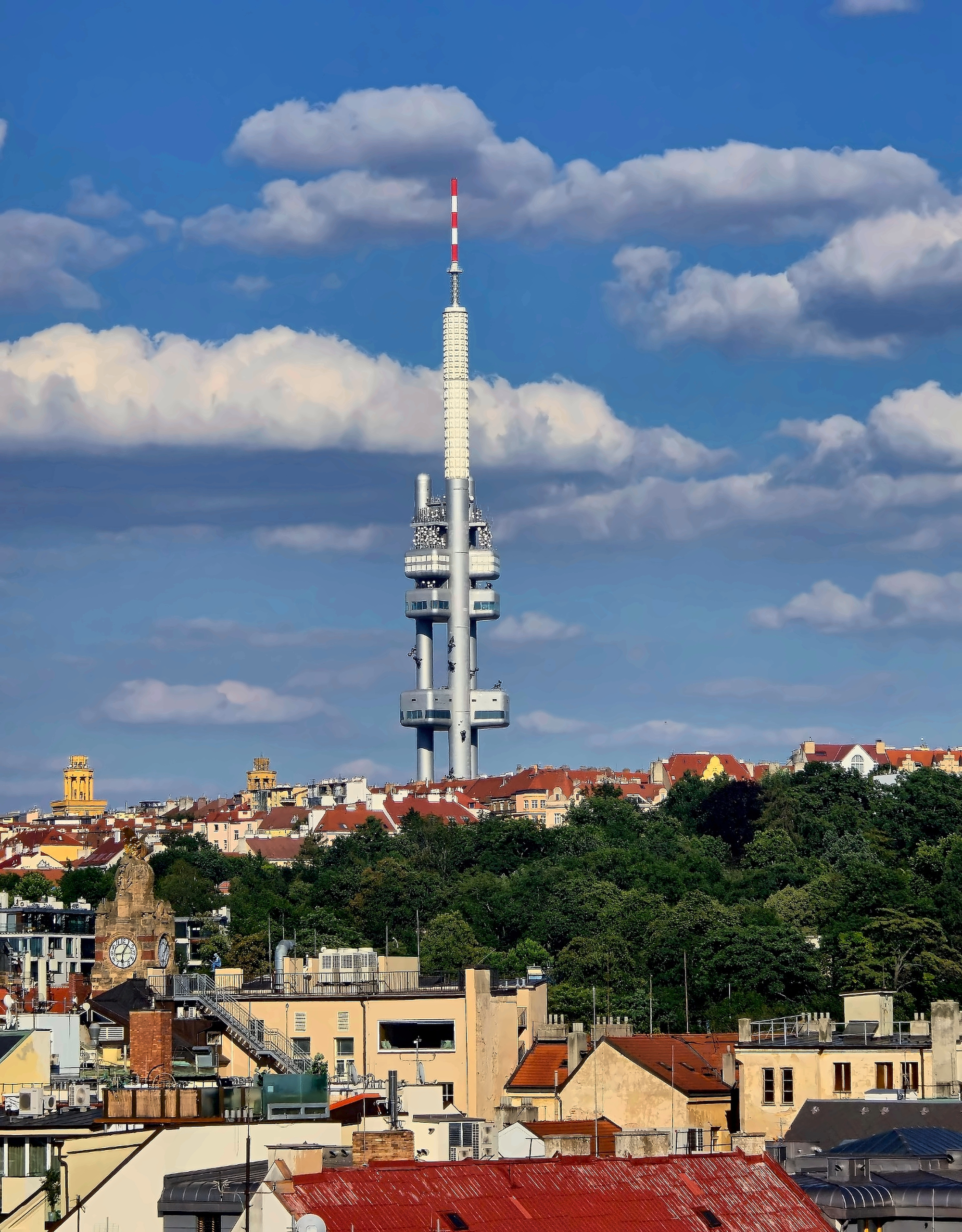
The second set of babies is ten black fibreglass figures crawling up the shaft of the Žižkov Television Tower (Mahlerovy sady 1, Prague 3), in place since 2001. They're on the outside of the tower, so you can see them from the park below without buying a ticket for the viewing platform. The ones up there now aren't the originals: according to Wikipedia, the first set came down in 2017 for repair, and heavier, more durable copies went up in April 2019. Any report from 2017 or 2018 that says the tower has no babies was true then, but it isn't now.
@ivan-drazic explains why the tower still divides people. It rises 216 metres over the roofs, it spent years on lists of the city's ugliest buildings, and the babies somehow made it stranger. The writer still isn't convinced it's beautiful.
Žižkov is a residential district east of the centre, and the tower makes a good excuse to eat nearby. @delishtreats's guide to vegan food in Prague names Moment, at Slezská 62 about 200 metres from Jiřího z Poděbrad metro station, as the writer's favourite place in the city. Check it's still trading before you build a morning around it.
The Memorial to the Victims of Communism on Újezd
This one isn't a joke, and it's worth knowing that before you walk up to it expecting another Černý piece. Olbram Zoubek's memorial stands at the foot of Petřín hill on Újezd, directly opposite Vítězná Street in Malá Strana. @phortun describes bronze men on a staircase who lose more of their bodies the further down the steps they stand. The first figure is whole. The ones below are missing limbs, and their bodies are split open.
@phortun counts six figures. Prague's tourism board counts six at the top of the staircase plus a seventh that survives only as a foot and part of an instep, which is easy to miss if you don't look for it. The memorial was unveiled in May 2002. It's in the same corner of Malá Strana as the Kampa babies, so you can see both in one walk.
Piss: the two men outside the Kafka Museum
@phortun didn't include it, but most lists of odd Prague statues do. Černý's Piss (2004) stands in front of the Franz Kafka Museum at Cihelná 2b, just north of Charles Bridge on the Malá Strana side. Two bronze men stand facing each other in a basin shaped like the Czech Republic. Prague's tourism board says an electronic mechanism turns their hips and moves them as they urinate. It isn't subtle.
St Wenceslas on a dead horse, in the Lucerna passage
Head up Wenceslas Square and you'll pass Josef Myslbek's equestrian statue of the country's patron saint, the dignified original. A few dozen metres away, inside the Lucerna passage at Štěpánská 61, Černý has hung its parody from the ceiling: St Wenceslas sitting on the belly of a dead horse that dangles upside down by its tied hooves, tongue out. According to Prague's tourism board, it was first made for an exhibition in 1999 and has hung in Lucerna since 2000. It's indoors, so it's a good stop when it rains.
Two more of @phortun's statues are nearby: three fairies by Josef Klimeš in the Franciscan Garden just off Wenceslas Square, and a seated man on a bench on the square itself. We couldn't confirm either in an official listing, so treat them as a bonus.
Charles Bridge: thirty statues, and most of them copies
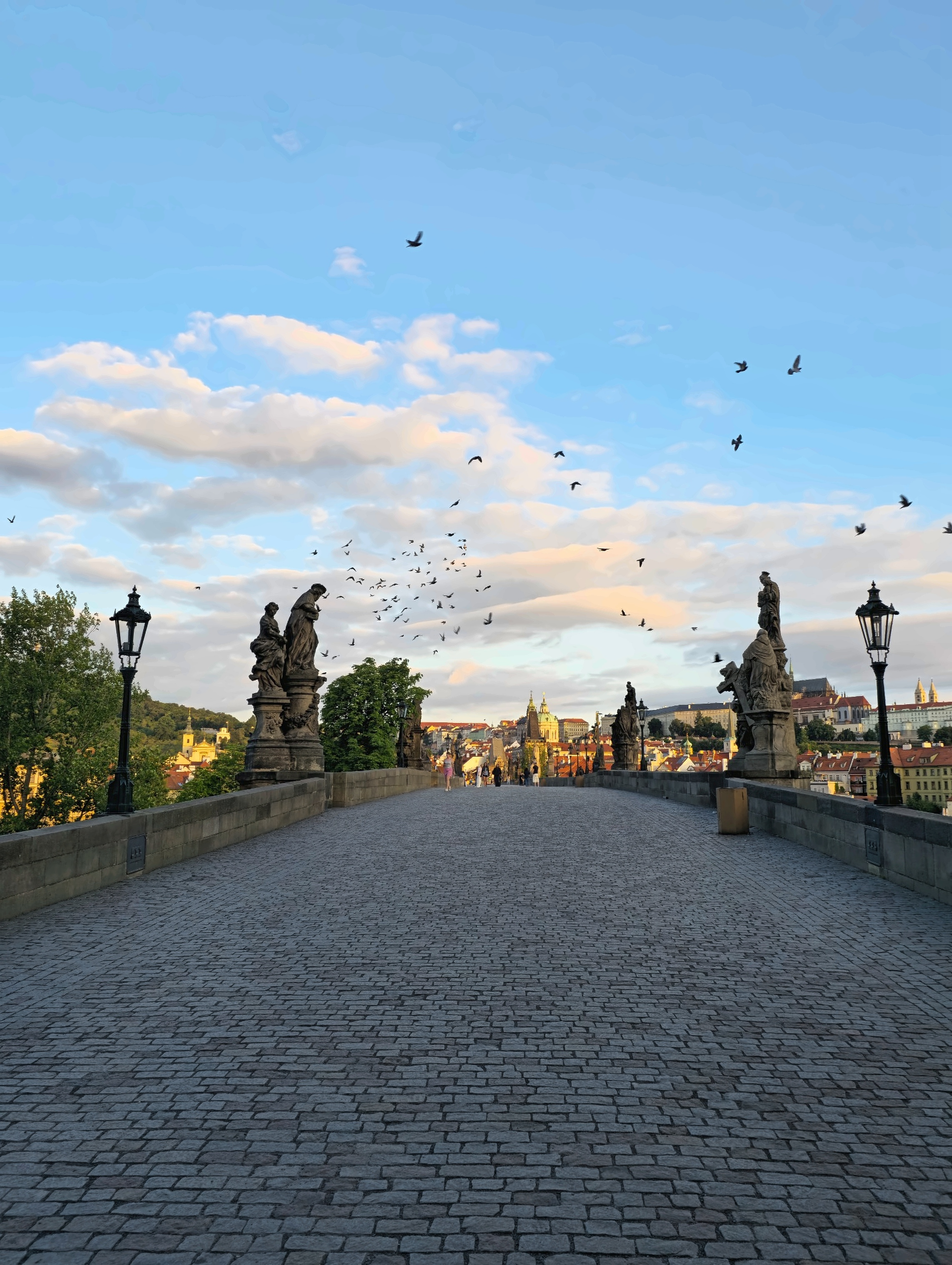
The oldest statues on this list are the ones everyone walks past. According to Prague's tourism board, thirty statues and sculptural groups line the bridge, most of them added between 1706 and 1714. Floods and weather damaged many of them over the centuries, and copies have replaced them. The originals went to the National Museum's Lapidarium or to Gorlice, an underground hall at Vyšehrad. The bronze St John of Nepomuk from 1683 is the exception. It's the oldest statue on the bridge and still the original. According to the same source, people touch the relief below the statue for luck.

Expect to share it. @jrvacation's walk over the bridge and up to the castle says it's full of tourists going in both directions on any normal day, with street artists and craft stalls along the way. The way round that is an alarm clock. @ivan-drazic got there at 5:35am and found the cobblestones almost empty, with room around the statues and lamps. @mibreit-photo, on a fifth visit, suggests late October or early November, when cold nights can bring fog over the Vltava. There's no guarantee of fog, though.
On the Malá Strana end of the bridge you're a short walk from the Lennon Wall, which isn't a statue but is on almost every route here. @jrvacation's Lennon Wall report counted about 200 people on a stretch of wall roughly 80 metres long, with buskers playing Beatles songs. The paintings change constantly, so what you see won't match the photos online.
Vyšehrad: where some of the bridge originals ended up
Vyšehrad is where the "copies" part of the bridge story ends up, and it's also a good place to get away from the crowds. The Gorlice hall in the fortress casemates holds six original Baroque statues from Charles Bridge. Vyšehrad's own tour page says you can only go in with one of their guides. Tours start at the Brick Gate (V Pevnosti 46/1) and last 45 to 60 minutes. Book through the ticket portal on that page.
Above ground there's more sculpture, and you don't need a ticket for it. According to Prague's tourism board, the outdoor grounds are open all year at no charge, and four sculptural groups by Myslbek, the sculptor of the Wenceslas statue, stand on the lawn west of the basilica. The nearest metro stop is Vyšehrad on line C.
@haydae's account of a last day in Prague describes the way in by tram: off under a huge road bridge, through a gloomy park past odd-looking statues, through a tunnel into the fortress, then up steep stairs to the wall. Their real find was the Basilica of St Peter and St Paul, with Art Nouveau paintings and stained glass they called "riveting" and nothing like the marble-heavy Baroque churches in the centre. If you'd rather skip the climb, @ivan-drazic's tip is to do Vyšehrad downhill: take a car up to the cemetery, then explore on foot on your way back towards the city.
Pegasus and Speederman: Černý out in Jinonice
Two more Černý pieces stand in Prague 5, on the site of the old Walter aircraft engine factory. @jjprac's walk around Jinonice starts at the metro station on line B and crosses a footbridge to Waltrovka, the offices and flats built where the factory stood. On Walter Square (Walterovo náměstí) are the three Pegasus sculptures: horse bodies with aircraft engines. CzechTourism's Kudy z nudy site says Černý made them in 2017, that they're mechanical, and that their propellers turn.

Speederman is close by, in the passage through the Aviatica office building. @jjprac describes a superhero stuck in fast motion. Prague Art Week's 2026 programme still includes both works in its Penta Art event at Walterovo náměstí.

A route that links the central statues
The statues in the centre link up on foot. Starting on the Malá Strana side, go in roughly this order:
- Memorial to the Victims of Communism, Újezd, at the foot of Petřín
- The bronze babies on Kampa, next to the Kampa Museum
- Kabourek at the Grand Priory Mill, and the Lennon Wall if you want it, on the way north
- Piss, outside the Kafka Museum at Cihelná 2b
- Across Charles Bridge, past St John of Nepomuk
- Idiom at the Municipal Library, Mariánské náměstí
- Head of Franz Kafka at Quadrio, Národní třída (time your arrival for the top of the hour)
- The Lucerna horse and the Franciscan Garden, around Wenceslas Square
Three stops need their own trip. The Žižkov babies are out east (take the metro to Jiřího z Poděbrad and have breakfast nearby), Vyšehrad is south on metro line C, and Pegasus and Speederman are at Jinonice on line B. If you only have time for one extra, choose by what you want: Žižkov or Jinonice for more Černý, Vyšehrad for the original bridge statues and fewer people.
For more from TravelFeed writers on the rest of the country, see our Czechia destination page.
FAQ
Where is the monkey statue with golden balls in Prague?
It isn't in central Prague any more. King Kong Balls by Denis Defrancesco stood on Miloš Forman Square in 2019 as part of the Sculpture Line festival, where @phortun photographed it. Later accounts say it moved to Beroun, outside Prague.
When does the Kafka head in Prague rotate?
According to Quadrio, the shopping centre it stands outside, the head moves during the first 15 minutes of every full hour between 9:00 and 23:00. It's at Spálená 22, by Národní třída metro station, and free to watch.
Where are the giant babies in Prague?
In two places. Three bronze babies are in the park next to the Kampa Museum in Malá Strana, and ten fibreglass ones climb the Žižkov Television Tower at Mahlerovy sady 1.
Are the statues on Charles Bridge originals?
Mostly not. Many of the thirty were replaced with copies after flood and weather damage, and the originals are in the National Museum's Lapidarium or the Gorlice hall at Vyšehrad. The bronze St John of Nepomuk from 1683 is still the original.
