 Gryfice County, West Pomeranian Voivodeship, Poland

A wooden house at 6 Grunwaldzka Street in Pobierowo has been left to deteriorate for decades. It sits about 50 meters back from the cliff above the Baltic, surrounded by scrubby trees that have grown up around it. Local hotels and Baltic tourism websites confidently market it as Eva Braun's wartime summer residence. That's the draw, and it has spread far enough that visitors arrive from across Europe.
Whether the attribution holds up is a different question, and one worth asking before you drive out here. As @koenau documented after visiting in April 2024, there is no written evidence connecting Braun to this specific address. What exists is a 1930s wooden villa in the right geographic area, in the right architectural style, with traces of a guarded perimeter — and a strong local marketing tradition that has been circulating the story long enough that everyone now treats it as confirmed.
This guide is for people deciding whether the trip is worth making. Short version: the house itself is closed and deteriorating, the historical case is thin, and the site is most interesting as part of a longer day that takes in Gryfice County's other neglected estates. Here's what each part of that day looks like.
What remains at 6 Grunwaldzka Street
The structure is a two-story wooden villa with the proportions and detailing common to German interwar vacation houses along this stretch of the Baltic coast. When @koenau visited, the doors and windows were boarded and locked. No guided tours, no organized access of any kind. The wrought iron fence that once defined the property survives in fragments along the perimeter. Further into the surrounding treeline, there are concrete foundations that appear to be the remains of a guard post, and scattered lengths of barbed wire half-buried in the undergrowth.

Photo by @koenau
The interior is accessible in the way any broken-into abandoned building is accessible — through gaps rather than doors. People have been getting in for years, and the evidence is visible: graffiti across the walls, kick damage around the openings, an empty fireplace that was once a substantial piece, and the general dampness of a building that has been unheated and unmaintained for decades. The kitchen had been partially cleared of debris at some point but wasn't kept up afterward. Mold is present throughout.
The setting has a strange present-tense quality. The cliff is right there, and the sea is audible. The stairway that once led down to the beach is sealed shut. And directly adjacent to this collapsing ruin, two large hotel blocks were under construction when @koenau visited in spring 2024. The house is becoming a curiosity surrounded by resort infrastructure, which seems like exactly the kind of thing that will eventually settle the question of what happens to it.
There are no opening hours because there is no official access. Approaching and photographing the exterior is what most visitors do. The perimeter features are worth a look if you go around back into the trees.
The attribution — what's documented and what isn't
The Baltic coast around this area was vacation territory for senior Nazi figures during the war. That part is well established. Hermann Göring reportedly had a residence in Międzywodzie, the neighboring village. The area now known as the Rewal commune, which includes Pobierowo, was during the war part of the German province of Pomerania, and the shoreline was used by officials and their families.
Eva Braun's connection to this specific house rests on the period, the location, and the architectural type — plus decades of local tradition. @koenau's investigation found no ownership record, no wartime registry entry, nothing in writing. The regional hotel and tourism websites that describe the house as Braun's do so without citing primary sources. The story essentially circulates back to itself.
What the physical evidence does support is that whoever owned or used this house cared about security. The guard post foundations, the barbed wire, the perimeter fence — these aren't typical civilian vacation house features. The house was being protected by someone. Whether that someone was Braun, or Göring using it as a secondary property, or another official entirely, is the gap the documentary record doesn't fill.
This matters mainly because it calibrates expectations. Visitors who arrive expecting confirmed history leave slightly deflated. Visitors who arrive expecting a genuinely atmospheric piece of wartime-era coastal Pomerania — one with real physical traces of a security perimeter and a genuine mystery at its center — tend to find the visit worthwhile.
Dreżewo palace — the other forgotten estate, 25 kilometers inland
If you're already driving into Gryfice County, the village of Dreżewo is worth the detour. It takes about 25 minutes from Pobierowo by car.
The palace there has a longer documented history: it appears in records from 1287, passed through several noble families, and ended up in the hands of Eduard von Bonin in 1875. What defines it is an 1890 fire. According to @koenau's account of the estate, the fire broke out when Bonin's fiancée arrived and a romantic rival — a woman named Girona de Val Florida — died in the flames. Bonin subsequently rebuilt in neo-Gothic style, turning the original structure into something that now rises above the tree line like a misplaced castle.

Photo by @koenau
After 1945 the estate was Polish state property and used as a stud farm across its 302 hectares. The 7.5-hectare park around the palace has been growing unchecked since the state operation wound down. In 2006, a Spanish businessman named Ricardo Crespo Fuster bought the whole property with plans for a hotel and golf course. The plans were never realized. The result is a large neo-Gothic ruin in a park that has been reclaiming itself for nearly twenty years.
Scale is the thing here. The Pobierowo villa is a house. Dreżewo is castle-sized — the kind of thing that would require significant effort and money to properly ruin. There's no fence and no admission. The building is structurally compromised and has been for years. @koenau describes it as a ruin "overgrown with weeds," which undersells the visual: from the approach through the park, the tower profiles clear the treeline and the scale of the rebuild is immediately obvious.

Trzebiatów — the medieval town that still functions
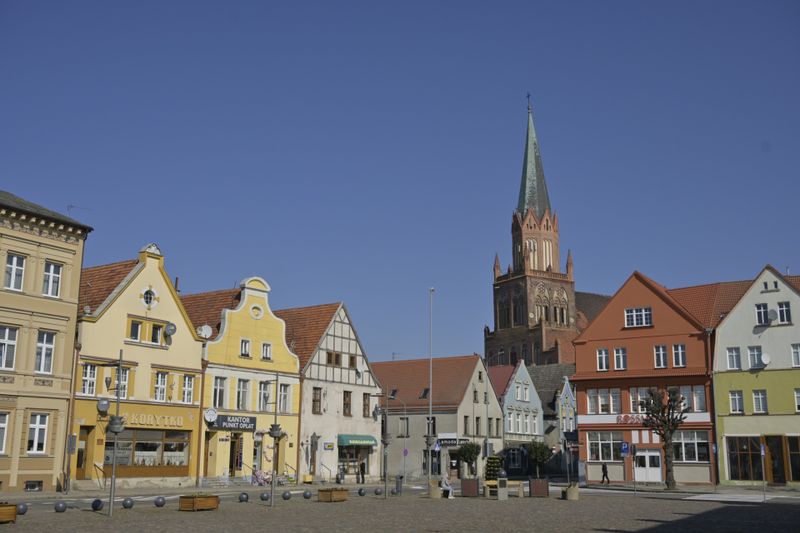
About 35 kilometers east of Pobierowo sits Trzebiatów, a market town that survived the war substantially intact and offers a very different kind of afternoon from the abandoned estates. In May 2025, @olusiu spent a full day working through the center and came away with a clear picture of what's there and what isn't.
The market square is the obvious starting point. The Gothic town hall on one side is, according to @olusiu, "one of the best preserved buildings of this type in Pomerania" — a claim that holds up visually. The surrounding tenement houses still define the square's perimeter and have kept their proportions. The Church of the Motherhood of the Blessed Virgin Mary dates to the 13th century and has Gothic vaulting, historic organs, and polychromes still in place. @olusiu arrived during a quiet moment — "we were lucky to come across a moment when silence reigned" — which, in July or August when beach tourists migrate up from the coast, is not guaranteed.

Photo by @olusiu
The Kaszana Tower is one of the surviving sections of the old town fortifications and can be climbed. The stairs are narrow and the stone walls stay cold even in warm weather. The views from the top cover the surrounding rooflines and the church tower. The Prince's Palace, now occupied by the local Cultural Centre, has exhibitions on the county's history — useful context for the estates you will have seen earlier in the day.
There is also an elephant mural attached to an old legend about a circus that passed through town in the 18th century. Specific enough to be true, and the kind of detail that makes a place feel like it has its own logic rather than a generic Old Town character.
One practical note from @olusiu's visit that captures the town accurately: the only place to get coffee near the market square was a flower shop. Trzebiatów is not set up for tourists in the way that Pobierowo — a Baltic resort town — is. That's part of its appeal, but bring snacks if you're visiting between meals.
Getting there and when to visit
Pobierowo is on the Baltic coast in West Pomeranian Voivodeship, roughly 100 kilometers northwest of Szczecin. By car from Szczecin the route runs via the E28 and takes around 90 minutes depending on traffic. There is no direct rail connection to Pobierowo; the nearest station with regular service is Trzebiatów, on the Szczecin–Kołobrzeg regional line, from which Pobierowo is about 15 kilometers by bus or taxi.
July and August are peak beach season along this stretch of coast and the roads, accommodation, and town centers fill up with Polish summer vacationers. If the goal is the Eva Braun house, Dreżewo, and Trzebiatów rather than the beach, May, June, or September are significantly more comfortable: cooler, quieter, and the Gothic interiors are easier to photograph without tour groups in the frame.
The Eva Braun house is a short walk from most of Pobierowo's accommodation, approached via the cliff path or from Grunwaldzka Street directly. Dreżewo village is a 25-minute drive inland. Trzebiatów is about 35 minutes from Pobierowo by car. A day that starts on the coast and works through both inland sites ends in the early evening with plenty of daylight in summer.
FAQ
Is Eva Braun's house in Pobierowo open to visitors?
No. The house is privately owned, boarded up, and there is no organized access. Visitors approach and photograph the exterior from the path near the cliff. The building has no official hours and no guided tours. Getting inside requires breaking in, which some visitors do — the interior shows the evidence.
Is the Eva Braun attribution confirmed by historical records?
No. The connection between the house and Eva Braun is local tradition rather than documented fact. No archival ownership records or wartime registry entries confirming Braun's connection to this address have been published. @koenau, who visited in April 2024, found no written evidence. The regional tourism industry treats the attribution as established; historians have not confirmed it.
How far is Pobierowo from Szczecin?
About 100 kilometers by road. The drive via the E28 takes around 90 minutes. Trzebiatów is the nearest rail station, on the Szczecin–Kołobrzeg regional line; from there Pobierowo is about 15 kilometers by bus or taxi.
Is Dreżewo palace accessible?
The grounds are unfenced and there is no admission charge or official entry point. The palace building is a ruin in poor structural condition. Visitors approach across the overgrown park at their own risk. There are no facilities, no information boards, and no staff on site.
