

Luh. The village that was once a city.
Another interesting place in the vastness of his native land. This is the village with the strange name of Luh. This village was once a city and even the capital city of a small principality.
And I only found out about the availability of such a place on the map when I was going to go to Nizhny Novgorod from Kostroma for the very first time. The thing is that there are several roads from Kostroma to Nizhny Novgorod. One of them and the largest is the road through the city of Ivanovo. This is a large and convenient route, but several dozen extra kilometers are required to travel along this road.
There is another road that allows you to shorten the path. This road leads through the city of Shuya. These are very beautiful places. On the way lies the village of Dunilovo, which is famous for its churches. I really love this place.
There is a third way. This path leads through the village of Luh. This is the shortest path, but it leads with very small paths and the quality of the road surface there has never been good.
But in recent years, in Russia I have been massively repairing and there are roads. Many roads that used to be of poor quality have now become very good, and sometimes I choose the small old track to drive in a completely new unknown way.
So this time, I chose the shortest road that I decided to scout and this road led me just through the village of Luh.

The history of this place is quite ancient. For the first time this city is mentioned in the annals that described 1238. Then the wild horde of Batu Khan defeated and burned many principalities of North-Eastern Russia: Ryazan, Moscow, Vladimir, Kostroma, Tver, Suzdal, Rostov with cities: Vladimir, Suzdal, Rostov, Luh, Yurevets, Kineshma and others.
Beginning in 1341, Luh joined the Principality of Suzdal and later joined the Principality of Moscow.
In 1428 the Tatars again burned these places. From this date, the date the city was created is calculated.
At the very beginning of the seventeenth century, these places were captured by the Polish-Lithuanian occupiers. But with the end of the Time of Troubles, everything returned to normal.
By the way, in those days, the city of Luh was part of the Kostroma province.
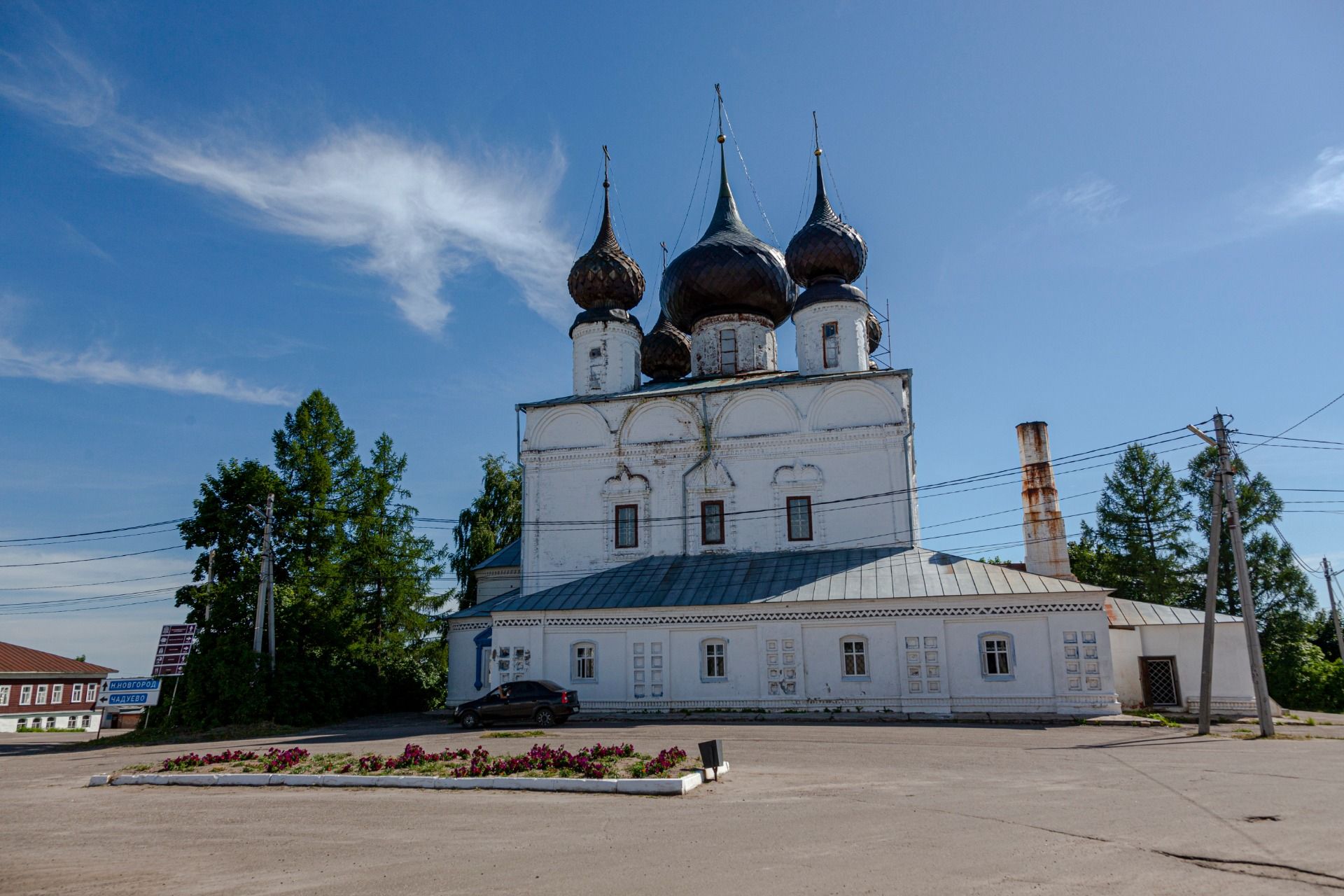
Just during the period of the city of Lukh in the Kostroma province, stone churches were erected in the city. This is the Resurrection Church, built in 1680, the Assumption Cathedral was built in 1754 and the Transfiguration Church, built in 1797.
Now the Holy Trinity Cathedral is functioning again in Luch. Ministry has resumed there since 1991. In 2005, services were resumed in the Assumption Cathedral.
In 1785, Luch received his coat of arms. It depicts a golden staircase in the scarlet field, which means that the city has been given the means of governorship by this institution to ascend to the top of its welfare.
Interestingly, the city of Luh was considered a city until 1925. This year, residents asked to transfer the status of the city to the village. This made it possible to preserve household plots and the general way of life.
Since then, Luh has become a village.
But the village of Luh has retained a large number of important attractions and interesting objects. One of these objects was the remains of large urban protective ramparts. It is part of an ancient twelfth-century fortress.


Usually, a wooden picket fence, towers, and large gates to enter the fortress were installed over such a shaft.
And outside the walls was the home of the prince and his entourage. Around such a fortress peasants settled. Thus the ancient Russian city turned out.
A part of the ancient fortress was recreated in the village of Luh. Of course, that the new building, but it is located on the old ramparts and looks exactly the same as the old fortress looked.
In addition to the fortress, a monument to the war is now installed on the ancient rampart. This soldier died in 1943, defending his homeland.
This great war is heard in any small city in Russia. Here and there are monuments to the fallen wars that defended our country and gave us life.
Of great interest is the architectural appearance of the main square of the city.
In 1680, at the expense of the townsman resident Maxim Fedorov, “the priest's son”, the Church of the Resurrection was erected; in the XVIII and XIX centuries. an extensive refectory is attached to it. Trinity Church was built in 1754, the Assumption Cathedral, which replaced the wooden two-headed church, and a separate bell tower - in 1775.


Of course, the village of Lukh is not at all big. But he is rich in history. If you peer, feel and love this land, it will give you the opportunity to learn many interesting details.
In these places, for example, the inventor of electric arc welding Nikolay Nikolaevich Benardos lived and worked.
This is probably the most famous person from these places. This inventor is known worldwide for his research in the field of electric welding of metals.
I enjoyed visiting the village of Luh on a good summer day. I walked along the ramparts, examined the architectural ensemble of the main square of the city.
This small town of Russia left a very warm and pleasant feeling. It has the amazing property of give warmth.
I think it will also be interesting for you to look at the photos from this place.


Working on this post I used info from:
