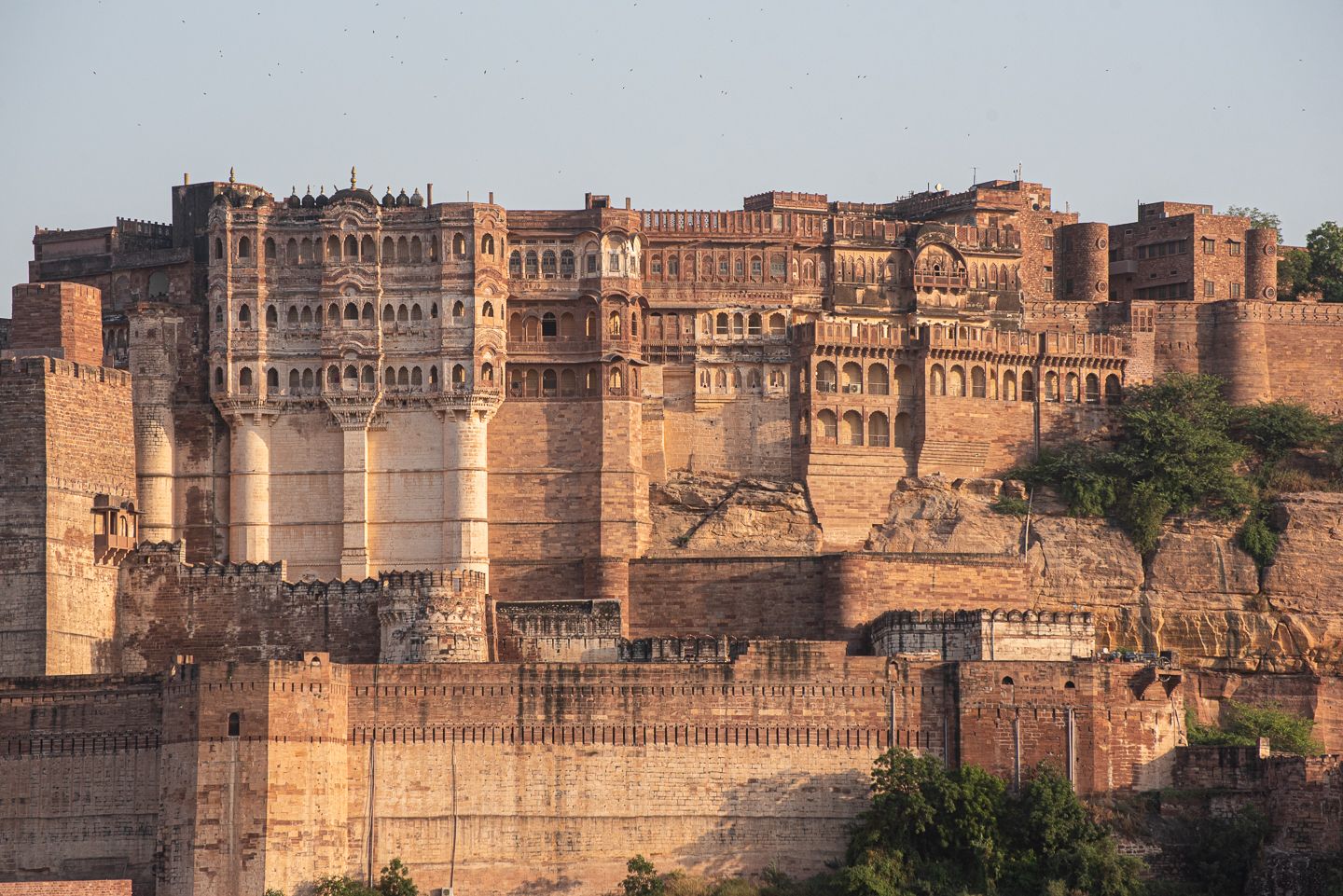
 Jodhpur, Rajasthan, India

It was such an idyllic day. I wandered into the unknown and discovered a beautiful natural park filled with colorful birds and langurs, with amazing views of a uniquely beautuful castle.
The whole idea emerged when I was researching Google.Maps:

The red pin is the main attraction of Jodhpur City, an enormous castle called Mehrangarh Fort, and there is a natural area to the North. I thought it could be two in one: views of the castle and nature with wildlife combined in one walk. You can also see on the map that the castle opens up to the West at this area. That means going there in the late afternoon is the best idea.
Secondly, I am quite tired of being in Indian urban chaos and going to the wild, with very few people around, is a cure I needed and still need. I even chose a hostel located near this natural area.
And, yes, all my calculations and expectations were correct. Sharing images.

I needed to walk only 10 minutes to reach the fortress. Its eastern side looked like a solid shade, so I kept walking westward to see the opposite side. This:

Spectacular, let me be honest. This castle could easily be part of The Lord of the Rings.
I was hurrying as it was already 4:25 pm - I wanted the front view of the western part of Mehrangarh Fort, and I needed to enter the mentioned natural area for that located on the right of the fort:

I tried to enter it from the fort's parking, but a security guard stopped me.
Entering from the road wasn't possible either as there was a fence all the way.
But I had another plan, thanks to street views on Google.Maps. And this idea was right. This is the official entrance to Rao Jodha Desert Rock Park Parking from where they have an official route to the rocks I needed. 100 rupees fee (for foreigners at least), but it's worth paying.
The nature looks this:

These aren't cacti, but a succulent called Euphorbia caducifolia.

In creeks and near water bodies, vegetation can be lusher with shrubs and trees:

And even this:


Thanks to water, the Rao Jodha Park hosts a great number of bird species. The Asian green bee-eater (Merops orientalis) is one of the most colorful of them, and numerous!

Before I started learning about birds and photographing them in Bangkok, I simply didn't know bee-eaters existed. Because they prefer flying high and perching on the top of trees, at least in Thailand. In Rao Jodha Part, they also choose the height but you can photograph them from slopes located above the wires they perch on.

Look, what a party:

Never seen so many bee-eaters in one place - around 30 birds in the image.
Meanwhile, the majestic walls of the fort were painted orange by the rays of the setting sun:


And that's when I spotted a group of gray langurs (Semnopithecus entellus), foraging and copulating.

My old friends I missed since 2015 and 2016 when I had two 3-month trips to India. Quite common in rural areas in India as well as present in many cities, but this doesn't make them less marvelous.

Love being near them - it's like watching into the window to the mystery world.

Bigger and more graceful than macaques, and less aggressive. But if humans treat them badly, they can fight back: a leap with a double hind-leg kick can send a person tumbling, which can become a disaster on rocky ground.
Knowing this not from my own experience, but from social media, for example:
https://www.youtube.com/shorts/CS71l3lTczQ
So better to be respectful, and you’ll receive the same in return... Hopefully 😁

Wonderful beasts. I'll come back to Rao Jodha Natural Park to spend more time near them.

The photos were taken with a Nikkor 70-300mm on a full-frame DSLR Nikon D750 in November 2025, in Jodhpur, Rajasthan, India.

Comments