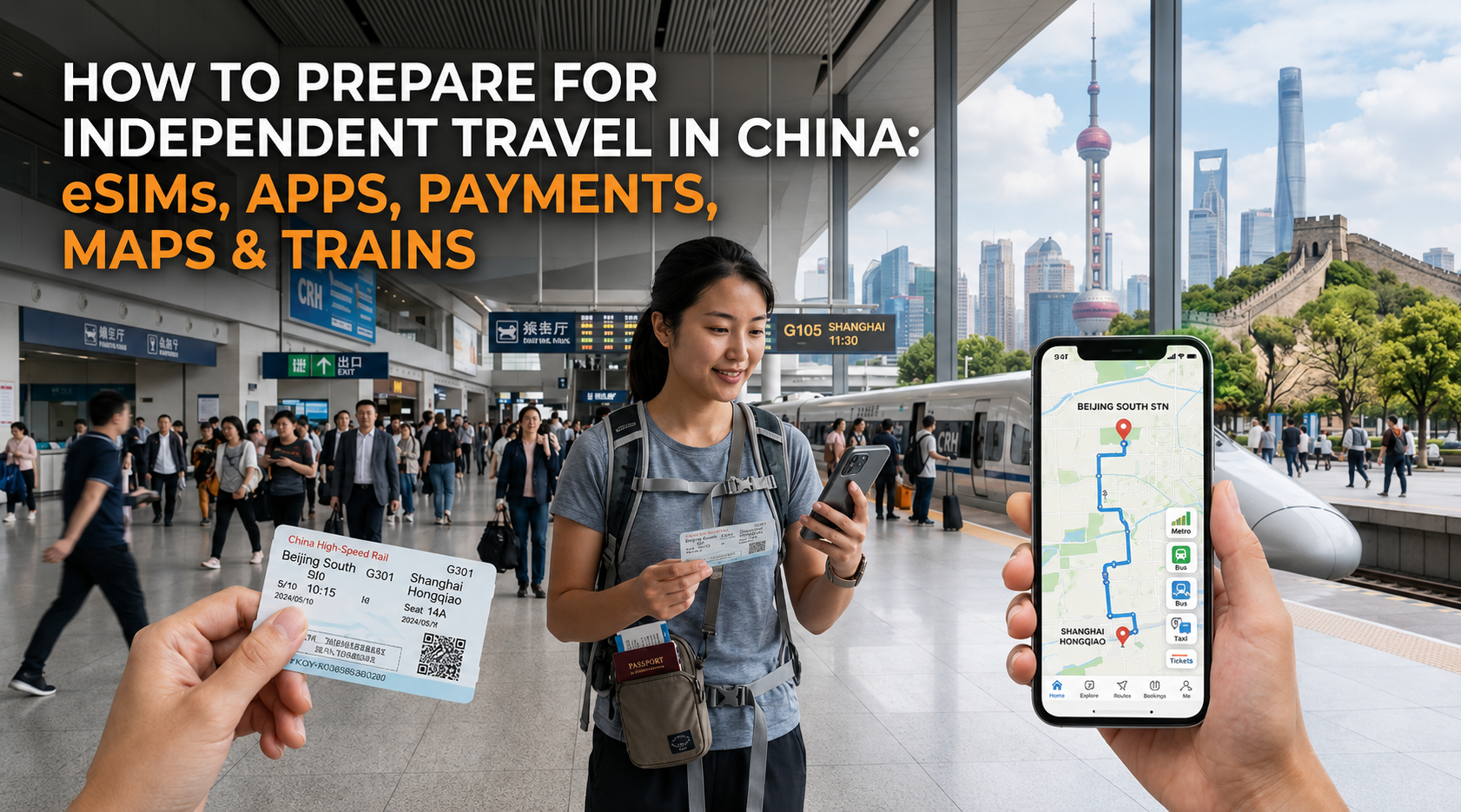

China is one of the most fascinating countries to travel through independently, but it is not a destination where you should land completely unprepared. The trains are excellent, the metro systems are efficient, and many cities are easier to navigate than first-time visitors expect. The challenge is that China runs on a different digital ecosystem from much of the world.
Before arrival, you need to think about mobile data, payments, maps, translation, train bookings, and app access. Without those basics in place, simple tasks such as finding your hotel, paying for a meal, booking a ride, or checking a train station can become more stressful than they need to be.
This guide covers the main things independent travelers should prepare before visiting China, especially if they are planning to move between cities without joining a fully organized tour.
Why Preparation Matters Before Arriving in China
Unlike many destinations where travelers can easily rely on international apps and credit cards, China has its own digital ecosystem. Many popular Western services are limited or unavailable, and cash is used less frequently than mobile payments.
Preparing your phone and travel tools before departure can save significant time and stress after arrival. A well-prepared traveler can navigate cities, purchase train tickets, communicate with locals, and access important information without difficulty.
Setting Up Mobile Data with an eSIM
Reliable mobile data is one of the most important parts of independent travel in China. You will need it for maps, translation, ride-hailing, train bookings, hotel addresses, QR codes, and basic communication. Wi-Fi is available in many hotels and cafés, but it is not something to rely on while moving through stations, airports, streets, and unfamiliar neighborhoods.
For many travelers, an eSIM is the easiest way to arrive connected. It can be installed before departure, activated on arrival, and used immediately without searching for a local SIM card at the airport. Before choosing a plan, it is worth checking a field-tested China eSIM guide so you understand coverage, app access, hotspot use, and the practical setup process before you travel.
An eSIM is especially useful if you are landing late, taking a train soon after arrival, or visiting several cities on one route. Install it before leaving home, save the setup instructions offline, and make sure your phone is unlocked and eSIM-compatible.
Essential Apps to Download Before Your Trip
China is much easier to travel through when your key apps are already installed, updated, and logged in before arrival. Some accounts can be harder to set up once you are already moving, especially if verification codes, international phone numbers, or payment cards are involved.
Translation Apps
A translation app is essential if you do not speak Mandarin. English is visible in major airports, high-speed rail stations, and some tourist sites, but smaller restaurants, local transport, guesthouses, and signs outside major cities may be mostly in Chinese. Download offline language packs before the trip so you are not fully dependent on mobile data.
Payment Apps
Mobile payments are part of daily life in China. Set up your payment options before arrival and test whether your card can be added. Even when cash is possible, QR-code payments are often faster and more widely expected in restaurants, shops, taxis, and attractions.
Navigation Apps
Save your hotel addresses in both English and Chinese. International map apps may not always give the most accurate local results, so it helps to have a China-focused map option ready as a backup. Pin airports, railway stations, hotels, and major attractions before each travel day.
Transport and Booking Apps
For independent travel, prepare apps or booking platforms for trains, ride-hailing, hotels, and attraction tickets. China’s high-speed rail network is excellent, but stations are large and busy, so having ticket details and station names saved in advance makes travel days much easier.
Understanding Mobile Payments in China
China is highly cashless, especially in major cities. Many everyday payments happen through QR codes, from restaurants and convenience stores to taxis, cafés, shops, and some attractions. International cards may work in more places than before, but they are still not something to rely on everywhere.
Before traveling, set up at least one mobile payment option and link a compatible card if possible. Keep a backup card with you and carry some cash for smaller shops, rural areas, markets, taxis, or situations where your app does not work.
The main point is not to arrive assuming that a foreign credit card will solve everything. Payment preparation is just as important as booking your hotel or train tickets.
Navigating China with Maps
Navigation is another area where preparation matters. Some familiar map services may not work as expected in China, and even when they load, local search results can be less reliable than travelers are used to.
Before traveling, save your hotel addresses, airport terminals, railway stations, major attractions, and restaurant names in advance. Keep key addresses in Chinese as well as English, especially for taxis, ride-hailing, and hotel check-ins.
Offline maps are useful as a backup, but they should not be your only plan. The safest setup is to combine mobile data, saved locations, screenshots of important addresses, and a China-focused navigation app if you are moving independently between cities.
Planning Train Travel Across China
China's high-speed rail network is one of the largest and most advanced transportation systems in the world.
For independent travelers, trains are often the easiest way to connect major destinations without dealing with airport transfers, domestic flight delays, or luggage restrictions. The system is efficient, but it works best when you book ahead, understand the station layout, and keep your passport accessible for checks.
Travelers often choose rail transport for routes connecting Beijing, Shanghai, Xi’an, Guangzhou, Chengdu, and many other destinations.
Book Tickets Early
Popular routes can sell out quickly, especially during holidays and peak travel seasons. Booking tickets in advance increases your chances of securing preferred travel times and seat classes.
Arrive Early at Stations
Chinese railway stations can be very large and busy. Security checks and identity verification procedures may require additional time.
A good rule is to arrive at least 45–60 minutes before departure, and earlier during holidays or at very large stations. Some cities have several railway stations, so always check the exact departure station before leaving your hotel.
Understanding Seat Classes
China’s high-speed trains usually offer Second Class, First Class, and Business Class. The differences are mostly about space, comfort, and price rather than safety or reliability. All three classes are modern and comfortable enough for most travelers.
Second Class
Second Class is the standard option and the best value for most trips. Seats are usually arranged in a 3+2 layout, with enough legroom for shorter and medium-distance journeys. It is practical, clean, efficient, and perfectly fine for routes such as Beijing to Xi’an, Shanghai to Hangzhou, or Chengdu to nearby cities.
First Class
First Class gives you more space, wider seats, and a quieter carriage. Seats are usually arranged in a 2+2 layout, which feels more comfortable on longer journeys. It can be worth paying extra if you are traveling several hours, carrying more luggage, or want a calmer ride.
Business Class
Business Class is the premium option, with the most space, reclining seats, and a more private feel. It is much more expensive than Second or First Class, so it is usually not necessary for budget-conscious travelers. It can be worth considering for a long route if comfort matters more than price, or if you want the smoothest possible travel day between major cities.
For most independent travelers, Second Class is enough. First Class is a useful upgrade on longer routes. Business Class is a comfort splurge rather than a practical necessity.
Save Offline Backups Before You Leave
Before departure, make sure your essential travel apps are installed, updated, and already logged in. Also save offline copies of your passport details, visa documents, hotel reservations, train tickets, insurance information, and emergency contacts.
This matters in China because app access, account verification, and internet access can be harder to fix once you are already on the move. Keep backups in cloud storage, but also save important screenshots directly on your phone.
Creating a Practical China Travel Plan
Good preparation combines technology, transportation, and realistic scheduling. Research destinations, transportation options, and local customs before departure.
If you are still deciding which cities to include, how many days to spend in each place, or how to connect long distances, it helps to read a practical guide on how to plan a trip to China before booking everything. Route order matters in China, because distances are large, train times vary, and some destinations need more preparation than they first appear to.
Consider Regional Differences
China is vast, and travel experiences vary significantly between regions. Climate, transportation infrastructure, language accents, and tourist density can differ from one province to another.
Researching each destination individually helps create a smoother and more enjoyable trip.
Final Thoughts
Independent travel in China becomes much easier when the digital basics are handled before arrival. Mobile data, payments, translation, maps, train bookings, and saved hotel details all affect how smoothly the trip works on the ground.
