
 Halle (Saale), Saxony-Anhalt, Germany
Germany - once the proud nation of high-tech industry and global-exporting factories - now finds itself fringed by tales of what might have been: abandoned innovation parks, ruined industrial halls, and ambitious visions lost to decay.

For two decades, the secret service headquarters on the outskirts of the German industrial city of Halle was an inaccessible haven shrouded in secrets. Here, surveillance was organized and the victory over the class enemy was celebrated. Today, the massive building stands empty, stripped of its totalitarian symbols.

Even late on Sunday evening, a light still burned in the large, red building. At the very top, on the far right, two windows of the district headquarters of the Ministry for State Security (MfS) shone out into the night over Halle – colloquially known as the "all-knowing eyes."

Passersby suspected that the officer on duty sat there. They believed that the wires through which the GDR state organized the surveillance of its citizens, even at night, converged there. No one knew for sure. And those who did were forced to remain silent.

The district headquarters of the feared East German secret service was – even for the neighbors living just a few meters away – a black hole, brimming with secrets, until December 1989. More than 3,000 people worked behind the watchtower-clad walls of the six-story Stasi headquarters, officially called the "District Administration." Soldiers of the guard regiment stood watch around the clock. Their duties included noting the license plates of passing Western vehicles.

From here, 23 independent local offices—called district offices—were directed, some 11,000 unofficial collaborators were managed, seven kilometers of files were stored, wiretapping was carried out, enemies of the state were observed, and so-called subversion measures were planned.

Until the peaceful occupation of the "castle of evil," as someone called it around the time of the fall of the Berlin Wall, even the fans of the SC Dynamo handball club, which played its home games right next to the Stasi headquarters, were unaware that the Ministry for State Security (MfS) had built a fountain, attractive sculptures, and a small park on the grounds.

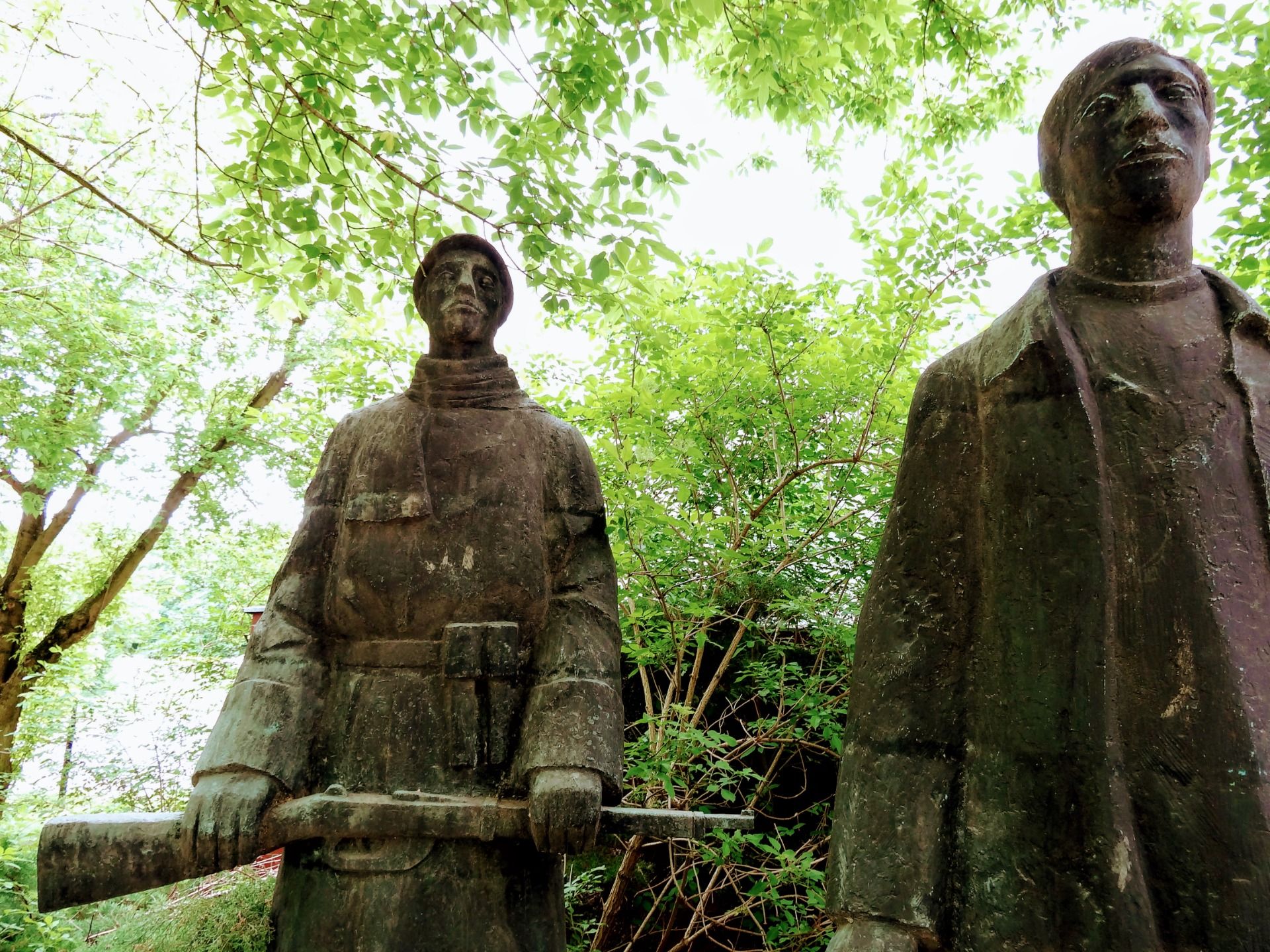
Three and a half decades after the end of the Mielke empire, its traces can still be found. Of the largest monument, a multi-ton bronze sculpture by the Halle sculptor Gerhard Geyer, only the pedestal remains after scrap metal dealers stole two of the figures.

The fountain has also crumbled, and the benches have lost their seats and backs. But half-overgrown, a mosaic of glazed clay depicting doves of peace, workers' fists, and Soviet stars can be found on a wall.

The infrastructure of the forbidden city between the more than 1,000-year-old Halle and the newly built suburb of Neustadt, constructed by the SED dictatorship and home to almost 100,000 inhabitants - later used by the university and the tax office after the end of the GDR - can still be discerned.

There was a barber shop and a store, a restaurant, a doctor's office, a sauna, a sports hall, a chic bar in the style of 1970s James Bond films, and a hall with a large stage where Stasi employees celebrated the anniversary of the Republic and May Day and held conferences.

The Stasi called the room, which remains well-preserved to this day, "Feliks Dzerzhinsky." Dzerzhinsky was the founder of the Soviet KGB, which, in 1918, at Lenin's behest, launched the "Red Terror" against "the bourgeoisie as a class," resulting in thousands of victims. The terrible godfather of individual terror was considered a heroic figure here. The oppressors of East Germans called themselves "the Chekists," after him and his comrade, Tschka.
Planning for the elaborate new building had already begun in 1966. The site chosen was part of the former Wehrmacht airfield Nietleben, used by the Soviet Army, which the Halle City Council transferred to the Ministry for State Security (MfS) on January 1, 1969. In the following years, a state within a state emerged on Gimritzer Damm – heavily guarded and secluded.

Residents only got a glimpse of the district authority's scale during alarm drills; it employed almost as many people as the Ammendorf railcar factory, one of Halle's largest companies.

Three decades after the dissolution of the MfS, ash, maple, and wild blackberries have reclaimed the sprawling grounds. Next to a gate in the remaining outer wall, right by the last surviving watchtower, the faded slogan "Halt! Schießen – Stop strelyat" (Stop! Shoot – Stop Strelyat) still stands. However, the slogan is not original – it was added years after the demise of the secret service and the departure of its scarcely less feared successor, the tax office, for filming.


Comments