
 Seaford, England, United Kingdom
Seven Sisters at 5:51 — grey skies, indifferent cows and the Coastguard Cottages I had travelled to see.
I almost always go somewhere for my birthday, and more often than not I end up in London. In 2022, though, things were a little different. London was still part of the trip, but one of the main reasons for the trip lay south of the city, on the East Sussex coast.
I wanted to see the Seven Sisters.
After an evening flight from Venice, I landed at Gatwick and spent the night at the Courtyard by Marriott London Gatwick Airport. My train towards the coast the next morning left at 5:51. The beginning of the trip felt more military than celebratory, but it was worth it.
It is a good example of the way I plan my trips. If I already know what I want to see, there is little point in going into London first only to head back south again. With the Seven Sisters in mind, Gatwick was the logical gateway to England, and staying by the airport meant I could be on my way to the coast only a few hours after landing.

What are the Seven Sisters?
The Seven Sisters are a chain of white chalk cliffs on the East Sussex coast, where the grassy South Downs drop towards the English Channel. Between Cuckmere Haven and Birling Gap, the coastline rises and falls through a sequence of chalk peaks and valleys, and that rhythm gives the landscape its distinctive shape.
The name is now slightly misleading. Although they are called the Seven Sisters, there are actually eight peaks — the sea has since exposed an eighth. Seen from the side, the cliffs do not form one enormous white wall above the sea. Instead, they appear as a succession of white cliff faces, one behind another, changing shape depending on where you stand.
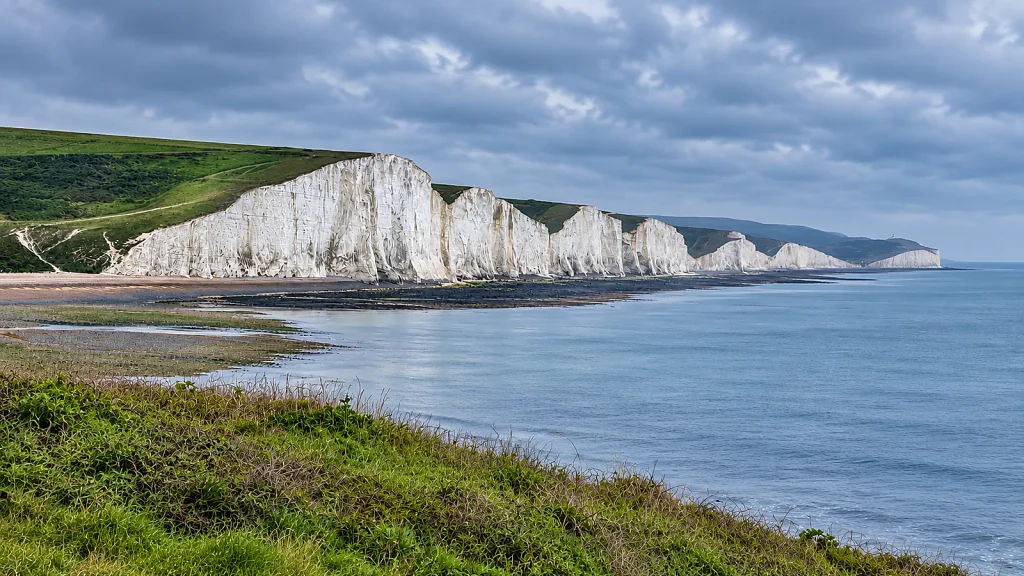
I was especially drawn to the view from Seaford Head towards Cuckmere Haven. Before the trip, I had seen photographs of the Coastguard Cottages: a handful of small houses set in a green landscape with the Seven Sisters rising behind them. That was the view I wanted to see for myself and, of course, photograph.
Towards the sea at 5:51
From Gatwick I travelled to Brighton by train at 5:51, changed trains there and arrived in Seaford early in the morning. The town was only just waking up as I set off towards the coast.
The weather was almost ideal for walking. All morning it looked as though rain might begin at any moment, but it never did. The air was slightly damp, and the temperature was just cool enough for a long walk.
Looking at the photographs now, I can reconstruct the beginning of the walk almost minute by minute: at 7:22 I was still among the houses of Seaford, then beside the colourful seafront huts and the first outcrops of white chalk, and by 7:49 I was already on the open paths above the coast.
After that, time stopped mattering.
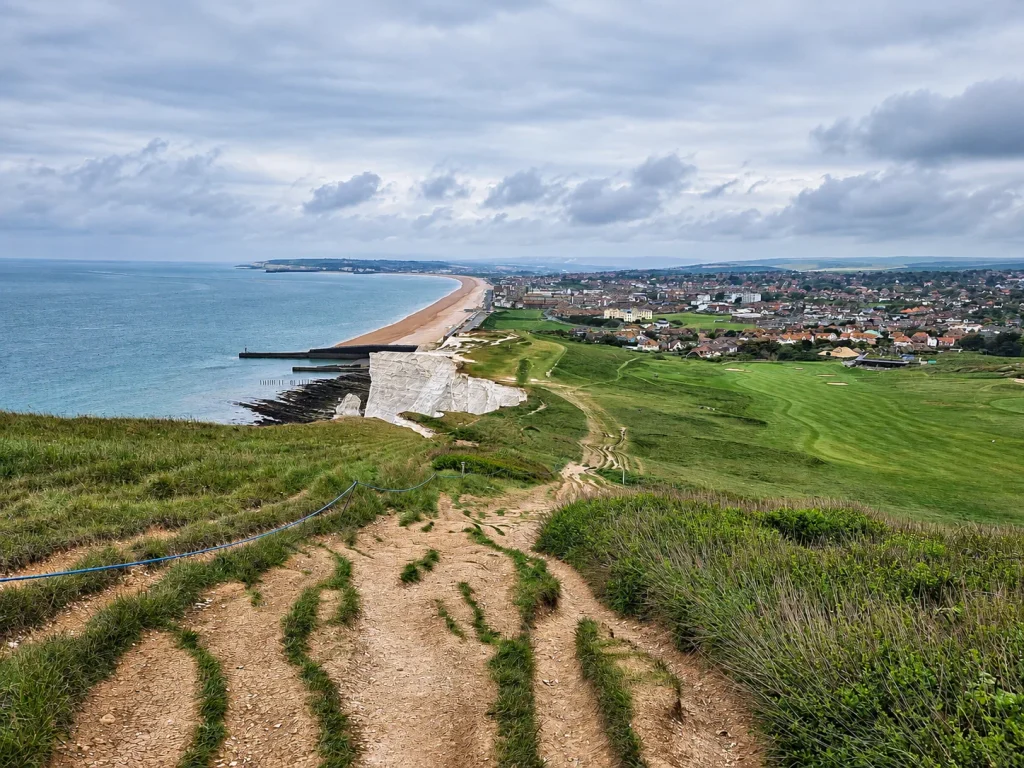
The town vanished, leaving grass, sea, paths and slopes unfolding one after another. The sea would come fully into view for a moment, then the land would hide it again, while somewhere farther ahead another white cliff edge appeared.
I no longer felt as though I was simply trying to reach a landmark or a predetermined point on a map. The walk itself had become part of what I had come for.
The England I knew from the movies
There is a version of England you somehow know before you ever see it.
Green hills, pastures, narrow paths, fences and the sea appearing beyond the next rise.
That morning I got almost the full package, including cows that regarded my enthusiasm for the landscape with complete indifference.
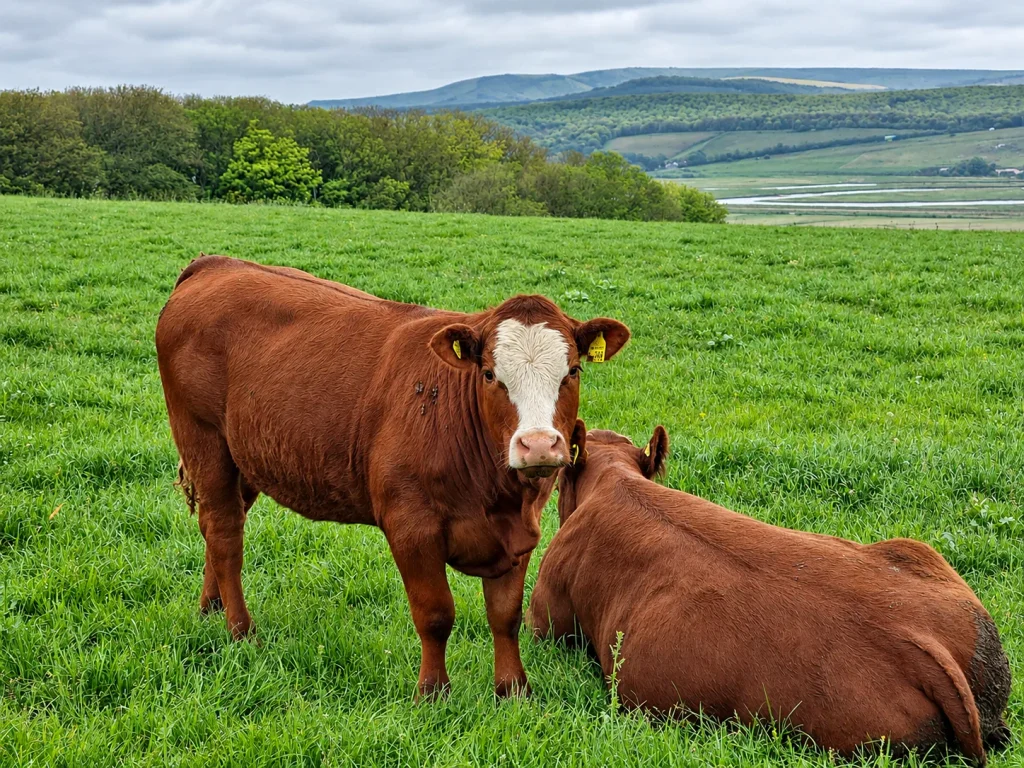
And that is not just a figure of speech. This stretch of coast has appeared in films including Atonement, Robin Hood: Prince of Thieves and Harry Potter and the Goblet of Fire.
Walking across those slopes, it was not difficult to understand why. There is a practical reason filmmakers keep returning here: unlike the defended cliffs at Dover, the Seven Sisters are allowed to erode naturally, keeping the chalk bright and the coastline relatively free of modern development. One film, though, belongs to this walk more than any other. Hope Gap (2019), with Annette Bening and Bill Nighy, is named after a stretch of Seaford Head I had just crossed, and much of it was filmed along my route — Seaford station, the seafront, Splash Point and Hope Gap itself.
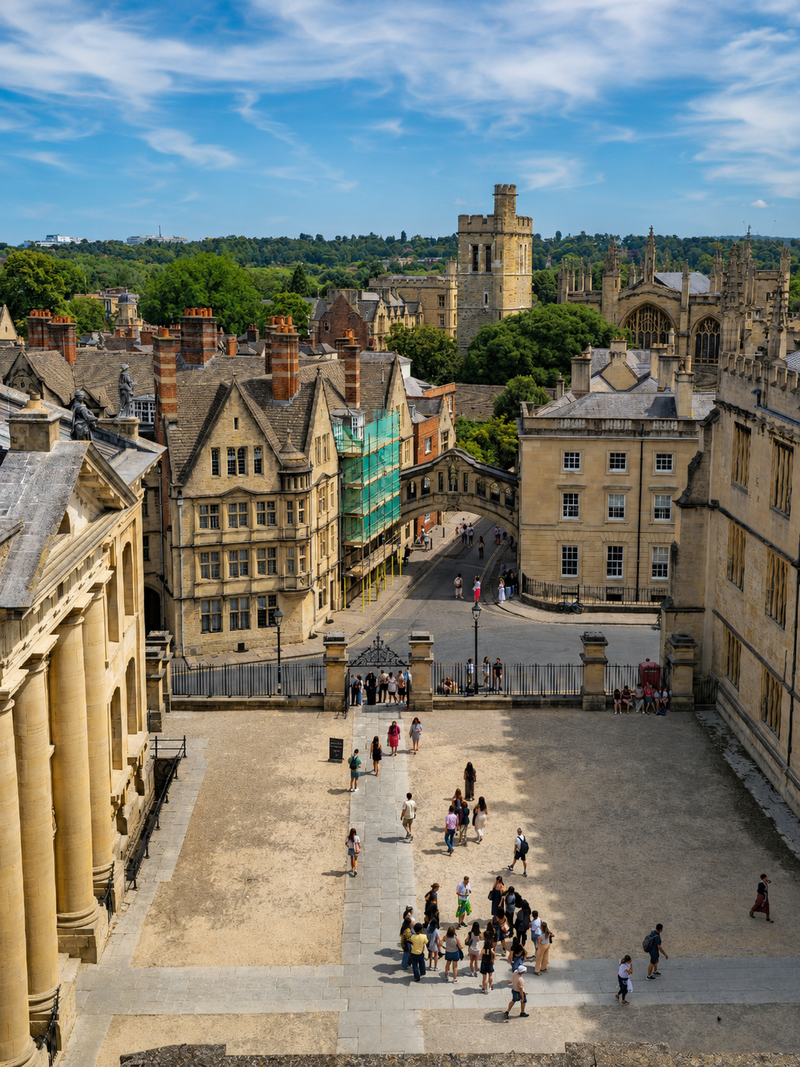
That cinematic version of England would follow me again in Oxford.
The grey weather suited the landscape. There was no golden light or blue sky for a tourist brochure, just a muted sea, intensely green slopes and a vast, heavy sky. The silence only deepened the melancholy of the scene.
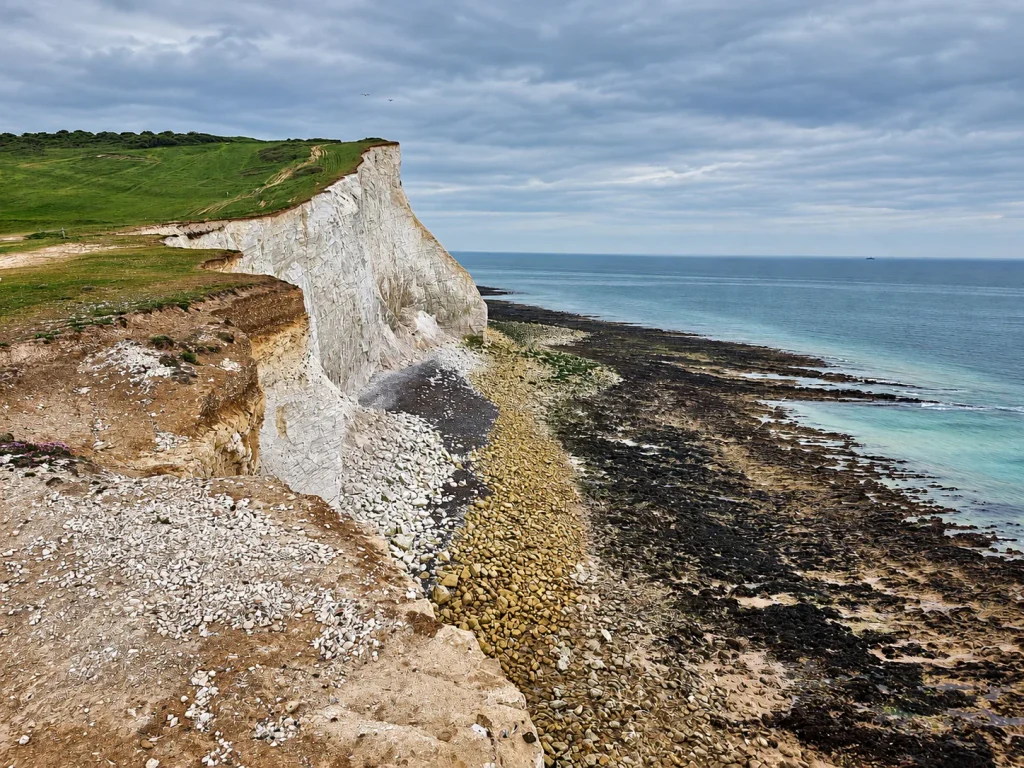
At times it felt as though I had stepped into a film scene and briefly left reality behind. Nothing spectacular was happening: I was simply walking through the grass towards the sea beneath a grey sky. But that simplicity was exactly what I wanted. There was no city and no schedule — only the landscape.
The view I had come for
Then the wider views towards the Seven Sisters began to open up, and not long afterwards the scene I had known only from photographs appeared ahead.
Coastguard Cottages.
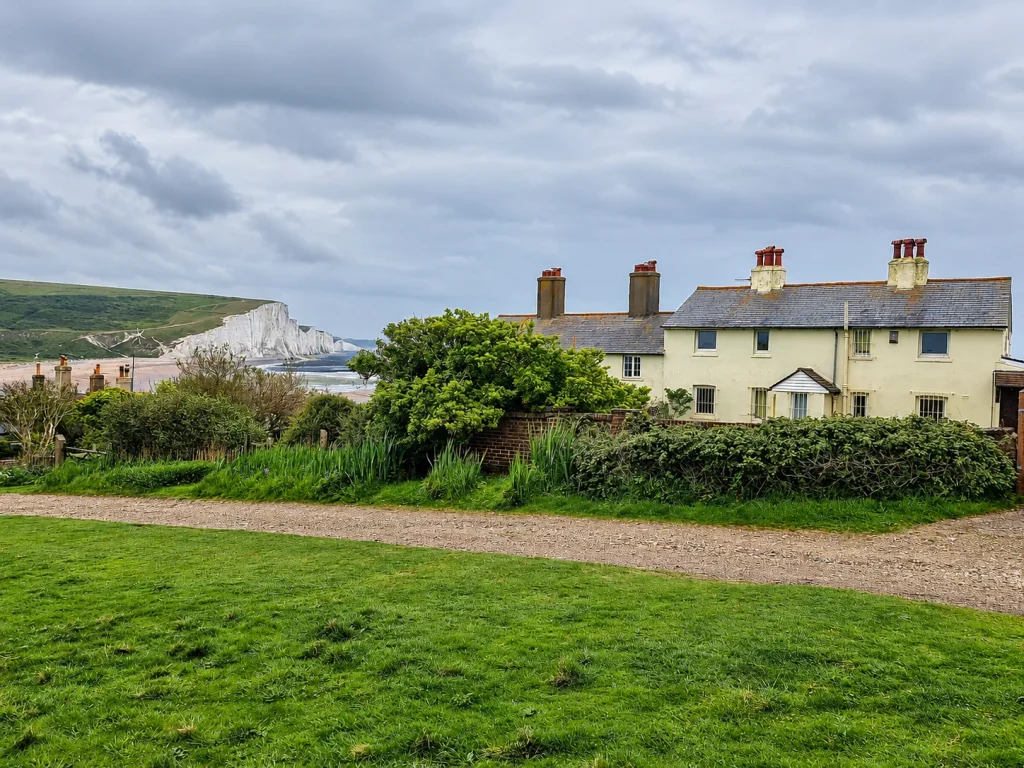
I had expected the view to lose some of its impact in real life, but the opposite happened. This was the moment I had come for. Only when I stood there did I realise just how small the cottages were compared with the landscape around them. Green slopes, chalk cliffs and sky filled almost the entire view, while those few houses in the middle gave the whole landscape a sense of scale.
With all the stops and photographs along the way, it took me about an hour and ten minutes to get from the railway station to that viewpoint. While other people were still having breakfast, I was already standing above Cuckmere Haven.
The Coastguard Cottages were not, of course, built there for the view. They are associated with the former coastguard and the fight against smuggling in the early nineteenth century, while the sea they once watched is still slowly reshaping the ground on which they stand.
The houses may look like a perfectly placed element in the landscape, but their relationship with the coast was never merely aesthetic.
A different way back to Seaford
For the return, I chose a different route. The way towards the cottages had taken me farther and farther from any sign of settlement, towards the sea and open slopes; the return led me through pastures, past the occasional house and road, gradually back towards Seaford and everyday life.
I had not simply looked at the landscape from one place. I had walked through it.
Epilogue
From Seaford I continued via Gatwick to Cambridge. Sandringham, Windsor and London came later — each of them a story for another time. But this one belongs to the Seven Sisters.
When I think about that trip now, London and Cambridge are not the first things that come to mind. Instead, I see a grey morning on the East Sussex coast, a green slope falling towards Cuckmere Haven, a handful of small houses and a line of white cliffs behind them.
It was a photograph of the Coastguard Cottages that took me there. Four years later, it is the view itself that remains.
