 City of San Marino, San Marino
Some countries remain in memory through landscapes, meals or people. San Marino survived in mine mainly because it was a country.
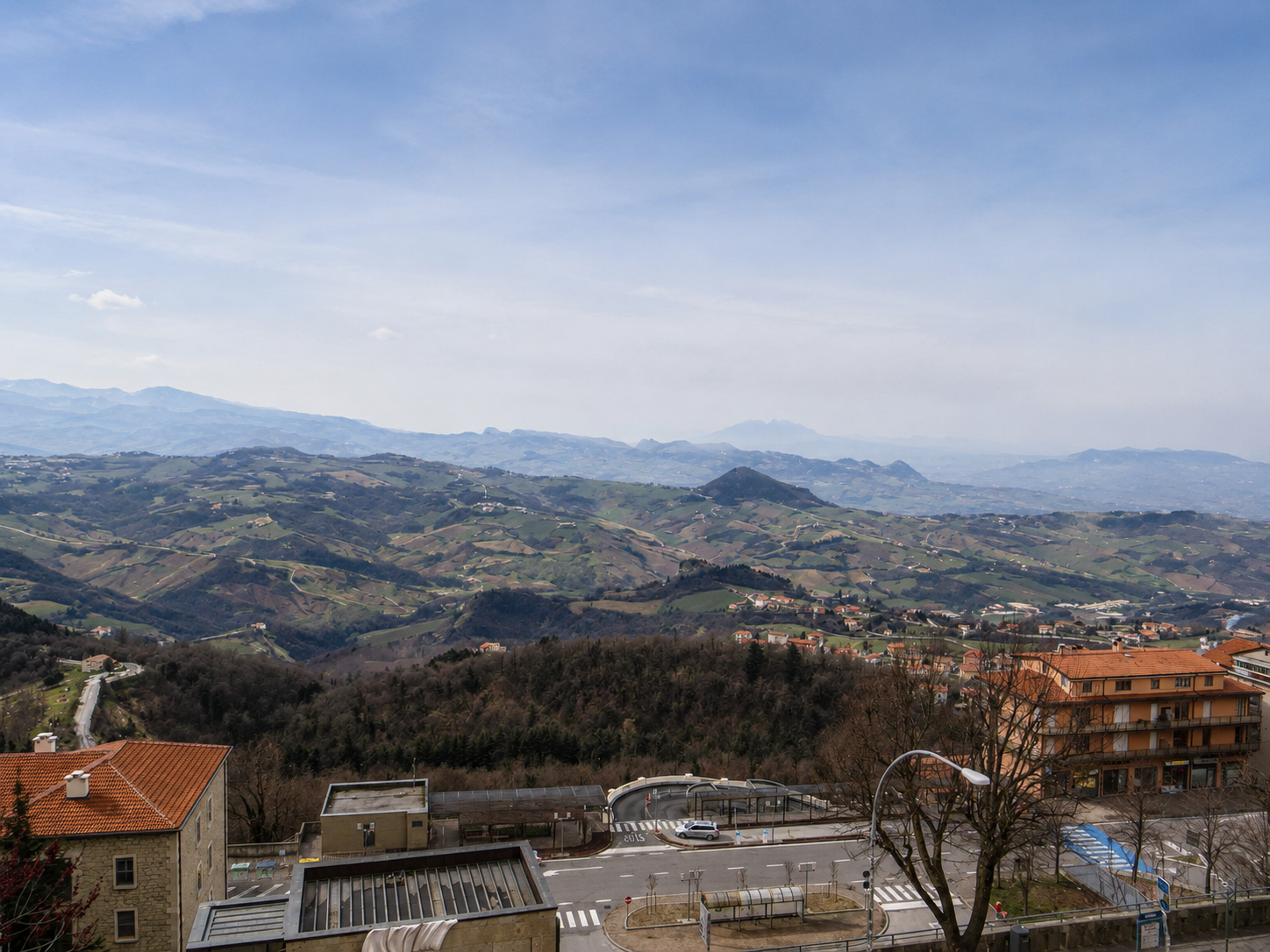
I remember a mountain, pale stone, crowds, too many shops, a guard in a glass booth and a hazy view over the surrounding hills. They are fragments rather than a coherent memory of a place.
What happened afterwards in an anonymous hotel in Rimini, unfortunately, remains much clearer.
In 2015, I joined an excursion organised by an association of mathematics teachers. The main purpose was not San Marino but Mateureka, a museum dedicated to mathematics and the history of calculation. San Marino was added because it was nearby, and ignoring an entire sovereign state when it was only a short drive away would have been rather absurd.
The order was simple: first the museum, then two or three hours in San Marino, followed by a night in Rimini.
Memory would eventually rearrange their importance.
The Museum I Remember Better Than the Country
Mateureka was the real reason for the journey.

Inside were historical calculating machines, mathematical games and physical objects designed to make abstract ideas visible. It was not simply a collection of old instruments placed in glass cases. The museum showed the long human attempt to calculate more quickly and accurately while still leaving room for experimentation and play.

Years later, I visited the much more famous National Museum of Mathematics in New York. Mateureka was incomparably better. Perhaps my expectations in New York had been too high, but Mateureka felt as though it had been created by people who understood both mathematics and the pleasure of explaining it.
After the museum, our bus continued towards Mount Titano.
This should have been the more memorable part of the day. We were about to enter another country, after all.
It did not feel particularly dramatic.
An Entire Country in Fragments
There was no border crossing that remained in my memory. No passport inspection, no substantial checkpoint and no sudden change of language or landscape. Italy simply continued uphill until, politically if not visually, it was no longer Italy.
By 2015, San Marino had long used the euro as its official currency. It is not a member of the European Union, but it uses the common currency through a monetary agreement and can issue limited quantities of coins with its own national designs. Familiar money made the transition even less visible.
What I remember most clearly is the density of people and shops.
The historic centre was not romantically suspended in medieval silence. It was busy. Tour groups moved through streets lined with commercial displays, and almost every suitable doorway appeared to have been converted into an opportunity to sell something.
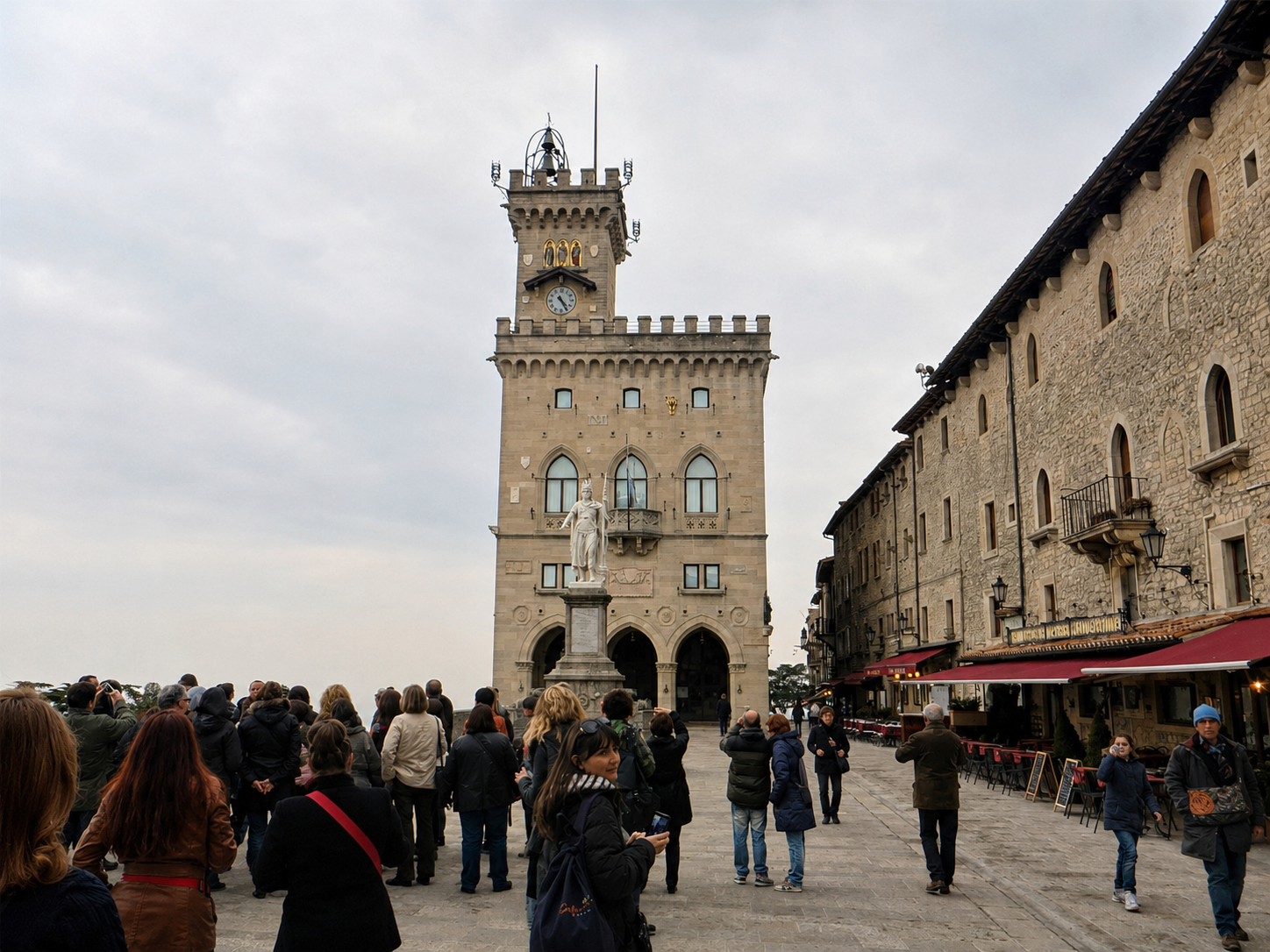
I remember the square in front of Palazzo Pubblico and a crowd that seemed slightly too large for it. The building looked appropriately governmental, but the scene around it felt more like the centre of a heavily visited Italian hill town than the institutional heart of an independent republic.
I also remember a uniformed guard standing inside a narrow glass booth while a bus passed directly in front of him.
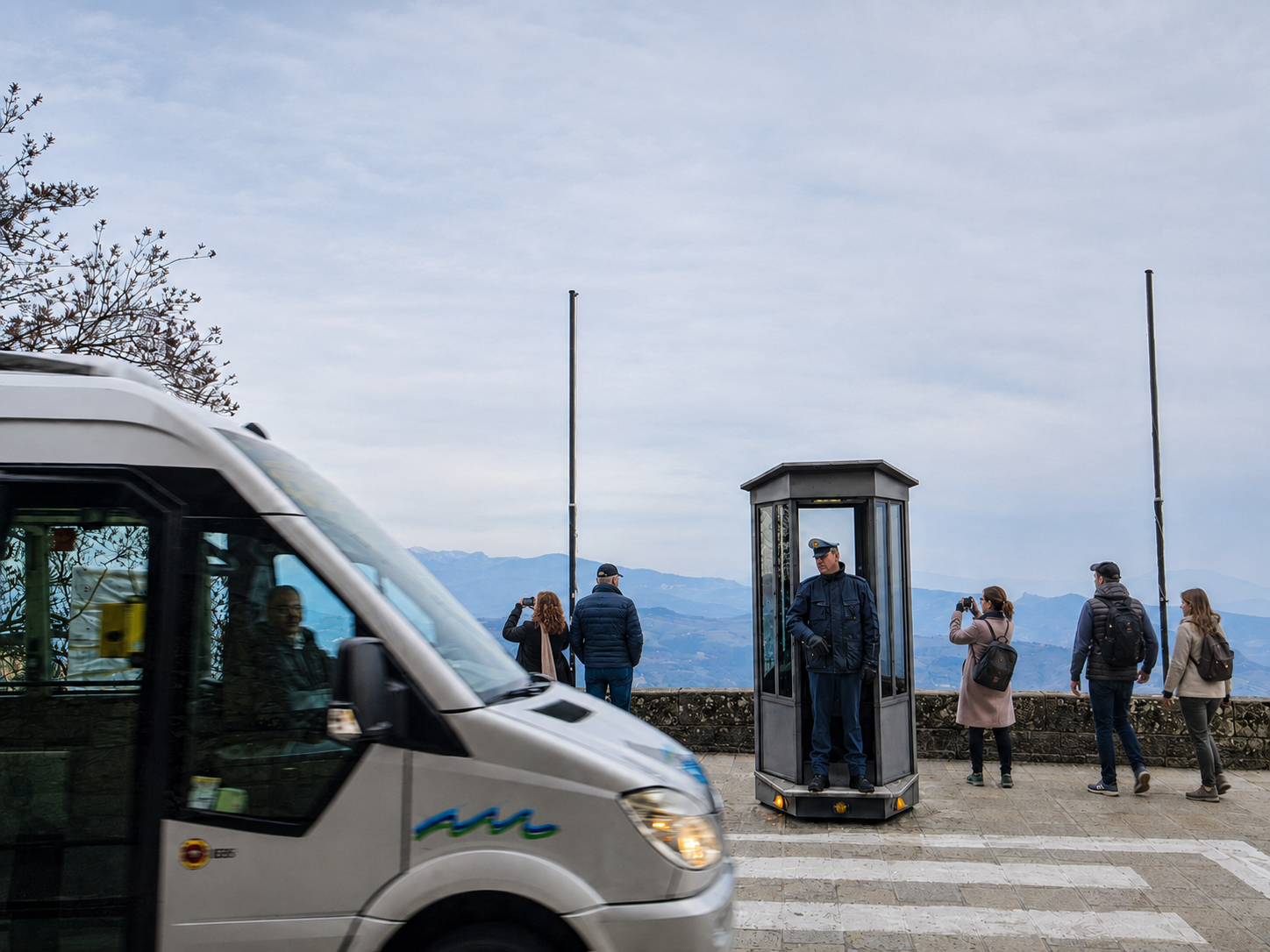
For a moment, the ceremonial dignity of one of Europe’s oldest republics was reduced to a traffic-management problem.
The weather did not help. The views were broad but faded into grey layers, removing much of the drama that Mount Titano might have offered on a clearer day.
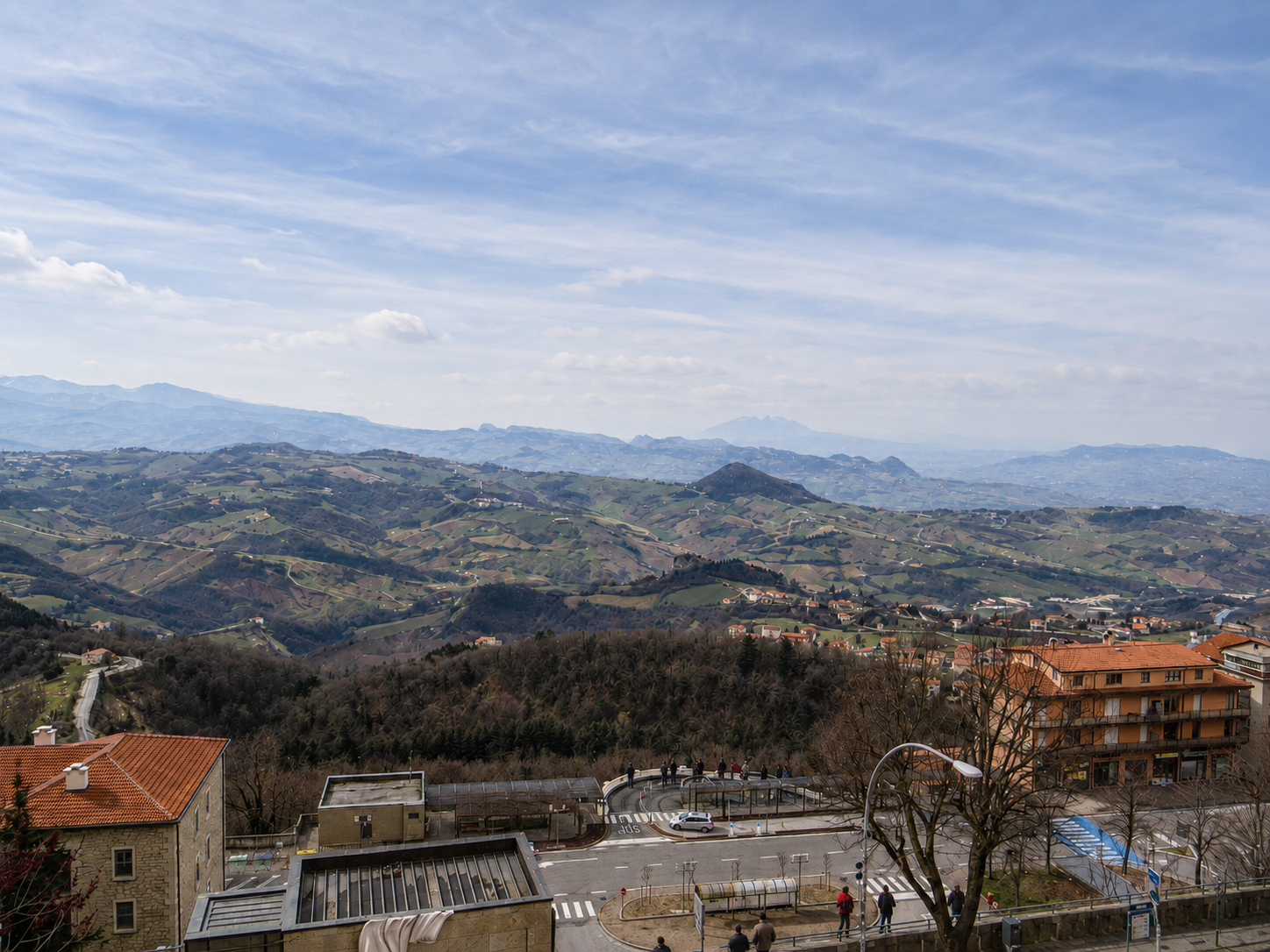
Nothing was actively unpleasant. It simply failed to form a strong identity in my mind. San Marino became a collection of visual notes rather than a place I could later reconstruct.
Why Saint Marinus Matters
The country takes both its name and its founding story from Saint Marinus.
According to San Marino’s traditional account, Marinus was a Christian stonemason from Dalmatia who arrived on the Italian peninsula in the third century to work in ancient Rimini. Tradition connects his birthplace with the island of Rab, in present-day Croatia. He later withdrew to Mount Titano, where a small Christian community supposedly developed around him. San Marino symbolically dates its foundation to 301.
This is a founding legend, not a securely documented fourth-century biography. The first known document confirming an organised community on Mount Titano dates from 885, almost six centuries later. The story of Marinus therefore belongs somewhere between hagiography, national tradition and history.

That distinction does not make the Croatian connection meaningless. Rab and San Marino have been twinned since 1968, and the saint from Rab remains the basis of the historical relationship between Croatia and the republic.
Our excursion had accidentally repeated part of the same geography.
According to the legend, Marinus travelled from the eastern Adriatic to Rimini and then towards Mount Titano. Seventeen centuries later, a bus full of Croatian mathematics teachers followed roughly the same sequence.
We had not planned a pilgrimage. We had merely added a nearby country to the programme.
Sovereignty Without the Usual Signs
The absence of an obvious border makes San Marino easy to mistake for an autonomous fragment of Italy.
It is not.
San Marino is a sovereign state with its own parliament, government, laws and international relations. Its most distinctive institution is the pair of Captains Regent: two joint heads of state elected for terms of only six months. The arrangement developed from medieval communal government and was intended to prevent power from becoming concentrated in one person.
San Marino survived from the political world of medieval Italian communes and city-states. Almost every comparable political entity was eventually conquered, merged or absorbed into something larger. San Marino somehow remained separate.
Beneath the shops and tour groups is therefore the capital of a political community that preserved its autonomy while nearly every state resembling it disappeared.
That was the real paradox of my visit.
Politically, I had entered one of Europe’s most unusual states.
Experientially, I seemed to have arrived in a crowded Italian hill town filled with souvenir shops.
Both impressions were true.
The Shopping Question
The quantity of shops was not entirely accidental.
San Marino forms a customs union with the European Union, but it maintains its own indirect-tax system instead of using the standard Italian VAT structure. Its traditional imposta monofase is a single-stage tax applied mainly when goods are imported.
That difference helped San Marino develop a reputation as a shopping destination. It is not a simple airport-style duty-free system, and not every item is necessarily cheaper. Still, the separate tax regime created both real and advertised opportunities for bargains, encouraging visitors to look for watches, jewellery, perfumes, tobacco and souvenirs alongside medieval architecture.
In 2015, I knew none of this.
I simply wondered why an ancient republic appeared to contain more shops than history.
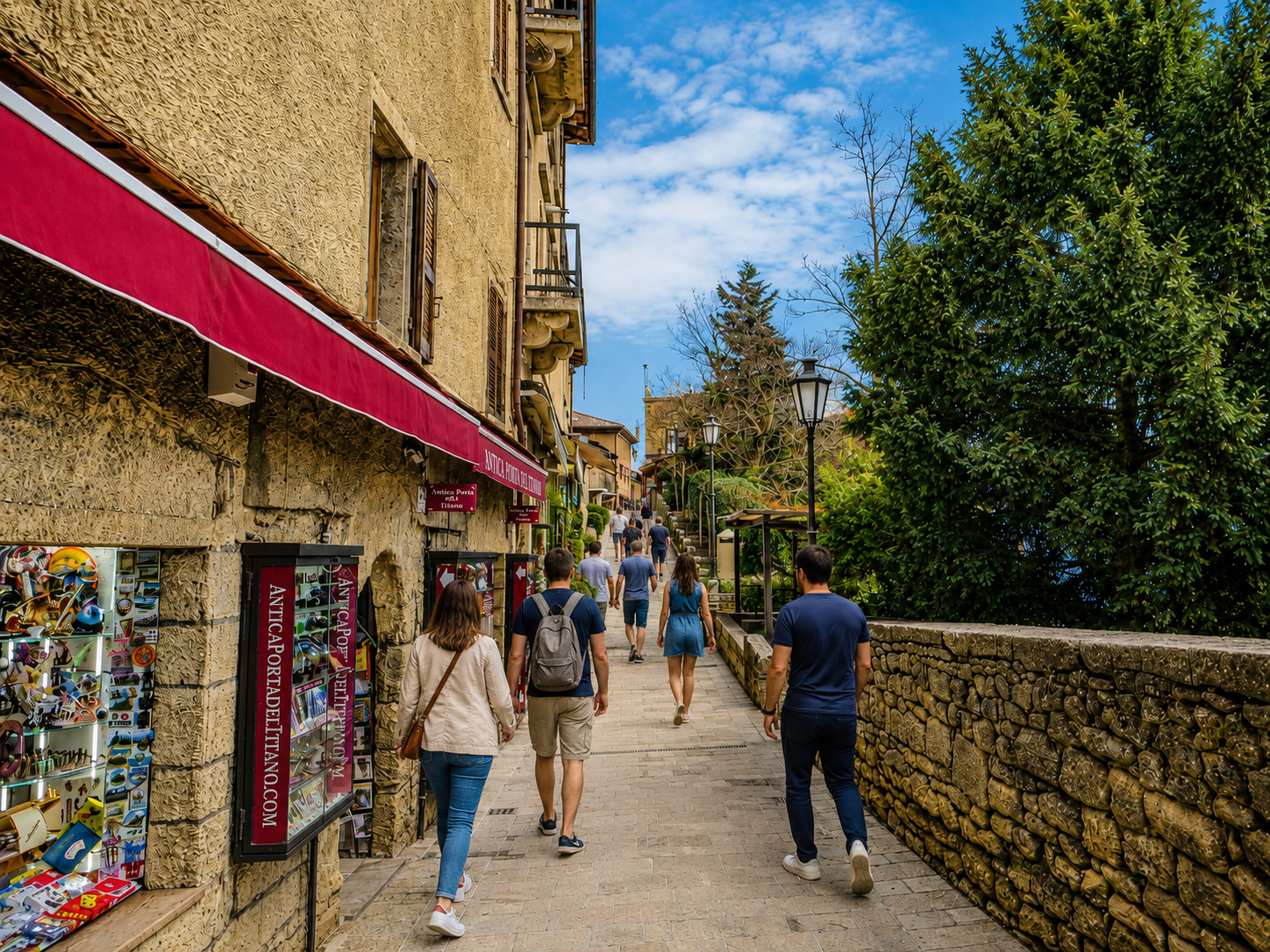
I bought nothing.
What I Only Understood Later
Only when I later looked at the map and read more about San Marino did I realise how much of the obvious itinerary I had either rushed through or failed to understand.
The three towers of Guaita, Cesta and Montale form the defining image of the republic and appear on its coat of arms and flag. Palazzo Pubblico is not merely the photogenic building at the end of a crowded square; it houses the country’s central political institutions. The Basilica of Saint Marinus connects the functioning modern state to its founding tradition, while the paths along the ridge provide the views that dull weather largely denied us.
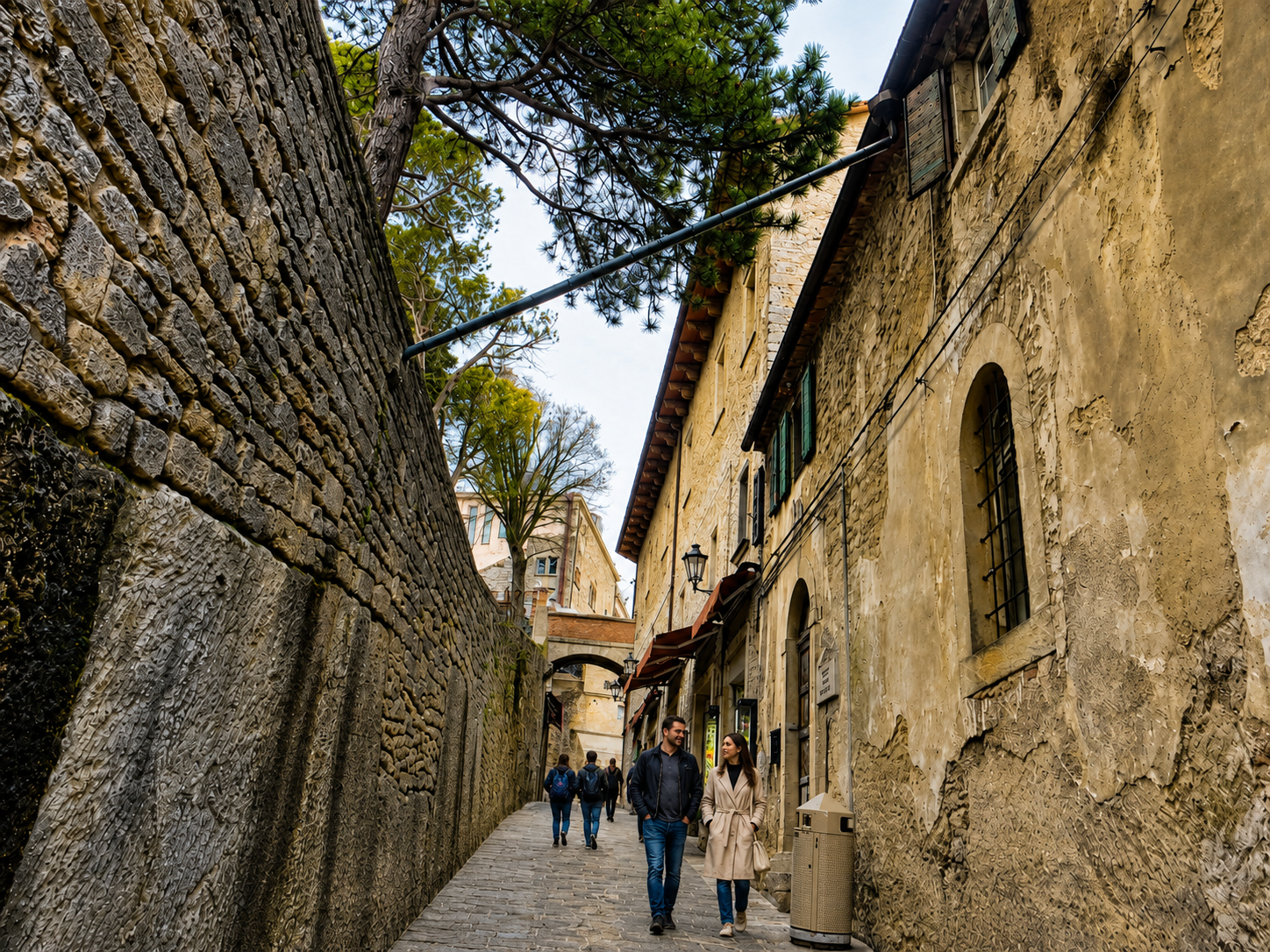
Looking at my photographs now, I can see attractive stone streets, fortifications, arcades and abrupt openings towards the landscape. I apparently walked through them without allowing them to become much more than background.
Perhaps I was not yet travelling in the same way that I do now. I had not developed much interest in political geography, architectural details or the difference between seeing a landmark and understanding why it exists. San Marino was simply another stop in a group programme.
Would I return?
Possibly.
I would now walk the full ridge, visit the towers properly, enter the institutional buildings and remain long enough for the day-trip crowds to thin. Spending a night inside the republic might reveal a place different from the retail corridor I remember.
The problem is that San Marino requires just enough effort to make a return difficult to justify. It is not remote, but without a car it is inconvenient. My first visit did not create a strong emotional reason to organise a second.
And by the end of that day, another place was already taking control of my memory.
The Hotel That Defeated a Sovereign Republic
After San Marino, we continued to Rimini and checked into a hotel whose name I have mercifully forgotten.
At the time, I was morbidly obese. I accept that this complicated my relationship with cramped interiors. Nevertheless, the bathroom appeared to have been designed for a guest travelling without a body.
The shower was mounted directly above the toilet.
Taking a shower therefore meant washing myself, the toilet and most of the floor simultaneously. It was less a bathroom than a small-scale flood simulation.
The bathroom was so small that I had to remove its door before I could enter properly.
I freely admit that I am a snob, but this was not a case of demanding marble, bathrobes or a pillow menu. I was merely asking to use the bathroom without first dismantling part of the building.
The bed linen and the tablecloths in the restaurant appeared to have been made from exactly the same material. Perhaps they were not. Perhaps the hotel had simply discovered two fabrics so unpleasant that the human eye could no longer distinguish between them.
We survived the night.
The following morning, the owner provided the final performance.
He moved through the breakfast room shouting at the guests about how much we were eating and warning that we would bankrupt him. Some people had taken more than one croissant, which he apparently regarded as a direct attack on the financial stability of the hotel.
He took the additional croissants from their plates and announced that one was enough.
A second croissant was not breakfast.
It was a hostile takeover.
I honestly do not know how I survived that accommodation.
San Marino had preserved its sovereignty through centuries of shifting borders, military powers and Italian unification. My memory was less respectful. It reduced the republic to a mountain, a crowd, some shops and a hazy view, while granting permanent independence to a bathroom door and a confiscated croissant.
