 Madrid, Community of Madrid, Spain

From lapis lazuli to bare flesh: seventy-five minutes of beauty, scandal and darkness at Madrid’s Prado.
Even before entering the Prado Museum in Madrid, visitors are greeted by two men who largely define its character.
Diego Velázquez, the seventeenth-century court painter who transformed royal interiors into some of the most sophisticated visual puzzles in European art, sits in front of the main façade with a palette and brush in his hands.
Francisco de Goya stands near another entrance. He, too, served the Spanish court, but his career eventually led far beyond polished royal portraits—towards war, cruelty, superstition, madness and some of the darkest images created by any major European painter.
Velázquez invites the viewer into the royal palace.
Goya waits to show him what may be hiding underneath it.
Seventy-five minutes later, I would understand why both men had been stationed outside.
By then, however, I would also have met Marta.
The guide who threatened to have us killed
The Prado is not a museum one casually completes between lunch and dinner.
Its collections grew largely from the tastes, marriages, inheritances and political ambitions of Spanish monarchs. The result is less encyclopaedic than the Louvre but extraordinarily concentrated: Bosch, Titian, Rubens, El Greco, Velázquez and Goya appear not as isolated trophies, but in groups dense enough to reveal entire artistic worlds.
Its monumental staircases and apparently endless corridors create the impression that one has entered a parallel city built entirely from paintings.
I had no intention of navigating that city alone.
My guided tour began at 3.30 p.m. and was scheduled to last approximately seventy-five minutes. The guide was Marta.
She spoke English fluently, knew exactly where to position the group and had an excellent instinct for the details that could make an old painting suddenly comprehensible.
She also had several recurring obsessions: royal deformities, real and alleged lovers, expensive pigments and, as would gradually become apparent, Goya’s refusal to omit female pubic hair.
The rules of engagement
Before we had seen a single painting, Marta informed us that photography was strictly forbidden.
Then she explained what would happen to anyone who ignored the rule:
The guards will find you and kill you.
At first, several of us smiled.
Marta did not.
No one tested her—not because the group was exceptionally obedient, but because she delivered the warning with such total conviction that taking out a phone suddenly seemed less like breaking a museum rule and more like volunteering for a public execution.
The guards were visible everywhere. Marta clearly knew them. Most importantly, none of us wanted to become the first person she used to demonstrate that she had not been joking.
That is why I have no photographs of my own from inside the Prado.
Later, one American couple would make the mistake of assuming that Marta’s threat had been merely decorative.
Medieval crossbows and impossible colours
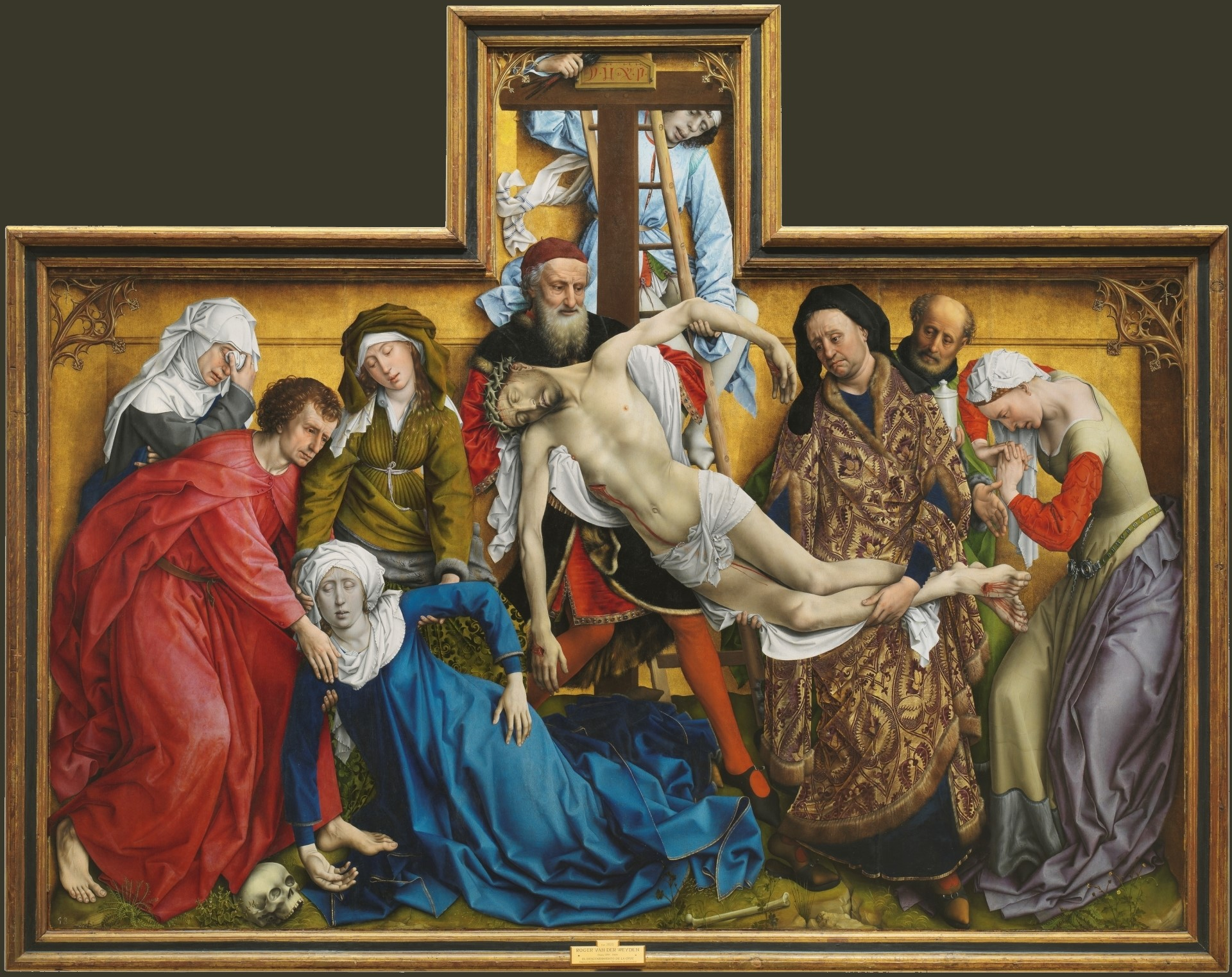
Our first major stop was Rogier van der Weyden’s The Descent from the Cross.
What struck me first was not the theology, the symbolism or even the grief.
It was the colour.
The red, blue and gold were so intense that the figures seemed less painted than physically assembled from fabric, metal, skin and light. Nearly six centuries after the work was created, the colours still looked almost indecently alive.
Christ’s dead body and the fainting Virgin repeat the same curved line, while the people around them collapse in different ways—some openly, some with restraint, others with almost theatrical despair.
Marta, however, was particularly excited about the crossbows.
The painting had been commissioned by a guild of crossbowmen in Leuven. Tiny crossbows appear in its upper corners, while the curve of Christ’s body can also be read as an echo of the weapon.
She presented this connection as something close to definitive proof of Van der Weyden’s genius.
I was still staring at the blue.
We had been inside the museum for perhaps ten minutes. Marta had already moved effortlessly from threats of murder to medieval weaponry, while the painting itself appeared determined to prove that fifteenth-century colour could overpower everything she was saying.
Marta’s blue-chip investment
Then came Fra Angelico’s Annunciation—and with it the first appearance of what would become the tour’s most persistent supporting character.
Not Gabriel.
Not the Virgin Mary.
Lapis lazuli.
The painting connects the expulsion of Adam and Eve from Paradise with the Annunciation, compressing humanity’s fall and the beginning of its salvation into the same visual space.
Marta acknowledged all of that.
Then she pointed to the Virgin’s robe.
The blue pigment had been made from lapis lazuli transported from the region of present-day Afghanistan. It was among the most expensive substances available to European painters, sometimes valued more highly than gold.
For Marta, this was not merely blue.
It was wealth ground into powder.
She spoke about it with the enthusiasm of a commodities broker who had discovered that the Virgin Mary was wearing a highly profitable mineral investment.
The robe suddenly became more than a religious symbol. It was also the fifteenth-century equivalent of appearing at a public event covered in diamonds while pretending the effect was purely spiritual.
Marta would return to lapis lazuli repeatedly. By the third mention, I began to suspect that the tour might end at a discreet museum counter where she would offer us a few grams at a preferential rate.
Still, she had achieved something useful.
I would never again look at the blue in an old painting as though it had simply emerged from a convenient tube.
What the hell was the Mona Lisa doing in Madrid?
The next surprise was not a hidden symbol or an expensive pigment.
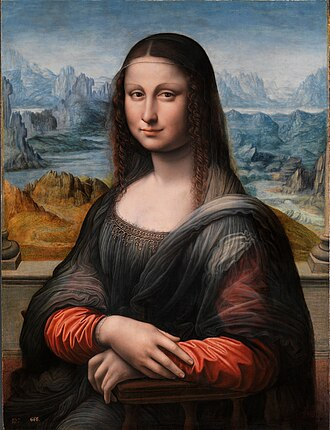
It was the Mona Lisa.
My first reaction was neither scholarly nor sophisticated.
What the hell was the Mona Lisa doing in the Prado?
Leonardo’s painting was in Paris, surrounded by glass, barriers and several hundred people attempting to photograph it from approximately the distance of another country.
Yet here she was again, in Madrid, looking brighter, younger and considerably easier to approach.
The Prado version is the oldest known workshop copy, painted while Leonardo was still working on the original. Technical examination has shown that the pupil followed several of Leonardo’s changes as they happened.
He was not simply copying a finished picture.
He was watching it evolve.
For centuries, the Madrid painting had been hidden beneath a black background added later. When conservators removed it, a landscape similar to the one behind Leonardo’s original reappeared.
That was enough technical history for me.
The more immediate fact was that I could stand close to the painting and actually look at it.
Marta declares war on the Louvre
Marta preferred the Madrid version’s brighter colours and better preservation. She also attacked the Louvre for refusing to “wash” its Mona Lisa, apparently allowing it to turn yellow beneath old varnish.
The accusation was wonderfully direct.
It also made restoration sound like a task involving warm water, a sponge and ten energetic minutes before closing time.
Leonardo’s extremely delicate glazes are not a kitchen window. An overconfident cleaning could remove precisely the ambiguity that makes the original exceptional.
Then Marta made an even more provocative claim.
The Mona Lisa, she said, had been lucky to be stolen.
She was referring to the theft from the Louvre in 1911. The painting had already been highly respected, but its disappearance, the police investigation and the international media frenzy transformed it into a global celebrity.
Marta’s version was simpler: one of the greatest career moves in art history was getting carried out of a museum by an Italian handyman.
She was exaggerating, but not entirely wrong.
The Madrid version may even be more immediately beautiful. Its colours are clearer, its face fresher and its landscape easier to read.
Yet it lacks the instability of Leonardo’s original.
In Madrid, I saw a beautiful woman smiling.
In Paris, the expression seems to change depending on whether I look at the eyes, the lips or the shadow around the cheeks.
The Prado had the Mona Lisa one could actually see.
The Louvre still had the one that refused to remain completely visible.
The moment Marta proved she was very good
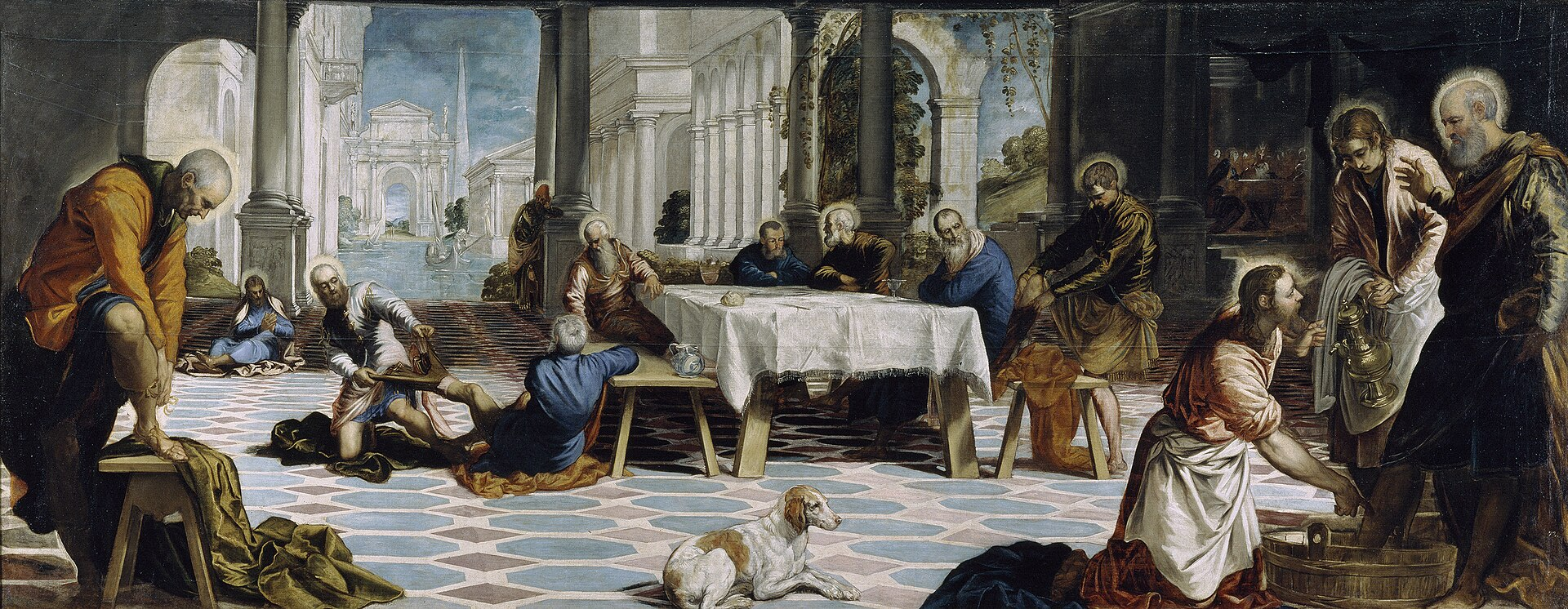
Tintoretto’s Christ Washing the Disciples’ Feet was the moment when Marta proved that she was far more than an energetic distributor of gossip and pigment prices.
At first, the enormous canvas seemed badly organised.
Christ, supposedly the centre of the event, had been pushed almost completely to one side. A long table cut through the scene, while architecture and figures performing ordinary movements occupied the middle.
Marta did not begin with an explanation.
She moved us.
First, we stood almost directly in front of the painting. Then she led us considerably further to the right.
The table appeared to turn with us.
From the second position, the composition suddenly tightened. Empty spaces disappeared. Diagonals connected. The architecture opened towards the distance.
Tintoretto had created the painting for a Venetian church where it would have been approached from the side. It had never been designed for a neutral museum wall or for visitors obediently standing at its centre.
Marta did not merely tell us how the painting worked.
She made us feel it by changing the position of our bodies.
Four and a half centuries after creating the picture, Tintoretto was still deciding where I had to stand.
That single demonstration justified the price of the tour.
The emperor who could be undressed
The Prado also contains sculptures and decorative objects inherited from royal collections.
The most memorable was the bronze Charles V and Fury.
The emperor stands over a defeated personification of rebellion and chaos, presented as a new Roman ruler—powerful, virtuous and naturally entitled to dominate everyone beneath him.
The sculpture also came with removable armour.
Charles could be displayed as a formal Christian emperor or stripped down to an idealised antique nude.
During my visit, he was naked.
The real Charles V had the unmistakable Habsburg jaw and suffered from considerable health problems. Marta described the bronze as Renaissance Photoshop.
That was difficult to dispute.
The sculpture was not intended to show what Charles actually looked like without clothes. It showed what imperial propaganda wanted him to look like: strong, fertile, masculine and almost supernaturally legitimate.
Marta then examined the discrepancy between his historical face and his sculpted body and concluded that a man who looked like Charles V was unlikely to have possessed either such a harmonious torso or such an ideally proportioned intimate attribute.
Her analysis of imperial propaganda was convincing.
Her implied correlation between facial structure and genital anatomy required a somewhat more adventurous methodology.
Nevertheless, the naked emperor efficiently removed any remaining danger that the tour might become excessively solemn.
The heart of the Prado
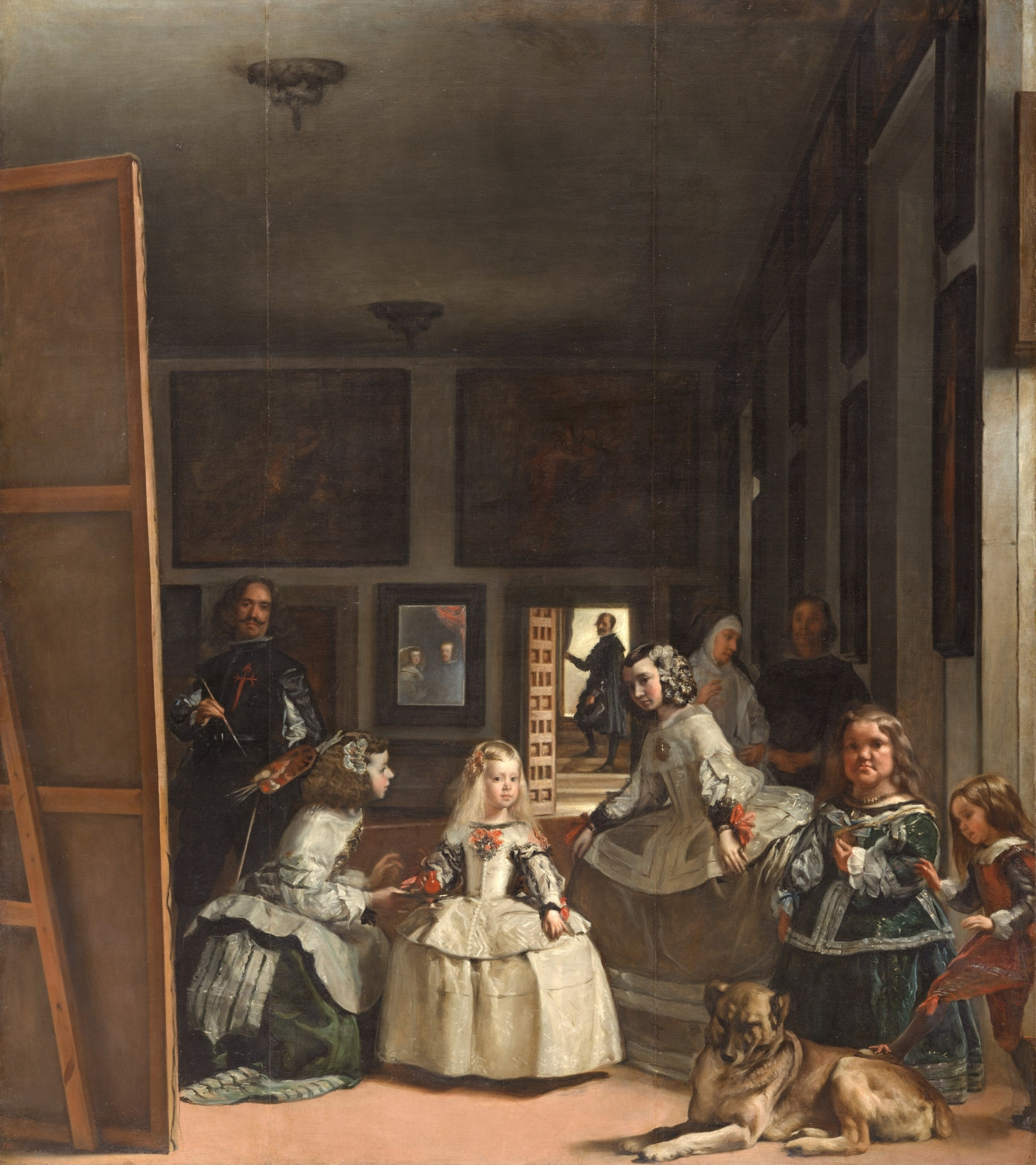
At the centre of the Prado—emotionally, intellectually and almost physically—stands Velázquez’s Las Meninas.
The museum contains paintings that may be more immediately beautiful, more violent or more spectacular. Yet Las Meninas feels like its heart because it does something no ordinary royal portrait should be able to do.
It refuses to remain inside its frame.
The Infanta Margarita stands among her ladies-in-waiting, attendants, two court dwarfs and a large dog. Velázquez appears on the left before an enormous canvas whose painted surface we cannot see. In a mirror on the rear wall, the king and queen appear as distant reflections.
Marta repeated one statement several times:
We do not know what Velázquez is painting. We will never know.
Formally, she was right.
The front of the canvas is hidden. Art historians have spent centuries arguing over whether Velázquez is painting the royal couple, the Infanta, the scene before him or perhaps the very picture we are looking at.
Yet standing there, I felt that we did know.
He was painting us.
Not literally, of course. But in some parallel dimension sealed inside the canvas, Velázquez appeared to be looking straight through the museum wall and at the people standing before him.
If the king and queen were posing, they occupied precisely the place where I stood. The painted figures were close to life-size, and the studio seemed to continue beyond the frame into the gallery.
The painting did not feel like a window onto a completed event.
It felt like a room that had trapped one moment four centuries ago and was still waiting for new people to enter it.
Every visitor became a possible royal model.
Every visitor was briefly caught inside Velázquez’s system of glances.
That, to me, was why Las Meninas felt like the heart of the Prado. It did not merely show the Spanish court. It absorbed the museum, the gallery and everyone standing inside it into its own parallel world.
The selfie that became a public trial
It was at precisely this moment—while Marta was explaining that the viewer might occupy the place of the king and queen—that an American couple decided to insert themselves into the composition rather more literally.
They attempted a selfie.
Perhaps they thought speed would protect them. A quick turn, one raised phone, two smiles and the crime would be complete before anyone noticed.
Marta noticed before they had properly arranged their faces.
Her reaction was immediate and gloriously disproportionate.
She turned towards them and launched an attack loud enough for the entire gallery to hear. This was not a discreet reminder, nor the polite museum whisper normally reserved for minor violations.
It was a public indictment.
Every nearby visitor stopped looking at Velázquez and began looking at them. The couple’s smiles collapsed. The phone descended slowly, like a weapon being surrendered after an unsuccessful coup.
Marta continued.
She reminded them, loudly and with surgical clarity, that photography was forbidden, that she had already explained this and that the Prado was not a theme park constructed for their personal content production.
The two of them seemed to shrink beneath the attention of the room.
Then Marta summoned a guard.
The woman appeared at speed, charging across the gallery like one of the Furies released from an ancient tragedy. She did not walk towards them so much as descend upon them.
Within seconds, the couple had been pulled aside beneath the gaze of the Infanta, Velázquez, the king, the queen and half the visitors in the room.
Of all the paintings in the Prado, Las Meninas was perhaps the worst possible place to become the object of everyone else’s attention.
They stood there visibly uncomfortable, no longer certain what to do with their hands, while the guard dealt with them and Marta resumed the tour as if she had merely corrected a small disturbance in the cosmic order.
I never discovered how the disciplinary procedure ended.
By then, Marta was already leading us towards Goya.
The selfie, I suspect, no longer seemed worth preserving.
Before leaving Velázquez, she stopped briefly in front of several equestrian portraits and announced that the great master could not paint horses.
Looking at one animal whose body appeared to have been assembled from several incompatible horses, her verdict did not seem entirely unreasonable.
Some distortions resulted from the paintings’ intended position high on palace walls, and assistants may have completed parts of them.
Still, not every horse painted by a genius is necessarily a genius horse.
That was Marta’s method at its best: one irreverent statement, followed by the sudden realisation that you were now examining the painting much more carefully than before.
Why Marta loved Goya
Marta’s tone changed when we reached Goya.
She admired him for one quality above all others:
Courage.
She repeated the word several times.
Goya had the courage not to flatter royal faces. The courage to paint war without heroism. The courage to expose superstition, stupidity and cruelty. Eventually, he had the courage to create images that did not seem to care whether anyone wanted to see them.
The royal tabloid opens
In front of The Family of Charles IV, Queen María Luisa of Parma immediately became the centre of Marta’s story, just as she is the visual centre of the painting.
Marta described her as dominant, politically influential and inseparable from the extraordinary rise of Manuel Godoy, who advanced from young guardsman to one of the most powerful men in Spain.
Godoy does not appear in the portrait.
Marta nevertheless made him its invisible protagonist.
Rumours long claimed that he was the queen’s lover and perhaps even the father of one of her children. There is no firm proof, but there was enough intimacy, protection and political influence to keep the story alive for more than two centuries.
Within minutes, the royal portrait had become a family photograph in which the most interesting man was the one who was not present.
Goya himself stands in the background, clearly referring to Velázquez’s position in Las Meninas. Yet the effect is completely different.
Velázquez creates uncertainty.
Goya switches on the lights.
Marta pointed to a conspicuous mark on the face of the king’s sister María Josefa as evidence that Goya refused to prettify his models.
That was a perceptive observation.
The subsequent discussion of whether the mark represented a mole, tumour or melanoma was a more ambitious attempt to practise dermatology on an eighteenth-century painting.
By that stage, I had learned considerably more about suspected royal bedrooms than about Goya’s role in the development of modern art.
And then, dear reader, we reached the part of the tour for which Marta appeared to have been emotionally preparing from the beginning.
The Majas.
A private mechanism for a very private devotion
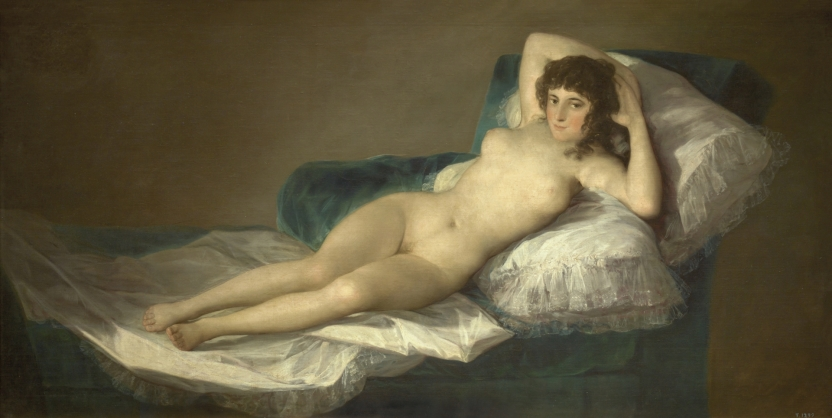
The identity of the woman in The Clothed Maja and The Nude Maja remains uncertain.
Marta repeated the famous story that the clothed version once stood in front of the nude and could be moved by a hidden mechanism: a respectable woman for public display, the same woman undressed for Manuel Godoy’s private enjoyment.
In Marta’s telling, this was not merely an ingenious hanging system.
It was an early nineteenth-century device designed less for artistic contemplation than for a more solitary and emphatically physical form of appreciation.
She did not need to describe Godoy’s presumed activities explicitly.
Her expression supplied the missing verb.
The image she created was unmistakable: Godoy alone with his mechanism, moving the respectable Maja aside whenever cultural admiration required a rather more intimate conclusion.
It is an excellent story.
Firm documentary evidence for it is considerably less impressive.
The Nude Maja, however, required no mechanism to provoke.
The woman is not disguised as Venus, a nymph or a mythological allegory through which nudity could be rendered respectable. She lies on a contemporary bed and looks directly at the person looking at her.
Marta had finally reached the detail she had apparently been waiting for all afternoon.
The pubic hair.
She pointed it out not casually, but triumphantly.
For Marta, those few dark brushstrokes were not a minor anatomical detail. They were a manifesto. Proof of Goya’s courage. Proof of his modernity. Perhaps proof that several centuries of idealised female nudity had finally been forced to acknowledge that real women were not manufactured from polished marble.
She returned to the subject with such enthusiasm that the rest of the body temporarily seemed to exist only as a frame for the revolutionary tuft at its centre.
This, in her view, was Goya refusing to lie.
This was realism.
This was courage.
This was almost the birth of modern art sprouting visibly between the model’s thighs.
I found the woman’s gaze more radical.
She is naked, but she is not passive.
She does not lower her eyes, apologise for her body or pretend not to notice the viewer. She looks calmly and directly back at whoever is examining her.
The anatomical realism matters. Marta was right about that.
But the painting’s true provocation, to me, was not simply that the woman had pubic hair.
It was that she knew we were looking—and refused to give us control of the encounter.
The darkest possible ending
The tour ended in the room containing Goya’s Black Paintings.
He had originally painted the fourteen disturbing scenes directly onto the walls of his home, the Quinta del Sordo. They were not commissions, were not intended for public exhibition and were transferred to canvas only decades later.
The atmosphere changed as soon as I entered.
It was not simply a darker palette.
It felt as though the air had disappeared.
After royal fabrics, gold, lapis lazuli, naked imperial bronze and Marta’s passionate defence of Goya’s anatomical honesty, I was suddenly surrounded by distorted faces, rituals, violence, old age, madness and fear.
There was nowhere comfortable to look.
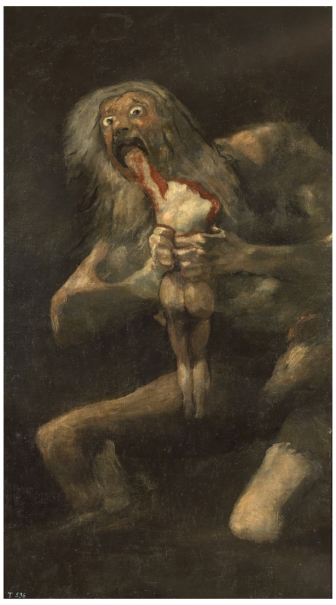
The worst was Saturn Devouring His Son.
Goya stripped the classical god of every trace of dignity.
Saturn is not an elevated mythological figure. He is a naked, deranged animal with staring eyes, gripping the mutilated remains of his own child.
The darkness around him does not behave like a background.
It feels like the space from which he has emerged and into which he will soon disappear again.
The painting may originally have been located in a room traditionally identified as Goya’s dining room, although that is not certain.
The possibility was disturbing enough.
Goya may have eaten while this blood-covered creature watched him from the wall.
He could extinguish the candles, but that would merely leave Saturn waiting in the darkness.
I did not find the thought comforting.
I did not leave the room overwhelmed by artistic admiration.
I left it relieved.
No tip for Marta
Marta had begun by threatening us with death for taking photographs and ended by leaving us with a father eating his child.
Somewhere in between, she had defended investment-grade blue pigment, prosecuted an American selfie, undressed an emperor, insulted Velázquez’s horses and located Goya’s modernity in a remarkably specific patch of anatomy.
I did not give her a tip.
At the time, the decision felt entirely reasonable. My legs hurt, my head was full, and I had just escaped from a room that seemed to radiate negative energy.
The inconvenient verdict
Outside the museum, however, something inconvenient became clear.
Marta had succeeded.
I might forget several dates and attributions, but I would not forget her investment pitch for lapis lazuli, her declaration that Velázquez could not paint horses, her attack on the American couple or the delight with which she defended Goya’s artistic courage.
More importantly, she had made me argue with the paintings.
She showed me where to stand before Tintoretto but left me free to decide what I saw.
She insisted that Velázquez’s canvas contained an unknowable secret, while I became convinced that he was painting us inside some parallel room trapped behind its surface.
She saw the birth of modernity in the Nude Maja’s anatomy.
I saw it in the fact that the woman looked back.
A forgettable guide delivers information.
Marta provoked resistance.
That may have been more valuable.
When I left, I passed Velázquez and Goya once again.
Velázquez now seemed to be watching the people entering, ready to pull them into one of his impossible rooms.
Goya looked as though he already knew what Marta had chosen for the ending.
After the darkness of his final gallery, stepping back onto the streets of Madrid felt almost like returning among the living.
