
 Helsinki, Uusimaa, Finland
One winter evening, one quiet morning and a ferry waiting at the end
Helsinki was never meant to be the main event. The journey had already taken me north to Lapland and then south to Tampere for an Erasmus programme, while Tallinn was waiting across the Gulf of Finland before the final return home. Helsinki entered the itinerary almost as a matter of principle: since we were already travelling through Finland, it seemed absurd not to spend at least one night in its capital.
It should have been a convenient stop between two longer stories. Instead, it became a compact first encounter with a city of white surfaces, green trams and subdued light. One evening and one morning were not enough to understand Helsinki, but they were enough to leave me wanting to return.

A train, two languages and one inexhaustible priest
We travelled from Tampere by train on 23 January 2026. It is not a particularly long journey, but our carriage contained a retired Finnish priest capable of filling every available minute. She spoke flawless English, had travelled extensively and had spent much of her life moving around the world through various religious assignments. Her stories ranged from distant countries to sacred traditions and distinctly Finnish approaches to faith, all connected by an impressive ability to continue without requiring much encouragement from either of us.
She was intelligent, cosmopolitan and genuinely interesting, but apparently lacked the internal mechanism that tells most people when a conversation has reached its natural conclusion. By the time we arrived in Helsinki, my colleague and I had received a concentrated course in international theology and were becoming increasingly attracted to Finland’s reputation for silence.
The train itself had seemed unusually substantial to me, somehow broader and heavier than those I was used to elsewhere in Europe. Finland uses a railway gauge of 1,524 millimetres, almost nine centimetres wider than the standard gauge found across most of the continent. That does not automatically make the carriages larger, but it suggested that my impression had not been entirely imaginary.
Something else caught me even more unprepared: Swedish. Before travelling to Finland, I had no idea that it was spoken there at all, let alone that it was one of the country’s two national languages. At stations and on public signs, names repeatedly appeared in both languages, including the capital itself: Helsinki and Helsingfors. It was one of those small discoveries that exposes how little you know about a country you thought you understood reasonably well.
Hotel U14 was within walking distance of the railway station, but “walking distance” becomes a flexible concept when there is snow underfoot, luggage in your hands and January air cutting through your clothes. An Uber seemed more intelligent than proving we could drag suitcases across central Helsinki.
The hotel I owed a visit
Hotel U14 had been waiting for me longer than most hotels reasonably should. I had booked it in 2020, when I was first supposed to travel to Finland for Erasmus, but the pandemic cancelled the journey. The hotel released the reservation without complications or financial games, and I remembered the gesture.
Booking it again six years later therefore felt less like choosing accommodation and more like settling a small personal debt. I had vaguely promised myself that if the postponed journey ever happened, I would finally stay there.
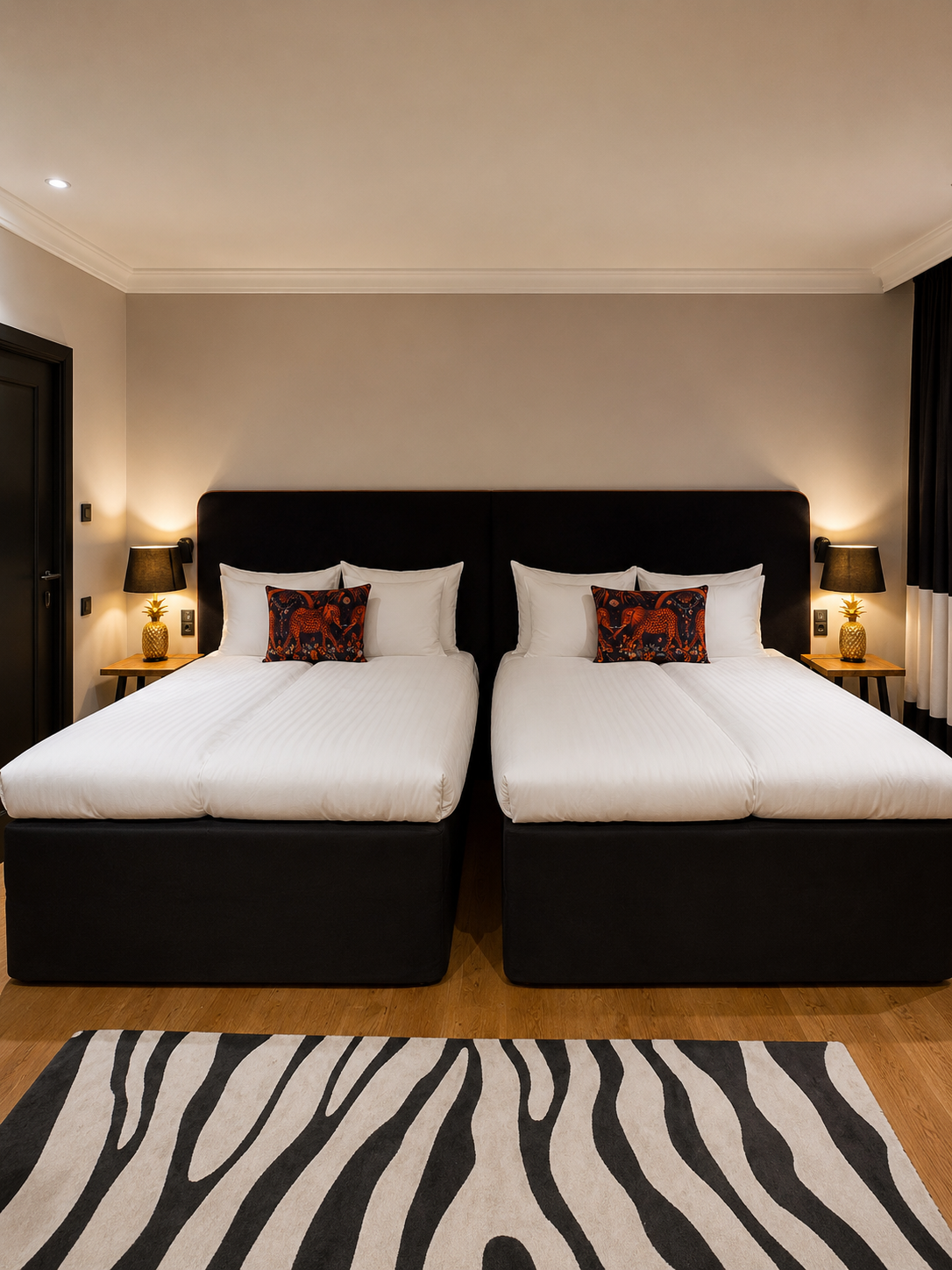
U14 is an upscale boutique hotel that opened in 2020, practically at the moment when international travel collapsed. With contemporary Finnish interiors and a more individual character than a conventional business hotel, it belonged to a noticeably more luxurious category than the practical Courtyard where we had stayed in Tampere. The upgrade was appreciated, the room was comfortable and the late check-out would prove particularly useful the following day.

The feature that fascinated me most was outside the room. The hotel’s spiral staircase curved through the building like an architectural sculpture, changing character with every floor and angle. I photographed it that evening and again the following morning, when the different light transformed the same geometry.

We did not remain in the hotel for long. The evening plan was modest: walk to the cathedral, see the centre after dark and then find dinner. After several days in Lapland and Tampere, the final point had become at least as important as the first two.
From one priest to another kind of religion
Helsinki Cathedral was only a short walk away. After spending much of the train journey listening to an internationally travelled priest, it was fitting that the first major sight awaiting us in the capital was another religious institution. The difference was that the cathedral, mercifully, remained silent.
The great white building dominating central Helsinki is the city’s Lutheran cathedral, designed by Carl Ludvig Engel and completed in the nineteenth century. It was originally dedicated to Saint Nicholas, a reminder that Finland was then an autonomous grand duchy within the Russian Empire.
The cathedral rises above Senate Square, the neoclassical centre Engel created for the new capital. Government, university and church were arranged around one monumental space intended to represent political, intellectual and religious authority. That explains why the square can feel almost scenographic: it was designed to impress, not to look accidental.

The streets were covered in snow, the air was sharp and the city seemed to have lowered its own volume. Snow naturally softens sound, but Helsinki also appeared unusually respectful of quiet. People passed without crowding one another, trams moved through the centre without destroying the stillness and even the traffic seemed reluctant to raise its voice.
That silence gave the evening an additional layer of mystery. The cathedral’s white façade glowed against the dark sky, floating above the broad steps and almost empty square. Helsinki did not try to impress us through movement, crowds or excess. The quiet made the darkness deeper, the snow brighter and the cathedral less like a functioning church than an apparition.
Anything but another reindeer
By then, my colleague and I had eaten enough reindeer. It had not ended with Lapland; the animal had followed us to Tampere as well. Reindeer had been appropriate, interesting and culturally correct, but it had fulfilled its obligations. We were ready for something that had never pulled Santa Claus through the sky.
Farouge, a Lebanese restaurant almost directly opposite the hotel, solved the problem without requiring serious research. I ordered baba ghanoush, warak inab—vine leaves stuffed with rice—and a lamb skewer whose precise menu name I no longer remember. The relevant zoological information was clear enough: it was lamb.
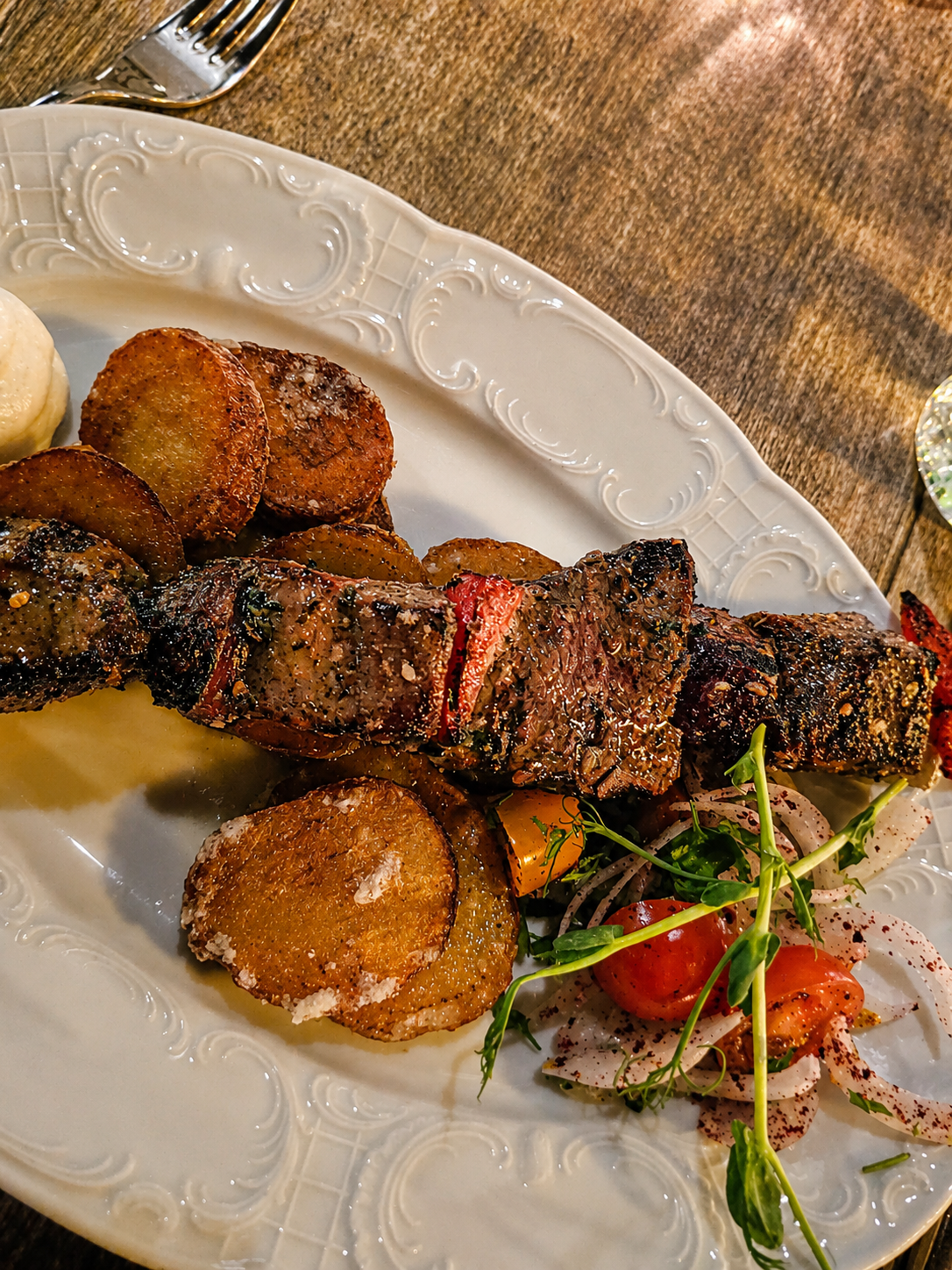
The food was excellent, the Lebanese waitresses were exceptionally kind and the warm dining room felt particularly inviting after the cold. The herbs, spices, grilled meat and smoky aubergine were a complete departure from the flavours of the previous days, which was exactly what we needed.
Partway through dinner, a belly dancer appeared. Farouge had apparently decided that serving superb Lebanese food opposite our hotel did not provide sufficient entertainment on its own. After the train journey, the concentrated theology, the cold and the unexpected choreography, we returned to U14 and went straight to bed.
A morning guided by photographs
The following morning began with breakfast at the hotel. It was generous and polished, exactly what one would expect from an upscale boutique property of that category, although not one of those hotel breakfasts that later becomes part of the mythology of a journey.
My colleague stayed at the hotel while I went out alone. The itinerary was not based on a dutiful list of Helsinki’s most important monuments. I had selected places largely because I wanted to photograph them: an unusual memorial, the Sibelius Monument, a red cottage, a street of colourful houses, the railway station and a contemporary wooden chapel. I was not trying to process Helsinki systematically; I was following whatever seemed visually worth the detour.
A few minutes from the hotel, I crossed Kasarmitori, or Barracks Square, named after the former Guard’s Barracks complex on one side of it. In the middle stood the National Memorial to the Winter War, a silver-coloured figure pierced by openings yet still upright.

The sculpture, unveiled in 2017, represents Finland surviving the Winter War of 1939–1940. I did not know that while standing there. At the time, it was simply a striking metallic figure against a wide field of snow, and that was reason enough to photograph it.
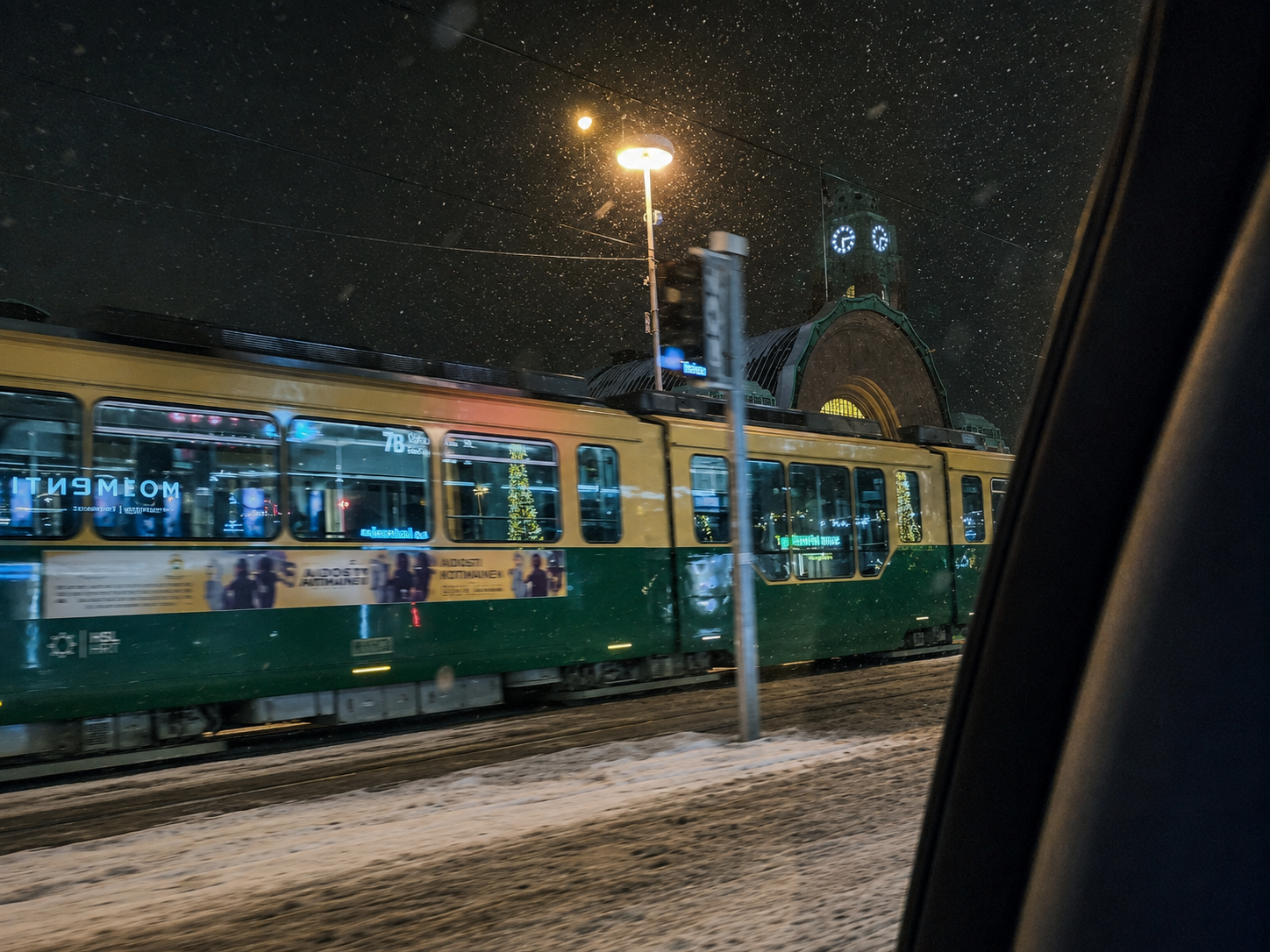
The trams became another recurring visual pleasure. Helsinki uses modern vehicles as well as older green-and-yellow models that appear to belong to a slightly different urban era. Against pale streets and grey skies, their green looked almost extravagant. They suited the city: practical, slightly old-fashioned and distinctive without making much fuss about themselves.
The monument I brought home
The Sibelius Monument was the main destination of the morning. I was not conducting a pilgrimage through the life of Finland’s most famous composer; I had seen photographs of the structure and wanted to experience it primarily as an object.
Created by Eila Hiltunen and unveiled in 1967, the monument consists of more than six hundred welded steel pipes arranged into an enormous abstract composition. It is often compared with an organ, although its real power comes from something less literal: the attempt to translate music, rhythm and the Finnish landscape into metal.
Under the snow, it was magnificent.

I moved around it repeatedly, photographing the pipes from below, from the side and through the surrounding trees. Their surfaces shifted between silver, grey and black, while the openings framed fragments of the winter sky. Snow softened the rocks and park beneath it, but the monument remained hard, metallic and slightly alien.
Its form changed with every few steps, rewarding movement rather than one dutiful photograph before departure. One of the images I took that morning now hangs on the wall outside my office, where I see it almost every working day.
A red cottage and the architecture I misnamed
A short distance away stood Café Regatta, another place that had entered the itinerary through travel blogs. The recommendation was essentially photographic: a tiny red cottage beside the water that looked especially charming in winter.
The building dates from 1887 and originally served as a storage shed for fishing nets belonging to the Paulig family, later famous for coffee. Its dark red walls and snow-covered setting created the impression of a piece of rural Finland accidentally left in the capital.

I did not go inside or manufacture an authentic Finnish moment around coffee and a cinnamon bun. I photographed the house against the surrounding whiteness and moved on. Sometimes a place is a scene rather than an experience, and there is no reason to burden it with more significance.
An Uber then took me to Huvilakatu, a street lined with colourful houses built mainly in the first decade of the twentieth century. The pink, yellow, green and blue façades formed an unusually soft sequence against the grey sky and snow-covered road.

The street remained primarily a photographic backdrop, but it sharpened something I had begun noticing throughout the morning. I had instinctively classified many of Helsinki’s rounded corners, geometric decorations and disciplined façades as Art Deco. Huvilakatu made it obvious that the picture was more complicated, because the street is primarily Finnish Jugend, the local version of Art Nouveau.
Elsewhere, Helsinki mixed that style with Nordic Classicism, genuine Art Deco and early Functionalism, often within a surprisingly small area. I may not have identified every façade correctly while walking, but I was responding to the coherence of the whole. The buildings could be colourful and decorative without becoming excessive.
Granite, lanterns and a wooden bowl
From Huvilakatu, I returned towards the centre by tram. Helsinki Central Station was another deliberate photographic stop. Designed by Eliel Saarinen and opened in 1919, it is one of the city’s defining buildings, with a massive granite façade, a clock tower and four monumental stone figures holding spherical lanterns.

In the winter light, the station appeared severe but not unwelcoming, while a passing green tram provided exactly the contrast I had hoped to catch. By then, the double names no longer felt like a minor curiosity printed on signs. Helsinki and Helsingfors had begun to suggest two versions of the same city: one immediately visible, the other pointing towards a Swedish-speaking history I had arrived without knowing existed.
Nearby stood the Kamppi Chapel of Silence, completed in 2012. Its curved wooden exterior resembles an enormous bowl or vessel unexpectedly placed in the middle of a busy commercial district. It was designed as a place where anyone could briefly escape the noise of the city.

I did not go inside. The reviews I had read were not enthusiastic enough to persuade me that entering would add much, and Helsinki had already supplied plenty of silence outside. The smooth wooden form was what had brought me there in the first place.
A dragon and two average cakes
From Kamppi, I continued to Hotel St. George. I was curious about it because it occupies a historic building and presents itself almost as an art collection with bedrooms attached. Its entrance is dominated by Ai Weiwei’s Tianwu, an enormous white dragon made from bamboo and silk, suspended above the lobby. It was difficult not to admire a hotel that introduced itself by hanging a mythical creature over the guests instead of relying on another tasteful flower arrangement.
The hotel also contains St. George Bakery, which turned architectural curiosity into a pastry stop. I ordered a Runeberg torte because I had seen it repeatedly in Tampere and assumed that anything appearing so consistently must carry some national importance.


The small cylindrical cake is named after Johan Ludvig Runeberg, Finland’s national poet. Traditionally eaten around his birthday on 5 February, it contains almonds and breadcrumbs, is usually flavoured with rum or arrack, and is topped with raspberry jam and a ring of white icing. Its cultural history proved more exciting than its taste.
The second choice was a laskiaispulla, a cardamom bun filled with whipped cream and raspberry jam, selected for the less intellectual reason that it looked good. Both cakes were pleasant enough, but neither came close to gastronomic revelation.
White on white
After the bakery, I walked back through the centre towards Senate Square. The previous evening, the cathedral had appeared illuminated against the dark sky, so I wanted to see what daylight would do to it.
The transformation was complete. At night, the building had floated above the square like a stage set; by day, its white walls merged with the snow covering the steps and surrounding space. The cathedral, statues and ground belonged to the same pale composition, separated only by softened shadows.

That daytime image remained with me more strongly than anything else in Helsinki. Not the Sibelius Monument, even though one of its photographs now hangs outside my office, and not Café Regatta or the colourful houses of Huvilakatu. What I remember first is the cathedral surrounded by snow, an almost excessive amount of whiteness that somehow made the scene feel composed rather than empty.
The square had been designed to represent power and authority, but winter had softened its ceremony. Government, university and church still surrounded it; the snow reduced them to architecture, light and silence.
Before returning to the hotel, I stopped at a supermarket and bought Finnish sweets as gifts. This proved to be a more reliable use of sugar than the two cakes. Back at U14, the late check-out allowed me to rest before departure instead of dragging luggage through the snow for several unnecessary hours. There is little dignity in exhausting yourself simply because tourists are expected to remain in constant motion.
The ferry waiting at the end
In the afternoon, my colleague and I took an Uber to the ferry terminal. The next stage—the ship, the crossing and our arrival in Estonia—belongs to the Tallinn story.

Helsinki ended after less than a full day, assembled from a journey postponed for six years, a cathedral seen in two different lights, Lebanese food, a globally travelled priest with unlimited conversational stamina and a solitary photographic route through deep snow.
Helsinki had entered the itinerary as a stop between larger stories. Somewhere between the green trams, the white cathedral and the snow-muted silence, it quietly became one of its own.
