
 Stonehaven, Scotland, United Kingdom
A £3.85 bus from Aberdeen, a castle seen from the outside and an easy coastal walk to Stonehaven
There are places I visit because I want to understand them, and places I visit because I want one photograph good enough to justify the journey.
Dunnottar Castle belonged firmly to the second category.
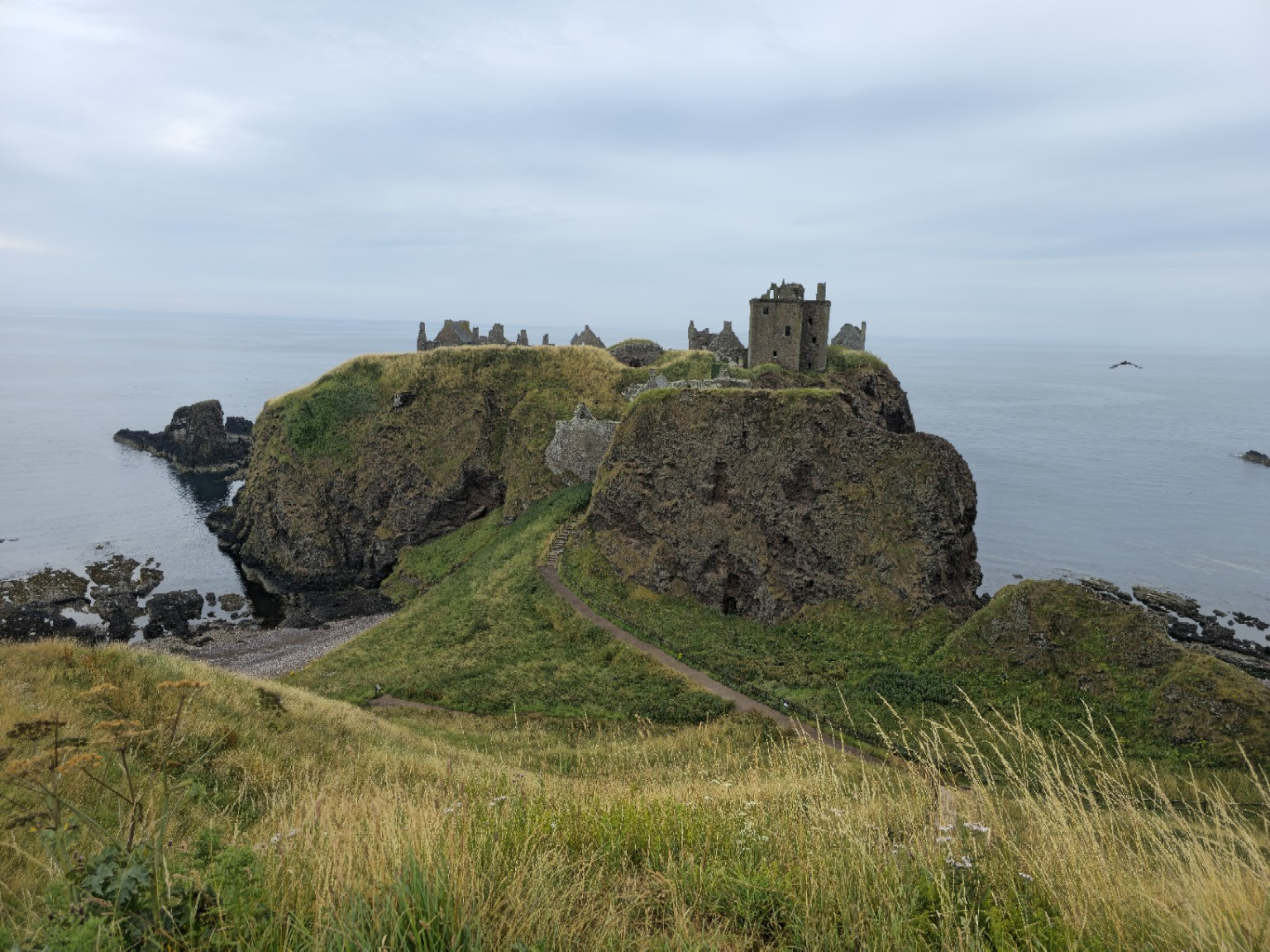
I had known about it for years. It appears with suspicious regularity on lists of Scotland’s most dramatic sights, usually photographed from exactly the angle that explains why. A ruined fortress occupies an isolated slab of rock above the North Sea, surrounded by cliffs and connected to the mainland by a narrow strip of land.
Subtle it is not.
My objective was refreshingly simple: get there and find the strongest viewpoints.
For once, the plan worked.
Aberdeen to Dunnottar, Almost Too Easily
Getting from Aberdeen to Dunnottar proved almost offensively easy.
I booked an Ember coach online for £3.85, boarded on Union Street at 08:05 and stepped off at the Dunnottar Castle stop at 08:43. Ember’s comfortable electric coaches, online booking and live vehicle tracking have made it one of the most useful transport discoveries of this trip.
The walk from the stop was short and pleasant, mostly along a quiet road. There was no heroic trek, no elaborate navigation and no need to hire a car merely to abandon it in a car park.
A few minutes later, Dunnottar appeared.
It did not require a carefully selected angle or an imaginative photographer to become impressive. From the first unobstructed view, the castle looked exactly as dramatic as advertised.
That is rarer than travel writing would have us believe.
The Castle I Chose Not to Enter
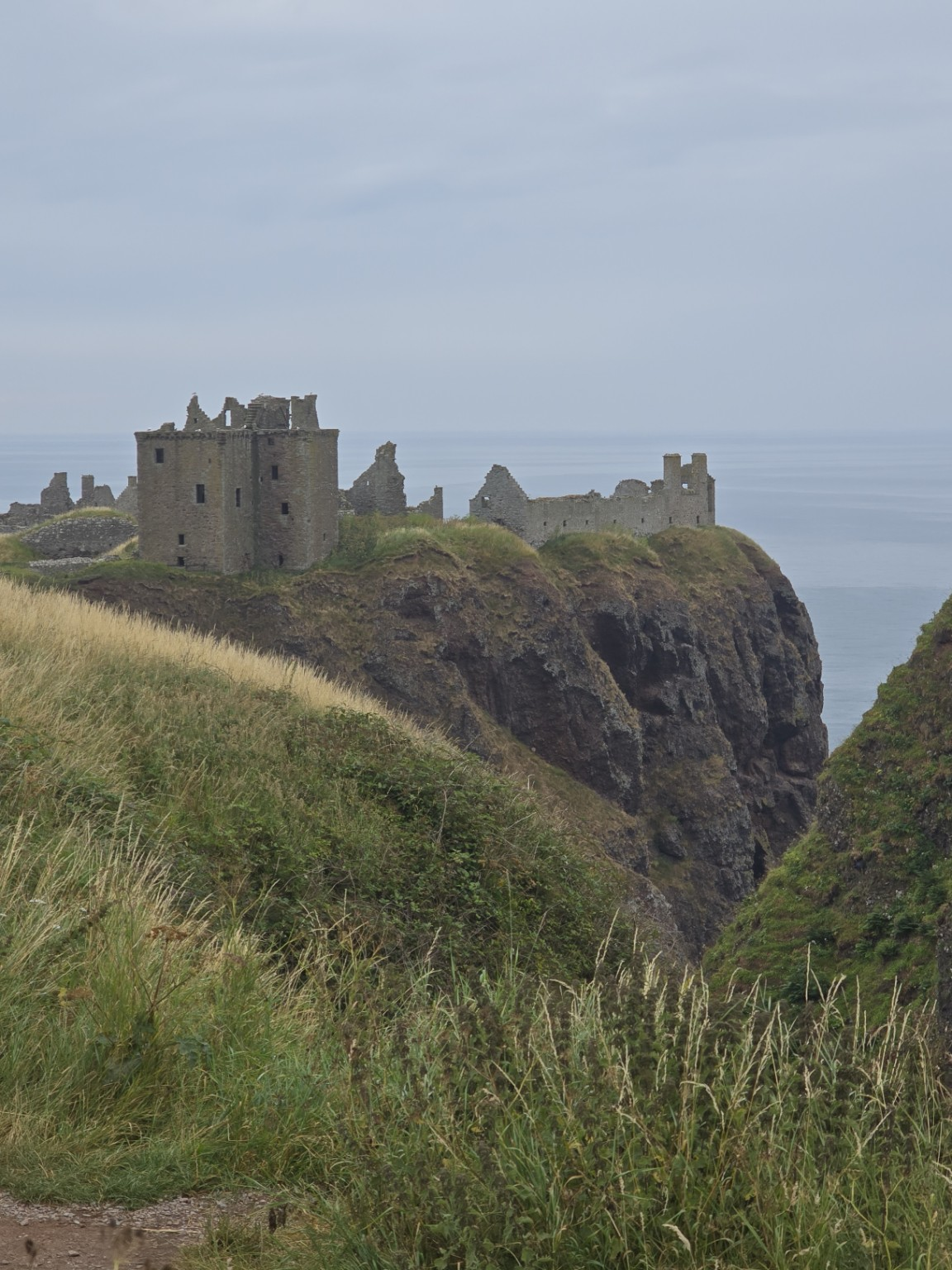
I decided almost immediately that I would remain outside.
This was not caused by a lack of time, an objection to the ticket price or some sudden philosophical rebellion against admission booths. I have simply visited enough ruins to know that their most spectacular feature is often the relationship between the building and its landscape.
From outside, Dunnottar is a fortress suspended between rock, grass and sea. Inside, there was a reasonable danger that it would become another collection of roofless rooms requiring explanatory signs to identify where people once ate.
I had come for the castle on the rock, not for a closer inspection of the rocks inside the castle.
The geography had, of course, been arranged for defence rather than photographers. In the 1650s, Dunnottar helped protect the Honours of Scotland—the Scottish crown jewels—from Cromwell’s army. From the cliff above, it was easy to understand why: the sea defended three sides, while the remaining approach was narrow enough to make any attack thoroughly unpleasant.
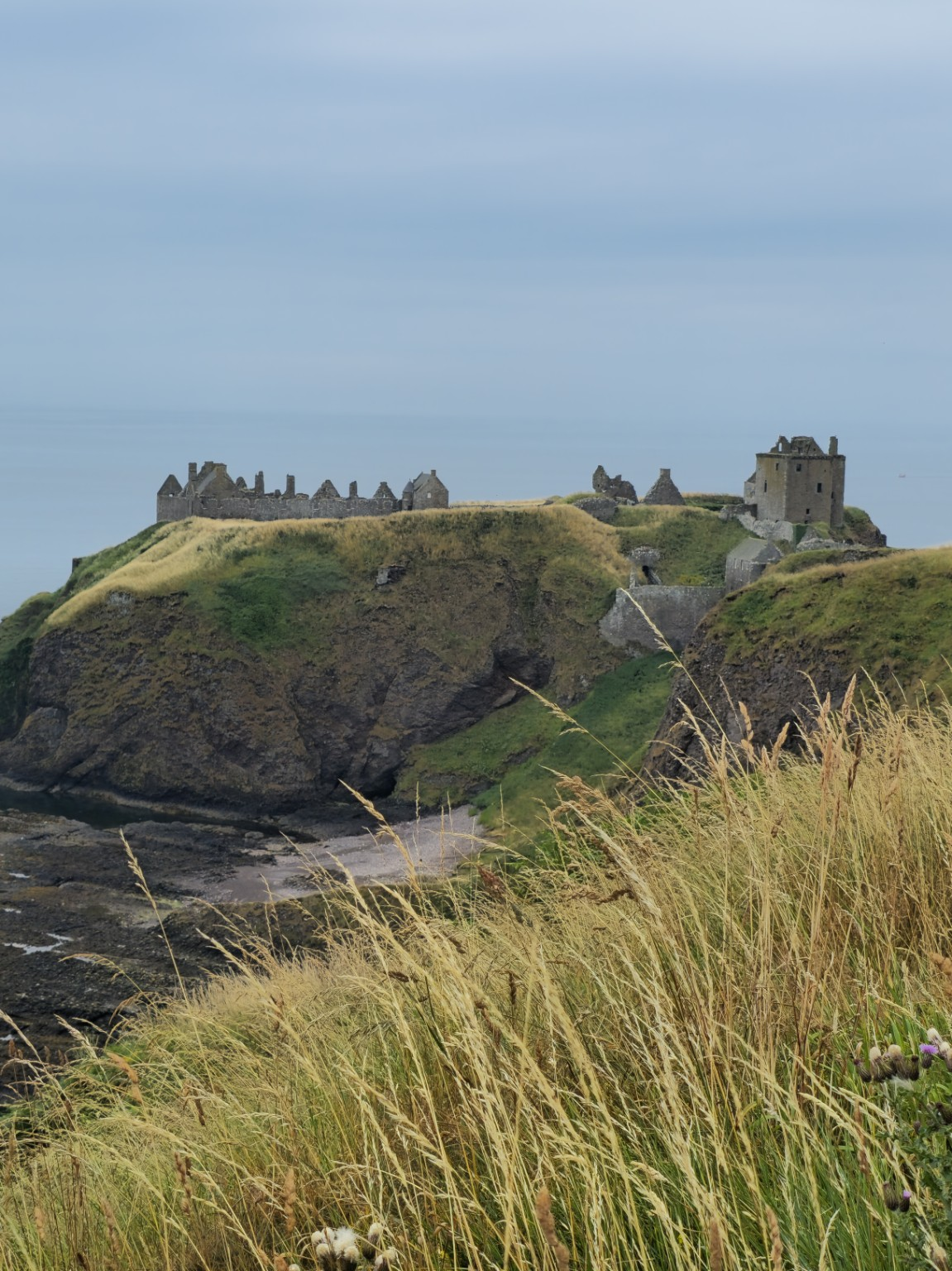
I wandered between viewpoints without following much of a system. Some photographers arrive with lens calculations, light forecasts and firm opinions concerning the golden hour. I mostly moved whenever another patch of grass appeared likely to produce a cleaner foreground.
The flat grey sky was hardly glamorous, but it suited the castle. Bright sunlight might have made the scene prettier; the low clouds made it Scottish.
The fortress worked both as the dominant subject and as a smaller element in the wider coastline: isolated above the water, framed by grass, or positioned at the end of the path leading towards it.
I had obtained what I came for.
The rest of the morning could easily have been an epilogue. Instead, it became half the story.
Walking Away from the Main Attraction
The usual version of this walk begins in Stonehaven and builds towards Dunnottar. I did it in reverse, leaving the castle behind and continuing north along the coast.
It was the right decision.
Rather than spending the walk anticipating one famous object, I began with the expected climax and watched the landscape gradually take over. Dunnottar became smaller behind the grass, the coastline opened ahead, and the excursion stopped being merely a castle visit.
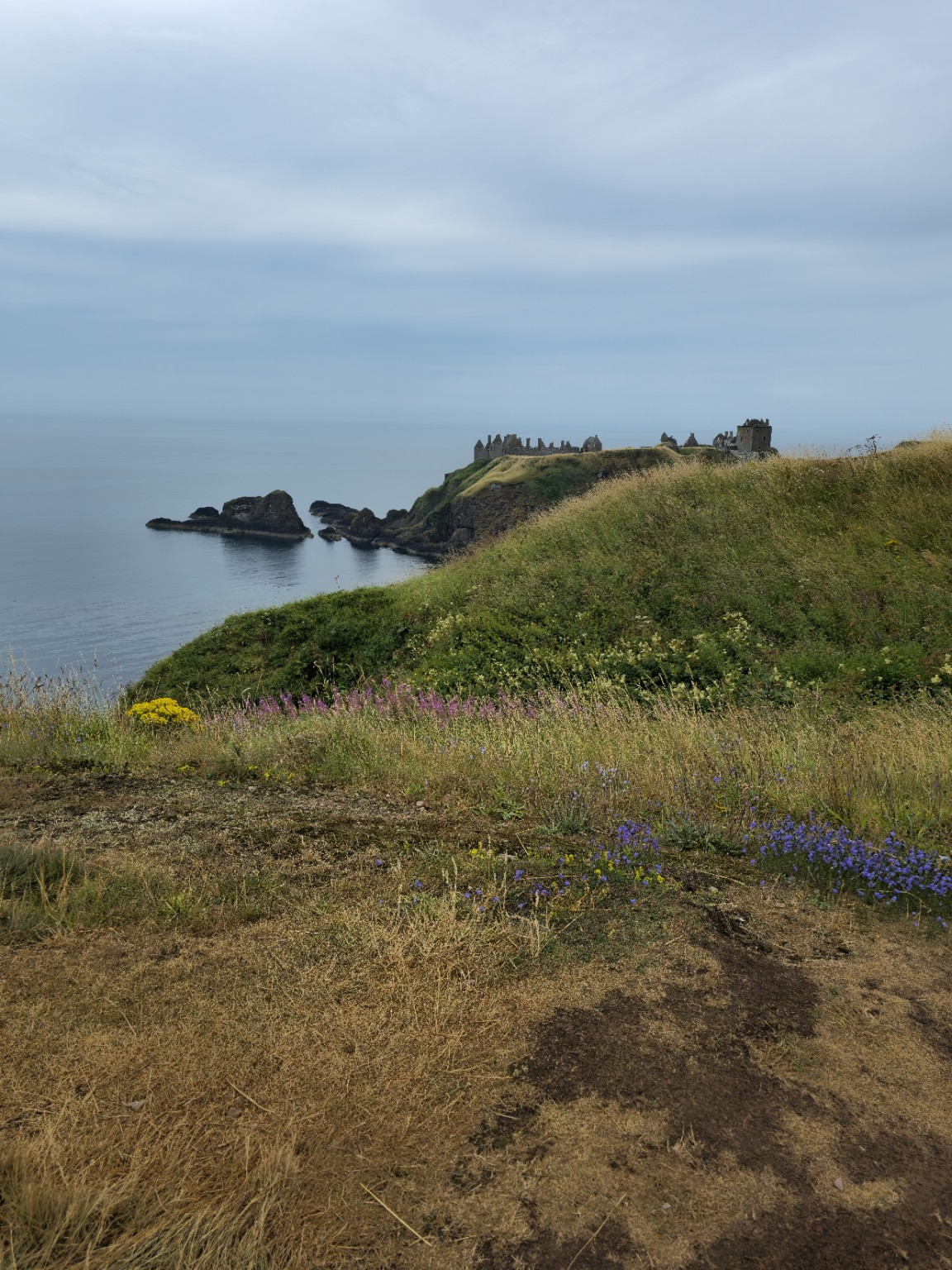
The route was considerably easier than its clifftop setting might suggest. There were gentle inclines, good stretches of path and no moment when I questioned my judgement. The later climb through Stonehaven towards the railway station was more tiring than the coastal section itself.
Even better, everybody I passed greeted me.
Not with the exhausted politeness of people forced to share a narrow trail with tourists, but with the casual recognition normally reserved for someone who walks there every Sunday. For several minutes, I apparently became a local resident who had misplaced his dog.
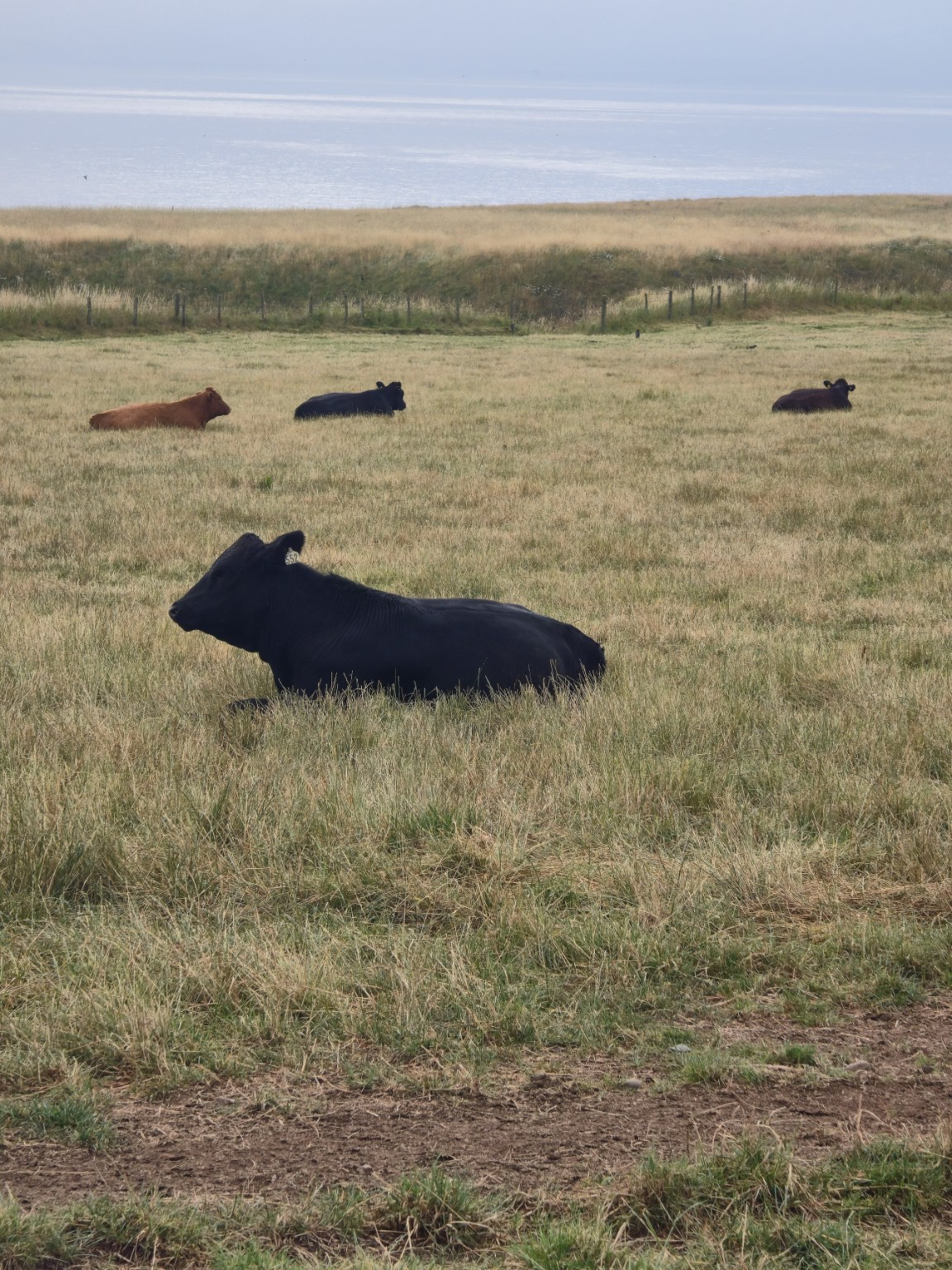
The cattle scattered across the fields strengthened that illusion. Nothing had been arranged for visitors. There were no theatrical Highland cows posing beside a souvenir shop, just ordinary animals lying in the grass while the North Sea continued behind them.
The Ruined Temple on Black Hill
The walk’s second major visual moment was not another castle.
Stonehaven War Memorial appeared ahead on Black Hill, standing alone above the coast like the remains of a small classical temple. From a distance, it could easily be mistaken for something ancient. It is, in fact, a twentieth-century structure deliberately designed to resemble a ruined Greek temple.
Local architect John Ellis was commissioned in 1921, and the memorial was unveiled in 1923. It commemorates those killed in both world wars; First World War battle names are carved around the upper structure, while later inscriptions were added around its base.
Its form is unusually effective. It is neither a conventional statue nor a polished monument pretending that war can be made visually tidy. The incomplete ring of stone columns looks exposed, damaged and unfinished.
On that empty hill under a heavy sky, it was brutally photogenic.
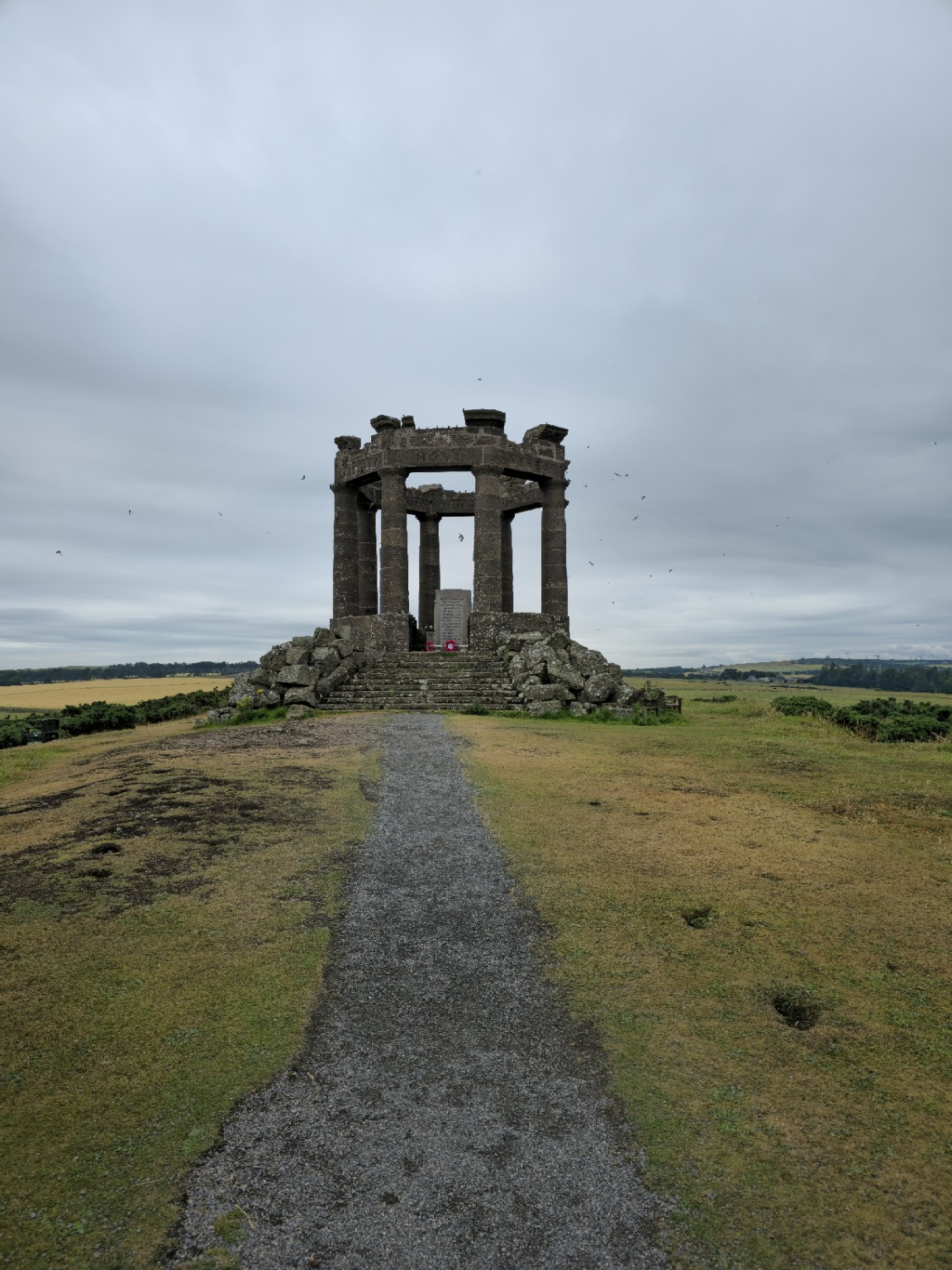
The strongest composition practically arranged itself: a dark path running directly towards the memorial, the structure framed against the grey horizon and almost nothing else competing for attention.
Dunnottar had been the planned photograph. The War Memorial was the unexpected one.
Stonehaven Makes Its Entrance
Soon afterwards, the path reached the edge of the hill and Stonehaven appeared below.
That was the moment when the town began stealing the day.
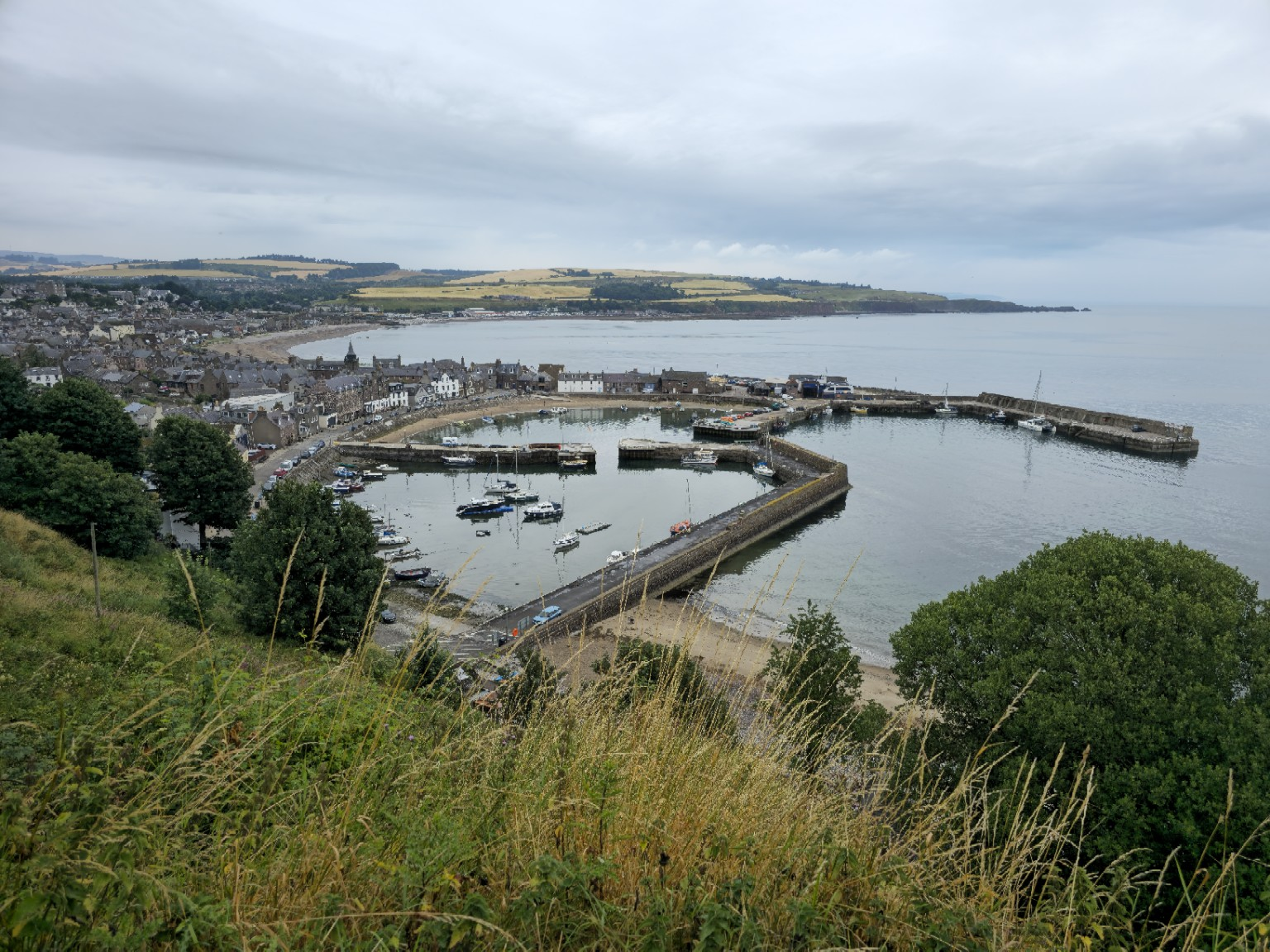
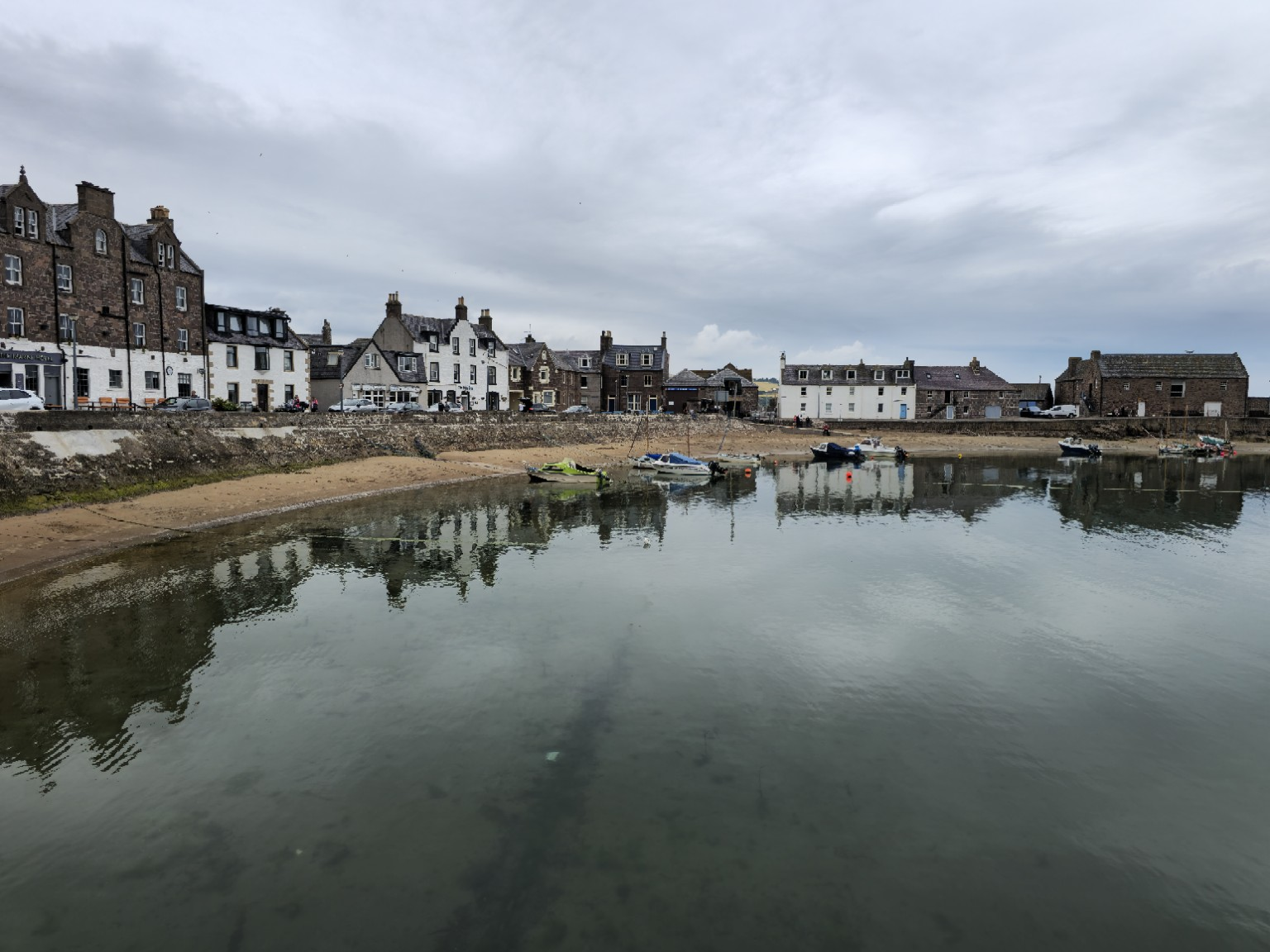
Stonehaven’s impact was primarily visual: a compact settlement wrapped around the water, its harbour enclosed by stone walls and the surrounding green slopes holding everything together. After the exposed cliffs, it looked almost improbably sheltered.
I had expected a convenient place with a railway station. I had not expected the approach to be nearly as memorable as the castle I had travelled to photograph.
Descending into town revealed something increasingly rare in famously scenic destinations: Stonehaven still felt local. Boats rested on the exposed harbour floor, rows of houses followed the curve of the water, and nothing around them appeared particularly interested in performing for visitors.
It was picturesque without behaving like a stage set. The streets had not been reduced to souvenir shops, and the harbour did not seem to exist solely as a background for other people’s photographs.
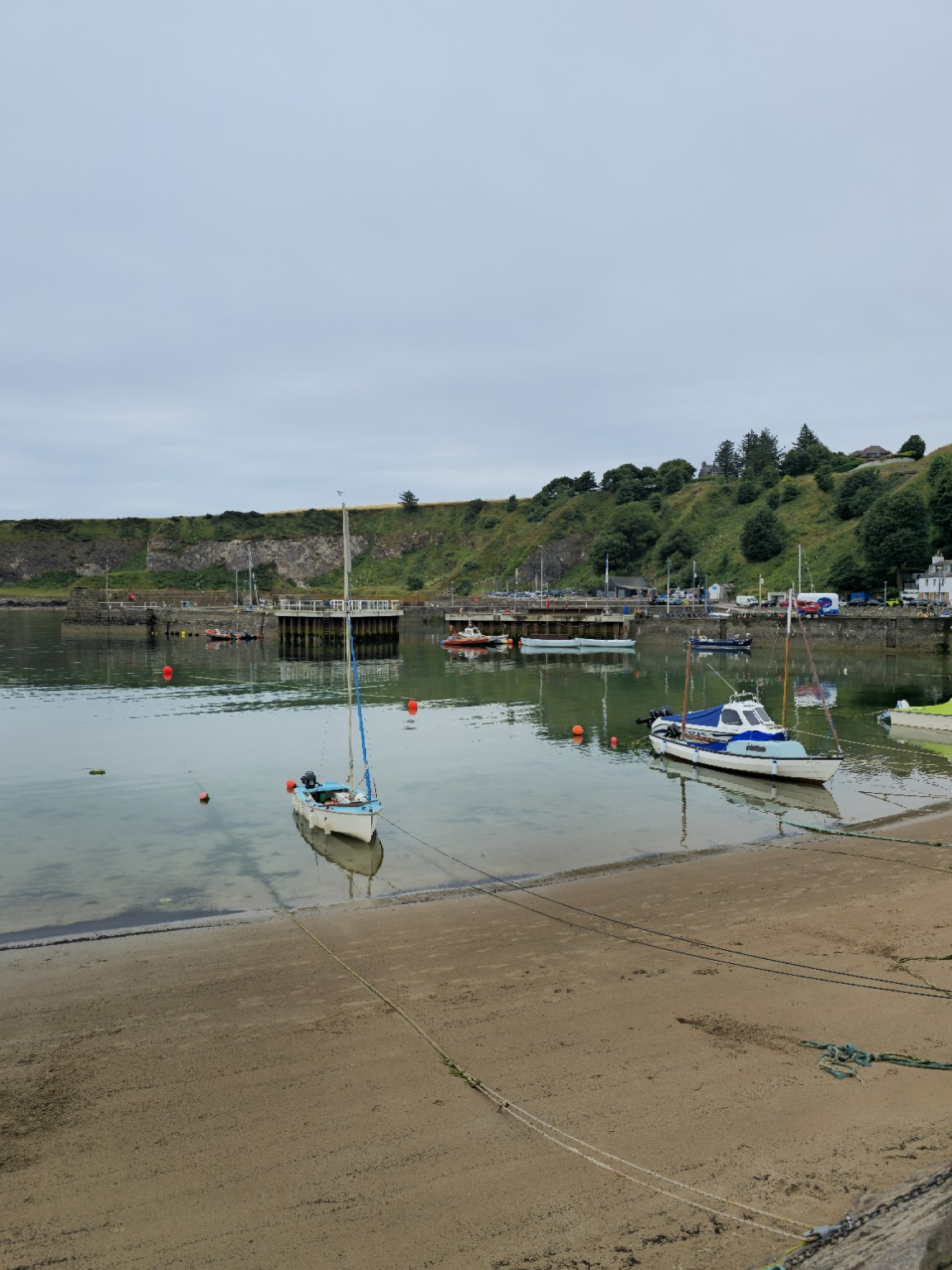
The harbour has considerably more substance than its appearance as a pleasant marina might suggest. A harbour existed here before 1607, although storms destroyed several early versions. The successful nineteenth-century reconstruction followed a plan drawn up by engineer Robert Stevenson in 1825.
That history helps explain why it feels integral to Stonehaven rather than added as decoration. The town developed around the water; the harbour is not merely something viewed from a café terrace.
I walked beside it and through the parts of town lying naturally on my route towards the station. I did not conduct an exhaustive survey, visit every historic building or manufacture a profound cultural encounter over lunch.
I did not even stop for tea.
That is the one change I would make. Not because the morning needed another attraction, but because Stonehaven deserved a slower departure.
From my first photograph near Dunnottar to the harbour, only about fifty minutes had passed, including several stops to find better compositions. The route was short, easy and disproportionately rewarding.
Aberdeen Had Other Plans
A 22-minute train ride returned me to Aberdeen with enough time to continue sightseeing.
I took a taxi to King’s College, still operating under the dangerous belief that every available hour must be filled simply because the map contains additional labels. The rain began almost immediately.
I considered persevering. Then I remembered that being wet near an attraction does not constitute a deeper cultural experience.
I boarded the first bus back to the Residence Inn.
My Marriott status had placed me on the sixth and top floor, with a view across Aberdeen’s dense granite rooftops towards the Town House clock tower and the working harbour beyond. I had already photographed it the previous evening, when the harbour lights were beginning to appear beneath a suitably threatening sky.
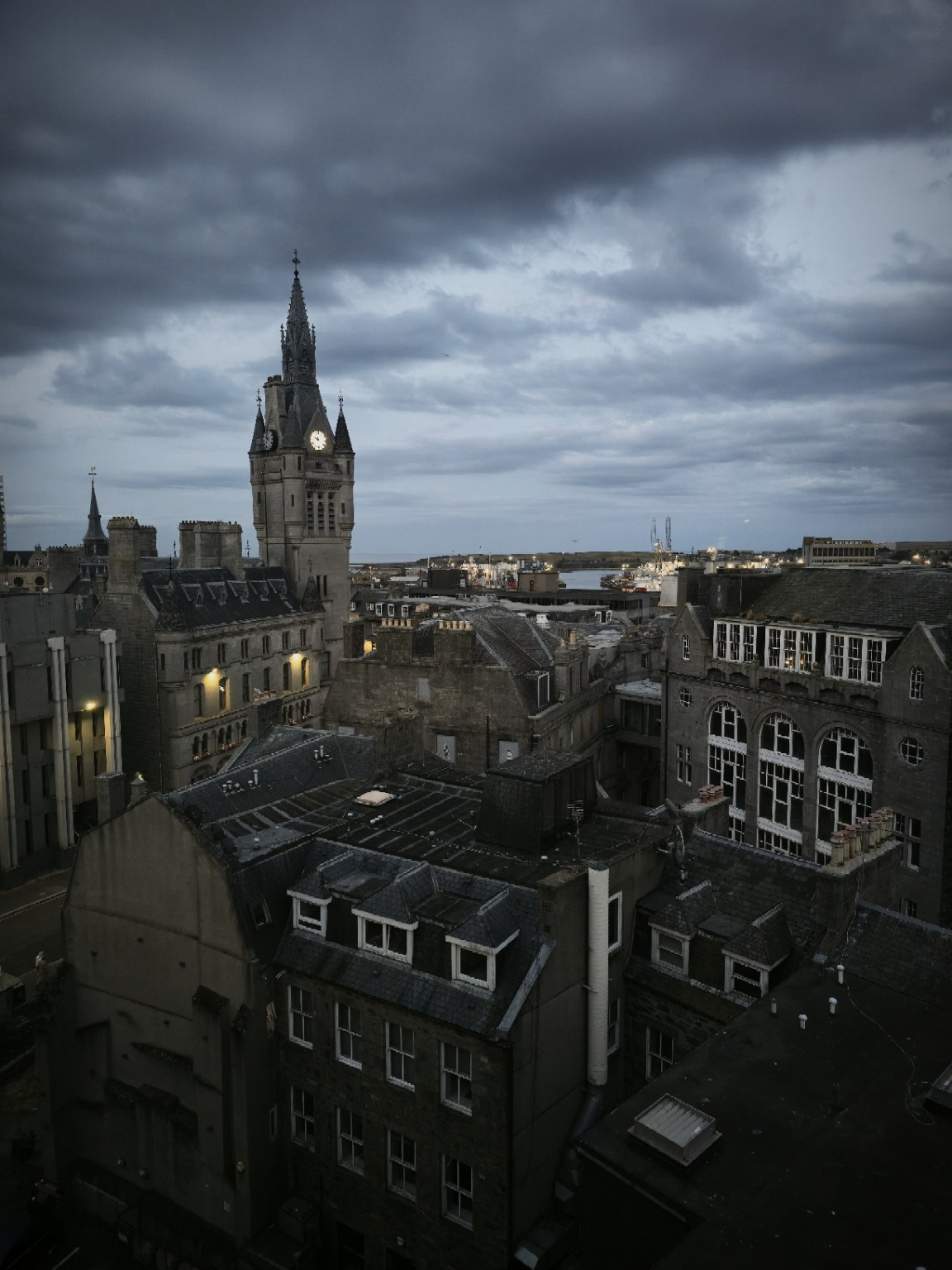
Returning to the same view after the rain cancelled King’s College hardly felt like defeat. Dunnottar had delivered the photographs I wanted, the walk had produced a memorial I had not expected, and Stonehaven had come dangerously close to becoming the real highlight.
Aberdeen had simply arranged the final scene one evening early.
Marriott rules.
How to Do the Same Trip
Outbound transport: I booked an Ember coach from Aberdeen’s Union Street to the Dunnottar Castle stop. My journey left at 08:05, arrived at 08:43 and cost £3.85. I displayed the ticket to the driver on my phone.
Direction: Starting at Dunnottar and walking towards Stonehaven worked particularly well. You begin with the castle, follow the coast and finish beside cafés, the harbour and a railway station rather than having to retrace your steps.
Walking time: My first photograph near Dunnottar was taken at 08:46, and I reached Stonehaven Harbour at approximately 09:37. That means about fifty minutes at a comfortable pace, including several photography stops.
Difficulty: Easy. The coastal section is gently undulating rather than strenuous. The climb from Stonehaven towards the railway station was the most tiring part.
Castle admission: Dunnottar can be visited inside, but I deliberately remained outside because my objective was photography. Tickets are available online or at the entrance, and severe weather can affect opening.
Return: Direct trains from Stonehaven reach Aberdeen in around 22 minutes, making the return considerably faster than the outbound coach and avoiding any need to repeat the coastal walk.
What I would change: Almost nothing. I would merely leave enough time for tea beside Stonehaven Harbour before climbing to the station.

Comments