 Albufeira, Faro, Portugal
A conference in Seville was waiting. The Atlantic had other plans.
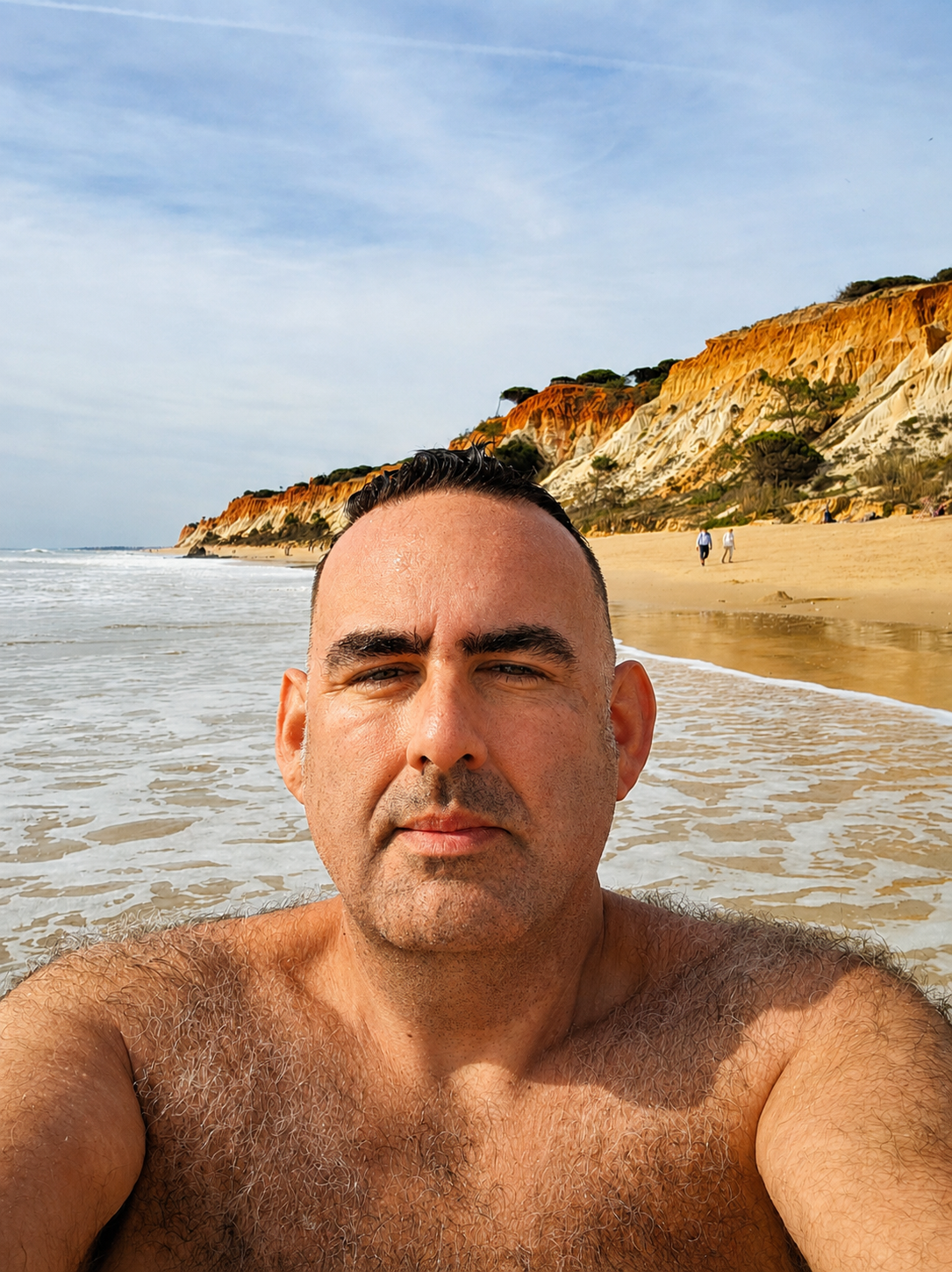
At eleven on a Sunday morning in November, I was swimming in the Atlantic.
Behind me, Praia da Falésia stretched beneath cliffs that looked as if someone had cut open the earth and exposed its colours: chalky white, ochre, rust and deep orange. A few people walked along the waterline. Two other swimmers were farther out. The sun was warm enough to make the calendar seem unreliable.
By four that afternoon, I had to leave for Seville and become a functioning academic again.
That was the problem.

A Portuguese detour from Seville
None of this had started as a carefully designed Algarve itinerary.
I was travelling to a conference in Seville. A direct flight left Trieste around six in the morning and landed shortly after nine, giving me a free weekend before the work began. Portugal appeared on the map not as my main destination, but as a tempting geographical accident.
The Algarve was only a little over two hours away by car.
So I collected a rental car at Seville Airport and drove west. The border passed without ceremony. Spain became Portugal somewhere between road signs, service stations and a subtle change of language.
Before checking into the hotel, I stopped in Faro.
That seemed logical. Faro is the capital of the Algarve, and I had expected a compact old town perched on some photogenic hill, perhaps with the Atlantic spread beneath it.
Instead, I found a city that felt low, quiet and strangely empty.

Faro was not ugly. Its old centre had white façades, cobbled streets and the heavy stone front of the cathedral. It simply offered the wrong kind of beauty for what I had imagined.
The city faces the Ria Formosa, a vast system of lagoons, marshes, channels and barrier islands. Its landscape is horizontal rather than dramatic. Faro does not tower above the open Atlantic because the open Atlantic is not really its immediate stage.
I understood that later.
At the time, I simply thought it was rather flat and rather dull, returned to the car and continued west.
The cheapest room with the most expensive view
Pine Cliffs Hotel, part of Marriott’s Luxury Collection, stands above Praia da Falésia near Albufeira.
I had booked the cheapest available room, without a view, for roughly €250. One night. A minor extravagance before several days of conference halls, presentations and professional conversations.
At reception, my Marriott Titanium status produced the kind of upgrade that briefly makes loyalty programmes seem less ridiculous. The basic room became one overlooking the gardens and the Atlantic. A bottle of Portuguese wine, Algarve-inspired sweets and a handwritten welcome note waited inside.


The room was comfortable rather than outrageously extravagant: terracotta floors, pale blue details, a large bed and a balcony.
Then I opened the balcony door.
The itinerary ended there.
Below me were umbrella pines, white resort buildings and carefully maintained gardens. Beyond them, the land suddenly dropped away. The Atlantic filled the horizon.
For one night, I felt indecently rich.
Not because the room was full of gold taps or theatrical luxury. It was not. The real privilege was spatial: the distance between my balcony and the ocean appeared almost to have disappeared.

Pine Cliffs is a large resort, yet in November it did not feel crowded. There were guests, open restaurants and people around the pools, but the frantic machinery of summer had slowed down.
The lawns were almost aggressively green. Bird-of-paradise flowers flashed orange between white buildings. The pines threw long shadows across the paths.
I had imagined driving around the Algarve that afternoon.
Within minutes, that plan felt idiotic.
Down to Praia da Falésia
A lift takes guests through most of the height between the resort and the beach. It does not deposit you directly on the sand. Wooden paths and steps complete the descent.
That final section matters.
A beach reached without effort is merely convenient. Praia da Falésia reveals itself in stages.
First comes the view from above: the long curve of the coast, the blue Atlantic and the orange wall of cliffs. Then the path drops between pines and exposed layers of earth. Finally, the beach opens below.

The Portuguese word falésia means cliff, and this beach has earned the name without subtlety.
These are not dark, vertical walls of rock. They are softer and more theatrical: layered deposits of sand and clay, coloured by minerals and carved into gullies by rain and erosion.
That softness explains both their beauty and their fragility. Water cuts grooves through the cliff face, sections crumble, and the fallen material helps replenish the sand below. The same process that slowly dismantles the cliffs also helps create the beach.
From a distance, they resemble permanent architecture.
Up close, they look temporary.

Praia da Falésia runs for kilometres along the coast between the Albufeira and Vilamoura areas. It is long enough for hotel guests, local walkers and occasional swimmers to disappear into the landscape rather than dominate it.
In summer, the same sand fills with parasols and bodies. In November, it was not deserted, but comfortably alive.
That distinction matters.
A completely empty beach can feel abandoned. This one felt available.
Lunch, white wine and the end of the itinerary
I stopped at the resort’s beach restaurant for lunch.
The food was perfectly good and almost certainly more expensive than it needed to be. There was also chilled white wine, bright sunshine and the Atlantic immediately beyond the terrace.
Under those circumstances, the price became less offensive.

I had originally imagined visiting another town or searching for another famous Algarve beach that afternoon.
The idea became increasingly absurd.
Why would I return to the car when I could walk barefoot beneath cliffs that changed colour every few hundred metres?
Solo travel sometimes exposes the difference between freedom and loneliness. In a large resort filled with couples and families, travelling alone might look like a deficiency.
It did not feel that way.
I did not need to negotiate how far to walk, where to stop or whether the beach had become boring. Nobody was waiting for me to finish photographing the same cliff from six slightly different angles.
I walked until distance stopped mattering.

The wet sand reflected the sky. Small waves dissolved into thin white lines. Vegetation clung to the eroded slopes with the stubbornness of plants that had received no sensible advice about where to grow.
Above the cliffs stood occasional umbrella pines, reduced by distance to dark silhouettes.
One of them would later frame the sunset.
Swimming in November
I did not swim that first afternoon.
The next morning, after breakfast, I went back to the beach. The air was fresh, but the sun was already warm. The ocean looked calm enough to remove the last excuse.
So I entered.
Atlantic water in November is supposed to sound heroic or unpleasant. This was neither.
The first few seconds demanded concentration. After that, it was simply water: cool, clear and entirely manageable. It felt warmer than the seasonal averages I had read before travelling, although that may have been the sun—or wishful thinking.
I did not step in merely to collect photographic evidence.
I swam.

There were a few other people in the water. Not many, but enough to prove that I was not conducting a private experiment in meteorological stupidity.
The strangest part was not the temperature.
It was the date.
Early November usually belongs to coats, wet pavements and the first complaints about winter. Here I was floating in the Atlantic beneath orange cliffs while my conference clothes waited in a wardrobe above me.
“Swimming in November” sounds like a slogan invented by a tourism board.
It felt better than that.
It felt like getting away with something.
A Bellini at sunset
Pine Cliffs understands the commercial value of a sunset.
The Mirador Champagne Bar occupies a terrace above the cliffs, facing the Atlantic. I ordered a Bellini and watched guests begin to turn their chairs towards the horizon.
For a few minutes, the entire resort faced west.


The drink arrived orange-gold against the falling sun. Conversations grew quieter as the light changed.
The solitary pine became a black silhouette. The sea moved from blue to silver, then orange. After the sun disappeared, the sky continued through softer yellows before erupting into red and purple.
So did the bill, presumably.
But some combinations resist rational judgement: an Atlantic sunset, a champagne bar and the pleasantly temporary illusion of being considerably wealthier than one really is.

Portugal, cooked slowly
I ate every meal inside the resort.
That would usually feel like a failure. Hotels can isolate travellers from local life with alarming efficiency, and “we never had to leave” is not always a compliment.
Here, the confinement was voluntary.
The beach, cliffs and gardens had already consumed the available hours. I did not want to interrupt them merely to prove that I had found a restaurant beyond the hotel gates.
At dinner, I ordered what the menu described as a traditional Portuguese lamb stew cooked for hours. It arrived in a thick, brick-coloured sauce with a generous pile of dark greens—most likely grelos, the slightly bitter shoots and leaves commonly served in Portuguese cooking.

The dish was rich, heavy and exactly right after a day beside the Atlantic.
It did not look delicate.
It tasted as though delicacy had never been the intention.
This was food built around patience: meat softened by long cooking, sauce reduced until it clung to everything, and bitter greens cutting through the richness.
After lunch above the beach, a Bellini at sunset and dinner inside the hotel, my one-night stay had become a controlled experiment in how efficiently a person could avoid leaving a resort without feeling trapped.
The result was conclusive.
One night that became almost two days
A standard one-night hotel stay can be brutally short. Check in during the afternoon, sleep, eat breakfast and leave before the room has begun to feel familiar.
My status included a late checkout at four.
That changed the mathematics.
The booking technically covered one night, but it gave me most of two days: arrival before lunch, an entire afternoon, sunset, dinner, breakfast, another long walk, a proper swim and several final hours with the balcony door open.
That is the secret behind this story.
I did not really see the Algarve. I did not visit Lagos, Benagil, Sagres or Tavira. I stayed with one stretch of coast long enough to watch it change: afternoon light, sunset, night, morning and the hard brightness before departure.
Perhaps that was a limitation.
Perhaps it was the better way to see it.
Shortly before four, I stood on the balcony for the final time.
The gardens remained perfectly maintained. The Atlantic still occupied the horizon. Somewhere below, people were walking along the same sand I had left only an hour earlier.
Seville was waiting.
So were the conference, the presentations and the professional version of myself who had apparently organised this journey.
The drive back was not particularly long. That made leaving worse rather than easier. Paradise was not on the opposite side of the world. It was close enough to reach before lunch, yet far enough to require a decision.
I closed the balcony door.
The exact sentence in my head was not remotely literary:
For fuck’s sake. Now I have to drive to Seville and work.
Practical information: Algarve in November
Getting there: Pine Cliffs is near Olhos de Água, roughly 30–40 minutes by car from Faro Airport. From Seville, allow about 2 hours 15 minutes without long stops.
When to go: Early November can bring mild sunshine, quiet beaches and lower hotel rates, but the weather is variable. My weekend was exceptionally good; rain and cooler days are entirely possible.
Swimming: The Atlantic is cool. I found it comfortable enough for a proper swim, but this depends on weather, sea conditions and personal tolerance.
Beach access: Pine Cliffs guests use a lift, followed by paths and steps. The beach itself also has public access points outside the resort.
Safety: Keep a sensible distance from the base and edge of the cliffs. They consist of soft, eroding material, and rockfalls can occur.
How long to stay: One night worked only because I arrived early and had a 4 p.m. checkout. Two nights would be the more rational choice.
Hotel cost: I paid roughly €250 for the least expensive room in November 2025 and received an ocean-view upgrade through Marriott Bonvoy status. Rates vary substantially by date and season.
