 Oviedo, Asturias, Spain

Santa María del Naranco and San Miguel de Lillo stand about 100 metres apart on the slope of Monte Naranco, roughly 3 km above central Oviedo. Except on Mondays, you see them on a guided visit. It starts at Santa María, moves on to San Miguel, and is given in Spanish only. Turismo Asturias, the regional tourism board, lists general admission at €5. On Mondays entry is free, but nobody guides you. From October to March the monuments open Tuesday to Saturday from 10:00 to 14:30 and on Sunday mornings, so plan for a morning visit in winter.
That's the practical answer. The rest of this guide covers what you actually see on the visit, how to get up the hill without a car, and why the third church in this group, San Julián de los Prados (known locally as Santullano), deserves the detour that most visitors skip. It draws on five TravelFeed posts. @for91days based themselves in Oviedo and wrote up each church separately in 2020 and 2021. @juancar347 covered the two Naranco buildings in 2019. Hours and prices come from the official Turismo Asturias listings.

What the two Naranco buildings are
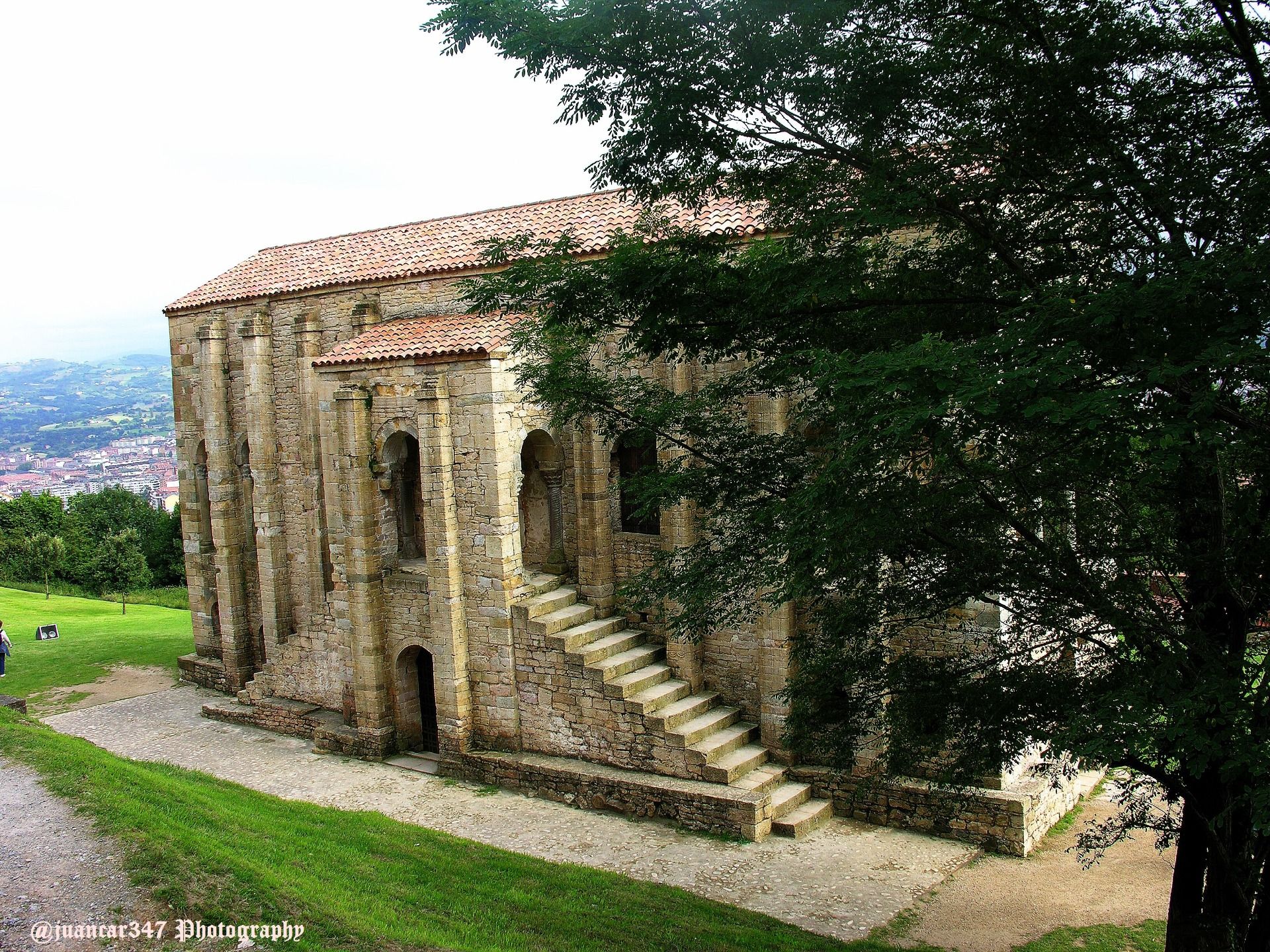
Ramiro I, king of Asturias, had both built in the 840s. Santa María was never meant to be a church. Wikipedia's account, which follows the Latin inscription on its altar, says the building was finished as a royal palace in 842 and consecrated in 848. It became a church dedicated to Mary only in the 12th century. San Miguel de Lillo, a few minutes' walk uphill, was built as a church from the start.
The pair have been part of the UNESCO World Heritage listing for the monuments of Oviedo and the Kingdom of Asturias since 1985. That listing grew in 1998 to take in Santullano. The style is usually called Asturian pre-Romanesque. As @juancar347 put it in 2019, these buildings are "not exactly pre-Romanesque" either, more an indigenous art with architects nobody can name. Wikipedia singles out the barrel vault, whose ribs line up one-to-one with the buttresses outside, as a clear precursor of Romanesque building.
@for91days' 2020 post on Santa María describes the walls, ceilings and carvings as almost all original, and calls the place "in tremendous condition" for a building over 1,100 years old. Their photos back that up. Twelve centuries on, the carving still has crisp edges.
How the guided visit works
The official listings for both buildings say the same thing: guided visits leave from Santa María del Naranco. The same visit carries on to San Miguel. @for91days confirms that the San Miguel visit is run together with Santa María's and starts from there. Turismo Asturias says the tours are in Spanish and have limited places.
Prices on both pages are €5 general admission, €4 per person for groups of more than 20 and €2 for school groups. Because a single guided visit covers both buildings, ask at the desk at Santa María what your ticket includes before you pay twice.
If you don't speak Spanish, the free Monday slot is worth thinking about. On Mondays both monuments open without a guide and without charge: 10:00 to 12:30 in the winter season and 09:30 to 13:00 in summer. You lose the commentary, but you can take your time. You can also make up for it beforehand by reading the two TravelFeed posts linked above.

What to look for inside Santa María
At the end of the building, an open arcade of carved arches and twisted columns frames the whole of Oviedo, with hills behind it. @juancar347 singled out that view, saying that from the top of the hill you can see almost the whole city, cathedral included.
Look closely at the walls as well. Carved stone medallions, some with an animal inside a ring of braided pattern and a small panel of figures above, are set into the stonework. In 2020, @for91days could photograph inside Santa María. Their post includes a shot of a dark stone interior lit only through narrow slits.

San Miguel de Lillo: the church that's only a third of itself
The walk between the two takes a few minutes. @for91days counted it as "just 300 steps", and Wikipedia puts the distance at about 100 metres. The building you reach is only part of a church. In the 12th or 13th century most of it collapsed, and only the western end survived. @for91days blames a landslide. That leftover section is narrow and unusually tall, which is why photos of it look slightly odd.
@juancar347's post on San Miguel passes on the local explanation: two underground streams run beneath the site, and the church has been slowly sinking into the ground. By that account, it's why the carved door jambs, with their scene of Daniel among the lions, now sit almost at ground level. The post compares the spot to the castle in the Arthurian legend that kept falling down because two dragons, really two underground streams, lived beneath it. Treat it as a story, but it's a good one to have in mind as you look at the jambs.

What survives is detailed. @for91days lists faded wall paintings that still show a throne and a human figure, the carved jambs at the entrance, and a raised royal gallery from which the king could follow the service. Wikipedia describes the windows as "plate tracery", each one cut from a single slab of stone and pierced through. You can see the windows from outside, so look up as you walk around the building.
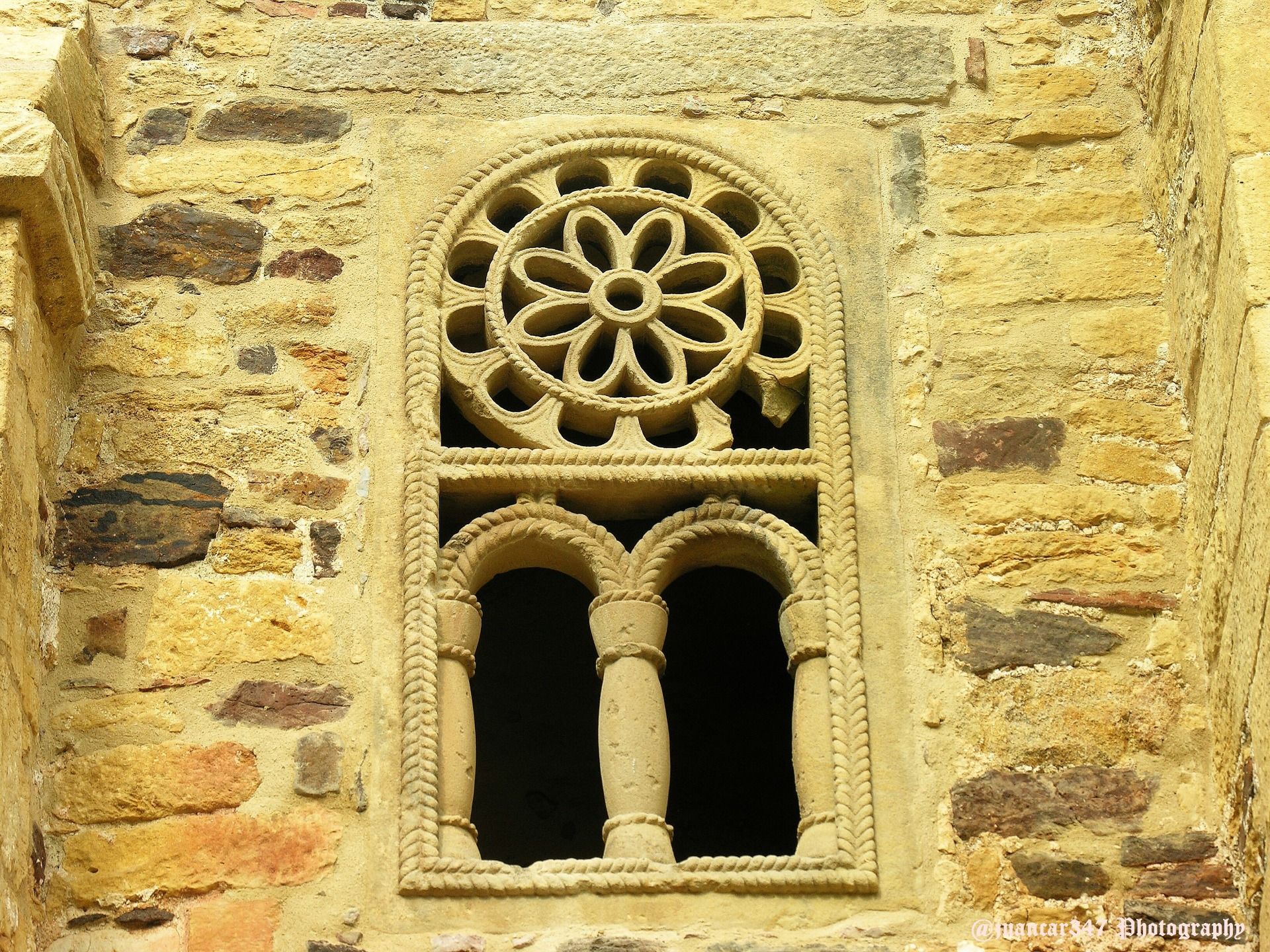
Plan your photos for the outside. When @for91days visited, "pictures were not allowed inside" San Miguel. They guessed this protects the fragile wall paintings. Their post only shows the exterior, and you should expect the same rule.
Getting up Monte Naranco without a car
The monuments are on the Avenida de los Monumentos, the road up the hill on the city's north side. @for91days timed the walk from Oviedo's train station at about 40 minutes, "almost all uphill". They noted that city buses can take you most of the way. The local operator is TUA, Oviedo's urban bus company. Check its route planner for the current line and stop before you set out, because routes change.
The short stretch between the two buildings is changing. In February 2026, the regional broadcaster RTPA reported that work had begun on a concrete footpath of about 200 metres between Santa María and San Miguel. It will cost more than €380,000 and follow the line visitors have already worn between the two. The aim is to keep pedestrians off the road. RTPA said it was due to be ready by summer 2026. If you find fresh paving, or a fenced-off works zone, that's what it is.
Before you go, check for closures. One Oviedo listings site reported in spring 2026 that Santa María would be closed for works until late September. The official Turismo Asturias page carries no closure notice as we publish in November 2026. The monuments' own phone line, 638 260 163, can confirm whether the visit is running that day.
Santullano, the one most visitors skip
San Julián de los Prados is older than the Naranco pair. Wikipedia dates it to Alfonso II's reign in the early 9th century and calls it one of the largest pre-Romanesque churches still standing. It isn't on the hill. @for91days places it about a kilometre outside the centre, along the highway from Oviedo to Gijón. @for91days called it "the pinnacle of Asturian pre-Romanesque" and pointed out that thousands of drivers pass it every day without stopping.
The reason to go is inside. The walls are covered in paintings about 1,200 years old: architecture, pastoral scenes and geometric patterns, but no human figures. That's unusual for a church. @for91days noted that they are among the best-preserved works of their period in Western Europe. Wikipedia describes the same paintings as "aniconic".

Santullano runs on its own timetable, separate from the Naranco tours. From 1 October to 30 April, visits are Monday to Saturday at fixed times only: 10:00, 10:45 and 11:30. From May to September there are more slots, afternoons included. It's closed on Sundays and public holidays. Tickets are €4 for adults and €1 for children aged 7 to 12. Entry is free without a guide on the first Monday of each month. Bookings go through 687 052 826. Prices have risen since 2021, when @for91days paid "less than two euros", so don't rely on older blog figures.
With winter slots ending at 11:30, Santullano and the Naranco churches can be done in one day. Take an early Santullano slot, then cross the city to the hill for a late-morning tour before the 14:30 close.
San Tirso, next to the cathedral
If you want to finish the day in the old town, there's one more pre-Romanesque link. @for91days wrote about San Tirso, the oldest church in the city centre, which stands right beside the cathedral. Alfonso II first built it in the 9th century, but a fire in 1521 and later rebuilding left little of the original apart from one wall and the plan. Come for the age, not the decoration. The interior is small, with a modest altarpiece. In the same post they recommend a cachopo afterwards at Mesón Casa Pedro on Calle Asturias, and warn that one is plenty for two people.

Practical details
- Santa María del Naranco and San Miguel de Lillo, winter (1 October to 31 March): Tuesday to Saturday 10:00 to 14:30, Sunday 10:00 to 12:30. Closed 25 December, 1 January and 6 January. Free unguided visits Monday 10:00 to 12:30.
- Same two monuments, summer (1 April to 30 September): Tuesday to Saturday 09:30 to 13:00 and 15:30 to 19:00, Sunday 09:30 to 13:00. Closed 8 and 21 September. Free unguided visits Monday 09:30 to 13:00.
- Tickets for the Naranco pair: €5 general, €4 each for groups over 20, €2 for school groups. Guided visits leave from Santa María, are in Spanish, and have limited places. Phone 638 260 163. Source: Turismo Asturias, Santa María del Naranco and San Miguel de Lillo.
- Santullano: timed visits, €4 adults, closed Sundays and holidays. Phone 687 052 826. Source: Turismo Asturias, San Julián de los Prados.
Turismo Asturias notes that hours and prices can change with the season, so check the official page close to your visit. For more on the region, see TravelFeed's Spain destination page.
FAQ
Can you go inside Santa María del Naranco?
Yes, on the guided visit from Tuesday to Sunday, or on the free unguided slot on Monday mornings. The guided visit starts at Santa María and continues to San Miguel de Lillo.
Are the Naranco tours available in English?
Turismo Asturias lists the guided visits as Spanish only. Visitors who don't speak Spanish may prefer the free Monday morning slot, when you can walk around without a guide at your own pace.
How long does it take to walk to Santa María del Naranco from Oviedo?
About 40 minutes from the train station, almost all uphill, according to @for91days, who based themselves in the city. City buses run most of the way up the hill.
Is Santullano part of the same ticket?
No. San Julián de los Prados has its own timed visits and its own €4 ticket, booked by phone at 687 052 826. It's in the city, not on Monte Naranco.
