
 Suchitoto, Cuscatlán, El Salvador

May 10 – Exploring Suchitoto
I spent my last weekend at Esquinita del Bambú, and for this occasion, we had planned a trip to Suchitoto. The town is one of El Salvador's best-known cultural centers, attracting visitors with its colonial atmosphere, cobblestone streets, and artistic vibe.

Suchitoto is located just 60 kilometers from Dulce Nombre de María, but given the road conditions in Central America, this meant almost a two-hour drive. So we set off in the morning to discover the town.
Suchitoto had a special atmosphere from the very first moment. With its colorful colonial houses and peaceful surroundings, it was easy to get the feeling that time had stood still here. The town's history dates back to pre-Columbian times, and it later played an important role during the Spanish colonial period and the Salvadoran Civil War. Today, it has evolved into a peaceful cultural center where artists, craftspeople, and travelers mingle with locals in the small streets and cafés surrounding Santa Lucía Church.
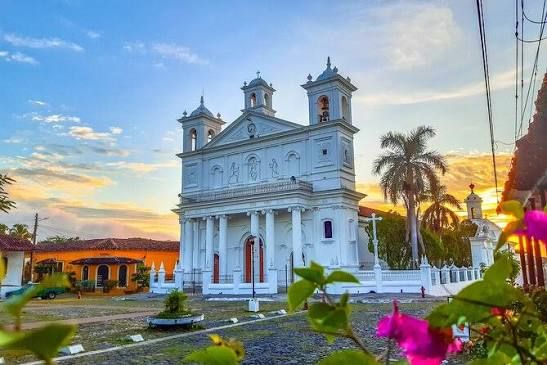
Suchitoto surprised me at first sight. It was clean and well-kept, and most of the buildings in the town center had been beautifully renovated – something that, unfortunately, had not been particularly common during my time in the country so far. The only thing that really bothered me about El Salvador was the amount of litter. Mexico hadn't been the cleanest either, but here, especially in the larger cities, the situation was sometimes quite disheartening. Suchitoto was a one-hundred-percent exception to this.

As we wandered along the cobblestone streets, we stopped at a café whose terrace offered a beautiful panoramic view of the Suchitlán Reservoir.
The country's largest river, the Lempa, flows past Suchitoto. In the 1970s, it was dammed near the town with the construction of the Cerrón Grande Dam, creating an artificial lake that, to the untrained eye, is almost impossible to distinguish from a natural one.

We sat on the terrace, admiring the vast expanse of water below us while sipping fresh smoothies.
Contrary to what the news might suggest, Bitcoin adoption in the country is progressing quite slowly, and the Circular Economy – meaning that most businesses accept cryptocurrency – is really only working in a few regions. These include El Zonte, the famous Bitcoin Beach, San Salvador, and Berlin, a small town in the mountains.
Despite this, we guys – Hagen, Ruben, and I – tried to pay with Bitcoin everywhere we went.

We were particularly pleased when we discovered that this café also accepted Bitcoin. It felt good to use Bitcoin in such an everyday situation, and after making the payment, we even managed to have a brief conversation with the owner about it. This little experience made our time at the café especially memorable.
After that, we walked over to the previously mentioned Santa Lucía Church, around which several stalls run by local artisans were lined up. They offered all kinds of goods, from ceramics and wood carvings to handmade clothing. Hagen was looking for a T-shirt like one of those, Karina was more interested in buying a souvenir, while I settled for a bag of coffee beans.

The heat was getting increasingly intense, so we started looking for an attraction where we could spend some time in the shade. That's how we came across the Alejandro Cotto Museum. Alejandro Cotto was a Salvadoran film director, poet, and writer, whose childhood home was turned into a museum after his death.

Cotto gained international recognition and won numerous awards throughout his career. He also gave a great deal back to his hometown of Suchitoto: he supported local art, music, and theater, and helped establish cultural centers and festivals.

The old colonial-style house displays his personal belongings, photographs, art collection, and exhibitions related to Suchitoto's cultural heritage. The garden was full of tropical and exotic plants, winding cobblestone paths, and fountains, all complemented by a stunning view of Lake Suchitlán.

Through the museum, we not only learned about Alejandro Cotto's life but also gained a deeper understanding of the town itself, its history, and its culture.
By the time we finished, we were hungry, so we returned to the town center to look for a simple place to eat. We eventually settled into a small Mexican eatery, and since it was already getting late, we headed back home afterward.

May 11 – Removing the Fallen Tree, Fishing with the Locals, and Our Last Evening at Bambú
On the second day of the weekend, Sunday, Ranulfo's local acquaintances finally arrived. He had been urgently trying to get hold of them over the previous few days so they could help remove the massive, dried-out tree trunk that had fallen onto my bungalow.
They brought professional equipment with them: a chainsaw, ropes, a winch, and everything else needed for the job. Naturally, we volunteers joined in to help with the operation.

First, the local old-timer with the chainsaw cut off the troublesome branches, and then they tied the trunk to a nearby sturdy, living tree. As the rope tightened, the dried-out trunk slowly began to move. The plan was to pull it off the roof without causing any further damage.
They kept tightening the trunk with the winch, while we volunteers tried to push it from the other side. But it wouldn't budge – mainly because the dented sheet-metal roof was holding it in place as well.
They attached another rope to a different nearby tree to better control the direction of the movement. Luckily, the tree had fallen onto the corner of the small bungalow, so it only needed to move about a meter to come off the roof. With a combined effort, although not without difficulty, we eventually managed to get it down.
We only watched the next steps.
First, the old-timer cut the trunk into larger pieces, about one or two meters long. Then, without any preliminary markings or measurements, he turned them into such perfectly straight floorboards that our jaws practically dropped. The workers at a sawmill would surely have tipped their hats to his performance.

Within just a few hours, most of the tree trunk had been turned into beautiful floorboards. He cut the remaining pieces into smaller sections so we could carry them away and pile them up in one place. Ranulfo was already mentioning that he wanted to make small garden stools out of the smaller pieces.
Meanwhile, more of Ranulfo's acquaintances had arrived. He was delighted to see them, as it had been quite a while since they had last met.
There is also a small pool on the farm where Ranulfo breeds fish. Since his friends had arrived, he decided that we could catch a few fish for lunch.
The pool was only 5 × 5 meters in size, but nearly two meters deep. Three of his friends grabbed the fishing net and stretched it across the pool, while one of them jumped into the water to drive the fish in one direction.
They had attached small lead weights to the net, so when they released it all at once, it sank neatly to the bottom of the pool. I watched from a distance as they tried to catch the fish, but despite having a good strategy and such a small pool, it wasn't as easy as it seemed.
Eventually, I joined in too and grabbed the net at one of the corners. After quite a struggle, we managed to catch two fish, but since this was going to be our lunch, we still needed quite a few more – there were about twelve of us altogether.
Our efforts eventually paid off, and in the end, we managed to catch six or seven fish. We handed them over to the kitchen, where the others fried them in oil. It was a fantastic experience to have freshly caught fish for lunch.

In the late afternoon, Hagen, Karina, and I went for a walk in the nearby hills. As we wandered through the forest, we stumbled upon a local Easter procession. People were singing, dressed in elaborate outfits, and carrying Catholic religious objects.

We also struck up conversations with some of the locals who were looking around nearby. They listened with curiosity to our stories about how we had ended up in Dulce Nombre de María as Europeans.
When we returned to Bambú, a campfire was already waiting for us. Ranulfo and his friends were sitting around it, chatting. We joined them, each with a drink in hand.
It was our last night as volunteers at Bambú, and it turned out to be a truly memorable way to end our stay.

I was finally able to move back into my bungalow, but I definitely wanted to try what it was like to sleep in a hammock. I grabbed my belongings, carried them out to the garden hammock, and tried to fall asleep.
Despite trying for hours, I just couldn't get into a deep sleep in that strange position. One moment this was uncomfortable, the next something else was, and I simply couldn't switch off my mind.
So eventually, I gave up and went back to my bungalow to sleep in my regular bed.
