
 Mpumalanga, South Africa
I knew we would see a lot of wildlife in Kruger National Park, but I was not at all prepared for the density of animals. We saw elephants at least once an hour and literally thousands of impala. We saw four out of the “big five” - elephant, water buffalo, lion, leopard, but not rhino. We saw baby animals and recently deceased. I thought they deserved their own post.
Greatest Hits
Some animals we saw so often, you’d think you’d get bored of them, but I never did.


Elephants were surprisingly one of the most frequently seen. Maybe because they are hard to miss! They can’t hide, and they spend up to 20 hours a day eating, so we saw them from dawn to dusk. We got to see many full grown and young elephants, playing in the river, taking dust baths, or raising their trunks high to drink out of a cistern.


Giraffe have the most delightful gait. They walk with both legs on the same side at once, like a camel. They look gangly but somehow elegant when they run, goofy and adorable when they turn to stare at you.


‘Zebra Crossing’ is a sign that should be posted once every kilometer in the park. They are everywhere, but often on the road. We saw some playful little guys and some that looked ready to birth foals any second.

The Hippo was another animal we saw on a daily basis. Most big rivers or reservoirs have them and we even saw quite a few out of the water, in the heat of the day. I had heard they usually walk around at night to eat and stay in the water all day to avoid sunburn. They definitely get a lot more talkative at night - we could usually hear their bellowing from our beds.


We didn’t see Water Buffalo as frequently as these other big animals, but when we saw them, it was often huge herds that extended on farther than I could see. At one point we were stuck in a long traffic jam while one group made its way across the street. Another time, the herd had crossed, followed by a hobbling, injured calf. I felt for him, as I am hobbling myself with an ankle injury. I’m sure he is providing someone with easy pray.
Antelope


By far the animal with the greatest population here is the Impala. The census said the park has 150000 of them, and I think we saw a good portion.


Wildebeest or Gnu are also pretty prevalent. They often hang out with zebra, helping each other watch for predators. Wildebeest have better hearing and sense of smell, while zebra have better vision.


The title of most majestic of the antelope goes to the Kudu, with his striking height and long spiral horns. The females are a little more ungainly with the camel hump. I saw them make some impressive jumps - apparently as high as three meters!


The shagy Nyala and striped-faced Sable Antelope are more rare species, though we saw the former in the iSimangaliso wetlands park.

Bush buck are pretty small, and often found in camp.


Water buck spend a lot of time wading in the shallows and they have a white circle on their backside to help each other follow the herd.


We saw a few of solitary small antelope, Steenbok, nocturnal Sharpe's Grysbok, Klipspringer, and Duiker.
Predators

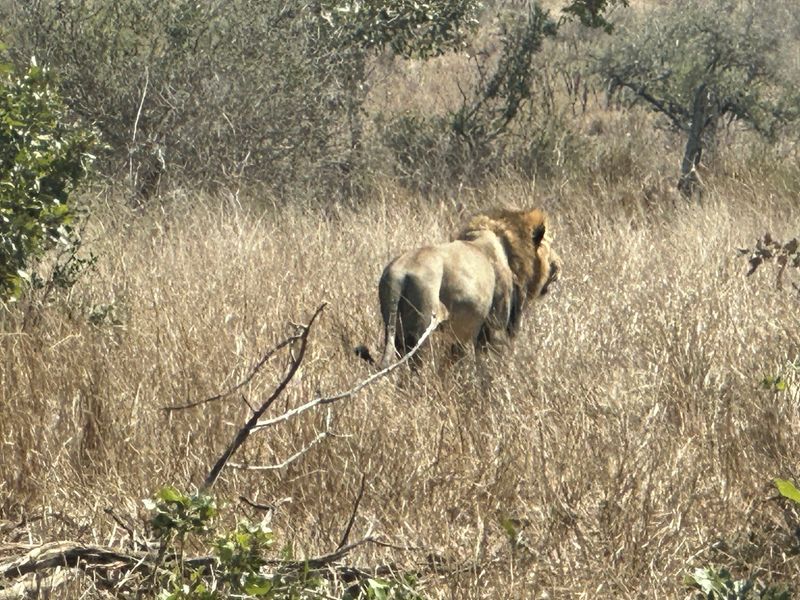

Seeing the Lion is definitely one of the most breathtaking experiences. The first we saw was a big male just walking right along the roadside. On two later occasions, we saw lionesses that supposedly had cubs nearby. Our last sighting, as we finished a cold and wet sunset drive in an open safari car, was of two lionesses hunting antelope right outside the gates of our camp.


The Leopard is truly amazing with the camouflage. We saw one because of several other cars and safari tours stopped by a tree. I’m sure we drove right by others without knowing it, and I know mistook many a dappled tree branch for a leopard. Once I was so sure I saw one, but binoculars revealed it to actually be an impala carcass hidden in the tree from scavengers.


Speaking of scavengers, we saw quite a few Hyena. They are formidable passing by the car, but goofy sitting in the middle of a watering hole to cool down. Two were guarding their den, puppies occasionally peeping out of a culvert under the road.


Wild dog are one of the more rare species, with under 150 in the park. Acting on a tip from another safari car, one of our tours found a pair in the middle of feeding on an impala, eight puppies watching and waiting for their turn. There was a thunderstorm going on, and it was adorable to see the puppies scatter and parents bark every time thunder struck.
Other Mammals


There were Wart Hog all over the south end of the park!


Baboons live in big family groups, with all the babies constantly racing around and playing, climbing and falling off things, and pestering adults until they get slapped.


The Vervet Monkey is cute but evil. I saw enough of them chewing through hard fruits to be terrified of the bared fangs on one monkey who leapt toward me during a run. In evading him I turned my ankle and was hobbled for the rest of the trip. They also pester people at picnic areas, and apparently are known to attack women.


Of course there were the tiny animals. We saw the skinny little Tree Squirrel and Slender Mongoose, the tree dwelling Large-Spotted Genet and the burrowing kangaroo-like Springhare. Not pictured, honey badgers, scrub hare, and dwarf mongoose.
Reptiles


The most terrifying animal in Kruger is the Nile Crocodile, and we saw plenty. Usually from afar with binoculars, sharing bodies of water with hippos, one of the few animals they fear.

We fortunately didn't see many snakes, as there are 16 poisonous species in the park. This endangered Thunderbird is one of their natural preditors.


There are also a number of different lizards, from the large brown iguana-sized guy we saw at one of the viewpoints to the finger-length pale green ones that scurried around the outsides of our huts. The most amazing was a bright blue one lounging by the pool at a rest camp. There are also tortoises and turtles.
Birds


There were too many colorful little birds flitting through the brush to ever photograph or identify them all. The black silhouette above is an insanely colorful sunbird and the striped guy is the African Hoopoe. One I saw a lot but never captured was the vibrant blue European Roller.


The most common, scavenging and begging at every picnic site, were the starling and hornbill.


So many different raptors circle over the Savannah and perch high in the trees. The bald eagle lookalike African Fish Eagle, the white-chested Martial Eagle, with its seven-foot wingspan, the striking red-beaked Bateleur, the brown Snake Eagle and many more.


A group of vultures is called a vortex, and we saw a good number of those, circling in groups, nesting alone, or swarming a carcass. It only takes them 48 hours to completely clean a large animal like this kudu!


Waterbirds abound, including egrets, ibis, herons, storks, lapwings, spoonbills, kingfishers, geese and ducks.


We never saw an owl, but the nocturnal Night Jaw was pretty common. You also couldn't miss the ox picker which sweep every antelope, buffalo and giraffe for ticks. Large groups of spurfowl and helmeted guinea fowl travel the roads and through camp.


No ostrich either, but some relatively large ground birds, including the Ground Hornbill, aka Thunderbird, and this strange long legged turkey like thing we were surprised to see take clumsy flight.
The diversity wildlife in this park is nothing short of awe-inspiring. Traversing different habitats at different times of day, we saw new species constantly. Mountains, grasslands, bush plains, tropical forests and rivers - even the gravel and tar roads belong to them.


