
 Binz, Mecklenburg-Vorpommern, Germany
In Prora on the island of Rügen, Hitler wanted to create a gigantic holiday paradise. The plans for the KdF (Strength Through Joy) seaside resort were awarded a prize at the World's Fair – but were never implemented. Eight decades after construction was halted, the workers are back in the ruined landscape.

The excavator brings the next load of concrete slabs, this time for the parking lot. It stretches along the southern beach to the edge of the forest – a boulevard of concrete blocks that fits in with the rest of the landscape in Prora, right on the Baltic Sea coast. For over four and a half endless kilometers, the gigantic concrete blocks stretch along the shore, from which the most colossal holiday resort of the Third Reich was intended to be built 80 years ago.

"Strength Through Joy"
The Mukran seaside resort, named after Hitler's leisure organization "Strength Through Joy" (KdF), founded in 1933 – stone witnesses to history, dilapidated, empty, and ruined. An MZ series shows forgotten places. Part 30: Hitler's holiday town on Rügen.

The concrete skeleton with its brick facade – a monstrosity by the sea – would have accommodated 20,000 people upon completion. Ten thousand rooms, each with two beds, two chairs, a table, and a wardrobe, all with sea views, were intended to bolster the enthusiasm of the German people for the regime.

A Concrete Nightmare
A reinforced concrete nightmare on a white sandy beach, which, according to the regime's plans, over a million people would have been allowed to enjoy for a week each year.
To this end, the holiday resort, nestled between a pine forest and the Baltic waves, had been meticulously designed for maximum efficiency by Cologne architect Clemens Klotz. In addition to the accommodation blocks, the plans included a 20,000-seat festival hall, a swimming pool, a large fairground, and two piers extending 800 meters into the Baltic Sea, where KdF cruise ships could have docked.

At the 1937 World's Fair in Paris, the designs were awarded a prize – at that time, the Nazi leadership was still planning to build a total of five similar mega-resorts on the Baltic coast.
Hidden in the woods
When construction in Prora was halted in 1939 because the project was deemed not essential to the war effort, not only the accommodation blocks, parts of the service buildings, and a section of the pier had been completed, but also – now barely visible, hidden in the woods – the accommodations for thousands of support and service staff who were one day supposed to work on ensuring the happiness of vacationers at the KdF (Strength Through Joy) resort.

Unlike the kilometer-long concrete beach fortress, 150 meters from the waves – once described by the architect Daniel Libeskind as "evil incarnate" – these ruins in northern Prora still offer a glimpse of what they looked like in their original state.
High rising Sceletons

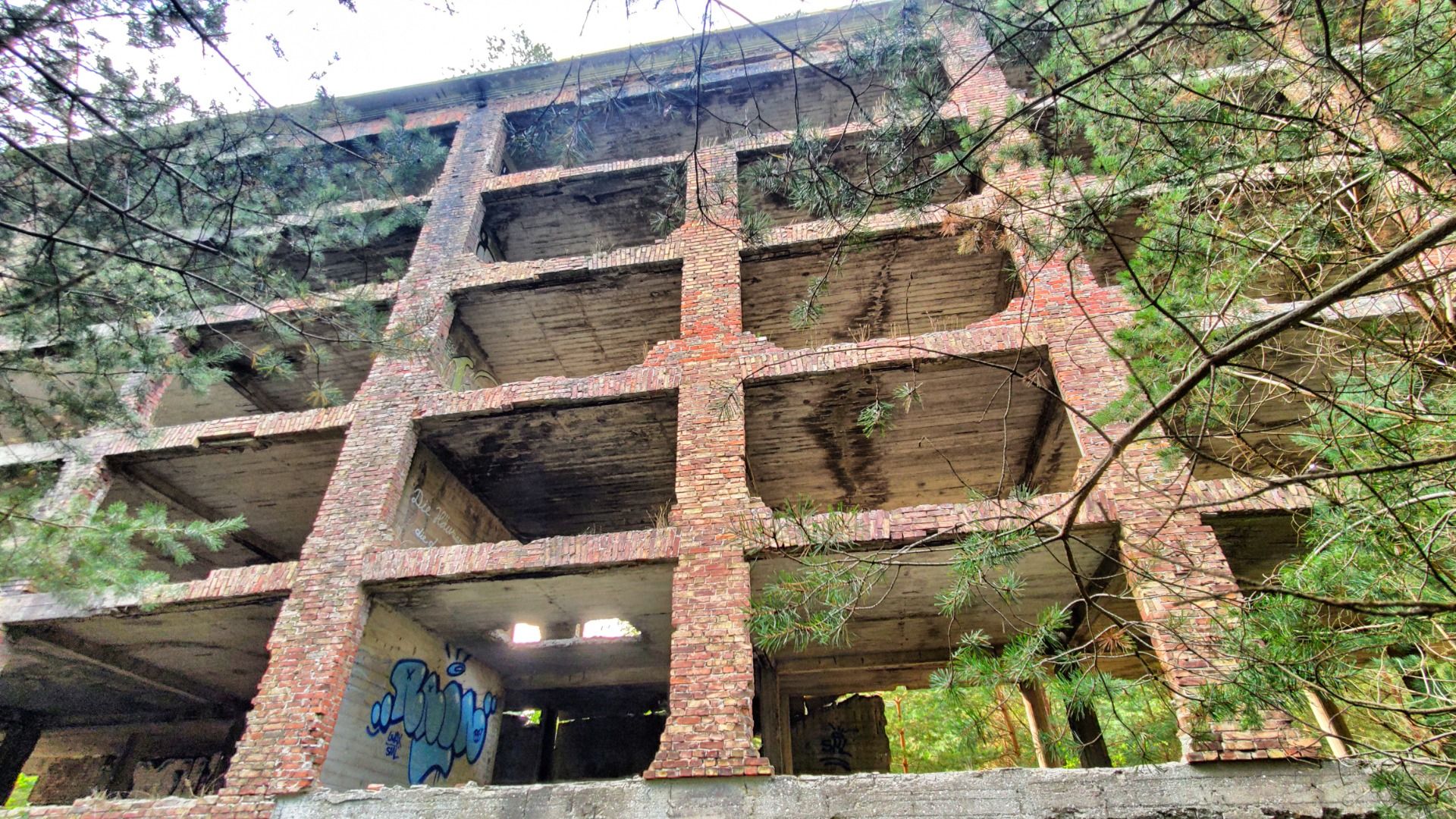
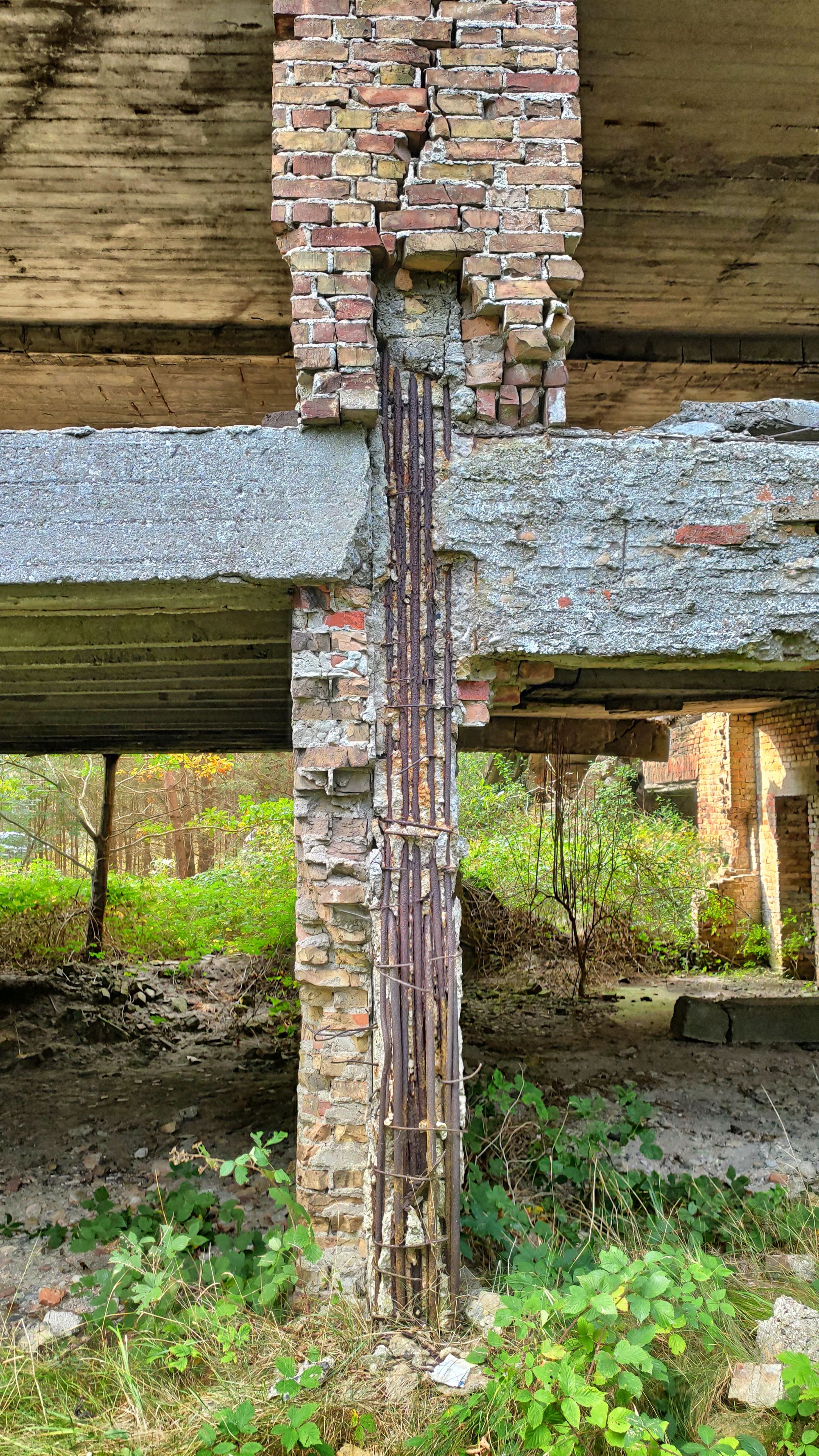
Six-story-high concrete skeletons were infilled with brick. Beneath them are extensive cellars and service tunnels whose original purpose is now almost entirely obscured.

The Soviet Army, which took over the 650-hectare KdF resort after the war, withstood demolition attempts by the Soviet Army, but the 220-meter-long rectangular building in the north has now become a lost place amidst dense undergrowth.

Until 1953, Soviet troops used this part of the remote site as a training ground. Subsequently, the GDR trained officers for the Barracked People's Police here. Grass grows over the history in the parking lot of the NVA tank garages.

Home of the National Army
Prora, which even during the war served as a training facility for, among others, the notorious Reserve Police Battalion 105 – which later participated in mass executions of Jews – remained inaccessible to the public.

The military held sway over everything, even the guests of an NVA recreation center, by the sea. The Barracked People's Police had already begun to complete the unfinished buildings in the south.

With the founding of the National People's Army (NVA), Hitler's promise of a holiday paradise for loyal comrades transformed into a remote prison for tens of thousands of young East German citizens who were forced to perform their military service there.

One of the largest military bases
With 13,000 soldiers, Prora was one of the largest military bases in East Germany. Among those exiled were numerous construction soldiers who refused to bear arms. In contrast, students from the "Otto Winzer" Officers' Academy, where future leaders from Cuba, Congo, and Yemen were trained, came voluntarily.

With the end of East Germany, not only did this use of the giant complex on Rügen come to an end. For years, investors were sought, buyers came—and bankruptcies followed. Only in recent years has construction resumed in Prora, but now with breathtaking momentum.

Now it is an expensive Place
The majority of the old barracks buildings have already been converted into condominiums and luxury apartments. The cheapest apartment costs €350,000, while a penthouse can be had for €650,000. More than 90 percent of the available units have already been sold.




Comments