 Ávila, Castile and León, Spain

Ávila is one of those Spanish capitals that, due to its unique beauty, as well as its incredible historical-artistic content, seems to have been specially designed to provoke the so-called Stendhal syndrome in the visitor's mind.

Or what amounts to the same thing: to provoke an excess of Art, a detail that should not be forgotten, at all, when understanding the reason for its deserved declaration of World Heritage City.

Located on the banks of the river Adaja and just over an hour away from Madrid, strolling through Ávila can undoubtedly become the closest possible, comparatively speaking, to making an exciting cultural trip, in which to satisfy all the recreational needs that the traveler has in mind.

A first glimpse of its monumentality, assails the traveler as soon as he sets foot in this ancient Arevaca land (1) and contemplates its elegant and extraordinarily well-preserved walls, which surround the entire ancient city and inside whose interior, past and present are conspired so that the visitor throws a pleasant sensation of unfolding, knowing himself in the present but at the same time, indisputably walking through the past.

It would be, unfortunately, an endless post to go on describing, one by one, the long succession of places and interesting details that make Ávila one of the richest heritages in Spain, but we can stop, even to offer a brief and I hope interesting I glimpse, in those that, due to their monumentality and greatness, can be considered as inevitably more relevant, saving the fact, in addition, that Ávila is the birthplace and the city that saw the growth of one of the most outstanding mystics of the so-called Century of Spanish gold: Saint Teresa of Jesus.

As in most cases, the origins of the Cathedral of Ávila, dedicated, like the Cathedral of Oviedo, to the figure of the Savior, are very dark and in many respects are based on legend, although what I do know for sure , is that it is considered one of the first Gothic temples that were built in Spain.

Leaving aside the importance that we can give to this detail, it is also known that it was built on an old church of Mozarabic origin (2) and that at least the oldest parts (such as the apse, attached to the walls) are attributed to an obscure master stonemason of French origin and named Früchel, arrived with the court of the Duke of Burgundy, in charge of the repopulation of these lands, the trace of whose construction activity we will find again in that other monumental complex, which is the Basilica of San Vicente.

Apart from its extraordinary monumentality and the exorbitant amount of details, one of the characteristics that make the Cathedral of San Salvador nothing less than unique in its kind, is the use of a very special stone, called 'berroque' (3) and very abundant in Avulean quarries, which give it a mystical blood-like appearance and form curious optical illusions when in contact with light.
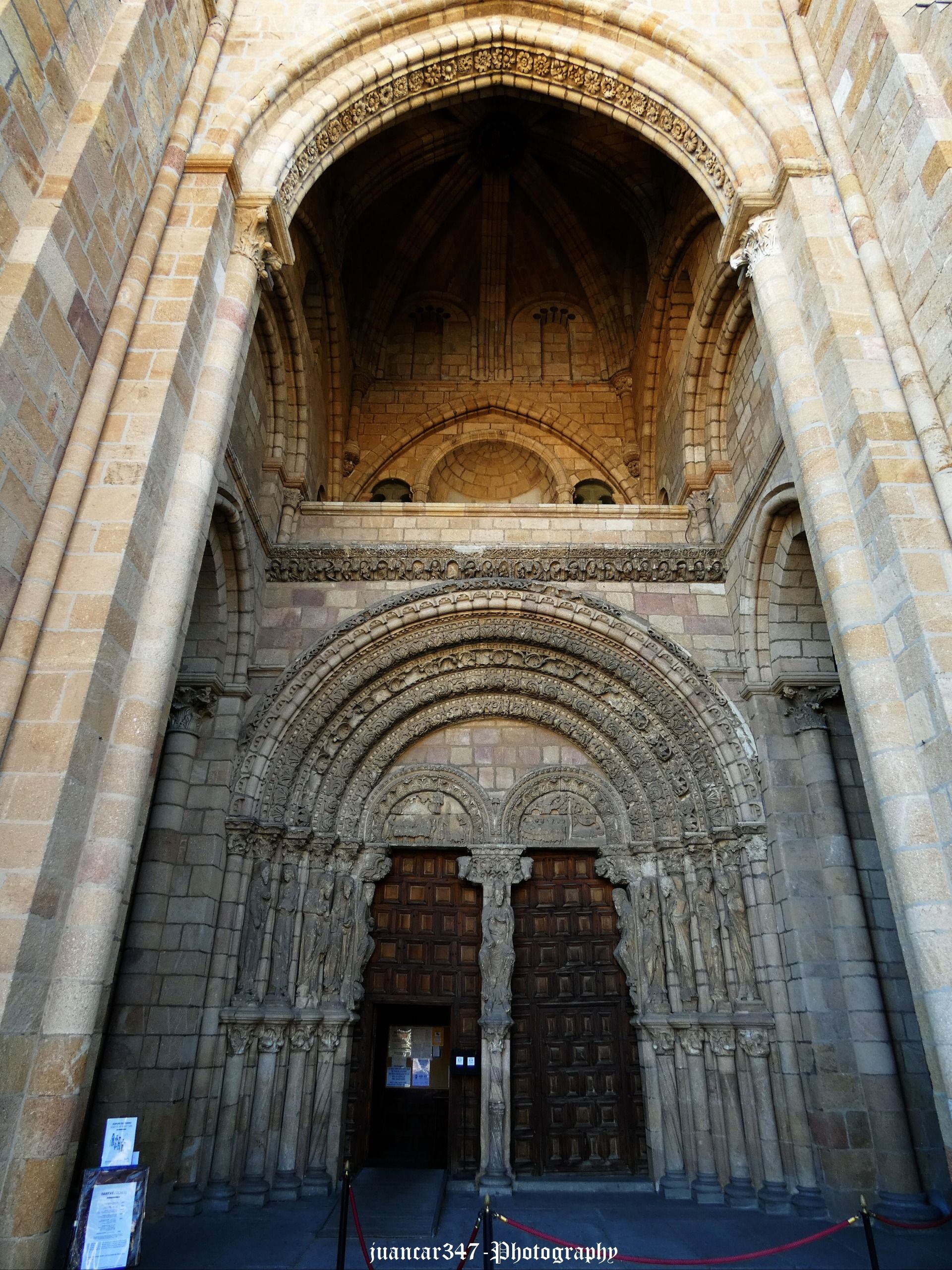
The Basilica of San Vicente, located just in front of one of the medieval doors that also bears the same name (Puerta de San Vicente) is, together with the cathedral, another of the immeasurable artistic monuments, whose visit is highly recommended.

Although it is Romanesque in origin for its sculptures, but with Gothic views, as shown by the height of the nave, as well as the apse, the forked shape of its main portal, located on the west side, follows the patterns of the one called by historians as 'Romanesque of the Camino de Santiago', which are basically none other than those used by Maestro Mateo and his school and which can be seen, among many other monuments, on the main portal of the Cathedral of Santiago de Compostela.

Apart from the significant detail that it was raised above a cave or nook, where a Romanesque image of the Virgin and Patroness was located in a miraculous way, called precisely for this reason 'la Soterraña' (4) stands out, because it contains a beautiful Gothic cenotaph, which still preserves its original polychrome and which, dedicated to the figures of the Holy Martyrs, is the work of Master Früchel, the one who, as we have seen, intervened in the first phases of the Cathedral of El Salvador.

About half a distance from the cathedral and the basilica, the old palace known as Casa de los Deanes, converted into the Provincial Museum of Ávila, is also a must-see, as it contains an invaluable selection of artistic objects, from all periods and condition -many of them, from the private collection of the Marqués de Benavites- among which stands out, without a doubt, the impressive Flemish triptych dedicated to the life and Passion of Christ, attributed to Hans Menling, although lately they are more Art historians who choose to attribute it to the no less skilled, but more mysterious teacher, known as Petrus Christus.

Glossary:
(1) The Arevaci, as well as the Vetons, were bellicose Celtiberian tribes, who occupied these lands, maintaining continuous confrontations with the Roman conquerors.
(2) Mozarabic: it was the term that was used to define the Christians who lived in territory conquered by the Muslims and who progressively were incorporated into the territories liberated by the Christian kingdoms during the Reconquest.
(3) Berroque: it is a special type of stone, very abundant in the region, which due to its high iron content, offers a very interesting bloody appearance.
(4) Soterraña: distortion of the word underground, below ground, which also connects us with the ancient Celtic traditions and the image of the Virgin Pariturae (the one who will give birth) that used to be venerated inside a cave.

NOTICE: Both the text and the accompanying photographs are my exclusive intellectual property and are therefore subject to my Copyright.


