
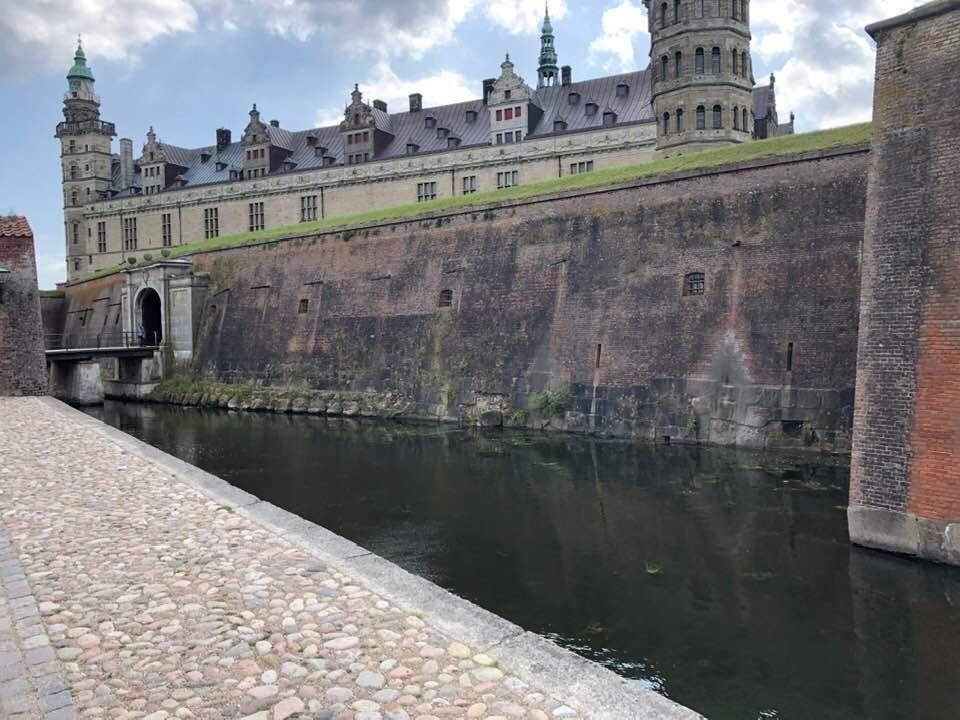
Kronborg's casemates and moat
On the north end of Kronborg Slot in Helsingør, Denmark are the casemates, the underground fortified areas of the castle where the soldiers lived and could safely retreat during a siege. These areas are dark and spooky, perfect to explore at this time of year!

The casemates or kasematterne are technically underground; in the photo above you can see earth and grass growing on top of them. But the uppermost level of the casemates has a corridor along the fortified wall that's dimly lit with a few windows overlooking the moat.
These aren't the stately windows of the royal living quarters. The windows of the soldier barracks are small, defensive, and covered in centuries of dust, mold, and cobwebs:


The barracks chambers were sometimes completely black and we turned on our phone flashlights just to see what was in front of us! Most of the winding tunnels were lit with modern lamps.
Walking into a spiderweb was a constant threat. Here I was in flipflops, and completely creeped out as we blindly stepped into these rooms! Had there been mice, they could have touched my naked toes! Allan (@hanedane) was braver than I was, so he led the way. Occasionally an arrow would point us in the right direction so we didn't get lost.

We entered one dank chamber that contained a circular air vent extending up about 30 feet, pictured below:


And then, right in the middle of the dreary casemates of Kronborg Slot you find a grotto. Against its far wall sits the bigger-than-life statue of Holger Danske, the Danish national hero.


Holger Danske first appears in literature in 1060 as Oger le Danois in the French epic poem “La Chanson de Roland.” According to denstoredanske.dk, “[Holger] becomes the main character in the heroic poem “La Chevalerie d'Ogier de Danemarche” (1200-15, Ogier's Knightship), where he is the son of the Danish king Gudfred (d. 810)... He then appears frequently in European literature.”
Christiern Pedersen's 1534 publication of “King Olger Danskis Krønicke” became the main source of Holger's exploits for Danish audiences and told of his emergence from various underground residences at Bulbjerg, Lovns, Nonnebakken, and Kronborg, among others, in order to save Denmark in times of peril.

Hans Christian Andersen wrote a fairy tale about him in 1845, “Holger Danske,” describing the hero sleeping in wait with his beard grown firmly into the marble table in Kronborg's basement.
In 1907, Hans Peder Pedersen-Dan created a sculpture of “the slumbering Holger Danske with crossed arms on his sword, commissioned in bronze for display at the Hotel Marienlyst in Helsingør. The same year, the original plaster model was placed in Kronborg's casemates; however, it crumbled in the humid environment, and in 1985 it was renewed in the art of Eric Erlandsen.”
Eventually we emerged into a huge medieval larder where they stored foodstuffs in big stone containers that looked like sarcophagi! It was cool and dark in here, a perfect place to store potatoes! I could picture animal carcasses hanging from hooks and bottles of aquavit sitting dusty as kitchen servants must have descended down here with lanterns in their hands.


At the far end of the larder was the proverbial light at the end of the tunnel, and we found steps there climbing up to the front entrance of the castle. I turned to take a picture back down those stairs before we left.

What a wonderful castle tour this was! Don't miss my first two posts on the royal apartments and the setting of Hamlet:
Denmark's Kronborg Slot: the king and queen's apartments, ballroom, and chapel
Rosencrantz and Guildenstern are Danish
I hope to visit Kronborg Slot again, but I'll never forget the day we first visited this historic, lavish, spooky, magnificent place!

Thank you for reading and joining us on our travels! We're Allan and Stephanie... making our way through middle age.
All photos are originals, taken by @hanedane or @geke. (Dividing bars courtesy of pixabay.com.)
Please leave us a comment to let us know you stopped by! We'd love to hear from you. 😃

Comments